
Ask most Christians what they’re saved for, and you’ll get a one-word answer: heaven. Ask what determines whether they get there, and you’ll hear: faith in Christ. And both answers, as far as they go, are true. But they flatten something the Lord Jesus and His Apostles kept carefully distinct — and that flattening has quietly distorted how millions of believers understand their own lives.
Scripture speaks of two things, not one: a gift and a prize. Most theology has collapsed them into a single event called “getting saved.” But the biblical writers never did.
What Is the Gift?
The gift is everything God does for us and in us by His grace in this present age. It is Christ’s finished work on the cross. It is forgiveness of sins. It is the indwelling of the Holy Spirit. It is being brought out of the authority of darkness and into the kingdom of the Son of His love (Colossians 1:13). No one earns any of it. No one contributes to it. No one chooses the moment or the means. The gift is the Father’s sovereign initiative — He forms, He calls, He draws, He regenerates.
Paul captures this with striking clarity: “For by grace you have been saved through faith, and that not of yourselves; it is the gift of God, not of works, lest anyone should boast” (Ephesians 2:8–9). The gift is settled. It is the foundation upon which everything else is built.
If the story ended there, the Christian life would be simple: believe, receive, and wait. But it doesn’t end there. The very next verse continues: “For we are His workmanship, created in Christ Jesus for good works, which God prepared beforehand that we should walk in them” (Ephesians 2:10). The gift is given for something. It has a direction. It is ordered toward a destination that Paul, in Philippians, calls the prize.
What Is the Prize?
The prize is what the faithful receive at the appearing of the Lord Jesus in the age to come. It is not the same thing as the gift — it is what the gift was given to prepare us for.
Paul describes it in the language of an athlete pressing toward a finish line: “I press toward the goal for the prize of the upward call of God in Christ Jesus” (Philippians 3:14). The Greek word he uses for “prize” is brabeion (βραβεῖον) — a term drawn from the Isthmian and Olympic games. It is the victor’s award, given not to every runner but to the one who competes according to the rules and finishes the course. This is not a participation trophy. It is a crown earned through endurance.
And Paul doesn’t speak about this casually. He says, “I discipline my body and bring it into subjection, lest, when I have preached to others, I myself should become disqualified” (1 Corinthians 9:27). Disqualified — not from belonging to Christ, but from receiving the prize. This is the man who wrote Romans. This is the apostle who understood grace more deeply than perhaps anyone who has ever lived. And he was concerned about being disqualified.
What was he pressing toward? He tells us: he longed “by any means to attain to the out-resurrection from the dead” (Philippians 3:11, literal). Not the general resurrection — everyone is raised (John 5:28–29). The out-resurrection: the resurrection of life, the entrance into celestial glory, the firstborn inheritance in the Royal Priesthood. The writer to the Hebrews confirms this when he speaks of saints who endured terrible suffering in order to obtain “a better resurrection” (Hebrews 11:35). A better resurrection presupposes that not all resurrections are equal. There is a resurrection of life and a resurrection of judgment, and the difference between them is the difference between the gift received and the prize attained — or forfeited.
Where the Confusion Starts
Most Christian theology has merged these two realities into one package called “salvation.” You believe, you’re saved, you go to heaven when you die. There is no meaningful distinction between the person who received the gift and spent a lifetime being transformed by the Spirit and the person who received the gift and buried it in the ground.
But that is precisely the distinction the Lord Jesus draws in the parable of the talents. All three servants belong to the master. All three receive something freely — each according to his own ability. The distribution is entirely the master’s initiative. That is the gift. But when the master returns, only the two who traded faithfully hear the words: “Well done, good and faithful servant; you were faithful over a few things, I will make you ruler over many things. Enter into the joy of your lord” (Matthew 25:21). The language of entrance — “enter into the joy” — is the language of the prize. It is not automatic. It is awarded to the faithful.
The third servant — the one who buried his talent — does not cease to be a servant. He is not called an unbeliever. He is called “wicked and lazy” (Matthew 25:26). And he is cast into the outer darkness, the realm of weeping and gnashing of teeth. He loses the prize. He forfeits the joy. The gift was real, but it went unused — and there were consequences.
The same pattern appears in the parable of the ten virgins. All ten are part of the bridal company. All ten have lamps. All ten go out to meet the bridegroom. But five have oil — the sustained, inward reality of the Spirit’s transforming work — and five do not. The oil could not be borrowed at midnight. It was the product of a life lived in the Spirit, day by day. When the door opened, only those with oil entered. The rest heard, “I do not know you” (Matthew 25:12).
In the parable of the wedding feast, a man enters without the wedding garment — the righteousness produced by obedience to the Spirit — and is cast out. He was inside the banquet hall. He had been invited. He was a guest. But he treated the occasion as though showing up was enough.
Why the Collapse Matters
When the gift and the prize are collapsed into a single event, two opposite errors follow — and both are spiritually dangerous.
The first is complacency. If the gift is the prize — if receiving Christ automatically guarantees the full inheritance — then nothing that happens between conversion and death ultimately matters. Faithfulness is nice but optional. Obedience is appreciated but not decisive. The Christian life becomes a long waiting room between the moment of belief and the moment of heaven. This is the error that turns grace into passivity and produces the buried-talent believer: still a servant, still in the household, but doing nothing with what was given.
The second is terror. If there is no distinction between the gift and the prize, then every warning about forfeiting the inheritance sounds like a threat of losing salvation entirely. The believer who reads the Lord Jesus’ severe kingdom parables and hears Paul’s language of disqualification is left with a terrible conclusion: maybe I was never really saved at all. This produces anxiety, legalism, and a distorted picture of the Father — a God who might revoke His gift at any moment.
Both errors vanish when the distinction is restored. The gift is secure. God does not take back what He freely gives. The believer who has been begotten of the Spirit is a child of God, and nothing can change that identity. But the prize — the firstborn inheritance, the resurrection of life, the entrance into the joy of the Lord, the participation in the Royal Priesthood in the Age to Come — is awarded to those who respond to the gift with faithful obedience, who walk in the Spirit, who endure the Father’s discipline, and who are found ready when the master returns.
Paul understood this. He could say with confidence, “I know whom I have believed and am persuaded that He is able to keep what I have committed to Him until that Day” (2 Timothy 1:12). That is the security of the gift. And in the same breath he could say, “I have fought the good fight, I have finished the race, I have kept the faith. Finally, there is laid up for me the crown of righteousness, which the Lord, the righteous Judge, will give to me on that Day, and not to me only but also to all who have loved His appearing” (2 Timothy 4:7–8). That is the prize — laid up for those who finish the race.
The Question That Changes Everything
The gift has already been given. If you belong to the Lord Jesus, the Spirit dwells in you, your past sins are forgiven, and the Father has begun a work in you that He intends to complete. That is grace, and it is unshakable.
But the prize is still before you. It is the upward call. It is the crown of life. It is the entrance into the joy of your Lord and the inheritance of the firstborn. And it depends on what you do — by the power of the Spirit — with what you have been given.
The question is not whether you have received the gift. The question is whether you are pressing toward the prize.
Paul never stopped pressing. Neither should we.
This post is drawn from Sonship, Inheritance, and the Restoration of All Things: A Biblical Theology of the Ages. The book traces the full witness of Scripture — Torah, Prophets, the Lord Jesus, and the Apostolic Epistles — through the ages God has ordained: the gift and the prize, the resurrection of life and the resurrection of judgment, the reality of Gehenna, the fire that purifies, and the restoration of all things in Christ. If what you’ve read here opened a door, the book is where you walk through it.
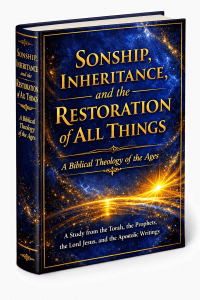
Available Here:
 Restoration Theology Press
Leave a comment