
You’ve probably heard this phrase in a sermon. A preacher quotes Matthew 25:30 — “Cast the unprofitable servant into the outer darkness. There will be weeping and gnashing of teeth” — and the application is immediate: this is what happens to people who reject Christ. Outer darkness is hell, and hell is for the lost.
But what if that reading misses the most unsettling part of the passage?
Look again. The man cast into outer darkness is not an outsider. He is a servant of the master. He was given a talent — freely, without earning it. He belonged to the household. He was entrusted with something real by the one he called Lord. And when the master returned, the problem was not that this servant denied him, cursed him, or walked away. The problem was that he did nothing. He buried what he was given, played it safe, and handed it back unchanged.
The master’s verdict is severe: “You wicked and lazy servant” (Matthew 25:26). And his sentence is outer darkness — the same realm of weeping and gnashing of teeth that appears again and again in the Lord Jesus’ kingdom teaching.
This is where most readers stop. They assume outer darkness is simply another name for the fate of unbelievers, and they move on. But to read it that way, you have to ignore the one detail the Lord Jesus made unmistakable: the man cast out was already inside.
The Pattern in the Parables
This isn’t an isolated case. When you line up the Lord Jesus’ parables of the kingdom, a striking pattern emerges. In nearly every case, the person who faces the warnings is not an outsider but a member of the household who failed to live up to what was given.
In the parable of the ten virgins (Matthew 25:1–12), all ten belong to the bridal company. All ten have lamps. All ten go out to meet the bridegroom. But five have no oil — no inner reserve of the Spirit’s sustaining work — and when the door opens, they are shut out. “I do not know you,” says the bridegroom.
In the parable of the wedding feast (Matthew 22:1–14), one man enters without the proper garment. He is already seated among the guests. He is inside the banquet hall. Yet he is bound hand and foot and cast into the outer darkness, where there is weeping and gnashing of teeth. Many are called, the Lord says, but few are chosen.
In the parable of the wise and foolish stewards (Luke 12:42–48), the unfaithful steward is not an enemy of the master. He is the master’s own appointed servant who, thinking the master delayed, began to live carelessly. At the master’s return, he is cut asunder and assigned his portion with the hypocrites. And then the Lord states a principle that should make every believer pause: “That servant who knew his master’s will, and did not prepare himself or do according to his will, shall be beaten with many stripes. But he who did not know, yet committed things deserving of stripes, shall be beaten with few” (Luke 12:47–48).
Notice what is happening. The Lord Jesus is not describing the fate of pagans who never heard the gospel. He is describing what happens to servants of the household — people who knew the master, received his gifts, bore his name — and failed to respond with faithfulness.
What Most Theology Misses
The standard theological options for “outer darkness” tend to fall into two camps. The traditional view says it means eternal conscious torment for all who are lost. The most popular universalist view says it can’t be real punishment at all. But the Lord Jesus’ own parables don’t fit neatly into either category.
To be clear: outer darkness is not reserved exclusively for unfaithful believers. The ungodly — those who never knew the master at all — face judgment in the same age. The Lord Jesus teaches that when He appears, all the dead will be raised: some to the resurrection of life, and some to the resurrection of judgment (John 5:28–29). Those who are raised in judgment — both the unfaithful servant who buried his talent and the ungodly who never acknowledged the master — enter the age to come outside the joy of the Lord. Outer darkness, the realm of weeping and gnashing of teeth, is the condition of that entire age for all who are not counted worthy of the resurrection of life.
But within that realm, the experiences are not the same. The unfaithful servant who knew his master’s will and did not do it receives many stripes — corrective discipline aimed at finishing the work he refused in this age. The one who did not know receives fewer stripes. And the ungodly, who lived in open rebellion, face what Paul calls “indignation and wrath, tribulation and anguish, on every soul of man who does evil” (Romans 2:8–9). The severity differs. The purpose differs. But both the unfaithful and the ungodly share the common ground of judgment.
What most theology misses is not that outer darkness exists — nearly every tradition acknowledges some form of future judgment. What it misses is that the Lord Jesus aimed His most vivid warnings about outer darkness at His own servants. The shocking element in these parables is not that the ungodly face judgment. Everyone expects that. The shock is that members of the household face it too — not for rejecting the master, but for doing nothing with what he gave them.
This reframing does not soften the warning. If anything, it intensifies it. Outer darkness is not someone else’s problem — not a threat aimed only at atheists and pagans far from the household. It is aimed directly at those inside. It is the Lord Jesus telling His own followers: what you do with what I have given you matters. Grace is real. But grace ignored, buried, and returned unused has consequences that reach into the Age to Come.
The Gift and the Prize
The key to understanding this distinction lies in what the Apostle Paul calls the difference between the gift and the prize. Salvation — the initial grace of being brought into the household, receiving the Spirit, being made a child of God — is a gift. No one earns it. The master distributes the talents according to his own will. The virgins all receive lamps. The guests are all invited to the feast.
But entrance into the joy of the Lord — the prize of ruling with Christ, of entering His rest, of sharing in the inheritance of the firstborn — depends on faithfulness. The two servants who traded and multiplied their talents heard the words every believer longs to hear: “Well done, good and faithful servant; you were faithful over a few things, I will make you ruler over many things. Enter into the joy of your lord” (Matthew 25:21). They did not earn the original gift. But they responded to it with active, obedient faith — and the prize was given.
The unprofitable servant did not lose his identity as a servant. He lost the prize. He forfeited the joy. He entered not the master’s rest but the outer darkness — a realm of correction, not of annihilation.
Paul understood this pattern. He wrote to the Corinthians that a man’s work might be burned up on the day of judgment, “but he himself will be saved, yet so as through fire” (1 Corinthians 3:15). Saved — but through fire. Still belonging to the household — but having lost everything built on the wrong foundation. The gift preserved, but the prize forfeited.
Why This Matters Now
If outer darkness is aimed at insiders, then the comfortable assumption that “I’m saved, so none of this applies to me” is exactly the attitude the Lord Jesus was warning against. The unprofitable servant’s error was not atheism. It was passivity — the quiet confidence that belonging to the household was enough, that the master would be satisfied with the talent returned, that showing up was the same as being faithful.
The oil the wise virgins carried was not purchased in a crisis. It was the accumulated reality of a life lived in the Spirit — day by day, choice by choice, in the quiet obedience of this present age. It could not be borrowed at midnight.
The Lord Jesus’ parables of the kingdom are not abstract theological puzzles. They are warnings delivered with urgent love by a master who wants every servant to hear “Well done” — and who knows that many will not, because they buried what they were given and called it faithfulness.
The question outer darkness poses is not “Am I in the household?” It is “What am I doing with what I’ve been given?”
That is a question worth sitting with.
This post is drawn from Sonship, Inheritance, and the Restoration of All Things: A Biblical Theology of the Ages. The book traces the full witness of Scripture — Torah, Prophets, the Lord Jesus, and the Apostolic Epistles — through the ages God has ordained: the gift and the prize, the resurrection of life and the resurrection of judgment, the reality of Gehenna, the fire that purifies, and the restoration of all things in Christ. If what you’ve read here opened a door, the book is where you walk through it.
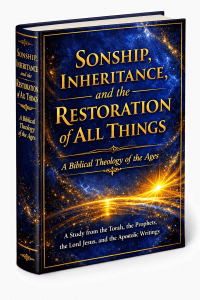
Available here:
 Restoration Theology Press
Leave a comment