
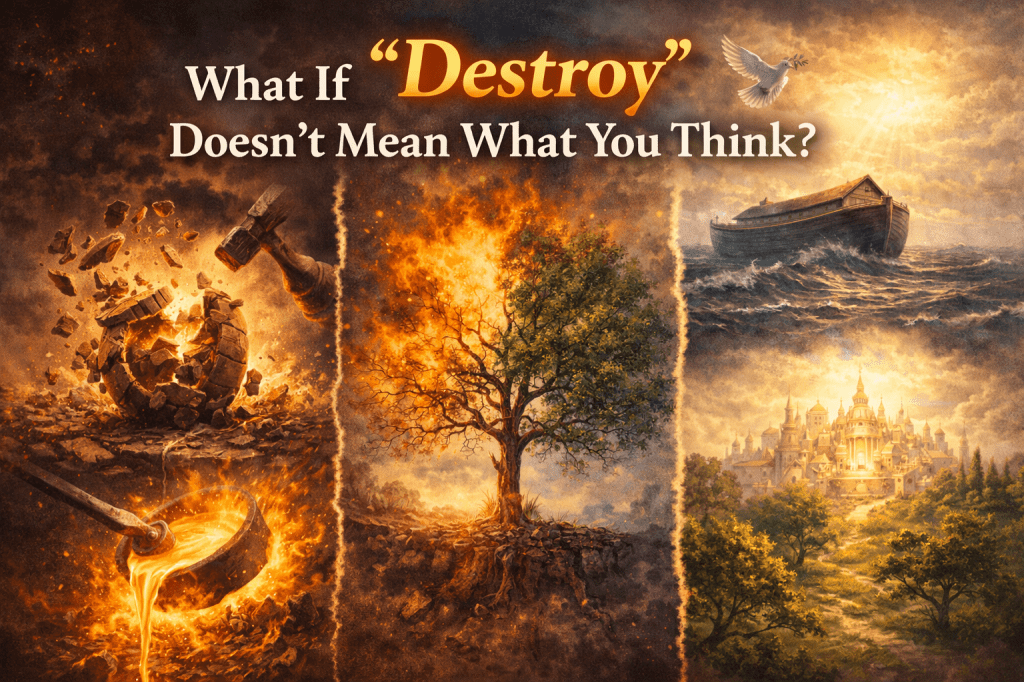
Few words in the Bible carry more theological weight — or more unexamined assumptions — than the word “destroy.” When most people encounter it in Scripture, they hear one of two things: either permanent extinction (the person ceases to exist) or the opening act of eternal conscious torment (the person is ruined and then suffers forever). Both readings share the same assumption: destruction is the end of the story.
But what if the Bible itself defines destruction differently? What if, from Genesis to the Apostolic Writings, the consistent testimony of Scripture is that divine destruction is not the end of the story but the middle of it — the painful, necessary act by which God removes what is corrupt so that He can remake what He loves?
The answer is not hidden. It is written across nearly every page of the biblical witness, once you know what to look for.
The Torah: Destruction That Serves Renewal
The first large-scale act of divine destruction in the Bible is the Flood. The Hebrew verb used for the corruption and ruin of the pre-Flood world is shāḥat — to corrupt, to ruin, to destroy. God said to Noah, “The end of all flesh has come before Me, for the earth is filled with violence through them; and behold, I will destroy them with the earth” (Genesis 6:13). The language is total. The judgment is devastating.
Yet the earth was not annihilated. It was purged by water, cleansed of its violence, and renewed as the setting for a fresh covenant. The old order perished — the destruction was real — but the earth endured and was made the basis for a new beginning. This is the Torah’s first demonstration that destruction serves renewal.
The cities of the plain provide a second witness. The Lord “overthrew those cities, all the plain, all the inhabitants of the cities, and what grew on the ground” (Genesis 19:25). The Hebrew verb hāphak means to overturn, to overthrow, to turn upside down. The destruction of Sodom was total — its corrupt social order, its inhabitants, and its fruitfulness were entirely removed. If any city in Scripture deserves to be called permanently destroyed, it is Sodom.
And yet. Centuries later, Ezekiel records a word from the Lord that should stop every reader in their tracks: “When I bring back their captives, the captives of Sodom and her daughters… then you and your daughters shall return to your former state” (Ezekiel 16:53, 55). The destruction of Sodom was real and devastating. But God speaks of restoring its fortunes in a future age. Destruction removed the corruption. Restoration will follow in its appointed time.
Even the Torah’s revelation of God’s own nature confirms this pattern. When the Lord appeared to Moses, “the bush was burning with fire, but the bush was not consumed” (Exodus 3:2). Divine fire does not annihilate what God intends to preserve. The bush burned and remained whole. Later, Moses told Israel plainly: “The LORD your God is a consuming fire” (Deuteronomy 4:24). God’s fire consumes what is incompatible with His presence — but it does not destroy what is consecrated to His purpose. The nature of God is the nature of His judgment.
The Prophets: The Potter, the Refiner, and the Furnace
The Prophets take up the Torah’s pattern and develop it with extraordinary force.
Jeremiah’s visit to the potter’s house provides what may be the single clearest image of destruction-as-remaking in all of Scripture. The vessel being formed on the wheel was “marred in the hand of the potter; so he made it again into another vessel, as it seemed good to the potter to make it” (Jeremiah 18:4). The Hebrew verb used for the marring of the vessel is shāḥat — the very same word used for the corruption of the earth before the Flood. The vessel was ruined, destroyed as to its present form. Yet the potter did not discard the clay. He remade it into another vessel according to his own purpose. The Lord then says, “O house of Israel, can I not do with you as this potter?… Look, as the clay is in the potter’s hand, so are you in My hand” (Jeremiah 18:6).
This is not annihilation. This is destruction in the service of design.
Isaiah portrays the same reality in the language of metallurgy. The Lord says to Jerusalem: “I will turn My hand against you, and thoroughly purge away your dross, and take away all your alloy. I will restore your judges as at the first, and your counselors as at the beginning. Afterward you shall be called the city of righteousness, the faithful city” (Isaiah 1:25–26). The destruction of dross is not the annihilation of the metal. It is the removal of impurity so that what is pure may shine. And Isaiah carries it further: “Behold, I have refined you, but not as silver; I have tested you in the furnace of affliction” (Isaiah 48:10). The furnace does not destroy the person. It destroys what is incompatible with God’s purpose for the person.
Malachi brings this to its sharpest expression: “He is like a refiner’s fire and like launderers’ soap. He will sit as a refiner and a purifier of silver; He will purify the sons of Levi, and purge them as gold and silver, that they may offer to the LORD an offering in righteousness” (Malachi 3:2–3). The fire of divine judgment is directly connected to the priesthood and to worship. The refiner sits over the crucible — watching, controlling, purposing. He purifies the sons of Levi so that their offerings may be acceptable. The fire is not aimless rage. It is skilled, patient, purposeful work.
Hosea captures the paradox of divine destruction in a single breath: “O Israel, you are destroyed, but your help is from Me” (Hosea 13:9). The nation is destroyed — its corrupt order is brought to ruin — yet the same God who destroys also helps and restores. And what follows immediately? The great defiant cry against death itself: “I will ransom them from the power of the grave; I will redeem them from death. O Death, where are your plagues? O Sheol, where is your sting?” (Hosea 13:14). Destruction and ransom, ruin and redemption, stand side by side as two movements of a single divine purpose.
And Jeremiah names the order explicitly. The Lord has set him over nations and kingdoms “to root out and to pull down, to destroy and to throw down, to build and to plant” (Jeremiah 1:10). The verbs of destruction — rooting out, pulling down, destroying, throwing down — are not the final verbs. They serve the building and the planting that follow. God tears down in order that He may truly build.
The Lord Jesus: Destroying the Corrupted Self
The Lord Jesus uses this same vocabulary when He warns that God is able “to destroy both soul and body in Gehenna” (Matthew 10:28). Read through the lens of eternal torment, this sounds like the ultimate threat — permanent ruin with no escape. Read through the lens of annihilationism, it sounds like extinction — the person ceases to exist.
But read through the lens of the Torah and the Prophets — the very Scriptures the Lord Jesus was steeped in and quoted from constantly — a different picture emerges. The destruction of soul and body in Gehenna is not the erasure of the person. It is the undoing of what sin has formed in the soul — the breaking of the corrupted vessel so that the potter may form it anew. The Adamic self, with its entrenched pride, its rebellion, its refusal of God’s purpose, is brought to a real end. The “old man” is crucified and finished so that new creation life may come forth (Romans 6:6).
The Lord Jesus speaks as Moses and Isaiah and Jeremiah spoke. When He says “destroy,” He means what they meant: the removal of corruption, not the annihilation of the creature.
Paul: Saved Through Fire
Paul confirms this pattern in one of the most remarkable sentences in the Apostolic writings. Speaking of believers whose life’s work is tested on the Day of the Lord, he writes: “If anyone’s work is burned, he will suffer loss; but he himself will be saved, yet so as through fire” (1 Corinthians 3:15).
The fire destroys the work — wood, hay, and straw cannot survive the refiner’s furnace. The loss is real. But the person himself is saved through the fire. Not around it, not apart from it — through it. The fire that destroys is the same fire that saves. It removes what cannot endure so that what endures may be preserved.
This is the Torah’s burning bush. This is Isaiah’s refiner. This is Jeremiah’s potter. This is Malachi’s purifier of the sons of Levi. The pattern has not changed. From Genesis to the Epistles, destruction in the hands of God is never the final word. It is the necessary word — the painful, severe, devastating act by which corruption is ended — but it serves something greater than itself. It serves restoration.
Why This Matters
If destruction means extinction, then millions of human beings simply cease to exist, and God’s purpose for them ends in the trash heap. If destruction means eternal suffering with no resolution, then the fire burns forever but never accomplishes anything — it produces neither purity nor renewal, only endless pain. Both readings make the fire purposeless.
But if destruction means what the Bible consistently shows it to mean — the breaking of the marred vessel, the smelting of the dross, the purging of the corrupt order — then divine judgment, however severe, is going somewhere. The fire has a purpose. The potter has a design. The refiner is watching the crucible. And the God whose declared purpose is “the restoration of all things, which God has spoken by the mouth of all His holy prophets since the world began” (Acts 3:21) is not a God whose final word over any creature is ruin.
The Flood destroyed the earth and the earth was renewed. Sodom was overthrown and Sodom will be restored. The vessel was marred and the potter remade it. The dross was burned and the pure metal remained. The bush burned and was not consumed.
Destruction, in the hands of the living God, has never been the end of the story.
This post is drawn from Sonship, Inheritance, and the Restoration of All Things: A Biblical Theology of the Ages. The book traces the full witness of Scripture — Torah, Prophets, the Lord Jesus, and the Apostolic Epistles — through the ages God has ordained: the gift and the prize, the resurrection of life and the resurrection of judgment, the reality of Gehenna, the fire that purifies, and the restoration of all things in Christ. If what you’ve read here opened a door, the book is where you walk through it.
Available here:
 Restoration Theology Press
Leave a comment