
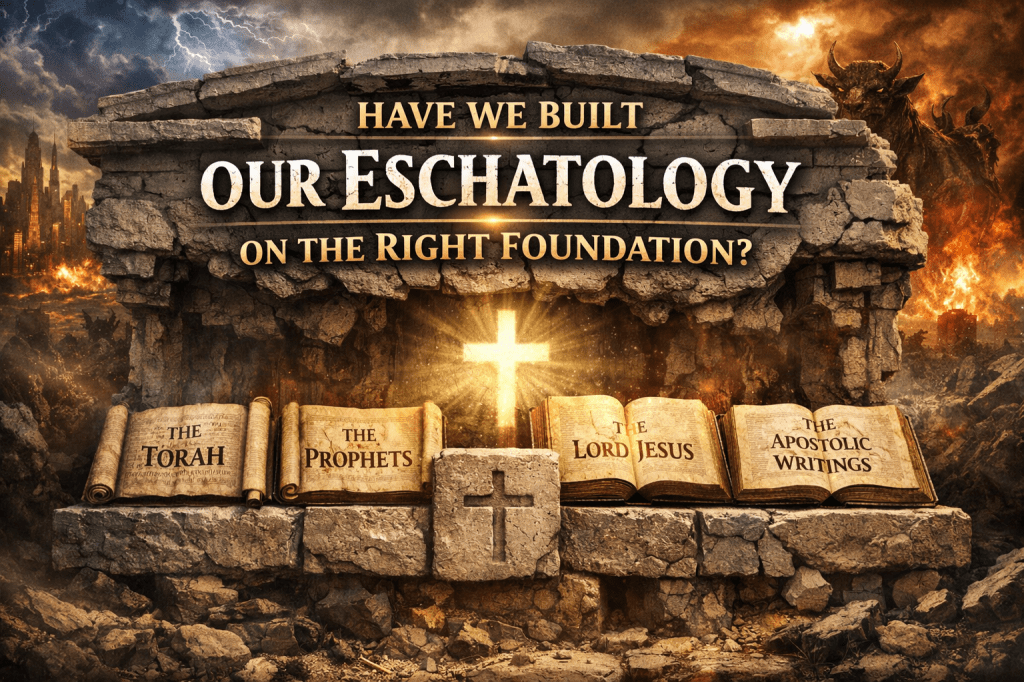
In the first three parts in this series, I raised the early church’s sustained doubts about Revelation, asked whether it passes Paul’s own gospel test, and pointed out that Revelation replaced the Apostles’ vocabulary with a parallel one that has shaped and distorted our debates ever since.
The inevitable question is: If not Revelation, then what?
Here’s what surprised me when I began working through this. The Apostles already had a complete, coherent eschatology. Every element we need, the appearing of Christ, the resurrection, the nature of judgment, the final state, is already present in the Torah, the Prophets, the Lord Jesus, and the Epistles. Revelation doesn’t fill a gap. There is no gap.
Let me lay out the pattern as the Apostles themselves present it. No Revelation. Just the canonical witness.
1. This Present Evil Age
Paul calls the current age “this present evil age” (Galatians 1:4). It is the age in which sin, death, and the powers hold sway. The wheat and the tares grow together until the harvest (Matthew 13:24–30). The faithful are called to walk by the Spirit, pursue holiness, and press toward the prize of the upward call (Philippians 3:14). This age ends, not gradually, not through a series of apocalyptic spectacles, but suddenly, at the appearing of the Lord Jesus.
2. The Appearing of the Lord Jesus
The Lord Jesus taught that His coming would be sudden, visible, and universal, like lightning flashing from east to west (Matthew 24:27). It breaks into a world absorbed in ordinary life: eating, drinking, buying, selling, building, planting, just as in the days of Noah and Lot (Luke 17:26–30). No one knows the day or the hour (Matthew 24:36). Paul confirms: the Day of the Lord comes “as a thief in the night” (1 Thessalonians 5:2). Peter says the same (2 Peter 3:10). His appearing ends this present age instantly.
3. One Resurrection, One Hour, Two Outcomes
The Lord Jesus said: “The hour is coming in which all who are in the graves will hear His voice and come forth, those who have done good, to the resurrection of life, and those who have done evil, to the resurrection of judgment” (John 5:28–29). One hour. All humanity. Two immediate outcomes. Paul affirms “a resurrection of the just and the unjust” (Acts 24:15). The faithful believers receive celestial, imperishable bodies and are caught up to meet the Lord (1 Corinthians 15:42–44; 1 Thessalonians 4:16–17). The unfaithful believers and the ungodly are raised in mortal bodies and remain on the earth for judgment.
There is no thousand-year gap. No “first resurrection” of martyrs followed by a delayed second resurrection. The Lord said one hour. Paul confirmed one resurrection of all at the Lord’s appearing. That’s the apostolic witness.
4. The Day of the Lord, The Seventh Day of Judgment and Purification
Peter teaches that the present heavens and earth are “reserved for fire until the day of judgment and perdition of ungodly men” (2 Peter 3:7). The heavens will be dissolved by fire, the elements will melt, and the earth will be laid bare (2 Peter 3:10–12). This is the Day of the Lord, not a twenty-four-hour event, but an age of divine fire and judgment that ultimately leads to restoration.
The Torah established this pattern at Sinai: fire, shaking, separation, and holiness. The Prophets expanded it into a vision of the Day when God would confront all rebellion, human and angelic, and renew creation. Isaiah taught that “when Your judgments are in the earth, the inhabitants of the world will learn righteousness” (Isaiah 26:9). Judgment teaches. It has a purpose and a horizon.
The Lord Jesus spoke of this Day as Gehenna, the fire of God that “destroys both soul and body” (Matthew 10:28). He warned of outer darkness, weeping and gnashing of teeth, and stripes proportioned to the light each person received and refused (Luke 12:47–48). Judgment is real, severe, and measured, but it is not purposeless, and it is not endless. The corrupted soul is brought to its appointed end, and the purified spirit returns to God who gave it (Ecclesiastes 12:7).
5. The Destruction of the Last Enemy
Paul teaches the sequence plainly: Christ must reign “till He has put all enemies under His feet. The last enemy that will be destroyed is death” (1 Corinthians 15:25–26). Isaiah confirms it: God “will swallow up death forever” (Isaiah 25:8). Death does not persist. It does not coexist with the new creation. It is abolished, not merely restrained, but consumed and brought to nothing.
This is the close of the Seventh Day. The fire of Gehenna has completed its work. The corrupted souls of those who entered judgment have been destroyed. Their purified spirits have returned to God who gave them. And now death itself, the last remaining enemy, is destroyed.
6. The Resurrection “of the End”, The Restoration of the Nations
Paul’s resurrection sequence in 1 Corinthians 15 is not a single event but an ordered progression. He writes: “Each one in his own order: Christ the firstfruits, afterward those who are Christ’s at His appearing. Then comes the end” (1 Corinthians 15:23–24). The Greek word for “order” is tagma, a military term meaning a ranked formation. There are stages.
The first tagma is Christ Himself, raised as the firstfruits. The second is the faithful, raised in celestial bodies at His appearing, the resurrection of life. But “then comes the end” is not merely the end of history. It is the final tagma, the resurrection “of the end,” when those who passed through the judgments of the Seventh Day are raised in new bodies on a renewed earth.
This is where the restoration actually happens. The spirits purified through the fires of Gehenna receive new terrestrial immortal bodies, incorruptible, deathless, suited for life on the new earth. Paul distinguishes these orders of glory carefully: “There are also celestial bodies and terrestrial bodies; but the glory of the celestial is one, and the glory of the terrestrial is another” (1 Corinthians 15:40). Celestial glory belongs to the faithful sons and daughters who inherit the inheritance of the Lord Jesus; they are joint heirs. Terrestrial glory belongs to the restored nations who inherit the renewed earth.
Peter confirms this same expectation when he says that heaven must receive Christ “until the times of restoration of all things, which God has spoken by the mouth of all His holy prophets since the world began” (Acts 3:21). The “restoration of all things” is not a vague hope, it has a mechanism: a final resurrection in which purified humanity receives new bodies and enters the new creation.
7. God Becomes “All in All”
And then the culmination: “When all things are made subject to Him, then the Son Himself will also be subject to Him who put all things under Him, that God may be all in all” (1 Corinthians 15:28).
Not all in some. Not all in the elect. All in all.
Paul calls it the reconciliation of “all things”, “whether things on earth or things in heaven”, through the blood of the cross (Colossians 1:20). The Psalmist sings: “All nations whom You have made shall come and worship before You, O Lord” (Psalm 86:9). Isaiah saw it: new heavens and a new earth in which “all flesh shall come to worship before Me, says the LORD” (Isaiah 66:23).
That’s the complete pattern:
This present evil age → the sudden appearing of Christ → one universal resurrection with two outcomes → the Day of the Lord as the age of judgment and purification → the destruction of death → the resurrection “of the end” in which the nations receive new bodies on a renewed earth → God all in all.
Every element is already there in the Torah, the Prophets, the Lord Jesus, and the Epistles. No Revelation needed.
Now here’s what I want this group to consider.
Most of us already believe in the restoration of all things. But many of us are still defending that belief against objections that come entirely from Revelation: the lake of fire, “forever and ever,” the “outside” of the New Jerusalem. We spend enormous energy trying to reinterpret Revelation’s categories to make them fit with restoration.
What if we don’t need to? What if the Apostles gave us a complete eschatology that already moves from judgment to restoration, and the only reason we’re stuck in these debates is that we accepted a foreign vocabulary from a disputed apocalypse and then spent centuries trying to make it say something it was never designed to say?
The gospel was preached to Abraham. It was confirmed by the Prophets. It was fulfilled in Christ. It was expounded by the Apostles. And it ends with God being all in all. That’s enough. It was always enough.
Next: Part 5 of 5: Revelation vs. the Apostles, A Side-by-Side Comparison
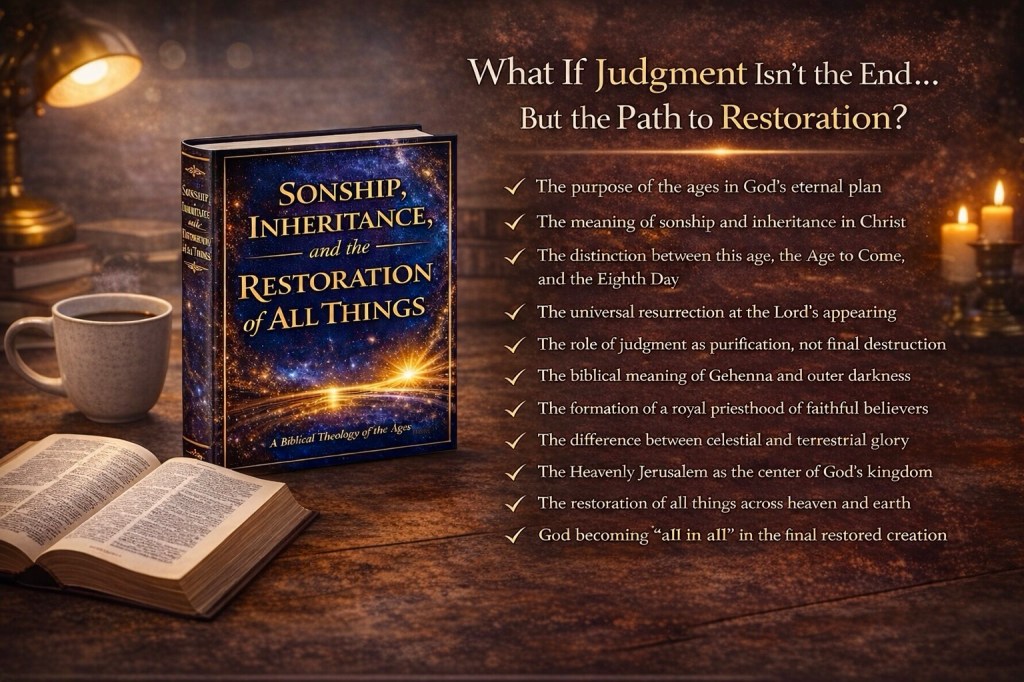
If you’re interested in reading the entire chapter from which this series originates, you can find it here: https://restorationtheologypress.com/table-of-contents/chapter-16/ .
 Restoration Theology Press