
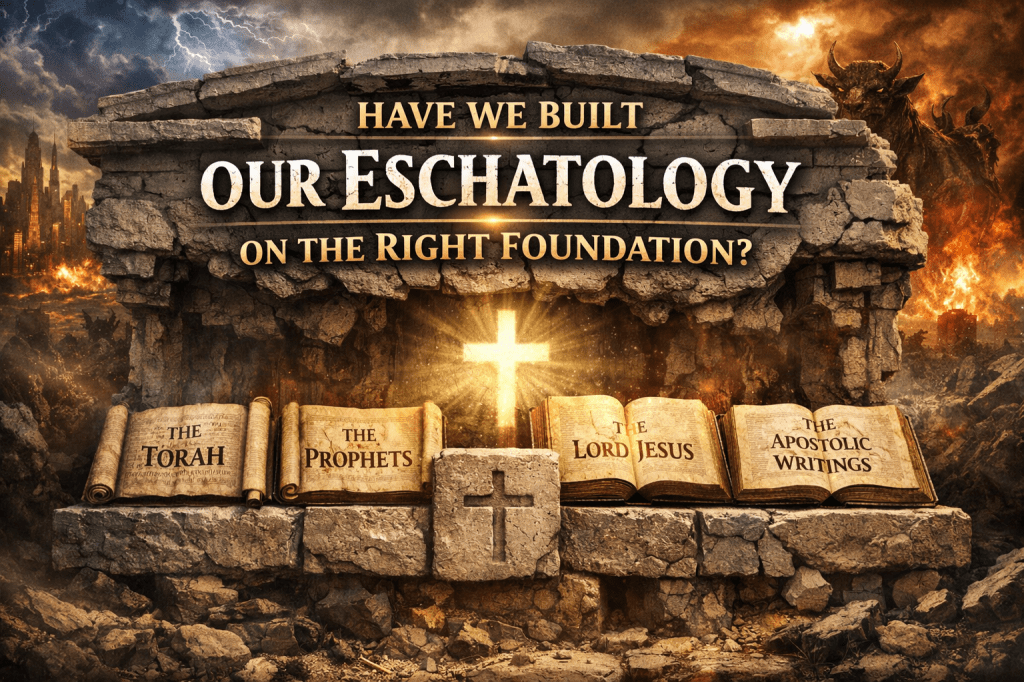
Over the last four parts, I’ve laid out the case: the early church’s sustained skepticism toward Revelation, whether it passes Paul’s gospel test, the vocabulary swap it introduced, and the complete apostolic eschatology that already exists without it.
This final post puts it all on the table. Here are five specific points where Revelation, if treated as doctrine, directly contradicts the teaching of the Lord Jesus and the Apostles. I’m not interpreting Revelation creatively here; I’m reading it the way the church has traditionally read it, and then placing it alongside what the Lord Jesus and the Apostles actually said.
Judge for yourselves.
1. The Appearing of Christ: Normalcy vs. Spectacle
THE LORD JESUS AND THE APOSTLES: His coming breaks into a world absorbed in ordinary life, eating, drinking, marrying, building, like the days of Noah and Lot (Matthew 24:37–39; Luke 17:26–30). It is sudden, like lightning from east to west (Matthew 24:27). The Day of the Lord comes “as a thief in the night” (1 Thessalonians 5:2; 2 Peter 3:10).
REVELATION: A prolonged sequence of seals, trumpets, and bowls, each filled with catastrophic plagues, cosmic upheavals, and worldwide destruction (Revelation 6–11; 15–16). Multiple cycles seem to reach a climax, kings hiding from the wrath of the Lamb, voices proclaiming the kingdom, only for new cycles of disaster to follow. If read as a timeline, the world is already devastated before the end arrives.
THE CONFLICT: The Lord Jesus says ordinary life continues until the sudden interruption. Revelation portrays a world already torn apart by escalating catastrophes. These two pictures cannot both be the controlling endtime picture. One must yield, and it cannot be the Lord’s own words.
2. The Resurrection: One Hour vs. Two Stages Separated by a Thousand Years
THE LORD JESUS AND THE APOSTLES: “The hour is coming in which all who are in the graves will hear His voice and come forth, those who have done good, to the resurrection of life, and those who have done evil, to the resurrection of judgment” (John 5:28–29). One hour. All humanity. Two outcomes. Paul confirms: “a resurrection of the just and the unjust” (Acts 24:15).
REVELATION: A “first resurrection” limited to martyrs who “live and reign with Christ for a thousand years,” and then: “the rest of the dead did not live again until the thousand years were finished” (Revelation 20:4–6). Two resurrections separated by a millennium.
THE CONFLICT: To accept Revelation 20 as doctrine is to rewrite John 5 and 1 Corinthians 15. The Lord’s “one hour” must be split into two hours separated by a thousand years. The canonical order, Torah, Prophets, the Lord Jesus, Apostles, cannot be subordinated to a single symbolic passage in a disputed apocalypse.
3. The Seventh Day vs. an Earthly Millennium
THE LORD JESUS AND THE APOSTLES: The appearing of Christ inaugurates the Day of the Lord, the age in which the corrupted heavens dissolve, the earth is laid bare under fire, and all remaining corruption is judged and purged (2 Peter 3:10–13; 2 Thessalonians 1:6–10). There is no intermediate political kingdom on this present earth. The pattern is simple: this age → His appearing → the age of judgment → new heavens and new earth.
REVELATION: A thousand-year earthly reign in which Satan is bound, then released at the end to deceive the nations again and lead them into yet another global war before fire falls from heaven (Revelation 20:1–10).
THE CONFLICT: Paul insists Christ “must reign till He has put all enemies under His feet” and that “the last enemy that will be destroyed is death” (1 Corinthians 15:25–26). But in Revelation’s scheme, death persists throughout the millennium, Satan is released for another worldwide deception, and the nations rebel again after a thousand years of Christ’s visible rule. If a thousand years of His reign still leaves death operative and the nations susceptible to wholesale deception, then Christ’s reign has not accomplished what Paul says it must. The Apostles know no such failure.
4. Judgment: Age-Lasting Gehenna vs. Eternal Lake of Fire
THE LORD JESUS AND THE APOSTLES: The Lord Jesus warns of Gehenna, a term rooted in the Valley of Hinnom (Isaiah 30:33; Jeremiah 7:31–32), the prophetic picture of divine judgment. In the Age to Come, this prophetic picture is fulfilled on a worldwide scale: the heavens pass through fiery dissolution and the earth itself becomes the realm of God’s purifying judgment, the true Gehenna of the Seventh Day (2 Peter 3:7, 10–12). He says God is able to “destroy both soul and body in Gehenna” (Matthew 10:28). He speaks of stripes proportioned to light received (Luke 12:47–48). Isaiah teaches that God’s judgments cause the inhabitants of the world to “learn righteousness” (Isaiah 26:9). Judgment has a purpose, a measure, and an end, the abolition of death and the renewal of creation.
REVELATION: Replaces Gehenna with the “lake of fire”, a term found nowhere in the Torah, the Prophets, the Gospels, or the Epistles. Describes torment whose smoke ascends “forever and ever,” where there is “no rest day or night” (Revelation 14:9–11). The devil, the beast, and the false prophet are “tormented day and night forever and ever” (Revelation 20:10). Death and Hades are personified as dramatic characters who are seized and thrown bodily into the lake (Revelation 20:13–14).
THE CONFLICT: If Revelation’s lake of fire defines the nature of judgment, then judgment is not proportional, not purposeful, and not bounded. It contradicts Paul’s insistence that the last enemy, death, will be destroyed (1 Corinthians 15:26), and Isaiah’s promise that God will swallow up death forever (Isaiah 25:8). An eternal lake of fire running alongside the new creation means death is never truly abolished, and God is never “all in all.”
5. New Creation: Restoration vs. Perpetual Exclusion
THE LORD JESUS AND THE APOSTLES: Peter speaks of “the times of restoration of all things, which God has spoken by the mouth of all His holy prophets since the world began” (Acts 3:21). Paul teaches that God will reconcile “all things”to Himself through the blood of the cross, “whether things on earth or things in heaven” (Colossians 1:20). Death is destroyed. Every enemy is subjected. God becomes “all in all” (1 Corinthians 15:24–28). The Psalmist sings: “All nations whom You have made shall come and worship before You, O Lord” (Psalm 86:9).
REVELATION: After the new heavens and new earth appear, there are still people permanently “outside” the New Jerusalem: “Outside are dogs and sorcerers and sexually immoral and murderers and idolaters” (Revelation 22:15). The impure are never admitted (Revelation 21:27). A reconciled city coexists with an unreconciled “outside”, permanently.
THE CONFLICT: This is the most devastating contradiction for universalists. If Revelation 22:15 governs the final state, then all things are never reconciled, death’s effects are never fully undone, and the Abrahamic promise that all the nations shall be blessed is permanently broken. The apostolic hope of God being “all in all” is reduced to God being “all in some” while a perpetual “outside” endures alongside His kingdom forever.
So here’s what I’d like to leave the group with.
These are not obscure tensions that require creative harmonization. These are five direct, point-by-point contradictions between Revelation and the unified witness of the Lord Jesus and the Apostles. On each point, you have to choose which voice governs: the Lord and His Apostles, or a disputed apocalypse that the early church itself could not agree on.
For those of us who believe in the restoration of all things, the choice should be clear. The apostolic witness already teaches everything we need. It moves from judgment to restoration. It ends with God being all in all. It doesn’t need to be rescued from Revelation’s categories, it needs to be freed from them.
The gospel was preached to Abraham, confirmed by the Prophets, fulfilled in Christ, and expounded by the Apostles. It ends with every knee bowing, every tongue confessing, and God being all in all.
You’re raising an important point, and I appreciate you engaging with it seriously. Let me take each one in turn.
On Matthew 25:46, you’re right that this is the passage ECT advocates lean on most heavily outside of Revelation. But the argument actually strengthens the case I’m making, not weakens it. The Greek word aiōnios (αἰώνιος) is the adjectival form of aiōn (αἰών), meaning “age.” It describes something that belongs to or pertains to the age. When the Lord Jesus says “kolasis aiōnios” and “zōē aiōnios,” He is speaking of punishment of the age and life of the age, the Age to Come.
The word aiōnios does apply equally to both, and that’s exactly the point. Both the punishment and the life belong to the same age. The life of the Age to Come is real and enduring. The punishment of the Age to Come is real and severe. But neither word tells you “timeless infinity.” It tells you “belonging to the coming age.” The punishment lasts as long as the age requires, and the Age to Come is the Seventh Day, the Day of the Lord, which has a beginning at the appearing of Christ and a conclusion when death, the last enemy, is destroyed (1 Corinthians 15:26) and God becomes “all in all” (1 Corinthians 15:28).
If we press aiōnios to mean “timeless eternity,” we create problems Scripture itself doesn’t support. Jude 7 says Sodom and Gomorrah suffered “the punishment of aiōnios fire”, yet those cities are not still burning. The fire accomplished its purpose and ended. Habakkuk 3:6 calls the mountains “aiōnios”, yet they will be dissolved in the Day of the Lord (2 Peter 3:10). The word describes duration within God’s ordered ages, not abstract infinity.
Also worth noting: the Greek noun kolasis (κόλασις) in Matthew 25:46 originally meant corrective pruning, cutting back so that healthy growth could emerge. It is not the Greek word for retributive torment (that would be timōria, τιμωρία). The Lord Jesus chose a word that implies purpose, not pointlessness.
On the blasphemy of the Holy Spirit, we need to look at both Matthew and Mark together, because they interpret each other.
Matthew records the Lord Jesus saying it “will not be forgiven, either in this age or in the Age to Come” (Matthew 12:32). Notice what He does: He names two ages, and only two, in which this unforgiveness operates. He does not say “forever” in a timeless sense. He uses the language of the ages. His words are framed with the noun aiōn (αἰών), meaning an age or ordered epoch, not with aidios (ἀΐδιος), the Greek term for what is eternal in the strict philosophical sense. The Lord’s statement is precise: unforgiveness spans two specific ages.
Now look at Mark’s version: “He who blasphemes against the Holy Spirit never has forgiveness, but is subject to eternal condemnation” (Mark 3:29, NKJV). This sounds more absolute, until you look at the Greek. The phrase rendered “eternal condemnation” is actually aiōnion hamartēma (αἰώνιον ἁμάρτημα). The word hamartēma does not mean “condemnation”, it means “sin” or “offense.” The literal reading is “age-lasting sin” or “sin of the age”, a sin whose guilt and consequences belong to the age. The NKJV’s “eternal condemnation” is an interpretive rendering, not a translation of what the Greek actually says. And the word aiōnion is the same adjective built on aiōn. It describes a sin whose judgment spans the full extent of the age, not a sin whose consequences are literally infinite. Mark is saying the same thing as Matthew in different words: this sin carries consequences that run through the coming age without relief.
Mark also adds the editorial explanation: “because they said, ‘He has an unclean spirit’” (Mark 3:30), making explicit that the blasphemy consists in attributing the Holy Spirit’s manifest work to Satan.
Here’s the critical point: the very specificity of the Lord’s phrasing in Matthew, “neither in this age nor in the Age to Come”, implicitly acknowledges more than two ages. If there were only two ages and nothing beyond them, the natural phrasing would simply be “never” or “forever.” The Lord does not use such language. He names two ages with deliberate precision and stops. What lies beyond the Age to Come, when death itself is abolished and God becomes “all in all” (1 Corinthians 15:26–28), He leaves in the hands of God who has declared His purpose to restore all things (Acts 3:21).
This is actually one of the strongest texts for the age-framework, not against it. Even the most severe sin is described within the structure of the ages, not in terms of abstract infinity.
And here’s the larger point. You’re right that ECT advocates don’t consciously build their case on Revelation alone. But Revelation’s vocabulary has shaped how they read the Gospels and Paul. The “lake of fire,” the “forever and ever” language of Revelation 14:11 and 20:10, the “second death”, these images have become the lens through which people read Matthew 25:46, even though none of those terms appear in the Lord Jesus’ own teaching. He spoke of Gehenna, outer darkness, many stripes and few stripes, debts paid “until the last penny,” and punishment “of the age.” Revelation replaced that vocabulary with the lake of fire and “forever and ever”, and then people read that imagery back into the Gospels. The Gospels don’t teach ECT when read on their own terms. They teach age-lasting, proportional, purposeful judgment that ends in restoration.
The real question is: whose vocabulary governs? The Lord Jesus spoke of Gehenna. He spoke of stripes proportioned to light. He spoke of debts paid until they are settled. He spoke of punishment belonging to the age. When we let His words stand without filtering them through Revelation’s imagery, the picture that emerges is severe, but it is bounded, purposeful, and moving toward restoration.
If you’re interested in reading the entire chapter from which this series originates, you can find it here: https://restorationtheologypress.com/table-of-contents/chapter-16/ .
 Restoration Theology Press