
Most Christians assume that the Book of Revelation is where eschatology finally comes together—that without it, the Church would be left guessing about the end. Rapture timelines, millennial kingdoms, apocalyptic beasts, lakes of fire—for most believers, these images are eschatology. Remove Revelation, and the whole framework seems to collapse.
But what if the framework that collapses isn’t the Apostolic one?
What if the Apostles already had a complete, coherent, breathtakingly unified eschatology—and they taught it, preached it, and defended it for decades before a single word of Revelation was ever written?
A Fact Most Christians Have Never Considered
Here is a simple historical fact that changes everything once you see it: every Apostolic letter in the New Testament was written before the Book of Revelation. Paul’s epistles—Romans, 1 and 2 Corinthians, Galatians, Ephesians, Philippians, Colossians, 1 and 2 Thessalonians, 1 and 2 Timothy, Titus, Philemon—were all composed in the 50s and 60s AD. The epistles of Peter, James, and Jude were written in the same period. The Gospel accounts of the Lord Jesus’ own teaching were circulating among the churches during this same generation. Hebrews was written and received. The churches were planted, instructed, corrected, and built up—all without any appeal to the Book of Revelation.
And yet Paul spoke with total confidence about the appearing of the Lord Jesus, the universal resurrection, the judgment that follows, and the final state when God becomes “all in all.” Peter described the Day of the Lord and the dissolution of the heavens and earth. The writer of Hebrews developed an elaborate theology of the heavenly sanctuary, the priesthood of Christ, and the world to come. The Lord Jesus Himself taught the suddenness of His coming, the resurrection of all humanity in one hour, the reality of Gehenna, the separation of the faithful from the unfaithful, and the beginning of the Age to Come.
None of them needed Revelation to say any of this. None of them were waiting for it. The Apostolic eschatology was already complete.
Three Centuries of Dispute
This matters even more when you consider what happened historically. The Book of Revelation was the last book to be associated with the Christian canon—and its path to acceptance was neither smooth nor universal. For roughly three hundred years, the churches debated whether it belonged in Scripture at all.
Eusebius of Caesarea, the most important church historian of the early centuries, classified Revelation among the “disputed” writings in his Ecclesiastical History around AD 325. Cyril of Jerusalem, one of the most influential catechetical teachers of the ancient Church, excluded Revelation from his list of canonical books entirely—instructing his students to read only the books he had listed and warning them against all others. The Council of Laodicea in AD 363–364 left Revelation out of its canonical list—and this was a council representing churches in Asia Minor, the very region where the seven churches addressed in Revelation’s opening chapters were located.
The Syrian churches present an especially telling case. These communities were geographically closest to the original Apostolic regions and linguistically closest to the Aramaic-speaking world from which Christianity emerged. They did not accept Revelation into their canon until the sixth century, and some communities continued to omit it even after that date. The Peshitta, the standard Syriac Bible, originally did not include Revelation.
Even the Protestant Reformation did not settle the question. Martin Luther placed Revelation apart from the rest of the New Testament and questioned its legitimacy. Zwingli refused to use it for doctrine. John Calvin, who wrote commentaries on nearly every book of the Bible, never wrote one on Revelation.
So What Did the Early Believers Believe?
This is the question no one asks—and it’s the question that changes everything.
If Revelation was disputed for three centuries, if entire regions of the Church never accepted it, if the communities closest to the Apostolic heartland were the most resistant to its claims—then what did those believers believe about the end? Where did they get their eschatology?
The answer is stunning in its simplicity: they got it from the Lord Jesus and the Apostles.
They believed what Paul taught—that at the appearing of the Lord Jesus, the dead would be raised, the living transformed, and all humanity would stand before God. They believed what the Lord Jesus taught—that there would be a resurrection of life and a resurrection of judgment, that both would occur in the same “hour,” that His coming would be sudden, visible, and universal. They believed what Peter proclaimed on the day of Pentecost—that heaven must receive the Lord Jesus “until the times of restoration of all things, which God has spoken by the mouth of all His holy prophets since the world began” (Acts 3:21).
They believed in the Day of the Lord—the great Seventh Day of divine fire, judgment, and purification, also called Gehenna—taught by Moses, proclaimed by the Prophets, confirmed by the Lord Jesus, and reaffirmed by every Apostle who wrote about the end. They believed that this Day would give way to a new creation, a renewed heavens and earth, in which righteousness dwells and God’s purpose for creation reaches its consummation.
And they believed all of this without a single reference to anything like what came later in the book of Revelation.
The Eschatology That Was Already There
Consider what the Apostolic writings already contain, without any appeal to Revelation:
The appearing of the Lord Jesus—sudden, visible, universal, breaking into a world absorbed in ordinary life (Matthew 24:27, 36–44; 1 Thessalonians 5:1–3; 2 Peter 3:10).
The universal resurrection—every human being raised by the voice of the Son of God. “The hour is coming in which all who are in the graves will hear His voice and come forth—those who have done good, to the resurrection of life, and those who have done evil, to the resurrection of judgment” (John 5:28–29).
The ordered resurrection—”each one in his own order: Christ the firstfruits, afterward those who are Christ’s at His coming. Then comes the end, when He delivers the kingdom to God the Father, when He puts an end to all rule and all authority and power” (1 Corinthians 15:23–24).
The subjection of all enemies — including the last enemy, death itself, swallowed up in resurrection so that God may be ‘all in all’ (1 Corinthians 15:26–28, 54).
The Day of the Lord—the elements dissolved with fervent heat, the earth and its works burned up, and yet “we, according to His promise, look for new heavens and a new earth in which righteousness dwells” (2 Peter 3:10–13).
The Restoration of All Things—”the times of restoration of all things, which God has spoken by the mouth of all His holy prophets since the world began” (Acts 3:21).
The reconciliation of all things—”and by Him to reconcile all things to Himself, by Him, whether things on earth or things in heaven, having made peace through the blood of His cross” (Colossians 1:20).
The final state—God becomes “all in all” (1 Corinthians 15:28). Death is abolished. Every knee bows and every tongue confesses that the Lord Jesus is Lord, to the glory of God the Father (Philippians 2:10–11).
Every element is already present. The structure of the ages, the nature of judgment, the destiny of the faithful and the unfaithful, the dissolution of the heavens, the renewal of creation, the Heavenly Jerusalem, the priestly inheritance, the Restoration of All Things, and the final state in which God is all in all—all of this is taught clearly, consistently, and in perfect harmony by the Torah, the Prophets, the Lord Jesus, and the Apostles.
The Invitation
If you’ve made it this far, you may be feeling what I felt when I first saw this—a mixture of shock and wonder. Shock, because most of us have spent our entire lives assuming Revelation was the key to understanding the end. Wonder, because the eschatology that was already there—the one the Apostles actually taught—is far more coherent, far more Scriptural, and far more glorious than the speculative systems we’ve been handed.
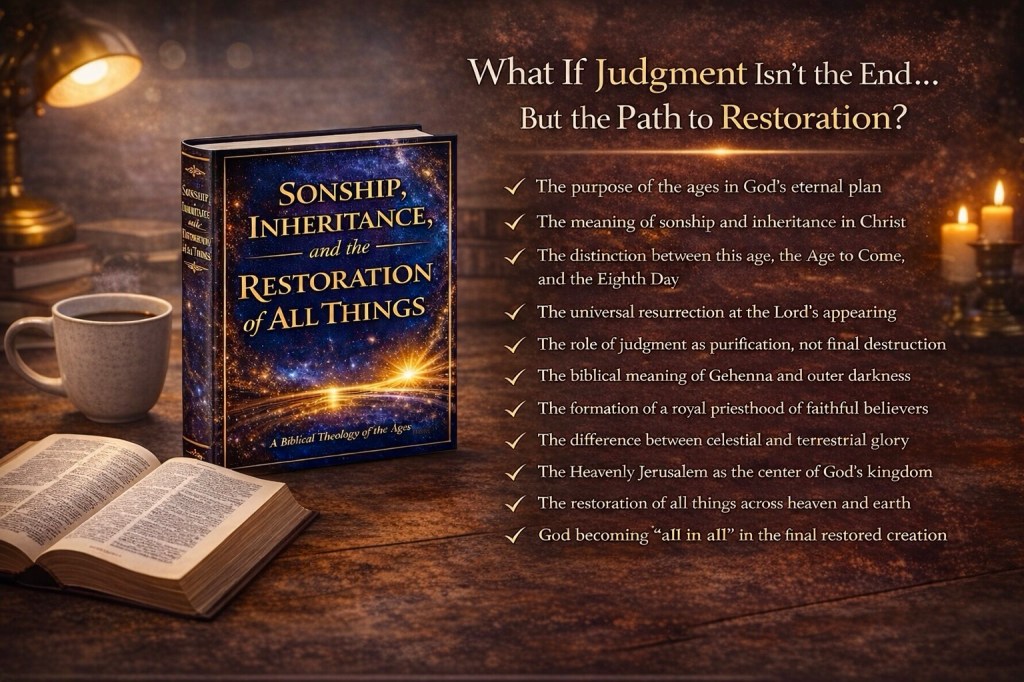
I’ve written a book that traces this Apostolic eschatology from Genesis through the Epistles. It’s called Sonship, Inheritance, and the Restoration of All Things, and it follows the canonical progression—the Torah, the Prophets, the Lord Jesus, and the Apostolic Epistles—to recover the complete eschatological pattern the Apostles taught.
The book is available to read free online.
Read the Book Here:
https://restorationtheologypress.com
 Restoration Theology Press