
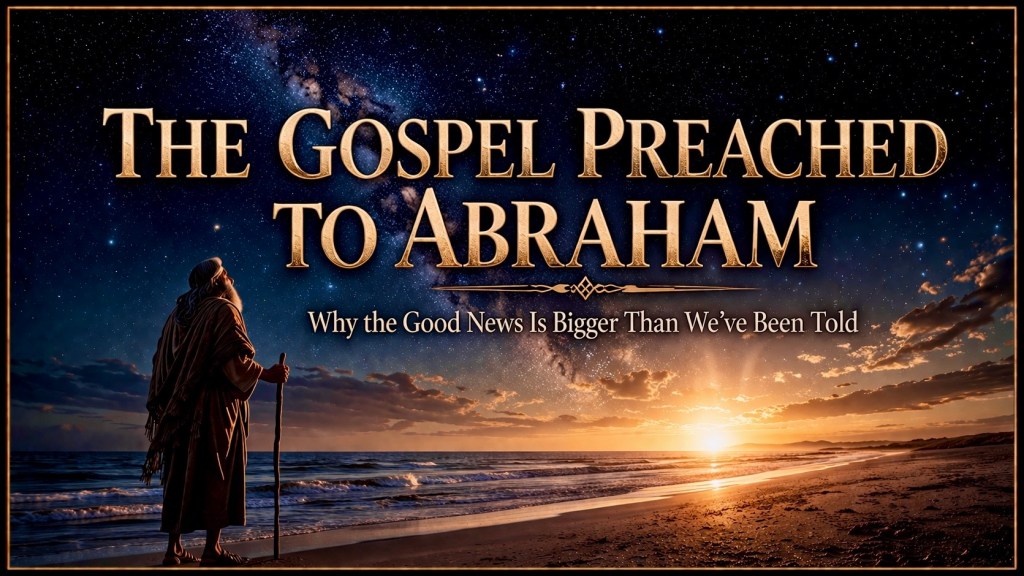
“And the Scripture, foreseeing that God would justify the Gentiles by faith, preached the gospel to Abraham beforehand, saying, ‘In you all the nations shall be blessed.’” (Galatians 3:8)
Introduction: The Gospel Did Not Begin at the Cross
Most Christians, if asked to define the gospel, would answer with a summary of the death, burial, and resurrection of the Lord Jesus Christ. That answer is not wrong—it names the decisive event upon which the entire purpose of God turns. But it is incomplete. It mistakes the climactic act of a story for the whole story. It confuses the fulfillment of a promise with the promise itself.
The Apostle Paul, writing under the inspiration of the Holy Spirit, traces the gospel not to the cross but to a much earlier moment. He says that the Scripture “preached the gospel to Abraham beforehand” (Galatians 3:8). The good news was not invented in the first century. It was announced in Genesis, confirmed in the Psalms, amplified by the Prophets, fulfilled in the Lord Jesus, and expounded by the Apostles. At its core, the gospel is not merely the announcement that sinners can be forgiven. It is the announcement that through the Seed of Abraham—the Lord Jesus Christ—all the nations of the earth will finally, fully, and permanently be blessed.
This teaching traces that gospel from its seed-form in Abraham through its fulfillment in Christ and its ultimate consummation in the ages to come. It is written for anyone who senses that the gospel they have been taught may be smaller than the gospel the Apostles actually preached. The Scriptures themselves will be our guide.
The Gospel Was First Preached to Abraham
When God called Abram out of Ur of the Chaldeans, He gave him a sevenfold promise that concluded with a phrase of breathtaking scope: “In you all the families of the earth shall be blessed” (Genesis 12:3). The Hebrew phrase kol mishpechot ha’adamah—”all the families of the earth”—reaches to every clan and nation scattered across the face of the ground. God did not say “some families,” or “a remnant drawn out of the families.” He said all.
Paul identifies this promise as the gospel itself. He does not say that the gospel was merely foreshadowed in Abraham, or that it was hinted at in the patriarchal narratives. He says that the Scripture, foreseeing the justification of the Gentiles by faith, “preached the gospel to Abraham beforehand” (Galatians 3:8). The word he uses—proeuēngelisato (προευηγγελίσατο)—means “announced the good news in advance.” The gospel that Paul preaches to the Galatians is the same gospel that God preached to Abraham. The two are not different messages. The one spoken in Genesis is the seed; the one proclaimed in the Apostolic writings is the full flower. But the DNA is identical: through Abraham’s Seed, all nations will be blessed.
Paul is also careful to identify the Seed. “Now to Abraham and his Seed were the promises made. He does not say, ‘And to seeds,’ as of many, but as of one, ‘And to your Seed,’ who is Christ” (Galatians 3:16). The Seed of Abraham is the Lord Jesus Christ. He is the one through whom all the families of the earth will be blessed. He is the heir of the covenant, the fulfiller of the promise, and the channel through whom the blessing reaches the nations. Those who belong to Christ in this present age are already Abraham’s seed and “heirs according to the promise” (Galatians 3:29), tasting its firstfruits. Yet the wording of the promise—”all the families of the earth”—reaches further than the present believing remnant. It sets the scope of the good news as nothing less than the eventual blessing of all the families and nations of the earth in the promised Seed.
This is not a stray promise that then recedes into the background. The Psalms take it up and amplify it as the very purpose for which God arises to judge: “Arise, O God, judge the earth; for You shall inherit all nations” (Psalm 82:8). God’s judgment is not opposed to the nations; it is ordered toward their inheritance. He judges the earth precisely so that all nations become His own. Psalm 86 confirms the outcome: “All nations whom You have made shall come and worship before You, O Lord, and shall glorify Your name” (Psalm 86:9). The scope is total: every nation God has made—not merely a fragment, not only a remnant taken out of them, but all nations as nations—will come, worship, and glorify His name.
Isaiah confirms the means by which this blessing reaches the nations: “For when Your judgments are in the earth, the inhabitants of the world will learn righteousness” (Isaiah 26:9). Judgment is not the negation of blessing but its instrument; the nations learn righteousness through God’s judgments, not in spite of them. Isaiah then unfolds the same promise in latter-days language: “It shall come to pass in the latter days that the mountain of the house of the LORD shall be established as the highest of the mountains, and shall be lifted up above the hills; and all the nations shall flow to it, and many peoples shall come, and say: ‘Come, let us go up to the mountain of the LORD, to the house of the God of Jacob, that He may teach us His ways and that we may walk in His paths.’ For out of Zion shall go forth the law, and the word of the LORD from Jerusalem” (Isaiah 2:2–3). The prophetic vision is not destruction and exclusion, but a willing, joyful procession of the nations toward the God of Jacob, drawn by His teaching and His word.
Isaiah connects the restoration of the nations with the abolition of death itself: “And in this mountain the LORD of hosts will make for all peoples a feast of choice pieces, a feast of wines on the lees, of fat things full of marrow, of well-refined wines on the lees. And He will destroy on this mountain the surface of the covering cast over all people, and the veil that is spread over all nations. He will swallow up death forever, and the Lord GOD will wipe away tears from all faces” (Isaiah 25:6–8). The feast is for all peoples. The veil is over all nations. The tears are wiped from all faces. Death is swallowed up forever. This is the Abrahamic blessing in its mature prophetic form: not merely the forgiveness of individual sinners, but the healing, restoration, and immortal blessing of all peoples, crowned by the abolition of death itself.
Even Israel’s great enemies are named as beneficiaries. Isaiah foresees a day when Egypt and Assyria—the house of Israel’s bondage and the destroyer of the northern kingdom—are joined with Israel in a threefold blessing: “Blessed is Egypt My people, and Assyria the work of My hands, and Israel My inheritance” (Isaiah 19:25). If such nations can be called “My people” and “the work of My hands,” then no nation lies beyond the reach of the promise spoken to Abraham.
The Apostles confirm this gospel with unmistakable clarity. Peter proclaims that heaven must receive the Lord Jesus “until the times of restoration of all things, which God has spoken by the mouth of all His holy prophets since the world began” (Acts 3:21). The “restoration of all things” is not a peculiarity of one apostle’s private theology; it is what “all His holy prophets” have spoken. Paul declares that it pleased the Father, in Christ, “to reconcile all things to Himself… whether things on earth or things in heaven, having made peace through the blood of His cross” (Colossians 1:19–20). He then describes the final goal: the Son reigning until all enemies are under His feet, death itself destroyed, and the kingdom handed back to the Father “that God may be all in all” (1 Corinthians 15:24–28).
Taken together, these passages—from the Torah, the Psalms, the Prophets, and the Apostles—define the gospel with a single, unbroken voice: through the Seed of Abraham, the Lord Jesus Christ, God will ultimately bless all nations, restore all things, reconcile all things in heaven and on earth, abolish death, and fill all creation with His presence. This is the gospel. It was preached to Abraham. It was sung in the Psalms. It was proclaimed by the Prophets. It was fulfilled in the Lord Jesus. And it was expounded by the Apostles. Any “gospel” whose final outcome falls short of this—leaving most of humanity in irreversible ruin, death unabolished, and God less than “all in all”—is smaller than the gospel Scripture actually preaches.
The Death, Burial, and Resurrection of Christ: The Fulfillment of the Gospel Preached to Abraham
When Paul writes to the Corinthians, he summarizes the gospel he delivered to them: “that Christ died for our sins according to the Scriptures, and that He was buried, and that He rose again the third day according to the Scriptures” (1 Corinthians 15:3–4). This is the event that most Christians identify as “the gospel,” and rightly so—it is the climactic, history-shattering act upon which everything turns. But Paul’s own language reveals that the death and resurrection of Christ are not the origin of the gospel; they are the fulfillment of a gospel that was already in motion. He says Christ died and rose “according to the Scriptures”—that is, in accordance with the promises, patterns, and prophecies that God had been unfolding since Genesis. The cross and the empty tomb do not begin the story; they bring it to its decisive turning point.
The death of the Lord Jesus is the moment at which the Seed of Abraham—the one through whom “all the families of the earth shall be blessed”—enters into the full weight of the curse in order to remove it. Paul makes the connection explicit: “Christ has redeemed us from the curse of the law, having become a curse for us… that the blessing of Abraham might come upon the Gentiles in Christ Jesus” (Galatians 3:13–14). The cross is not an interruption of the Abrahamic promise; it is its necessary mechanism. The blessing sworn to Abraham could not reach the nations until the curse under which all humanity labored was dealt with. At the cross, the Lord Jesus bore that curse in His own body, exhausted its claim, and opened the way for the blessing to flow without hindrance to every family of the earth. Thus the death of the Lord Jesus is not a separate gospel from the one preached to Abraham—it is the means by which the Abrahamic gospel is activated and released into the world.
The resurrection of the Lord Jesus is the firstfruits of the new creation. “But now Christ is risen from the dead, and has become the firstfruits of those who have fallen asleep” (1 Corinthians 15:20). In His risen body, the Lord Jesus is the living proof that death does not have the final word, that the Adamic curse is not permanent, and that the blessing sworn to Abraham will reach every nation. The resurrection is the Father’s public declaration that the cross accomplished what it was intended to accomplish: the curse has been exhausted, the way is open, and the promised Seed now lives in the power of an indestructible life to carry the blessing to the ends of the earth and the end of the ages.
This is why the gospel cannot be reduced to the formula “believe in the death and resurrection of Jesus so you can go to heaven when you die.” That formula, however sincerely held, captures only one dimension of the cross’s achievement and truncates the promise. The death and resurrection of Christ accomplish at least the following: the forgiveness of sins for those who believe in this present age; the justification of the ungodly by faith apart from works of law; the reconciliation of individual sinners to God; the destruction of the one who has the power of death; the defeat of the principalities and powers; the securing of the ground upon which all things—in heaven and on earth—will be reconciled; the provision of the blood by which peace is made with every person; and the inauguration of the resurrection order that will culminate in the abolition of death itself and God becoming “all in all.”
Consider the breadth of the terms Scripture uses to describe what the cross and resurrection accomplish. “Salvation” names the rescue of the whole person—spirit, soul, and body—from the dominion of sin and death, and it unfolds across the ages: the spirit is born anew in regeneration (Titus 3:5), the soul is saved through a life of obedience and faith (Hebrews 10:39; James 1:21; 1 Peter 1:9), and the body is redeemed at the resurrection (Romans 8:23). “Justification” names God’s judicial declaration that the sinner is righteous in Christ, but it is grounded in the promise to Abraham—”Abraham believed God, and it was accounted to him for righteousness” (Genesis 15:6; Romans 4:3)—and it reaches toward the justification of the nations by faith (Galatians 3:8). “Reconciliation” names the restoration of a broken relationship between the Creator and His creation, but its scope in Colossians 1:20 is “all things… whether things on earth or things in heaven.” “Redemption” names the price paid to free the enslaved, and the price is the blood of the Lamb—”the Lamb of God who takes away the sin of the world” (John 1:29)—not merely the sin of the Church, but the sin of the world. “Restoration” names the final state toward which the entire purpose of God moves—”the restoration of all things, which God has spoken by the mouth of all His holy prophets since the world began” (Acts 3:21). “The kingdom of God” names the realm in which God’s rule is fully acknowledged, and the Lord Jesus preached “the gospel of the kingdom” (Matthew 4:23; 9:35; 24:14)—a kingdom already present in seed-form within the faithful believers through the Spirit in this present age, for the Lord declared, “the kingdom of God is within you” (Luke 17:21), and those who walk in the Spirit have already “tasted… the powers of the age to come” (Hebrews 6:5). Yet this inward reality will be openly manifested in the Age to Come, when the faithful inherit celestial glory, and it extends until all enemies are subdued, death is destroyed, and the kingdom is delivered to the Father. At the end of Acts, we find Paul in Rome “preaching the kingdom of God and teaching the things which concern the Lord Jesus Christ” (Acts 28:31)—confirming that the gospel of the kingdom and the gospel of the cross are one and the same gospel preached to Abraham.
Every one of these terms—salvation, justification, reconciliation, redemption, restoration, the kingdom—is a facet of the one gospel preached to Abraham. They are not competing messages or unrelated doctrines. They are dimensions of a single divine purpose: the blessing of all nations through the Seed of Abraham, accomplished through His death, burial, and resurrection, and applied through the ordered ages until God is all in all.
When a person truly grasps this, the gospel is no longer a narrow transaction—a ticket out of hell and into heaven. It becomes the announcement that God is reconciling all things to Himself through the blood of the cross, restoring all things through the ages, blessing all nations through the Seed of Abraham, and bringing all creation to the point where He is “all in all.” The death, burial, and resurrection of the Lord Jesus is the explosive center of this purpose. It is not less than what most Christians have been taught. It is immeasurably more.
The Two Orders of Sonship Revealed in Abraham’s Blessing
The blessing given to Abraham—”as the stars of heaven and as the sand which is on the seashore” (Genesis 22:17)—contains, in seed-form, the two orders of sonship revealed in the resurrection. The “stars of heaven” foreshadow the faithful who inherit celestial glory, while the “sand of the seashore” anticipates the restored humanity who inherit terrestrial immortality. Thus the Torah’s earliest resurrection type already anticipates the two destinies the Lord Jesus calls “the resurrection of life” and “the resurrection of judgment” (John 5:29), which lead ultimately to celestial sons in the Heavenly Jerusalem above and terrestrial sons in the renewed earth below.
Paul deepens this distinction when he introduces the doctrine of celestial and terrestrial bodies: “There are also celestial bodies and terrestrial bodies; but the glory of the celestial is one, and the glory of the terrestrial is another” (1 Corinthians 15:40). The word translated “celestial” is epourania (ἐπουράνια), literally “belonging to the heavenly realm.” The word translated “terrestrial” is epigeia (ἐπίγεια), “earthly”—not in the sense of corruptible Adamic decay, but belonging to the renewed earth. These two kinds of resurrection bodies correspond to two distinct orders: celestial bodies for the faithful who inherit the kingdom in the Age to Come in the resurrection of life (Luke 20:35–36), and terrestrial immortal bodies for restored humanity who enter the renewed earth after the abolition of death (1 Corinthians 15:26–28).
Paul’s language of “glory” (doxa, δόξα) reveals that these are not merely differing rewards but differing constitutions and ranks. “The glory of the sun is one, the glory of the moon another, and the glory of the stars another; for star differs from star in glory” (1 Corinthians 15:41). As in Joseph’s dream, where sun, moon, and stars depict persons (Genesis 37:9–10), and in Daniel, where “those who are wise” shine like the brightness of the firmament and like the stars (Daniel 12:3), so here Paul uses heavenly lights as figures for resurrected orders of glory. The faithful celestial sons correspond to the glory of the sun—sharing in the brightness of Christ’s own risen body and “shining forth as the sun in the kingdom of their Father” (Matthew 13:43). The restored terrestrial humanity corresponds to the glory of the moon and the stars—each nation and person manifesting a distinct measure of radiance within the renewed earth.
Paul applies the celestial distinction directly to the faithful: “As we have borne the image of the man of dust, we shall also bear the image of the heavenly Man” (1 Corinthians 15:49). The “heavenly Man” is the risen Lord Jesus, whose glorified body is the prototype of the celestial sons and daughters (Philippians 3:21). This is the destiny of those who walked in the Spirit, crucified the flesh, endured suffering, pursued holiness, and obeyed the Lord Jesus. They receive the celestial body at His appearing. This transformation occurs at the sounding of “the last trumpet”: “We shall not all sleep, but we shall all be changed—in a moment, in the twinkling of an eye, at the last trumpet” (1 Corinthians 15:51–52). Resurrection is universal—all who are in the graves come forth at the voice of the Son of Man (John 5:28–29). But transformation into celestial glory is conditional, granted only to the faithful. The trumpet does not raise people out of the tomb; it clothes the already-raised faithful with immortal celestial glory.
The rest of humanity—those who did not walk faithfully in this age and those who never knew the Lord—though raised in the same hour, remain in mortal bodies and enter the resurrection of judgment. Their Adamic nature is destroyed in the fires of the Seventh Day (Matthew 10:28). When judgment is complete, their purified spirits return to God (Ecclesiastes 12:7). In the Eighth Day—the resurrection “of the end”—they receive terrestrial immortal bodies and enter the renewed earth as the healed nations.
The Harmony of the Two Orders in the Ages to Come
The divine purpose in establishing these two orders is not to create rivalry within the family of God but to manifest harmony. Paul declares that God’s plan is “that in the dispensation of the fullness of the times He might gather together in one all things in Christ, both which are in heaven and which are on earth” (Ephesians 1:10). In the Eighth Day, this gathering reaches its mature form. The faithful celestial sons dwell in the Heavenly Jerusalem above, ministering in the true sanctuary and exercising heavenly government with Christ. The restored terrestrial humanity inhabits the renewed earth below. The nations themselves ascend in willing worship, saying, “Come, and let us go up to the mountain of the Lord… He will teach us His ways, and we shall walk in His paths” (Isaiah 2:3). Heaven and earth, the city above and the nations below, together form one ordered kingdom under one Head, the Firstborn Son.
In this structure, the celestial sons mediate the immediate light and life of the throne to the renewed earth; the nations receive instruction and blessing through their ministry until “the earth shall be full of the knowledge of the Lord as the waters cover the sea” (Isaiah 11:9). Authority flows downward in love, and worship rises upward in gratitude. Each order glorifies God in the sphere appointed to it. Together they fulfill the promise given to Abraham: his descendants as “the stars of heaven and as the sand which is on the seashore” (Genesis 22:17). The celestial sons are as the stars, shining in the heavens with the glory of the Firstborn; the restored terrestrial sons are as the sand, covering the renewed earth with the knowledge of God. Through both, the nations are blessed, and the covenant word is fulfilled: “In your seed all the nations of the earth shall be blessed” (Genesis 22:18; Galatians 3:8). The two orders of the redeemed do not fragment the kingdom; they complete it, displaying a universe in which every measure of glory, nearness, and service contributes to one end: that the Father may be all in all through His Firstborn Son.
The Blood of the Cross and the Reconciliation of All Things
“For it pleased the Father that in Him all the fullness should dwell, and by Him to reconcile all things to Himself, by Him, whether things on earth or things in heaven, having made peace through the blood of His cross.” (Colossians 1:19–20)
This passage is the theological spine of the gospel preached to Abraham, for it declares that the reconciliation accomplished through the blood of the cross extends to “all things”—not merely all believers, not merely all humans, but all things in heaven and on earth. The scope of reconciliation matches the scope of the Abrahamic promise. The same God who said, “In you all the families of the earth shall be blessed,” here reveals the means by which that blessing reaches every corner of creation: the blood of the cross of His Son.
The grammar of the passage holds two realities together. The aorist participle eirēnopoiēsas (εἰρηνοποιήσας)—”having made peace”—points to the cross as an accomplished fact. The peace was secured at Calvary. The blood was shed once for all. But the infinitive apokatallaxai (ἀποκαταλλάξαι)—”to reconcile”—points to the purpose and outworking of that accomplished peace. The Father was pleased, through the blood already shed, to reconcile all things to Himself. The reconciliation is grounded in a completed act and applied through a process that unfolds across the ages. The cross secured the victory; the ages apply it. The blood made the peace; the ordered judgments bring that peace to every person.
Why Is the Blood of the Cross Needed After Judgment?
This question strikes at the heart of the matter. If the unfaithful and the ungodly are judged according to their works—if their Adamic bodies are destroyed, their corrupted souls dismantled under divine fire, and their spirits purified through the anguish of judgment—why do they still need the blood of the cross to be reconciled? Has not judgment itself done the work?
The answer is that judgment and the blood of the cross serve different purposes within a single redemptive design. Judgment destroys the corruption. The blood provides the ground upon which God can fill the emptied vessel with His own life.
The fires of judgment accomplish the destruction of everything in the person that is hostile to God—the Adamic body, the corrupted soul-life, the rebellion, the defilement accumulated through a lifetime of sin. Judgment strips away everything that cannot endure the presence of a holy God. But judgment, by itself, does not create new life. It does not generate the right of a purified spirit to receive a new body. It does not open a door for the Creator to reconstitute a person that was under the sentence of death. Judgment burns away the dross, but it cannot forge the gold into a new vessel. Something more is needed—a ground, a basis, a right by which God can act in mercy toward a person that has been justly judged. That ground is the blood of the cross.
The blood of the Lord Jesus is not merely the means by which individual sins are forgiven in this present age. It is the cosmic ground upon which the entire new creation rests. Every reconciled person, every restored nation, every healed corner of creation stands upon the blood that was shed once for all. The Eighth Day does not arrive by the sheer passage of time; it arrives because the Lamb was slain, the price was paid, and the reconciliation secured on the cross is applied through the ordered judgments of the ages until it reaches every realm and every creature. Judgment is the surgeon’s knife; the blood is the life that flows into the wound. Without the blood, judgment would be mere destruction with no basis for renewal. Without judgment, the blood would remain unapplied to those who refused its mercy in this age. Together, they accomplish what neither could accomplish alone: the full, ordered reconciliation of all things to the Father.
But there is something even deeper at work in this passage. Paul says that “it pleased the Father that in Him all the fullness should dwell.” The word plērōma (πλήρωμα)—”fullness”—refers to the totality of divine life, power, and presence. The Father’s pleasure is not merely to pardon sinners but to fill all things with His own life through His Son. The blood of the cross removes every barrier—legal, moral, and ontological—between the Creator and His creation, so that the divine fullness that dwells in Christ can flow outward into every reconciled person. This is the ultimate meaning of “God may be all in all” (1 Corinthians 15:28). The blood does not merely cancel a debt; it secures the right of the Creator to reconstitute, to fill, and to dwell in the person that judgment has purified. The one who objects, “If they are judged for their works, why do they need the blood?” has grasped only the forensic dimension of the cross and has missed the ontological dimension. The blood of the cross is the ground of cosmic filling, not merely individual pardon. Without it, there would be nothing to fill the emptied vessel after judgment has done its work. The purified spirit, returning to God after the destruction of the Adamic soul (Ecclesiastes 12:7), can receive a new terrestrial body in the resurrection “of the end” only because the blood of the cross has secured the ground for that act of new creation.
The cross is therefore not merely the center of the gospel—it is the center of the ages. It stands between the Firstborn over all creation and the Firstborn from the dead (Colossians 1:15, 18). It is the hinge upon which the old creation passes and the new creation emerges. And it is the ground upon which every person—whether reconciled by faith in this age, or reconciled through judgment in the Age to Come—will stand in the Eighth Day, clothed in immortality and filled with the life of God.
The Gospel Standard: Testing All Teaching by the Abrahamic Promise
Paul roots his non-negotiable standard for testing all teaching not in his own authority, but in God’s earlier word to Abraham. Having identified the Abrahamic promise as the gospel itself, he then issues the most severe warning in all his writings: “But even if we, or an angel from heaven, preach any other gospel to you than what we have preached to you, let him be accursed” (Galatians 1:8). He repeats the warning for emphasis: “As we have said before, so now I say again, if anyone preaches any other gospel to you than what you have received, let him be accursed” (Galatians 1:9).
The standard is absolute. Any message—no matter who delivers it, no matter what credentials support it, no matter what visions or traditions accompany it—must be measured against the gospel preached to Abraham. And the gospel preached to Abraham has a definite content and a definite outcome: “In you all the nations shall be blessed.” When the good news has run its full course, the result is the blessing of all nations—not their irreparable loss.
If the final outcome of any teaching is a universe in which most of humanity remains permanently unreconciled, in which death is never truly abolished, in which a realm of eternal torment runs alongside the new creation, and in which God is not actually “all in all”—then that teaching has produced a result that contradicts the gospel preached to Abraham. The nations are not blessed; they are ruined. The promise is not kept; it is broken. The cross has not reconciled all things; it has failed to reach vast portions of creation. And God is not “all in all” but one sovereign over two kingdoms—one reconciled, one forever hostile.
By the Apostle’s own standard, such a message falls under the weight of his warning. It does not matter how ancient the tradition, how deeply held the conviction, or how passionately the teachers defend it. The measuring rod is the gospel preached to Abraham, confirmed by the Prophets, fulfilled in the Lord Jesus, and expounded by the Apostles.
This does not mean that judgment is unreal, or that the fires of the Seventh Day are merely symbolic, or that all paths lead to the same reward. The gospel preached to Abraham includes judgment as the instrument by which the nations learn righteousness (Isaiah 26:9). It includes the destruction of the Adamic nature in those who refused the cross in this age. It includes proportional recompense for every deed done in the body. It includes weeping and gnashing of teeth for those who squandered the light they were given. But it also insists—with the full weight of the Torah, the Prophets, the Lord Jesus, and the Apostles behind it—that judgment is not the last word. Blessing is the last word. Restoration is the last word. Reconciliation is the last word. God “all in all” is the last word. The gospel preached to Abraham settles the question: the purpose of God for the nations is blessing, not ruin, and every judgment along the way serves that purpose.
Conclusion: The Gospel That Began in Abraham Will Be Fulfilled in All Nations
The gospel did not begin at the cross, though it was fulfilled there. It did not begin with Paul, though he expounded it with unmatched clarity. It began with a promise spoken to one man in Mesopotamia: “In you all the families of the earth shall be blessed.” That promise was taken up by the Psalms, expanded by the Prophets, embodied in the Lord Jesus, and proclaimed by the Apostles. At no point in this canonical progression does the promise shrink. At no point does “all the families” become “some of the families.” At no point does the blessing of the nations become the eternal ruin of the nations.
The death, burial, and resurrection of the Lord Jesus is the mighty act by which this promise is secured. Through the cross, the curse is exhausted. Through the resurrection, the new creation emerges in power. The blood of the cross is the ground upon which all things—in heaven and on earth—will be reconciled. The resurrection is the firstfruits of the harvest that will, in its ordered time, gather every person into the life of God.
In Abraham’s blessing, two orders of sonship are already visible: the stars of heaven and the sand of the seashore, the celestial and the terrestrial, the faithful who inherit glory at the Lord’s appearing and the restored nations who inherit terrestrial immortality in the Eighth Day. In the harmony of these two orders, the purpose of the ages is displayed: one kingdom, one Head, one priestly family mediating the light and life of God to a renewed creation, until “the earth shall be full of the knowledge of the Lord as the waters cover the sea” (Isaiah 11:9).
The blood of the cross reaches further than most have dared to believe. It is not merely the basis for individual forgiveness. It is the cosmic ground upon which judgment is turned to restoration, purified spirits receive new bodies, and the fullness of God fills every person. Without the blood, judgment would end in destruction. With the blood, judgment gives way to the resurrection “of the end,” and the God who made all things reconciles all things through the Seed in whom He first spoke the promise.
The Apostle Paul, having traced this gospel from Abraham to the cross to the resurrection to the ages to come, arrives at the only conclusion that does justice to the promise: “For God has committed them all to disobedience, that He might have mercy on all. Oh, the depth of the riches both of the wisdom and knowledge of God! How unsearchable are His judgments and His ways past finding out!” (Romans 11:32–33).
The gospel preached to Abraham will not fail. The nations will be blessed. Death will be abolished. God will be all in all. And the Seed of Abraham—the Lord Jesus Christ—will see the travail of His soul and be satisfied.
“He shall see the labor of His soul, and be satisfied. By His knowledge My righteous Servant shall justify many, for He shall bear their iniquities.” (Isaiah 53:11)
A note on “many”: The Hebrew word rabbîm (רַבִּים), translated “many” in Isaiah 53:11, is the same word used in Daniel 12:2, where “many of those who sleep in the dust of the earth shall awake.” In Hebrew idiom, rabbîm often denotes the great multitude or totality—not a restricted subset. Paul confirms this when he writes, “For as by one man’s disobedience many were made sinners, so also by one Man’s obedience many shall be made righteous” (Romans 5:19). The “many” made sinners through Adam is the whole human race; the “many” made righteous through Christ is no smaller in scope. The Lord Jesus Himself resolves the question by replacing Daniel’s “many” with “all”: “The hour is coming in which all who are in the graves will hear His voice and come forth” (John 5:28–29). The “many” of the Prophet is the “all” of the Lord Jesus.
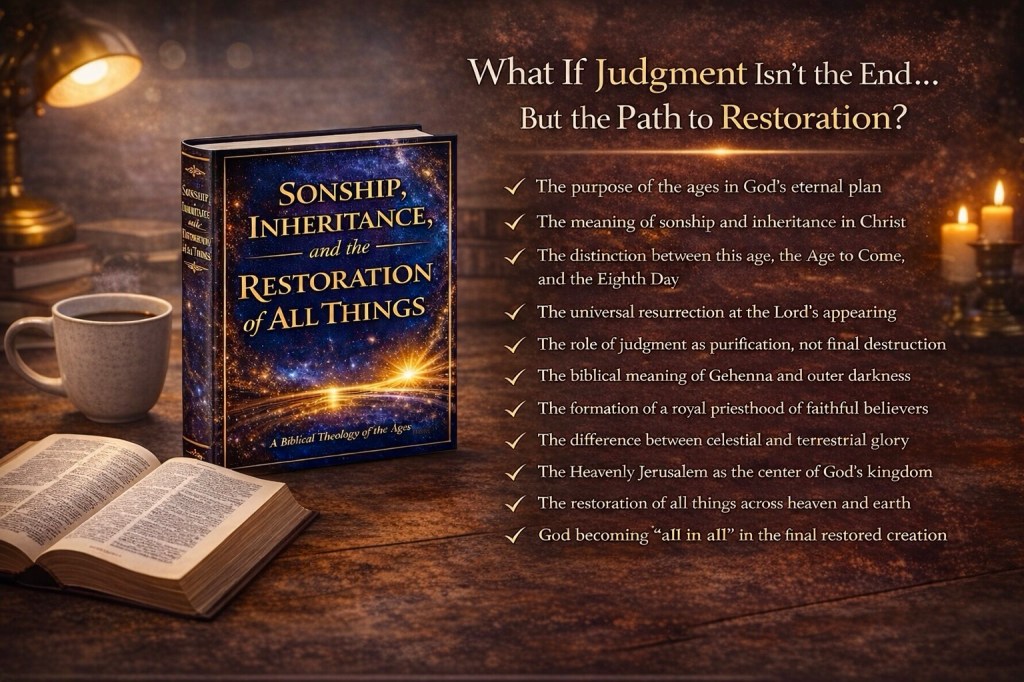
If you’re interested in reading the book: Sonship, Inheritance, and the Restoration of All Things from which this teaching originates, you can find it here:
https://restorationtheologypress.com.
 Restoration Theology Press