
What Did the Early Church Actually Have?
The Book of Revelation was the last book to enter the Christian canon, and its path to acceptance was anything but smooth.
In the third century, Dionysius of Alexandria, a student of Origen and one of the most respected bishops in the East, conducted a detailed analysis of Revelation’s Greek style, vocabulary, and theological content. He compared it with the Gospel of John and John’s epistles and concluded that Revelation could not have been written by the same author. His conclusion carried weight: as bishop of Alexandria, his judgment coloured the reception of the book across the Eastern churches for centuries.
In the fourth century, the doubts intensified. Eusebius of Caesarea, the foremost church historian of the early centuries, classified Revelation among the “disputed” writings in his Ecclesiastical History (c. AD 325). He could not resolve whether it belonged among the accepted books or the spurious ones, and his indecision reflected the actual state of the Church: there was no consensus.
Cyril of Jerusalem, one of the most influential catechetical teachers of the ancient Church, excluded Revelation from his list of canonical books entirely in his Catechetical Lectures (c. AD 348). He listed the four Gospels, Acts, the epistles of James, Peter, John, and Jude, and the fourteen epistles of Paul, but Revelation was absent. He then instructed his catechumens to read only those books he had listed, warning them against all others. In the mid-fourth century, in Jerusalem itself, Revelation was not considered suitable for the instruction of the faithful.
The Council of Laodicea (AD 363–364) left Revelation out of its canonical list, a decision by a regional council representing churches in Asia Minor, the very region where the seven churches addressed in Revelation’s opening chapters were located.
The Syrian churches present an especially telling case. These communities were geographically closest to the original apostolic regions and linguistically closest to the Aramaic-speaking world from which Christianity emerged. They did not accept Revelation into their canon until the sixth century, and some communities continued to omit it even after that date. The Peshitta, the standard Syriac Bible, originally did not include it. To this day, the official lectionary of the Syriac Orthodox Church and the Assyrian Church of the East presents lessons from only the twenty-two books of the Peshitta, and Revelation is not among them.
Even the Protestant Reformation did not settle the question. Martin Luther placed Revelation apart at the end of his 1522 New Testament and questioned its legitimacy. Zwingli refused to use it for doctrine. Calvin, who wrote commentaries on nearly every book of the Bible, notably declined to write one on Revelation.
This history raises a question that most Christians have never been asked to consider.
If the early Church was divided on Revelation, if bishops, councils, and entire regions rejected or excluded it, then what did they believe about the coming judgment? What did they have that was not in dispute?
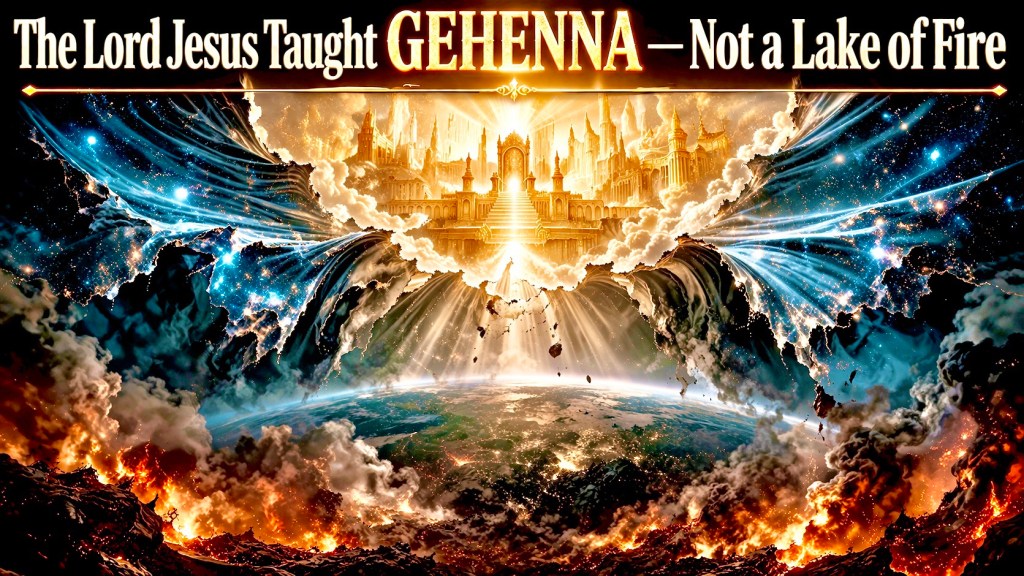
They had the Torah. They had the Prophets. They had the Gospels and the Apostolic Epistles. And in those Scriptures, the word the Lord Jesus used for future judgment was not “lake of fire.” It was Gehenna.
The term “lake of fire” appears nowhere in the Torah, nowhere in the Prophets, nowhere in the teaching of the Lord Jesus, and nowhere in the Apostolic Epistles. It is found exclusively in the Book of Revelation, the very book that was disputed for centuries. The “second death” is likewise a term unique to Revelation, absent from every other stratum of Scripture.
Gehenna, on the other hand, comes directly from the mouth of the Lord Jesus. He used it repeatedly. He drew it from the Hebrew prophets. And it carried a meaning that the modern concept of “hell” has almost entirely obscured.
So what did the Lord Jesus actually mean when He spoke of Gehenna?
The word Gehenna (γέεννα) is a Greek transliteration of the Hebrew Gē Hinnōm (גֵּי הִנֹּם), the Valley of Hinnom. This valley, running south of Jerusalem, was the site where Judah committed its most abhorrent idolatry, burning sons and daughters to Molech in the fire (Jeremiah 7:31; 2 Kings 23:10). The Lord declared through Jeremiah that this valley would become “the Valley of Slaughter,” a place of death, disgrace, and divine wrath (Jeremiah 7:32). What was once the site of Israel’s worst abominations became the chosen theatre of covenant judgment, the place outside the holy city where the Lord made visible what the Torah had already threatened: death and exposure for those who break His covenant.
Isaiah adds that Tophet, in this valley, is “prepared of old,” with a pyre “deep and large,” kindled by “the breath of the LORD, like a stream of brimstone” (Isaiah 30:33). The Valley of Hinnom was not only a historical site of horror, it was a prophetic sign of a future burning prepared by God Himself.
By the time the Lord Jesus walked the earth, the Valley of Hinnom had become the place outside Jerusalem where refuse was burned and corpses consumed. When He took this name upon His lips, He was not inventing a new doctrine. He was filling the prophetic image with its eschatological content. The valley outside Jerusalem became, in His teaching, the name for the realm of divine judgment in the age to come.
He warned that anger and contempt put a person “in danger of the fire of Gehenna” (Matthew 5:22). He urged His disciples to cut off hand or foot rather than be “cast into Gehenna” (Matthew 5:29–30; Mark 9:43–48). He declared that the One to fear is God, “who is able to destroy both soul and body in Gehenna” (Matthew 10:28). And when He described Gehenna as the place “where their worm does not die and the fire is not quenched” (Mark 9:48), He was deliberately quoting the prophet Isaiah (Isaiah 66:24), grounding His warning not in a new vision but in the canonical prophetic witness.
Notice what is present—and what is absent.
The Lord Jesus spoke of Gehenna. He grounded it in the Torah and the Prophets. He applied it to the future judgment of the age to come. He warned of the destruction of body and soul. He quoted Isaiah.
He never mentioned a “lake of fire.” He never spoke of a “second death.” He never described torment that continues “forever and ever” alongside a renewed creation. Those images come from elsewhere, from a book that the early Church spent centuries debating.
The question, then, is this: Should the Church’s understanding of divine judgment be shaped by the clear, repeated, prophetically grounded teaching of the Lord Jesus, or by the symbolic imagery of a disputed apocalypse?
In the next post, we will trace Gehenna’s roots deeper, into the Torah itself, where the God who is “a consuming fire” reveals the pattern of holy judgment that the Prophets later focused into the Valley of Hinnom and that the Lord Jesus gathered into His warnings about the age to come.
The Roots of Gehenna in the Torah and the Prophets
In the previous post we saw that the Lord Jesus never spoke of a “lake of fire” or a “second death.” Those terms belong exclusively to the Book of Revelation, the very book that was disputed, excluded, or questioned by Dionysius, Eusebius, Cyril, the Council of Laodicea, the Syrian churches, Luther, Zwingli, and Calvin. The word the Lord Jesus used for future judgment was Gehenna, and He drew it from a canonical stream that began long before His earthly ministry.
In this post we trace that stream to its headwaters: the Torah and the Prophets. What we will find is that Gehenna did not drop out of the sky. It was built on a foundation laid by Moses and developed by every major prophet in Israel’s history.
The God Who Is a Consuming Fire
The Torah prepares the way for the Lord’s teaching on Gehenna by revealing a God whose holiness is inseparable from fire.
At Sinai, the Lord descended upon the mountain in fire, cloud, and earthquake. The mountain burned “to the heart of heaven,” and the whole assembly trembled at the voice that spoke from the midst of the fire (Exodus 19:16–19; Deuteronomy 4:11–12). Strict boundaries were set: if man or beast broke through and touched the holy mountain, they were to be put to death (Exodus 19:12–13). Moses alone could enter the cloud of glory. The priests were allowed partway. The people were warned not to approach lest they die.
Moses gathered the meaning of that event into a single declaration: “For the LORD your God is a consuming fire, a jealous God” (Deuteronomy 4:24). This is not a metaphor imposed by later theology. It is the Torah’s own foundational statement about the nature of God, and the writer to the Hebrews quotes it directly: “Our God is a consuming fire” (Hebrews 12:29).
What happened at Sinai was a localized preview of the Day of the Lord. Every element later associated with that Day was present in seed form: fire, cloud, trumpet, voice, shaking, and separation between those who could approach and those who could not. Sinai reveals what happens when God comes down in unveiled holiness: fire surrounds His presence, and everything that cannot stand before Him is consumed.
Fire That Reveals, Not Fire That Annihilates
One of the most important principles established by the Torah is that divine fire does not destroy indiscriminately. It reveals the true nature of what it touches.
The fire that consumed the acceptable sacrifice on the altar (Leviticus 9:24) is the same fire that consumed Nadab and Abihu when they offered what was profane before the Lord (Leviticus 10:1–3). The fire that led Israel by night as a pillar of protection (Exodus 13:21) is the same fire that fell upon Korah, Dathan, and Abiram in judgment for their rebellion (Numbers 16:35). What is holy endures. What is unholy is consumed. This principle, established in the Torah’s earliest chapters, governs everything the Prophets and the Lord Jesus will later say about judgment.
Even the burning bush teaches this. The bush burned with the presence of God and was not consumed (Exodus 3:2). Divine fire does not annihilate what God intends to preserve. It consumes what is incompatible with His presence while leaving intact what He has chosen. This image stands at the head of the entire biblical doctrine of fire and judgment.
Sodom: Fire That Destroys—and a City God Promises to Restore
The destruction of Sodom and Gomorrah is the Torah’s most vivid picture of divine fire consuming an entire civilization for its wickedness. “Then the Lord rained brimstone and fire on Sodom and Gomorrah, from the Lord out of the heavens. So He overthrew those cities, all the plain, all the inhabitants of the cities, and what grew on the ground” (Genesis 19:24–25). Abraham looked toward the plain and “saw, and behold, the smoke of the land which went up like the smoke of a furnace” (Genesis 19:28).
The phrase “like the smoke of a furnace” deliberately echoes the language of Sinai, where “Mount Sinai was completely in smoke, because the LORD descended upon it in fire. Its smoke ascended like the smoke of a furnace” (Exodus 19:18). The same God who descended in fire at Sinai rained fire upon Sodom. The same furnace-smoke that marked the place of His holiness marked the place of His judgment.
Yet, and this is the point that transforms the entire doctrine, the fire that fell on Sodom is not God’s final word over Sodom. Through Ezekiel, centuries later, the Lord makes a promise so startling that it shatters every assumption about the finality of fiery judgment: “When I bring back their captives, the captives of Sodom and her daughters… I will restore the fortunes of Sodom and her daughters” (Ezekiel 16:53, 55).
Sodom, the very city consumed by fire from heaven, is promised restoration. If Sodom can be restored after its fiery overthrow, then no entity lies outside the reach of divine redemption. The Torah’s most devastating judgment does not exhaust God’s intention toward those He judges. The fire destroys what cannot endure His holiness. The mercy that follows the fire restores what He intends to make new.
Covenant Curses That Burn—and End in Atonement
The Torah’s covenant curses reinforce this same pattern. Leviticus 26 warns that persistent disobedience will bring escalating judgments upon Israel, disease, famine, sword, exile, and the desolation of the land. The severity increases with each cycle of rebellion. Deuteronomy 28 unfolds a catalogue of curses so devastating that they include madness, disease, corpses left unburied, and the scattering of Israel among the nations.
The Song of Moses takes these warnings to their most extreme expression: “A fire is kindled in My anger, and shall burn to the lowest Sheol; it shall consume the earth with her increase, and set on fire the foundations of the mountains” (Deuteronomy 32:22). Here the language of fire reaching to the depths, consuming the earth and its foundations, anticipates the later prophetic descriptions of the Day when all the earth is devoured by the fire of His jealousy.
After listing the covenant curses in devastating detail, Leviticus turns a corner: “Yet for all that, when they are in the land of their enemies, I will not cast them away, nor shall I abhor them, to utterly destroy them and break My covenant with them; for I am the LORD their God” (Leviticus 26:44). Deuteronomy 30 completes the arc: “The LORD your God will bring you back from captivity, and have compassion on you, and gather you again from all the nations where the LORD your God has scattered you” (Deuteronomy 30:3). And the Song of Moses itself, after its ferocious description of fire burning to the lowest Sheol, ends with atonement and rejoicing, not for Israel alone, but for the nations: “Rejoice, O Gentiles, with His people; for He will avenge the blood of His servants, and render vengeance to His adversaries; He will provide atonement for His land and His people” (Deuteronomy 32:43).
The Torah’s most severe judgments do not cancel the covenant. They operate within it. And the final word is not fire, it is atonement.
The Prophets Focus the Fire Into a Specific Place
Within the Torah pattern of consuming fire, sabbath judgment, and covenant curses, the Prophets take the theme of burning judgment and focus it into a particular place, and then expand it across the whole earth.
The place is the Valley of Hinnom (Gē Hinnōm) outside Jerusalem. In that ravine south of the city, Judah had burned its sons and daughters to Molech in the fire (Jeremiah 7:31; 2 Kings 23:10). The Lord declared through Jeremiah that this place of idolatry and bloodshed would become “the Valley of Slaughter,” (Jeremiah 7:32; 19:6). What was once the site of Israel’s worst abomination became the chosen theatre of His wrath, the place outside the holy city where the Lord made visible what the Torah had already threatened.
Isaiah adds that Tophet in this valley is “prepared of old,” with a pyre “deep and large,” kindled by “the breath of the LORD, like a stream of brimstone” (Isaiah 30:33). The Valley of Hinnom was not only a historical site of horror. It was a prophetic sign, a future burning prepared by God Himself.
Isaiah adds that Tophet in this valley is “prepared of old,” with a pyre “deep and large,” kindled by “the breath of the LORD, like a stream of brimstone” (Isaiah 30:33). The Valley of Hinnom was not only a historical site of horror. It was a prophetic sign, a future burning prepared by God Himself.
At the close of his book, Isaiah gathers these themes into a single compressed vision. He speaks of the new heavens and the new earth which the Lord will make, and of all flesh coming to worship before Him (Isaiah 66:22–23). Then, in the same vision, he shows the worshippers looking “upon the corpses of the men who have transgressed against Me. For their worm does not die, and their fire is not quenched. They shall be an abhorrence to all flesh” (Isaiah 66:24).
On a quick reading it can appear that an eternal scene of burning corpses runs alongside the new creation. But the prophetic literature often compresses events into single composite visions rather than presenting them in a linear timeline, for example, Isaiah 61:1–2 joins the Messiah’s first coming with the final day of vengeance in one sentence, as the Lord Jesus Himself reveals when He stops mid-verse in the synagogue at Nazareth (Luke 4:16–21). Isaiah is not constructing a step-by-step chronology. He is bringing the certainty of new creation and the certainty of completed judgment into one closing horizon, so that his hearers see both outcomes together: the same God who secures the permanence of restoration also secures the completeness of judgment. The corpses, the undying worm, and the unquenchable fire are not a description of an eternal realm of torment running beside the renewed earth. They are a prophetic portrayal of the judgments of the Day of the Lord brought to their full end, a permanent memorial to what rebellion merited and what the holy love of God did to remove it.
This is the very passage the Lord Jesus later quotes in Mark 9:48 when He warns of Gehenna. The prophetic image of unquenchable fire and undying worm was already embedded in the canonical witness, waiting for the Lord to gather it into His teaching and give it its full eschatological weight.
The Prophets Expand the Fire Across the Earth
The Prophets do not leave judgment confined to a single valley. They take the burning of the Valley of Hinnom and extend it across the whole earth in the Day of the Lord.
Joel announces “a day of darkness and gloominess, a day of clouds and thick darkness,” before which “a fire devours” and behind which “a flame burns” (Joel 2:1–3). Amos warns that the Day of the LORD “is darkness, and not light… very dark, with no brightness in it” (Amos 5:18–20). Zephaniah speaks of “a day of wrath… a day of trouble and distress, a day of devastation and desolation, a day of darkness and gloominess,” when the Lord pours out “the fire of My jealousy” and “all the earth shall be devoured” (Zephaniah 1:14–18; 3:8). Malachi declares, “Behold, the day is coming, burning like an oven, and all the proud, yes, all who do wickedly will be stubble. And the day which is coming shall burn them up” (Malachi 4:1).
This is the language of a world turned into a furnace. The Prophets describe a Day in which the fire that once fell on Sodom, the fire that once burned outside the holy city in the Valley of Hinnom, engulfs the entire earth.
Yet alongside this severity, the Prophets never leave fire as the final word. Isaiah promises to “thoroughly purge away your dross, and take away all your alloy,” so that Zion may again be called “the city of righteousness, the faithful city” (Isaiah 1:25–26). Ezekiel likens Israel to metals gathered into a furnace, not to be destroyed, but to be melted and refined (Ezekiel 22:20–22). Malachi compares the Lord to “a refiner’s fire” who purifies the sons of Levi so that they may offer an offering in righteousness (Malachi 3:2–3). Isaiah declares, “When Your judgments are in the earth, the inhabitants of the world will learn righteousness” (Isaiah 26:9).
And Jeremiah extends the pattern of judgment-then-restoration beyond Israel to the pagan nations. Of Moab: “Yet I will restore the fortunes of Moab in the latter days” (Jeremiah 48:47). Of Ammon: “Afterward I will restore the fortunes of the people of Ammon” (Jeremiah 49:6). Of Elam: “In the latter days I will restore the fortunes of Elam” (Jeremiah 49:39). In every case, the judgment is severe, yet in every case it is bounded, and followed by restoration.
What the Torah and the Prophets Establish
By the time the Lord Jesus opens His mouth to speak of Gehenna, the canonical foundation is already deep and wide. The Torah has revealed that God is a consuming fire whose holiness burns against all that is unholy; that His fire reveals, purifies, and consumes corruption; that even Sodom, destroyed by fire from heaven, is promised restoration; and that the covenant curses, however devastating, end in atonement, not annihilation.
The Prophets have gathered this fire into the Valley of Hinnom, expanded it across the earth in the Day of the Lord, described it as refining and purposive, and consistently followed judgment with restoration, even for the nations.
This is the stream the Lord Jesus stood in when He warned of Gehenna. He was not borrowing a pagan image of an eternal torture chamber. He was filling a prophetic image, one that stretches from Sinai to Isaiah to Malachi, with its eschatological content. And He was doing so in a vocabulary that every faithful Jew would have recognised, because it came from the Scriptures they already possessed.
In the next post, we will hear the Lord’s own words about Gehenna and examine what He actually taught about the nature, purpose, and duration of divine judgment.
What the Lord Jesus Actually Taught About Gehenna
In the first two posts we established that the “lake of fire” and the “second death” are terms found exclusively in the disputed Book of Revelation, absent from the Torah, the Prophets, the Gospels, and the Apostolic Epistles. We then traced the deep canonical roots of Gehenna through the Torah’s consuming fire and the Prophets’ Valley of Hinnom, showing that the Lord Jesus inherited a fully developed theology of fire and judgment long before any apocalypse introduced a “lake of fire.”
Now we come to the decisive question: What did the Lord Jesus Himself actually teach when He warned of Gehenna? What did He say it is, what does it do, and how long does it last?
The Lord’s Gehenna Warnings
The Lord Jesus spoke of Gehenna repeatedly, and every warning is grounded in the vocabulary of the Torah and the Prophets.
He warned that anger and contempt put a person “in danger of the fire of Gehenna” (Matthew 5:22). He urged His disciples to cut off hand or foot and pluck out an eye rather than be “cast into Gehenna” whole (Matthew 5:29–30; Mark 9:43–48). He declared that the One to be feared is God, “who is able to destroy both soul and body in Gehenna” (Matthew 10:28). He pronounced woe upon the scribes and Pharisees, asking, “How can you escape the condemnation of Gehenna?” (Matthew 23:33). And when He described Gehenna as the place “where their worm does not die and the fire is not quenched” (Mark 9:48), He was deliberately quoting Isaiah 66:24, anchoring His warning in the prophetic witness.
Several truths stand out from these sayings.
Gehenna Is Future and Eschatological
Gehenna, in the Lord’s teaching, is not merely the valley outside Jerusalem in His day. It is the realm, or better, the condition, in which God will confront unrepentant sin at the turning of this present age into the age to come. The Lord is not describing a current location. He is warning of a future reckoning.
His parables reinforce this. The wise and foolish virgins, the faithful and wicked servants, the fruitful and fruitless branches, the sheep and the goats, all stand before the same Lord at the close of the age and confront the decision of the coming Day. Some enter the joy of their Lord, the wedding feast, the kingdom prepared from the foundation of the world. Others are shut out, cut off, or cast into outer darkness, where there is weeping and gnashing of teeth (Matthew 8:12; 22:13; 25:30).
This “outer darkness” belongs to the same reality as Gehenna. The Prophets had spoken of “darkness” and “deep darkness” covering the earth (Isaiah 60:2) and of the unfaithful seeing “trouble and darkness, gloom of anguish,” and being “driven into darkness” (Isaiah 8:22). The Lord takes this prophetic language and applies it to the condition of the earth under judgment in the age to come, the age in which the faithful are gathered to the Lord in light, while those left below endure gloom and anguish.
Gehenna Concerns the Whole Person—Body and Soul
The most sobering of the Lord’s Gehenna warnings is Matthew 10:28: “And do not fear those who kill the body but cannot kill the soul. But rather fear Him who is able to destroy both soul and body in Gehenna.”
The Lord draws a sharp distinction between what human violence can accomplish and what divine judgment accomplishes. Human enemies can kill the body. Only God can destroy both soul and body.
The Greek verb translated “destroy” is apollymi (ἀπόλλυμι). This word does not mean to annihilate into non-existence. Throughout the New Testament it means to ruin, to bring to complete loss of well-being, to cause to perish in a functional sense. The same verb is used when wineskins “perish” (Matthew 9:17), they are ruined and useless, not obliterated from existence. More importantly, it is the same word the Lord uses throughout His ministry for what is “lost.” The lost sheep (Luke 15:4), the lost coin (Luke 15:8–9), and the lost son (Luke 15:24) are all described with forms of apollymi. In every case, what is “lost” or “destroyed” is not erased from existence, it is separated, ruined, out of place, and in danger, yet still capable of being found, restored, and brought home. The father declares of the prodigal, “This my son was dead and is alive again; he was lost and is found” (Luke 15:24).
When the Lord says God is able to “destroy” both soul and body in Gehenna, He is saying that the entire Adamic constitution, the mortal body and the corrupted soul-life, is brought to ruin under divine judgment. The person is not erased. The Adamic nature is dismantled.
Notice what the Lord does not say. He does not say that God destroys the spirit. Scripture consistently distinguishes three dimensions of the human person: the body, the soul, and the spirit. Paul writes, “Now may the God of peace Himself sanctify you completely; and may your whole spirit, soul, and body be preserved blameless at the coming of our Lord Jesus Christ” (1 Thessalonians 5:23). The writer to the Hebrews speaks of the word of God “piercing even to the division of soul and spirit” (Hebrews 4:12). And Solomon, speaking of the final destiny of the spirit, declares that “the spirit will return to God who gave it” (Ecclesiastes 12:7), a statement that describes not what happens immediately at death, but the end of the path, after judgment has completed its work.
The body and soul are destroyed in Gehenna. The spirit, purified through the very judgment that dismantles the Adamic nature, returns fully and finally to God who gave it. Only when the soul has been destroyed and its corruption consumed can the spirit, freed from the filthiness it carried through its union with the corrupt soul, be returned to its Maker. This is not annihilation. It is the dismantling of the mortal body and the corrupted soul so that the spirit may be preserved for God’s further purpose.
Gehenna’s Fire Is Purposive, Not Endless
Several features of the Lord’s teaching reveal that Gehenna’s fire has a purpose and a measure.
First, the fire is proportional. The Lord teaches that the servant who knew his master’s will and did not do it “shall be beaten with many stripes,” while the one who did not know and yet did things deserving of stripes “shall be beaten with few” (Luke 12:47–48). If there are many stripes and few stripes, then the judgment is measured. It has degrees. It is calibrated to the knowledge possessed and the disobedience committed. Proportional punishment requires a finite measure, it has a beginning, a middle, and an end. Stripes are counted; they are not infinite.
Second, the fire has degrees of tolerability. The Lord warns the cities that witnessed His mighty works: “It shall be more tolerable for the land of Sodom in the day of judgment than for you” (Matthew 11:24). If there is a “more tolerable” and a “less tolerable,” then the judgment itself is weighed. The court considers circumstances, knowledge, and deeds even in its most severe sentences.
Third, the fire seasons and preserves. In Mark 9:49, immediately after His Gehenna warnings, the Lord declares: “For everyone will be seasoned with fire.” The Greek verb halizō (ἁλίζω) means to salt, and salt in the ancient world was primarily a preservative. Fire that salts is fire that preserves what it touches. This remarkable statement, placed directly after the warnings about unquenchable fire and undying worm, reveals that the fire of divine judgment is not merely destructive. It has a preserving, seasoning function. It removes corruption while preserving the essential substance. In the Lord’s own vocabulary, the fire of Gehenna is a fire that seasons, that purifies and preserves, not a fire that annihilates.
Fourth, the “unquenchable” fire is not fire that burns without end, it is fire that cannot be extinguished by any creature before its work is done. When the Lord speaks of “the fire that shall never be quenched” (Mark 9:43), He is quoting Isaiah’s language of judgment brought to completion. The fire burns until it has consumed what God has appointed for burning. No resistance can put it out. But the burning has a purpose, and when the purpose is fulfilled, the fire has done its work.
The Parable That Shows How the Earth Becomes Gehenna
The parable of the wheat and tares provides the Lord’s most detailed picture of how the earth transitions into Gehenna at the close of the age. The field is the world. The good seed are sons of the kingdom. The tares are sons of the wicked one. Both grow together until the harvest, which the Lord identifies as “the end of the age” (Matthew 13:38–39).
He specifies the order: “First gather together the tares and bind them in bundles to burn them, but gather the wheat into my barn” (Matthew 13:30). In His interpretation He adds: “The Son of Man will send out His angels, and they will gather out of His kingdom all things that offend, and those who practice lawlessness, and will cast them into the furnace of fire. There will be wailing and gnashing of teeth. Then the righteous will shine forth as the sun in the kingdom of their Father” (Matthew 13:41–43).
The field itself, once the tares are bound and the wheat is gathered, becomes the furnace. The world that was the mixed field of wheat and tares throughout this present age becomes, once the faithful are gathered above, the realm of divine fire. This is the earth passing into its role as Gehenna.
The Apostles Confirm the Lord’s Teaching
The Apostles do not use the word Gehenna (the Lord Jesus alone employs it, with the single exception of James 3:6), but their teaching confirms every element of His warnings.
Paul describes the Lord’s appearing as bringing “rest” to the faithful and “flaming fire” upon the disobedient (2 Thessalonians 1:6–8). He speaks of their destiny as “destruction from the presence of the Lord and from the glory of His power” (2 Thessalonians 1:9). The Greek noun olethros (ὄλεθρος), translated “destruction,” does not mean annihilation. It means ruin, devastation, the complete breakdown of a mode of existence. Paul uses the same word in 1 Corinthians 5:5 to describe delivering a sinning believer to Satan “for the destruction of the flesh, that his spirit may be saved in the day of the Lord Jesus.” The pattern is consistent: the flesh is destroyed; the spirit is preserved.
The writer to the Hebrews warns those who sin willfully after receiving the knowledge of the truth that there remains “a certain fearful expectation of judgment, and fiery indignation which will devour the adversaries” (Hebrews 10:26–27). Peter declares that “the heavens will be dissolved, being on fire, and the elements will melt with fervent heat,” before speaking of “new heavens and a new earth in which righteousness dwells” (2 Peter 3:12–13). The order is clear: first the Day of the Lord in fire, then the new creation.
In every case, the Apostolic witness points to the same reality the Lord Jesus described: a real, fearful, age-lasting judgment by fire that destroys the Adamic nature, yet leads, through its appointed course, toward the renewal of all things.
What Is Present—and What Is Absent
When the Lord Jesus teaches about future judgment, He speaks of Gehenna, outer darkness, fire, stripes, destruction of body and soul, proportional punishment, and fire that seasons. He draws His vocabulary from the Torah and the Prophets. The Apostles confirm His teaching using the same canonical framework.
What is entirely absent from His teaching, and from the entire Apostolic witness, is a “lake of fire,” a “second death,” torment described as lasting “forever and ever,” and the personification of Death and Hades as dramatic figures cast into a symbolic lake. Those images come from one source alone: the Book of Revelation, the most disputed book in the Christian canon.
The question remains: Should the Church build its doctrine of judgment on the clear, repeated, prophetically grounded teaching of the Lord Jesus and His Apostles, or on the symbolic imagery of a disputed apocalypse that introduces a vocabulary the Lord Himself never used?
In the next post, we will ask a question the Lord’s teaching raises but does not fully answer in His sayings alone: How does Gehenna move from a valley outside Jerusalem to a worldwide furnace of divine judgment? The answer lies in what the Scriptures teach about the structure of the heavens, the firmament as a cosmic veil, and the transformation of the earth at the appearing of the Lord Jesus.
How the Earth Becomes Gehenna
In the previous posts we traced the roots of Gehenna through the Torah and the Prophets and listened to the Lord Jesus’ own warnings about the nature, purpose, and measure of divine judgment. We saw that Gehenna concerns the whole person, body and soul destroyed, spirit preserved, and that the fire is proportional, purposive, and bounded.
But a question remains. When the Lord Jesus warns of Gehenna, He is not speaking of the Valley of Hinnom as it existed in His day. He is speaking of something far greater, a future, eschatological reality tied to the age to come. So how does a valley outside Jerusalem become the name for a worldwide furnace of divine judgment?
The answer is found in what the Scriptures teach about the structure of the heavens and the transformation of the created order at the appearing of the Lord Jesus.
The Structure of the Heavens
Scripture speaks of “heavens” in the plural because the created cosmos is structured in distinct realms. Paul was “caught up to the third heaven” (2 Corinthians 12:2), confirming that the biblical cosmology recognizes ordered levels.
The first heaven is the atmospheric sky, the realm where the birds fly (Genesis 1:20). The second heaven is the celestial realm of the sun, moon, and stars, and the domain of spiritual rulers and principalities (Deuteronomy 4:19; Daniel 10:13; Ephesians 6:12). The Third Heaven is God’s dwelling, the Heavenly Jerusalem, “the city of the living God” (Hebrews 12:22), which is “not of this creation” (Hebrews 9:11).
Only the first and second heavens belong to the created world and are therefore subject to dissolution. The Third Heaven is unshakable (Hebrews 12:27–28). It is the “true tabernacle which the Lord erected, and not man” (Hebrews 8:2), the throne of God in the heavens, from which the Lord Jesus ministers as Great High Priest. It is the heavenly side of the pattern in which “Heaven is My throne, and earth is My footstool” (Isaiah 66:1).
When Scripture speaks of “the heavens passing away,” it never refers to God’s dwelling place. It refers to the created heavens beneath the throne of God, including the firmament of Genesis 1:6–8.
The Firmament as the Cosmic Veil
On the second day of creation, God made the firmament to separate the waters above from the waters below (Genesis 1:6–8). This firmament served as the barrier between the visible world and the realm of God, enclosing the created order within a bounded space.
The significance of the firmament becomes clear when it is set alongside the Tabernacle. Scripture repeatedly presents the created cosmos as a sanctuary. The Third Heaven, God’s dwelling, corresponds to the Most Holy Place, where the Ark and the mercy seat rested in the presence of God. The visible heavens, with their luminaries set in the firmament, correspond to the Holy Place, where priestly lamps shone. The earth beneath corresponds to the outer court, where creation draws near.
Within this sanctuary pattern, the firmament functions as the cosmic veil, the structural equivalent of the embroidered curtain that separated the Holy Place from the Most Holy Place in the Tabernacle (Exodus 26:31–33). Just as the Tabernacle veil shielded the Ark of the Covenant and the mercy seat from the outer room, so the firmament shields the throne of God and the Heavenly Jerusalem from the visible creation.
This identification governs everything that follows. If the firmament is the cosmic veil, then the dissolution of the firmament at the appearing of the Lord Jesus is the cosmic tearing of the veil, the permanent removal of the barrier between the throne of God and His creation.
The Tearing of the Temple Veil and the Dissolution of the Firmament
The connection is already established in the Gospels. When the Lord Jesus died on the cross, “the veil of the temple was torn in two from top to bottom” (Matthew 27:51). That veil had separated the Holy Place from the Most Holy Place, the realm of priestly service from the immediate presence of God. Its tearing opened “a new and living way” into the Holiest through the blood of Christ (Hebrews 10:19–20).
What the tearing of the Temple veil accomplished spiritually, the opening of access to God through the blood of the Lamb, the dissolution of the firmament accomplishes cosmically. The way that was opened to faith through the blood of the Lamb is opened to sight when the Lamb appears in glory.
At that moment, nothing remains between the earth and the throne of God except distance and holiness.
The Dissolution of the Heavens at His Appearing
The Prophets and Apostles speak with a unified voice about what happens when the Lord Jesus appears.
Isaiah declares, “All the host of heaven shall be dissolved, and the heavens shall be rolled up like a scroll” (Isaiah 34:4). Again he says, “The heavens will vanish away like smoke” (Isaiah 51:6). The Lord Jesus Himself warns, “The powers of the heavens will be shaken” (Matthew 24:29), echoing the word of Haggai: “I will shake heaven and earth” (Haggai 2:6). The writer to the Hebrews interprets this as a single, final shaking “yet once more,” when everything that can be shaken is removed so that what cannot be shaken may remain (Hebrews 12:26–27).
Peter gives the fullest explanation: “The heavens will pass away with a great noise, and the elements will melt with fervent heat” (2 Peter 3:10). The Greek term stoicheia (στοιχεῖα), translated “elements,” refers not to mere physical atoms but to the elemental structures and ruling powers that uphold the present order (cf. Galatians 4:3, 9; Colossians 2:20). These are the spiritual and structural systems, the firmament, the waters above, the angelic dominions, that sustain “this present evil age” (Galatians 1:4). Peter adds that while the heavens dissolve, “the earth and the works that are in it will be burned up” (2 Peter 3:10). The earth is not annihilated. It is exposed and laid bare before the face of God during the age to come.
The order is clear. The created heavens dissolve immediately at the Lord’s appearing. The first heaven, the atmospheric sky, dissolves. The second heaven, the celestial and angelic realm, melts. The firmament itself vanishes. The fallen angels, the “stars” of the rebellious host, fall to the earth for judgment (Isaiah 34:4; Luke 10:18). The earth remains, but it enters the Day of the Lord under judgment. With the firmament removed, the Third Heaven becomes visible to all creation, yet the earth, now under wrath and darkness, cannot ascend into its light.
The Unveiling of the Heavenly Jerusalem
Since the firmament is part of the created heavens dissolved at the Lord’s appearing, nothing remains between the earth and the Third Heaven. Stephen’s vision anticipates this unveiled condition: he “saw the heavens opened and the Son of Man standing at the right hand of God” (Acts 7:55–56). What Stephen saw momentarily, all flesh will see permanently when the firmament is removed.
At the appearing of the Lord Jesus, the Third Heaven is unveiled and its glory becomes visible to all. The throne of God and the Heavenly Jerusalem stand openly above creation. This is the same Heavenly Sanctuary described in Hebrews, the “true tabernacle” where the Lord Jesus ministers as Great High Priest (Hebrews 8:1–2; 9:24). The dissolving of the firmament removes the last veil between the throne above and the footstool below, so that what was formerly hidden is now seen by every creature.
Yet access to that realm is restricted. Only the faithful, those glorified in the resurrection of life, ascend to meet the Lord and are presented before the Father and the holy angels (1 Thessalonians 4:16–17; Matthew 10:32; Luke 12:8). They enter the Heavenly Jerusalem and join “the general assembly and church of the firstborn who are registered in heaven” (Hebrews 12:23). They have entered the true sabbath rest above. Their ministry during the Seventh Day is that of heavenly governance, sharing in the rule of the Son over the creation that passes through fire.
The earth beneath remains in outer darkness, under the fires of judgment, until it has been purified and renewed.
Light Above, Darkness Below
The Prophets foresaw this contrast between a world shrouded in darkness and a Zion crowned with light. Isaiah declares, “Arise, shine; for your light has come! And the glory of the LORD is risen upon you. For behold, the darkness shall cover the earth, and deep darkness the people; but the LORD will arise over you, and His glory will be seen upon you” (Isaiah 60:1–2).
This is not merely a comforting word for the present age. It anticipates the spatial architecture of the Seventh Day: light and glory above in the Heavenly Jerusalem, where the faithful dwell with the Lord Jesus; darkness and deep darkness below upon the earth, where the unfaithful and the ungodly pass through the fires of Gehenna. The same prophecy warns that “the nation and kingdom which will not serve you shall perish, and those nations shall be utterly ruined” (Isaiah 60:12).
Above, the sabbath rest of God and the glory of His faithful sons and daughters. Below, the furnace of divine holiness in which every remaining corruption is consumed.
This is the cosmic setting of Gehenna. It is not a subterranean cavern. It is not a symbolic lake. It is the earth itself, laid bare before the unveiled presence of God after the firmament has been removed, functioning as the outer court of the cosmic sanctuary, where the fire of God’s holiness confronts and consumes the Adamic nature in the age of judgment.
The Earth as Gehenna in the Seventh Day
Within this judged earth, the various orders of humanity face their appointed portion.
The unfaithful, those who truly belonged to the Lord Jesus in this age but resisted the Spirit’s sanctifying work and built with wood, hay, and straw upon the foundation of Christ (1 Corinthians 3:12), undergo disciplinary judgment according to their knowledge and disobedience. The Lord states plainly that the servant who knew his master’s will and did not do it “shall be beaten with many stripes,” while the one who did not know and yet did things deserving of stripes “shall be beaten with few” (Luke 12:47–48). Their judgment is not annihilating wrath but the chastening of a Father who disciplines those He loves (Hebrews 12:5–8).
The ungodly, those who hardened themselves in unbelief, suppressed the truth in unrighteousness, and refused the knowledge of God (Romans 1:18–21), experience punitive, age-lasting judgment according to their works. Paul describes their portion as “indignation and wrath, tribulation and anguish, on every soul of man who does evil” (Romans 2:8–9). Their judgment is the full encounter of the corrupt Adamic soul with the consuming fire of divine holiness.
In both cases, the Adamic body dies under the fire. The corrupted soul is punished and destroyed. The spirit, purified through the judgment that dismantles the Adamic nature, returns fully and finally to God who gave it (Ecclesiastes 12:7). Gehenna is age-lasting, purifying judgment within the Seventh Day, not an endless parallel realm of torment.
Peter frames the entire sequence within its larger purpose: “Nevertheless we, according to His promise, look for new heavens and a new earth in which righteousness dwells” (2 Peter 3:13). The fire does not destroy the earth in order to leave nothing behind. It prepares the earth for the new creation that follows. The present heavens and earth are “reserved for fire until the day of judgment and perdition of ungodly men” (2 Peter 3:7). The word “reserved” (tethēsaurismenoi, τεθησαυρισμένοι) means stored up, treasured, kept in trust, the present creation is being held for a divinely appointed purpose, and that purpose is the furnace of the Seventh Day.
What the Canonical Scriptures Establish—Without Revelation
Everything presented in this post, the three-heaven structure, the firmament as cosmic veil, its dissolution at the Lord’s appearing, the unveiling of the Heavenly Jerusalem, the earth entering the Seventh Day as Gehenna, light above and darkness below, the destruction of body and soul, the purification of spirit, and the new creation that follows, comes from the Torah, the Prophets, the Lord Jesus, and the Apostolic Epistles.
Not one element depends on the Book of Revelation. Not one requires a “lake of fire,” a “second death,” or the personification of Death and Hades as dramatic figures cast into a symbolic lake. The canonical Scriptures provide a complete, coherent, and deeply grounded architecture of judgment and restoration, an architecture built on the vocabulary of Moses, Isaiah, Jeremiah, Malachi, the Lord Jesus, Paul, Peter, and the writer to the Hebrews.
The question that has run through this entire series returns: Should the Church build its understanding of divine judgment on this canonical foundation, or on the symbolic imagery of a disputed apocalypse that introduces a vocabulary none of these voices ever used?
In the final post, we will bring the full picture together: what Gehenna means within the structure of the ages, how the Seventh Day gives way to the Eighth Day of new creation, and why the recovery of the Lord’s own teaching on judgment is an act of faithfulness to the full counsel of God.
Gehenna Ends—and God Becomes All in All
Over four posts we have traced the Lord Jesus’ teaching on Gehenna from its roots in the Torah, through the Prophets, into His own words, and into the cosmic architecture of the heavens and the earth. We have seen that Gehenna is not a pagan image of an eternal torture chamber, not a “lake of fire” borrowed from a disputed apocalypse, and not the annihilation of the person into nothingness. It is the earth itself, laid bare before the unveiled holiness of God after the firmament dissolves, functioning as the furnace of divine judgment in the sabbath-long Seventh Day.
But the most important thing about Gehenna may be this: it ends.
Gehenna Belongs to the Seventh Day
Every element of the Lord’s teaching about Gehenna places it within the structure of the ages, not outside them.
He speaks of “the fire of Gehenna” (Matthew 5:22) and of God who is able to “destroy both soul and body in Gehenna” (Matthew 10:28). He describes “the punishment of the age” (kolasis aiōnios, Matthew 25:46), not punishment that stretches beyond all ages into abstract infinity, but punishment that belongs to the coming age. The Greek adjective aiōnios (αἰώνιος) means “age-lasting” or “belonging to the age.” It does not carry the sense of absolute, unqualified endlessness. The Lord Himself uses the language of the ages. His warnings are set within the age to come, the Seventh Day, not within a timeless realm that stands alongside the new creation forever.
The Prophets confirm this. Joel announced a day of darkness and fire (Joel 2:1–3). Zephaniah described a day of wrath, trouble, devastation, and gloom (Zephaniah 1:14–15). Malachi declared a day “burning like an oven” (Malachi 4:1). Every prophet spoke of this Day as a bounded period, fierce, devastating, and real, yet leading somewhere. The fire of the Day of the Lord was never the last word. After every prophetic oracle of judgment came the promise of restoration, healing, and renewal (Apostle Peter confirmed this in Acts 3:21).
The Apostles anchor Gehenna within the same framework. Peter declares that “the heavens will be dissolved, being on fire, and the elements will melt with fervent heat,” and then immediately adds: “Nevertheless we, according to His promise, look for new heavens and a new earth in which righteousness dwells” (2 Peter 3:12–13). The order is clear: first the Day of the Lord in fire, then the new creation. The fire is not the destination. It is the passage.
The Last Enemy Destroyed
Paul provides the definitive ordering of the end. He writes: “Then comes the end, when He delivers the kingdom to God the Father, when He puts an end to all rule and all authority and power. For He must reign till He has put all enemies under His feet. The last enemy that will be destroyed is death” (1 Corinthians 15:24–26).
The Lord Jesus reigns throughout the Seventh Day, not over mortal nations on the old earth, but from the heavenly court, subduing every enemy until even death itself is abolished. If Gehenna were an everlasting realm of ongoing death and rebellion running beside the new creation, then death would never truly be destroyed. There would remain a kingdom where enemies are not under His feet. The Lord’s reign would coexist forever with an undefeated realm of death. Paul allows no such outcome. All hostile rule and power are brought to nothing. Death itself is abolished. And God becomes “all in all” (1 Corinthians 15:28).
This single passage makes the traditional doctrine of “hell” as eternal torment impossible to sustain from the canonical Scriptures. If death is the last enemy and death is destroyed, then no realm of death, by any name, persists into the new creation. Gehenna ends when the Seventh Day ends. The fire has done its work. What was corrupt has been consumed. What God intended to preserve has been preserved.
The Resurrection “of the End”
When the Seventh Day is complete and death is abolished, Paul speaks of “the end” (to telos), the resurrection at the dawn of the Eighth Day. In 1 Corinthians 15:23–24, he describes a ranked order (tagma, τάγμα): “Christ the firstfruits, afterward those who are Christ’s at His appearing. Then comes the end.”
At the appearing of the Lord Jesus, the faithful received celestial bodies and entered the Heavenly Jerusalem. The unfaithful and the ungodly entered the resurrection of judgment upon the earth, where their Adamic bodies were destroyed, their corrupted souls were brought to an end, and their spirits, purified through the judgment, were returned to God who gave them (Ecclesiastes 12:7).
Now, at the resurrection “of the end,” those purified spirits receive new bodies. These are not celestial bodies, that glory belongs to the faithful who entered the resurrection of life at the Lord’s appearing. These are immortal, incorruptible terrestrial bodies, suited for life on the renewed earth. Paul distinguishes the orders of glory with care: “There are also celestial bodies and terrestrial bodies; but the glory of the celestial is one, and the glory of the terrestrial is another” (1 Corinthians 15:40). A purified spirit, united with an incorruptible terrestrial body, receives a new soul, free from Adamic distortion, fitted for the renewed earth where righteousness dwells.
Isaiah announced this consummation: “He will swallow up death forever, and the Lord GOD will wipe away tears from all faces; the rebuke of His people He will take away from all the earth; for the LORD has spoken” (Isaiah 25:8). Paul receives this prophetic word and applies it directly to the resurrection: “Then shall be brought to pass the saying that is written: ‘Death is swallowed up in victory’” (1 Corinthians 15:54). The prophetic root and the apostolic flower are one. Death is not merely restrained or postponed. It is swallowed up in resurrection, when life reigns, death no longer exists. The last enemy falls, and with it falls every barrier between the purified dead and the new creation God is bringing forth.
The Eighth Day: New Heavens and New Earth
At this point God brings forth “new heavens and a new earth” in which righteousness dwells (Isaiah 65:17; 2 Peter 3:13). Creation itself is “delivered from the bondage of corruption into the glorious liberty of the children of God” (Romans 8:21). The veil of ignorance and unbelief that draped the nations is removed: “He will destroy on this mountain the surface of the covering cast over all people, and the veil that is spread over all nations” (Isaiah 25:7). The nations, now raised in incorruptible terrestrial bodies, walk in righteousness. Isaiah and Micah see them streaming to the mountain of the Lord: “Many peoples shall come and say, ‘Come, and let us go up to the mountain of the LORD, to the house of the God of Jacob; He will teach us His ways, and we shall walk in His paths’” (Isaiah 2:3; Micah 4:2).
The faithful, those who entered the resurrection of life at the Lord’s appearing, remain the Royal Priesthood in the Heavenly Jerusalem, serving in “the true tabernacle which the Lord erected, and not man” (Hebrews 8:2). They mediate the life and light of God to the nations below. Those who were once unfaithful, purified through the fires of Gehenna, now serve as terrestrial priests among the nations on the renewed earth. And the restored nations themselves, healed and raised in immortal bodies, inhabit a creation that no longer groans under the weight of Adam’s curse.
This is the consummation Paul describes: “Then comes the end, when He delivers the kingdom to God the Father… that God may be all in all” (1 Corinthians 15:24, 28). Not all in some. Not all in a remnant. Not all in a saved company surrounded by an eternal realm of torment. All in all.
What “All in All” Cannot Mean If Gehenna Is Eternal
If Gehenna, or any realm of torment by any name, persists eternally alongside the new creation, then God is not all in all. There remains a realm where His mercy has not reached, where death has not been abolished, where rebellion is sustained forever by the very fire meant to consume it. The Lord’s reign coexists with an undefeated kingdom of death. Paul’s declaration that “the last enemy that will be destroyed is death” becomes meaningless, because death persists in an everlasting Gehenna. Isaiah’s promise that God will “swallow up death forever” and “wipe away tears from all faces” becomes a partial truth at best. The Abrahamic promise that “in you all the families of the earth shall be blessed” (Genesis 12:3) is drastically narrowed. The prophetic hope of the “restoration of all things” (Acts 3:21) is quietly abandoned. And the vision of a creation reconciled in Christ, “all things… whether things on earth or things in heaven” (Colossians 1:20), is reduced to a fraction of what the Apostles proclaimed.
The canonical Scriptures will not allow this. The Torah’s covenant curses end in atonement (Deuteronomy 32:43). The Prophets follow every oracle of judgment with restoration, even for Sodom, Moab, Ammon, and Elam. The Lord Jesus speaks in the language of proportional, measured, age-lasting judgment, not in the language of abstract infinity. And the Apostles declare that the last enemy will be destroyed, all things will be reconciled, and God will be all in all.
Gehenna is real. It is severe. It is the full encounter of the corrupt Adamic nature with the consuming fire of divine holiness. But it is bounded by the Seventh Day. It belongs to the age to come, not to an age without end. And when it has done its work, when body and soul have been destroyed, when the spirit has been purified and returned to God, when death itself has been abolished, the fire gives way to the new creation, and the nations rise to walk in the light of the Lord.
Recovering the Lord’s Own Teaching
This series has asked a single question: What did the Lord Jesus actually teach about divine judgment?
The answer is Gehenna, not a “lake of fire.” He drew His vocabulary from the Torah and the Prophets. He grounded His warnings in the Valley of Hinnom, the covenant curses, the consuming fire of Sinai, and the prophetic imagery of Isaiah and Malachi. He spoke of the destruction of body and soul, proportional stripes, fire that seasons and preserves, outer darkness that belongs to the age to come, and a judgment measured by the light received and refused. He never mentioned a “lake of fire.” He never spoke of a “second death.” He never described torment that continues “forever and ever” alongside a renewed creation. Those images belong to one source alone—the Book of Revelation, the most disputed book in the Christian canon.
The early Church was divided on Revelation. Bishops excluded it. Councils omitted it. Entire regions rejected it for centuries. But the Torah, the Prophets, the Gospels, and the Apostolic Epistles were never in dispute. And in those Scriptures, the doctrine of judgment is complete. It needs no supplement from a disputed apocalypse. It needs only to be heard on its own terms.
The God who warns of Gehenna is the same God who promises the Restoration of All Things. The fire that consumes in the Seventh Day clears the way for the light of the Eighth Day. The One who destroys both soul and body in Gehenna is the One who brings forth new heavens and a new earth, who swallows up death forever, who wipes away tears from all faces, and who becomes, in the end, all in all.
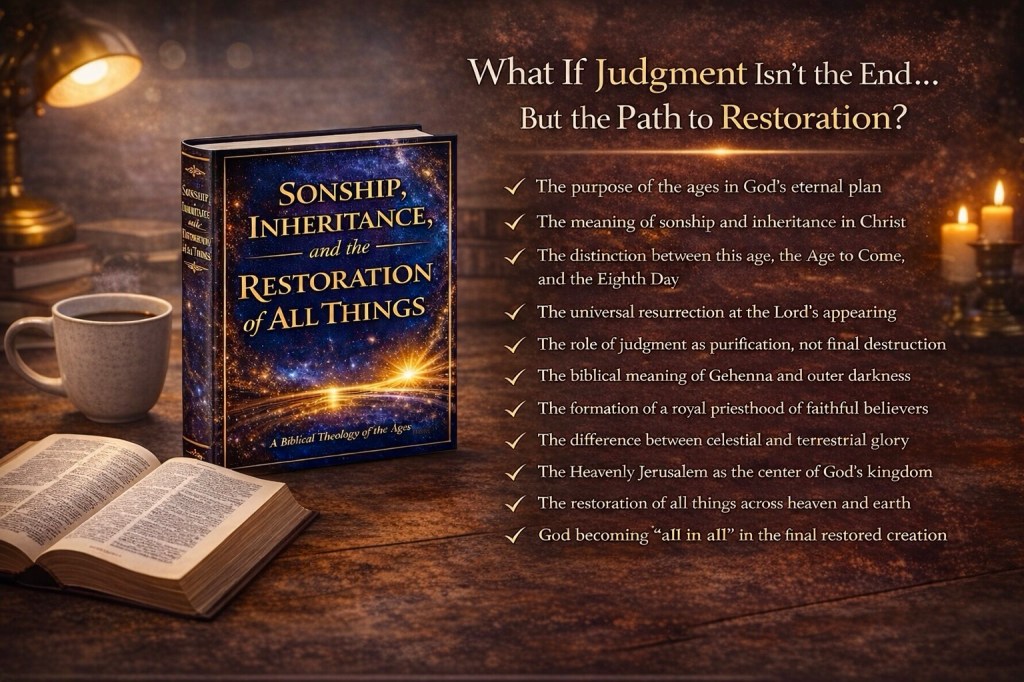
This post is drawn from the book “Sonship, Inheritance, and the Restoration of All Things: A Biblical Theology of the Ages.”
Read it free online.
https://restorationtheologypress.com.
 Restoration Theology Press