
A Controversy Built on a Missing Foundation
Few debates in the modern church generate more heat and less light than the controversy over the rapture and the resurrection. The argument is familiar. Pre-tribulationists insist that the righteous are secretly caught away before a period of global judgment, after which the Lord Jesus returns again in visible glory. Post-tribulationists insist that the church endures the tribulation before being gathered at the Lord’s return. Amillennialists and historic premillennialists staked their own positions long ago, and the lines between them have been drawn and redrawn across centuries of earnest disagreement. Charts are produced, timelines are constructed, prophecy conferences are organized, and books are written—and still the controversy persists.
What is remarkable, however, is how rarely any of these debates begin with the Lord Jesus Himself. Most of the architecture of modern eschatology is built on a single passage in the Book of Revelation—a book whose canonicity was disputed for centuries in the early church and whose literary genre makes it the least suitable foundation for doctrinal construction. A far more stable starting point presents itself in the Gospel of John, in a statement the Lord Jesus made publicly, in plain speech, without symbol or cipher. It is a statement so clear, so comprehensive, and so structurally decisive that it renders most of the rapture controversy unnecessary. It is found in John 5:28–29.
“Do not marvel at this; for the hour is coming in which all who are in the graves will hear His voice and come forth—those who have done good, to the resurrection of life, and those who have done evil, to the resurrection of judgment.”
This is not a supporting text to be fitted into a scheme built elsewhere. This is the Lord Jesus establishing the architecture of the resurrection from the ground up. Read it carefully, and the controversy begins to dissolve.
What the Lord Jesus Actually Said
The key to unlocking John 5:28–29 lies in examining precisely what the Lord Jesus said, and what He did not say.
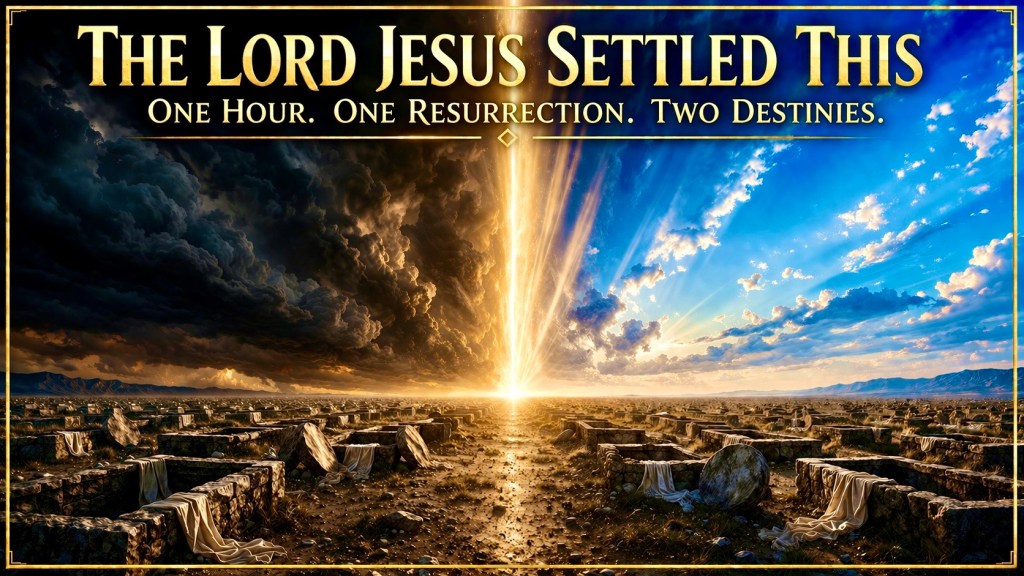
He said that the hour is coming—one hour, a single appointed moment—in which all who are in the graves will hear His voice and come forth. The Greek word translated “hour” is hōra (ὥρα), which in the Lord’s usage consistently refers to a decisive, appointed moment. He used the same word when He said, “the hour is coming, and now is, when the dead will hear the voice of the Son of God; and those who hear will live” (John 5:25). In John 5:28–29 He extends that same authority to the entirety of human history: one hour, one divine summons, one universal resurrection of all humanity.
The phrase He uses for those who rise is equally significant. The Greek reads pantes hoi en tois mnēmeiois (πάντες οἱ ἐν τοῖς μνημείοις)—”all who are in the tombs.” Not many, not most, not a select company—but all. The Lord does not qualify this universality with any chronological interval. He does not say that some will hear His voice now and others will hear it a thousand years later. He says all will come forth, and that this coming forth happens in the same appointed hour.
Within that single event, however, He immediately distinguishes two outcomes. Those who have done good rise to the resurrection of life (anastasis zōēs, ἀνάστασις ζωῆς). Those who have done evil rise to the resurrection of judgment (anastasis kriseōs, ἀνάστασις κρίσεως). The Lord’s distinction here is moral and relational, not chronological. Both groups are raised in the same hour; their destinies diverge immediately. One group enters life; the other enters judgment. The difference between them is determined not by when they rise, but by what they are—by whether their lives were defined by faithfulness or by the refusal of God’s grace.
It is worth pausing on this carefully, because the entire pre-tribulation rapture scheme rests on a chronological separation that the Lord Jesus Himself never teaches. The rapture theory requires that the righteous be raised and removed before the unrighteous face judgment—that there are, in effect, two bodily resurrections separated by a significant span of time. But the Lord says nothing of the kind. He says one hour, all the dead, two outcomes. The distinction is not in the timing but in the destiny. The Apostle Paul confirms this with a precision that should settle the matter: he charges Timothy “before God and the Lord Jesus Christ, who will judge the living and the dead at His appearing and His kingdom” (2 Timothy 4:1). The judgment is not scheduled for a millennium after His appearing. It is located precisely at His appearing. The appearing and the judgment are one event—exactly as the Lord Jesus declared in John 5:28–29.
The Lord Jesus also reveals something equally important about His own authority in this passage. Immediately before His words about the resurrection, He declares that the Father “has given Him authority to execute judgment also, because He is the Son of Man” (John 5:27). The universal resurrection is not an autonomous cosmic event; it is a judicial act carried out by the Son of Man at His appearing. He speaks, and the dead obey. Every grave in human history opens at the sound of His voice. This is why John 5:28–29 is not merely a proof text in a theological argument—it is a revelation of the person and power of the Lord Jesus as the sovereign Judge of all humanity.
The Worthy and the Unworthy: What “Resurrection of Life” Actually Means
Having established that the resurrection is one event with two outcomes, the Lord Jesus deepens the picture elsewhere in the Gospels. In the Gospel of Luke, when questioned about the resurrection, He gives a response that is theologically essential to understanding John 5:28–29 correctly. He says: “But those who are counted worthy to attain that age, and the resurrection from the dead, neither marry nor are given in marriage; nor can they die anymore, for they are equal to the angels and are sons of God, being sons of the resurrection” (Luke 20:35–36).
The Greek word rendered “counted worthy” is kataxiōthentes (καταξιωθέντες), and it is one of the most important words in the entire New Testament eschatology of the Lord Jesus. It means “deemed fit” or “judged worthy”—and it implies a divine evaluation based on the quality of a person’s life before God. Not everyone who rises is counted worthy of this particular resurrection. The resurrection of life—the resurrection into celestial glory—is reserved for those whose lives in this present age were defined by genuine faith, obedience, and endurance. It is not the automatic inheritance of every person who has ever prayed a prayer of repentance.
This point is crucial, and it resolves a confusion that runs through much of the rapture debate. The debate often assumes that the category of “the saved” is a single, undifferentiated group, all of whom will be caught up together at the same moment to the same glory. The Lord Jesus, however, draws a finer distinction. The resurrection of life is the resurrection “from among the dead”—a resurrection into celestial sonship, into bodies that neither die nor marry, into participation in the government of the age to come. This is not the destiny of every believer by default; it is the destiny of those who have been counted worthy of it.
There is a second group of believers—those who belong to Christ but whose lives did not manifest the obedience of faith—who also rise in that same hour. They rise to the resurrection of judgment. This is not the same as rising to the destruction of the ungodly, for the Lord and His Apostles consistently distinguish between the unfaithful believer and the openly ungodly pagan. But they do not rise to glory. They rise into a condition of judgment, entering an age of purifying discipline, because their lives did not accord with the grace they had received.
When John 5:28–29 is read in this full canonical context—as the Lord Jesus Himself fills it out across the Gospels—the picture becomes clear. The resurrection is universal: all rise. The resurrection of life is exclusive: only the faithful enter it. The resurrection of judgment encompasses the unfaithful and the ungodly alike. And the entire event takes place in one appointed hour at the appearing of the Son of Man.
The Out-Resurrection and the Apostolic Order
The Apostle Paul understood John 5:28–29 with a precision that is often missed in modern readings of his letters. He does not flatten the resurrection into a single undifferentiated event, nor does he introduce a second bodily resurrection separated from the first by a thousand years. What he does is draw a vital distinction within the one universal resurrection—a distinction that corresponds exactly to the Lord’s own words about the worthy and the unworthy.
In Philippians 3:11, Paul writes that his entire consuming aim is to attain “the resurrection from the dead.” The Greek here deserves close attention. Paul writes: eis tēn exanástasin tēn ek nekrōn (εἰς τὴν ἐξανάστασιν τὴν ἐκ νεκρῶν). The key word is exanástasis (ἐξανάστασις)—an intensified, compound form of the ordinary word for resurrection, literally meaning “the resurrection that is out from among the dead.” This is not Paul expressing anxiety about whether he will rise at all, as though the general resurrection were uncertain. Paul knows that all humanity rises. He is pressing toward something more specific: the out-resurrection, the resurrection of the faithful into celestial glory within the one universal event.
His surrounding language makes the nature of this goal unmistakable. He describes his pursuit in terms of a prize, a goal, an upward call: “I press on, that I may lay hold of that for which Christ Jesus has also laid hold of me… I press toward the goal for the prize of the upward call of God in Christ Jesus” (Philippians 3:12, 14). The “upward call”—hē anō klēsis (ἡ ἄνω κλῆσις)—is not the call to basic salvation, which Paul already possesses. It is the call to celestial inheritance, to the resurrection of life, to the glory of the sons and daughters who are found worthy at the appearing of the Lord Jesus. Paul is not striving to escape a general resurrection. He is striving to rise within it into the order of the faithful, to receive the celestial body suited for the throne, the court, and the Heavenly Jerusalem.
The writer of Hebrews confirms the same reality from a different angle. He speaks of those who refused release from torture so that they might “obtain a better resurrection” (Hebrews 11:35). The Greek adjective kreittōn (κρείττων), translated “better,” is a comparative—it presupposes at least two modes of resurrection. There is a resurrection, and there is a better resurrection. The better resurrection is not merely rising from the dead; it is rising into celestial glory, into the inheritance of the sons of God. Those who endured suffering rather than purchase their freedom by apostasy did so because they valued that better resurrection more than their immediate comfort. They understood what was at stake.
Paul situates this out-resurrection within a precise order in First Corinthians 15:23–24: “But each in his own order: Christ the firstfruits, afterward those who are Christ’s at His coming. Then comes the end.” The Greek word translated “order” is tagma (τάγμα), a military term denoting a company or rank. The resurrection unfolds in ordered ranks. Christ rises first as the firstfruits—the prototype whose resurrection defines the nature of the resurrection body the faithful will receive. Then, at His appearing, those who are His are raised and glorified. Between that moment and the final consummation lies the entire span of the age to come—the Seventh Day—in which those who rose to the resurrection of judgment face the fires of divine correction. The Lord Jesus taught that both body and soul are destroyed in Gehenna (Matthew 10:28), and that this destruction is not the end of the person but the end of their Adamic corruption. The mortal body returns to dust; the corrupted soul meets its sentence; and the spirit, freed from the defilement of the old nature, returns to God who gave it (Ecclesiastes 12:7). This is not annihilation—it is the severe but purposeful work of a God who judges in order to restore. Only after this age-long purging of all that is Adamic and corrupt does the final rank arrive. Then comes “the end”—to telos (τὸ τέλος), the consummation—the resurrection of all remaining humanity at the dawn of the Eighth Day, when death, the last enemy, is abolished, every spirit is clothed with incorruptible terrestrial life, and God becomes all in all (1 Corinthians 15:26–28).
Three ranks. Three moments in the unfolding of the resurrection across the ages. But crucially, the resurrection of the faithful and the resurrection of judgment belong to the same appearing, the same day, the same hour—just as the Lord Jesus taught. What is “ordered” in Paul’s tagma is not a separation by ages between the righteous and the unrighteous at the appearing; it is the distinction between the resurrection of the faithful at the appearing, and the resurrection of all remaining humanity at the close of the age to come.
One Appearing, One Resurrection, One Trumpet, One Court
If John 5:28–29 establishes the architecture, the Apostolic writings supply the details of its execution. When all of these texts are assembled and read in their proper relationship to one another, an integrated, coherent sequence emerges—one that requires no rapture theory, no two resurrections separated by a millennium, and no speculative construction drawn from apocalyptic imagery. The sequence is as follows.
At the appearing of the Lord Jesus—sudden, unexpected, breaking into the ordinary rhythms of human life as Noah’s flood broke into the days before it—the heavens of this present creation are dissolved and the veil between the seen and unseen realms is removed. At that moment, His voice sounds over the graves of the entire earth, and all who are in the tombs hear it and come forth. This is the universal resurrection of John 5:28–29. The Greek verb ekporeusontai—”to come forth,” “to emerge”—describes the act of exiting the grave, not ascending into heaven. All rise in mortal, resurrected bodies. The faithful, the unfaithful, and the ungodly all stand again upon the earth, fulfilling Paul’s testimony before Felix that he believed in “a resurrection of the dead, both of the just and the unjust” (Acts 24:15). The voice of the Son of Man initiates the resurrection; it does not yet confer immortality or glory.
Immediately following the universal resurrection, the last trumpet sounds. Paul writes: “We shall not all sleep, but we shall all be changed—in a moment, in the twinkling of an eye, at the last trumpet” (First Corinthians 15:51–52). At this trumpet, and only at this trumpet, the faithful receive their transformation. The Greek verb he uses for resurrection, egeirō(ἐγείρω), means “to raise up” or “to stand” but carries no implication of glorification. The verb he uses for transformation, allagēsometha (ἀλλαγησόμεθα), means “we shall be changed”—a fundamentally different kind of act, granted only to those who belong to Christ in faithfulness. The voice raises all; the trumpet transforms the faithful. These are not the same event described twice; they are two stages of the same divine command occurring in immediate succession.
When Paul writes in First Thessalonians 4:16 that “the Lord Himself will descend from heaven with a shout, with the voice of an archangel, and with the trumpet of God,” he is describing three dimensions of one heavenly command, not three separate chronological events. The royal shout dispatches the heavenly hosts; the voice of the archangel raises all the dead; and the trumpet of God clothes the faithful with immortality. Paul’s statement that “the dead in Christ will rise first” does not contradict the Lord’s declaration of a universal resurrection in one hour. Rather, Paul is describing the order of heavenly ascent that follows the universal rising. At the last trumpet, all the faithful—both the dead and the living—are simultaneously transformed and glorified in a moment, in the twinkling of an eye. But the ascent follows a precise order: the faithful dead rise to the Lord first, and then the faithful who are alive at His appearing are caught up after them, together meeting the Lord in the air. Their rising ‘first’ is not first out of the tomb ahead of the ungodly; it is first into the air, first into the presence of the Lord.
After the faithful ascend to meet the Lord, the heavenly court is convened. This is not a detail invented by later theology; it is precisely what the Lord Jesus taught when He said that at the end of the age the angels would “gather out of His kingdom all things that offend, and those who practice lawlessness, and cast them into the furnace of fire” (Matthew 13:41–42). The tares are bound and gathered for judgment; the wheat is brought into the barn. Again, Paul confirms this pattern in Second Timothy 4:1, where he charges Timothy before God and “the Lord Jesus Christ, who will judge the living and the dead at His appearing and His kingdom.” The judgment of the living and the dead is not separated from the appearing; it takes place at the appearing, at that same decisive moment.
This is the Apostolic order, preserved intact across every letter, every theological argument in the New Testament: one appearing, one universal resurrection, one trumpet of transformation for the faithful, one court session at which the destinies of all humanity are adjudicated. Nowhere in this order is there room for a secret preliminary catching away of the righteous before the general resurrection. Nowhere is there a gap of centuries between the rising of the just and the rising of the unjust. The Lord Jesus said one hour; the Apostles confirmed one resurrection event with two immediate outcomes. The framework is complete, and it stands without any assistance from later apocalyptic construction.
Why Two Resurrections Separated by Ages Cannot Stand
At this point, the most common objection must be named directly. The primary scriptural support for two bodily resurrections separated by a lengthy interval comes from the twentieth chapter of the Book of Revelation, which speaks of a “first resurrection” and then states that “the rest of the dead did not live again until the thousand years were finished” (Revelation 20:4–6). Entire systems of eschatology—pre-tribulationism, many forms of premillennialism—are built on this structure. If Revelation 20 is taken as the architectural text for the resurrection, then the Lord’s “one hour” in John 5 must be reinterpreted, Paul’s “resurrection of the just and the unjust” in Acts 24:15 must be qualified, and First Corinthians 15’s seamless order must be divided.
The problem with this approach is that Revelation is the wrong text to place at the center of the resurrection doctrine. The canonical order matters. The Lord Jesus speaks first and most authoritatively about the resurrection. The Prophets anticipate it. The Apostolic epistles expound what the Lord established. Revelation belongs to a disputed apocalyptic genre whose canonical reception in the early church was far more contested than most contemporary Christians realize. The churches of Syria, Cappadocia, and much of the East did not receive it as Scripture for centuries. Cyril of Jerusalem excluded it from his list of canonical books. The great Antiochene theologians were deeply cautious about it. When the church finally settled on its canon, Revelation was the most disputed text in the New Testament.
The literary genre of apocalyptic literature matters here as well. Apocalyptic writings use symbolic numbers, composite imagery assembled from fragments of older prophetic texts, personified abstractions, and visionary sequences that are not intended to function as a chronological timetable. To extract from Revelation 20 a two-stage resurrection separated by a thousand years, and then use that scheme to reinterpret the plain statement of the Lord Jesus in John 5:28–29, is to allow the most uncertain text in the canon to override the clearest.
When there is an apparent conflict between the explicit teaching of the Lord Jesus and the symbolic imagery of a disputed apocalyptic vision, canonical order demands that the Lord’s words govern and the vision yield. The Lord Jesus declared one hour, all the dead, two outcomes. That declaration stands. Any scheme that introduces a chronological separation of centuries between the resurrection of the righteous and the resurrection of the unrighteous must answer, first and finally, to the voice of the Son of Man Himself.
Conclusion: What John 5:28–29 Gives You
John 5:28–29 gives the church something more valuable than a winning argument in an eschatological debate. It gives the church its foundation—the sure word of the Lord Jesus about what awaits every human being on the other side of death, and about the nature of the judgment that stands at the threshold of the age to come.
It tells you that the resurrection is universal. No one escapes it. Every generation of humanity—from Adam to the last accountable soul before the Lord’s appearing—will stand before the Son of Man and hear His verdict. Death is not the end of the story for anyone. The graves open, and the human family rises.
It tells you that the resurrection of life is not automatic. It belongs to those who have done good—to those whose lives in this present age were defined by genuine faith working through love, by the crucifixion of the flesh, by obedience to the Lord Jesus in the power of the Spirit. The out-resurrection, the better resurrection, the resurrection into celestial glory and priestly sonship—this is the prize toward which Paul pressed with every ounce of his apostolic energy. It is not a prize distributed to the indifferent.
It tells you that judgment is real and immediate. Those who rise to the resurrection of judgment do not rise to annihilation; they rise to face the consequences of lives lived in the refusal of grace. The Lord Jesus was not cruel when He taught this. He was honest, and His honesty is the greatest act of pastoral kindness in human history. He told us what is coming so that we might live accordingly now, in this present age, while the Spirit of grace is still at work among us.
And it tells you that the Lord Jesus is the sovereign center of everything. He is the One who executes judgment because He is the Son of Man. He is the One whose voice commands the graves. He is the One before whom every human soul will stand. The rapture controversy, in all its intricate detail, often manages to make eschatology about charts and timelines and sequences of events—and in doing so it takes the eyes of the church off the Person. John 5:28–29 restores the focus. The resurrection is not primarily a doctrine about what happens to bodies. It is a revelation of who the Lord Jesus is and what He will do when the hour appointed by the Father finally arrives.
Press toward that hour well. The out-resurrection is the prize. The faithful are those who do not merely receive forgiveness and stop there, but who yield to the Spirit, pursue holiness, and endure to the end. In that appointed hour, when His voice sounds over all the graves of the earth, the lives of the faithful will be openly declared. That is the day worth living for.
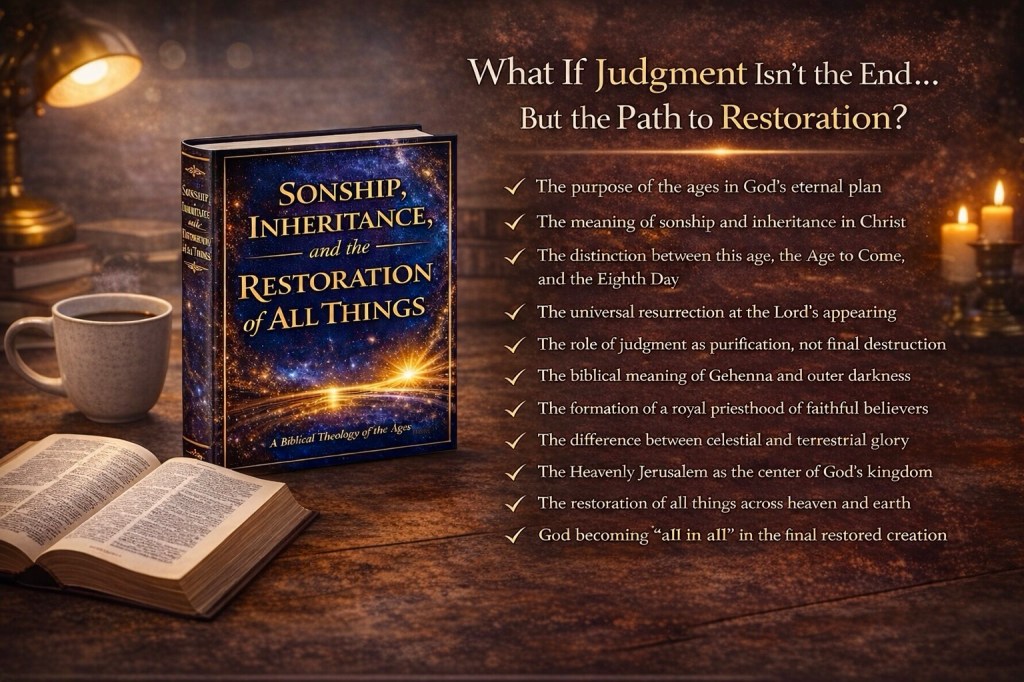
This teaching draws from Chapter 18 of “Sonship, Inheritance, and the Restoration of All Things: A Biblical Theology of the Ages”.
Available to read free:
https://restorationtheologypress.com
 Restoration Theology Press