
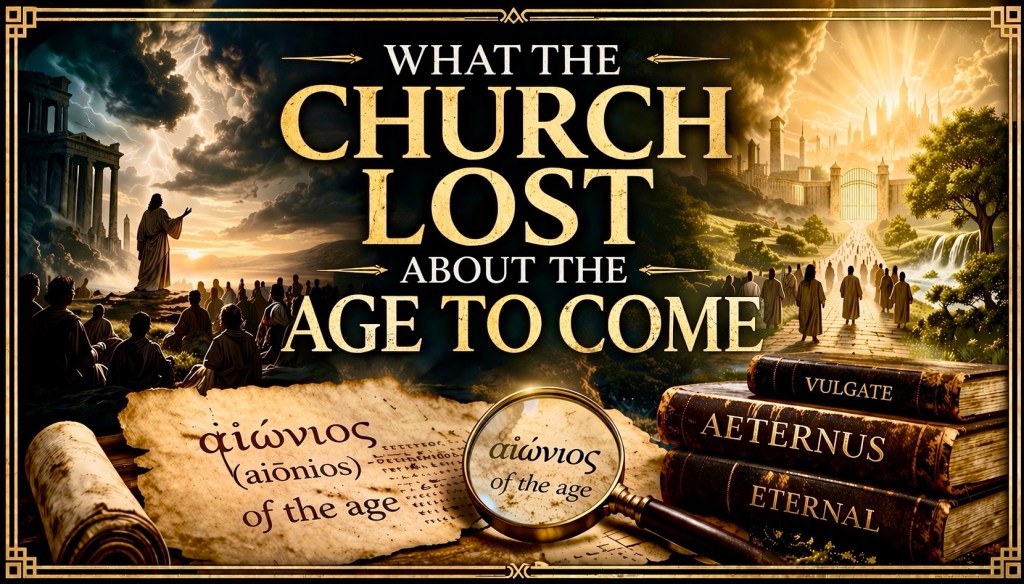
There is a word in the New Testament that has been quietly mistranslated for over a thousand years. It appears in some of the most important sentences the Lord Jesus ever spoke. It shapes how billions of people understand judgment, life, death, and the final destiny of the human race. And because it has been consistently rendered into English through a Latin lens rather than a Greek one, the actual structure of what the Lord Jesus taught about the coming age has largely vanished from the church’s consciousness.
The word is aiōnios (αἰώνιος).
When you read “eternal life” or “everlasting punishment” in your English New Testament, you are reading a translation that passed through Latin before it reached you. The Greek adjective aiōnios does not mean “endless” in the philosophical sense. It means “of the age”—belonging to, characterizing, and defining a particular age in God’s ordered purpose. It is built on the noun aiōn (αἰών), which simply means “age”: a bounded, structured period in the administration of God.
This is not a technicality invented to soften difficult texts. It is the ordinary lexical meaning of the word, recognized in Greek scholarship and reflected in several literal academic translations. The New Testament writers had access to another adjective—aidios (ἀΐδιος)—when they wished to describe what is truly eternal in the absolute sense, beyond all ages. Paul uses aidios of God’s “eternal power” (Romans 1:20). Jude uses it of the “everlasting chains” that hold the fallen angels until the Day of Judgment (Jude 6). These chains are aidios: they belong to God’s own sustaining power and do not expire. But when those same writers describe the life and the punishment of the coming age, they do not use aidios. They use aiōnios—the word that tethers both realities to a specific age that God has appointed.
The shift occurred in stages. Hebrew had its own age-word—ʿôlām (עוֹלָם)—which the Greek translators rendered faithfully as aiōnios. That was well. But when Latin theologians, above all Augustine, rendered aiōnios as aeternus, the age-structure was lost. Latin aeternus carries the sense of absolute, unqualified endlessness; it does not distinguish between “belonging to an age” and “without any end whatsoever.” From aeternus the word passed into the vernacular languages of Europe as “eternal” and “everlasting,” and by the time the English church received it, “eternal punishment” sounded indistinguishable from “punishment that never ends.” What the Lord Jesus had said—punishment of the age—had become, through no one’s deliberate malice but through centuries of translation drift, punishment without end.
Once that shift took hold, the result was an eschatology built not on the Lord’s own framework but on a Latin philosophical category that flattened the ages into an undifferentiated eternity. Two distortions emerged—one at each extreme. On one side, judgment became a realm of conscious torment stretching without limit, with no purpose, no horizon, and no final resolution. On the other side, a reaction arose that dissolved judgment altogether into a general, costless forgiveness that required nothing of anyone in this present life. Both positions, despite their apparent opposition, share the same root error: neither is working with the Lord’s own age-structured framework.
When the language of the ages is restored, the Lord’s teaching comes into sharp focus again. And what He taught is far more serious, far more concrete, and far more purposeful than either of those alternatives.
This Age and the Age to Come: The Lord’s Own Framework
The Lord Jesus consistently teaches from within a two-age framework. There is this age—marked by sin, death, satanic influence, and the co-existence of wheat and tares (Galatians 1:4; 2 Corinthians 4:4). And there is the Age to Come—marked by resurrection, open judgment, and the manifested rule of God. These are not vague religious concepts. They are the architecture of history as the Lord Himself describes it.
He speaks of sins that will not be forgiven “in this age nor in the Age to Come” (Matthew 12:32), implying a real distinction between the two. He promises to those who follow Him the reception of “life in the Age to Come” (Mark 10:30; Luke 18:30). He speaks of those “counted worthy to attain that age and the resurrection from the dead” (Luke 20:35), using language that presupposes not everyone will attain it. He identifies “the harvest” of the wheat-and-tares parable as “the end of this age” (Matthew 13:39, literal), making the transition between this age and the next the decisive moment of reckoning.
This framework did not originate with the Lord Jesus. He was drawing upon a pattern that the Torah had already inscribed into the fabric of Israel’s life. The creation week—six days of labor followed by a sanctified seventh—was never merely a schedule. It was a prophetic grammar (Genesis 2:1–3; Hebrews 4:4–9). The Torah extended the sabbath principle outward: every seventh year the land rested and debts were released (Leviticus 25:1–7; Deuteronomy 15:1–6); after seven cycles of seven years, the fiftieth Jubilee was proclaimed—a year of liberty, restoration, and return to inheritance (Leviticus 25:8–13). These structures were the Torah’s own way of teaching that history moves in ordered ages, that labor and testing give way to rest and reckoning, and that the present season of sowing will eventually yield to a harvest age.
The Prophets took this Torah pattern and projected it onto the largest horizon: the Day of the LORD. Joel sees it as a day of darkness before which fire devours and behind which a flame burns—yet the same prophecy promises the outpouring of the Spirit on all flesh afterward (Joel 2:1–3, 28). Isaiah sees the dissolution of the present heavens and the appearing of new heavens and a new earth (Isaiah 65:17; 34:4). The Prophets consistently describe a sequence: judgment first, then a new age of restoration that judgment makes possible. There is no timeless “eternity” in their vocabulary. There is a present age, a coming Day of the LORD, and beyond it a new creation. This is the structure the Lord Jesus inherits and brings to its fullness.
The Age to Come in this framework is the great sabbath Day of the Lord that begins at the appearing of the Lord Jesus and the universal resurrection. It is the age in which judgment is openly administered, in which the faithful enter into their inheritance and celestial glory (Luke 20:35–36; Philippians 3:20–21), and in which the unfaithful and the ungodly undergo the consequences of how they lived in this present age. Beyond it lies the Eighth Day—the new creation age in which death is abolished, all things are reconciled in Christ, and God becomes all in all (1 Corinthians 15:24–28; Colossians 1:20; Acts 3:21).
Understanding this sequence changes everything about how we read the Lord’s warnings—and His promises.
What the Lord Jesus Actually Said: Aiōnios Life and Aiōnios Punishment
The most contested text in this discussion is Matthew 25:46: “And these will go away into the punishment of the age, but the righteous into the life of the age” (literal). The standard objection goes like this: since both destinations are described with the same adjective aiōnios, if the punishment is not endless, then neither is the life.
The observation about parallelism is correct. But the conclusion drawn from it is not. The parallelism in aiōnios means that both life and punishment belong to and define the same coming age. Both are equally real, equally certain, and equally weighty within that age. The adjective does not specify what happens beyond that age; it locates both realities within it.
The duration and outcome of each is then determined by the nature of the thing itself, not by the bare adjective. Life “of the age”—zōē aiōnios (ζωὴ αἰώνιος)—does not end, because it is participation in the life of the One who is Himself the Life (John 11:25; 14:6). The only power that could interrupt it—death—is abolished at the close of the Seventh Day (1 Corinthians 15:26). The life continues because of what it is, not because aiōnios means “endless.” Punishment “of the age”—kolasis aiōnios (κόλασις αἰώνιος)—is the consuming of what is contrary to God’s life. Its duration is determined by what must be purified. When the last enemy is destroyed and God becomes all in all, there is no rival kingdom of unreconciled punishment standing alongside the new creation (1 Corinthians 15:24–28; Acts 3:21). The age of judgment has accomplished its task.
There is also a word-choice within Matthew 25:46 that deserves attention. The noun the Lord uses for “punishment” is kolasis (κόλασις), not timōria (τιμωρία). In classical Greek usage, these two words were carefully distinguished. Timōriawas retributive punishment: the satisfaction of the one offended, punishment aimed at meeting the demands of justice on behalf of the punisher. Kolasis was corrective punishment: discipline aimed at the reformation and eventual good of the one being punished. It is the word used of pruning a vine to make it fruitful—precisely the image the Lord Himself uses in John 15:2, where the Father “prunes” every branch that it may bear more fruit. That the Lord chose kolasis—not timōria—is a lexical decision of real significance. The punishment He describes is not an act of divine revenge sustained without end; it is corrective, purposeful discipline located in the coming age, serving the larger goal of God’s restoration of all things.
The Parables Are Parables of the Age to Come
Perhaps the most neglected implication of recovering this age-framework is what it does to the parables. The Lord Jesus did not speak His parables to humanity in general. He spoke them specifically about the boundary between this age and the next—about what happens at His appearing, at the universal resurrection, at the harvest of the age.
Every major parable of the kingdom is set at this threshold. The wise and foolish virgins both belong to the company of those who await the bridegroom—covenant insiders, not strangers. Five are ready; five are not. The door is shut. This is not a parable about who goes to heaven after death; it is a parable about which believers, at the Lord’s appearing, are found ready to enter the joy of the Age to Come (Matthew 25:1–13). The faithful and wicked servants are both servants within the same household. Both were entrusted with oversight. But the faithful servant, found doing his master’s will, is placed over all his goods; the wicked servant, who abused his position, is cut in two and assigned his portion with the unfaithful (Matthew 24:45–51). Again: this is judgment at the appearing of the Lord, not a sorting of believers versus unbelievers at death. The parable of the talents operates identically. Two faithful servants double what was entrusted and hear “Well done, good and faithful servant; enter into the joy of your lord.” The unprofitable servant, who buried what was given out of fear and sloth, is cast into outer darkness—”there will be weeping and gnashing of teeth” (Matthew 25:14–30).
The outer darkness is not annihilation. The weeping and gnashing of teeth is not endless torment stretched into a philosophical eternity. It is the experience of the Age to Come for those who failed to be faithful in this age—the exclusion from the firstborn inheritance, the loss of the celestial glory, the entrance into the judgment of the Seventh Day. The servant is not destroyed; he is chastened (Hebrews 12:6–11). But the loss is real, the exclusion is real, and the severity is real. The Lord tells these stories not to provide comfort to the careless but to produce holy fear, faithful endurance, and urgent obedience in those who hear Him.
The parable of the wheat and tares makes the age-structure explicit. The Lord interprets it Himself: “The harvest is the end of this age” (Matthew 13:39, literal). The angels gather the tares and burn them; the righteous shine forth as the sun in the kingdom of their Father (Matthew 13:41–43). The shining of the righteous is their celestial glory in the Age to Come. The burning of the tares is the Seventh Day judgment of those whose lives, sown in unrighteousness, yielded a harvest of corruption. Both outcomes are the harvest of what was sown in this present age. The parable is a parable about this age and the Age to Come—not about heaven and hell as abstract eternal destinations.
When we lose the two-age framework, the parables become uninterpretable. Who are the five foolish virgins? Where exactly do the unprofitable servants go? What is the outer darkness? These questions have no satisfying answer within the eternal-torment system, and they have no answer at all within a system that dismisses judgment as merely metaphorical. But within the Lord’s own framework—this age of sowing, the Age to Come as harvest—every parable finds its place and every outcome finds its logic.
Sowing and Reaping: The Bridge Between This Age and the Next
The Lord’s two-age framework is not a speculative theological structure for academic discussion. It is the architecture that gives daily life its ultimate weight. Because the Age to Come is the harvest of what is sown in this age, nothing in this present life is theologically neutral.
Paul states the principle as plainly as it can be stated: “Do not be deceived, God is not mocked; for whatever a man sows, that he will also reap. For he who sows to his flesh will of the flesh reap corruption, but he who sows to the Spirit will of the Spirit reap life of the age” (Galatians 6:7–8, literal). The phrase “life of the age” is zōē aiōnios—the same phrase the Lord uses in John 3:16. Paul is saying that sowing to the Spirit now is what produces the harvest of life in the Age to Come. And sowing to the flesh produces the harvest of corruption in that same coming age. The Age to Come is the harvest-field; this present age is the sowing-season.
The Lord reinforces this in the Sermon on the Mount: “Enter by the narrow gate; for wide is the gate and broad is the way that leads to destruction, and there are many who go in by it. Because narrow is the gate and difficult is the way which leads to life, and there are few who find it” (Matthew 7:13–14). The destruction He warns of is not abstract; it is the loss of the soul in the Age to Come (Matthew 10:28). The life He promises is not a vague hereafter; it is life in the Age to Come—attained through the narrow way of obedience, endurance, and cooperation with the Holy Spirit in this present age.
This is the very connection that the church has most needed and most often missed. The loss of the two-age framework did not merely produce a confused eschatology. It severed the living nerve that connects the daily choices of believers to their portion in the coming age. When “eternal life” sounds like a static destination granted once and secured forever regardless of how one lives, the Lord’s warnings become irrelevant background noise. But when “life of the age” is understood as the harvest of what is sown now—through obedience, through the cross, through cooperation with the Spirit’s work of forming Christ within the soul (Galatians 4:19; Romans 8:29)—then every day of this present age carries eschatological weight. Every act of faithfulness is a seed sown toward the resurrection of life. Every act of compromise is a seed sown toward the resurrection of judgment.
The Holy Spirit, in this light, is not merely the guarantee of heaven after death. He is the firstfruits of the Age to Come already at work within the believer. Hebrews speaks of those who “have tasted the heavenly gift, and have become partakers of the Holy Spirit, and have tasted the good word of God and the powers of the Age to Come” (Hebrews 6:4–5). Paul calls the Spirit the arrabōn (ἀρραβών)—the down payment, the pledge, the guarantee of the inheritance to come (2 Corinthians 1:22; 5:5; Ephesians 1:13–14). The Spirit’s present work—convicting, forming, sanctifying, renewing—is the Age to Come breaking into this present age in advance. Those who yield to His work are being made ready for the harvest. Those who resist are storing up a different kind of harvest for the coming Day (Romans 2:5).
What the Restoration of All Things Does Not Abolish
At this point a question will arise in the mind of every honest reader—and it should be answered honestly.
If the Scriptures teach the Restoration of All Things (Acts 3:21)—if Paul declares that God will be “all in all” (1 Corinthians 15:28), that all things in heaven and on earth will be reconciled in Christ (Colossians 1:20), and that every knee will bow and every tongue confess that Jesus Christ is Lord (Philippians 2:10–11)—does this not dissolve the urgency of the Lord’s warnings? If everyone is eventually restored, does it matter what we do in this age?
The answer of Scripture is clear: the certainty of God’s ultimate restoration does not abolish the severity or the reality of the Age to Come’s judgment. It frames it. Judgment is not the final word—but it is an absolutely real and searching word on the way to the final one. The Torah already understood this. The curses of Leviticus 26 are among the most devastating passages in all of Scripture—yet the same chapter ends with the promise: “Yet for all that, when they are in the land of their enemies, I will not cast them away, nor shall I abhor them, to utterly destroy them and break My covenant with them; for I am the LORD their God” (Leviticus 26:44). Judgment operates within the covenant, not against it. Its goal is restoration, not extinction. But the judgment itself is real, measured, and unavoidable for those who refuse the light they have been given.
The Lord Jesus holds both truths simultaneously without apology. He warns of destruction, outer darkness, the loss of the soul, and the fire that destroys both soul and body in Gehenna (Matthew 10:28; 5:29–30). Paul declares that God ‘desires all men to be saved and to come to the knowledge of the truth’ (1 Timothy 2:4). He does not resolve this tension by softening the judgment or qualifying the restoration. He holds both in their full force, because both serve the same God whose purpose is to bring all things, in their proper order and time, into reconciliation through the cross of His Son (Colossians 1:19–20).
What the Age to Come settles, then, is not whether God will ultimately be victorious over death and corruption—He will (1 Corinthians 15:54–57). What the Age to Come settles is each person’s portion within God’s ordered purpose. The faithful who have sown to the Spirit, who have cooperated with grace, and who have allowed the cross to do its work in the soul will enter the resurrection of life. They will receive celestial bodies and take their place in the firstborn inheritance (Philippians 3:20–21; Romans 8:23). The unfaithful and the ungodly will enter the resurrection of judgment. The consequences they meet in the Age to Come are real, severe, and proportionate to what was sown in this age (Romans 2:5–9; Luke 12:47–48). They are also finite, purposeful, and bounded by the mercy that designed the ages in the first place.
The God of the Bible is not the god of endless torment who sustains the wicked in conscious misery for philosophical infinity. Nor is He the benign deity of costless universalism who winks at faithlessness and delivers everyone to identical bliss regardless of the harvest they have sown. He is the God who works through ordered ages, who judges within a purpose, whose fires serve a restoration, and whose final word over all creation is life—but whose penultimate word to His people in this age is urgency: choose life, that you and your descendants may live (Deuteronomy 30:19).
The Question This Leaves With Each of Us
The Lord Jesus taught in the language of the ages because that language carries the full weight of what is at stake. He was not speaking of a vague “eternity” beyond this life. He was speaking of a concrete age—the age that begins at His appearing, when the universal resurrection divides all who are in the graves into two companies: those who have done good, to the resurrection of life, and those who have done evil, to the resurrection of judgment (John 5:28–29).
That coming age is the harvest of this one. What is sown here is reaped there. What is formed in the soul by the Spirit’s work now is the body glorified in the resurrection of life then (Romans 8:11; 1 Corinthians 15:42–44). What is left unformed—the Adamic soul-life that refused the cross—will meet the fires of the Seventh Day, which accomplish by severity what grace would have accomplished by gentleness (Hebrews 12:29).
This is not a new theology invented by creative exegetes. It is the theology the Lord Jesus taught before the church received a Latin Bible, before the age-structure of the Greek text was flattened into aeternus, and before the parables of the kingdom were stripped of the two-age framework that gives them their meaning. It is the eschatology that makes every parable coherent, every apostolic warning urgent, and every present-day act of faithfulness or faithlessness eternally significant.
The question the Lord’s teaching leaves with each of us is not “Will I be saved?” as though salvation were a single past event that settles everything. The question the Lord actually asks is: What are you sowing in this age, and what harvest will you bring into the Age to Come?
The age is short. The harvest is certain. The Lord who taught these things is coming.
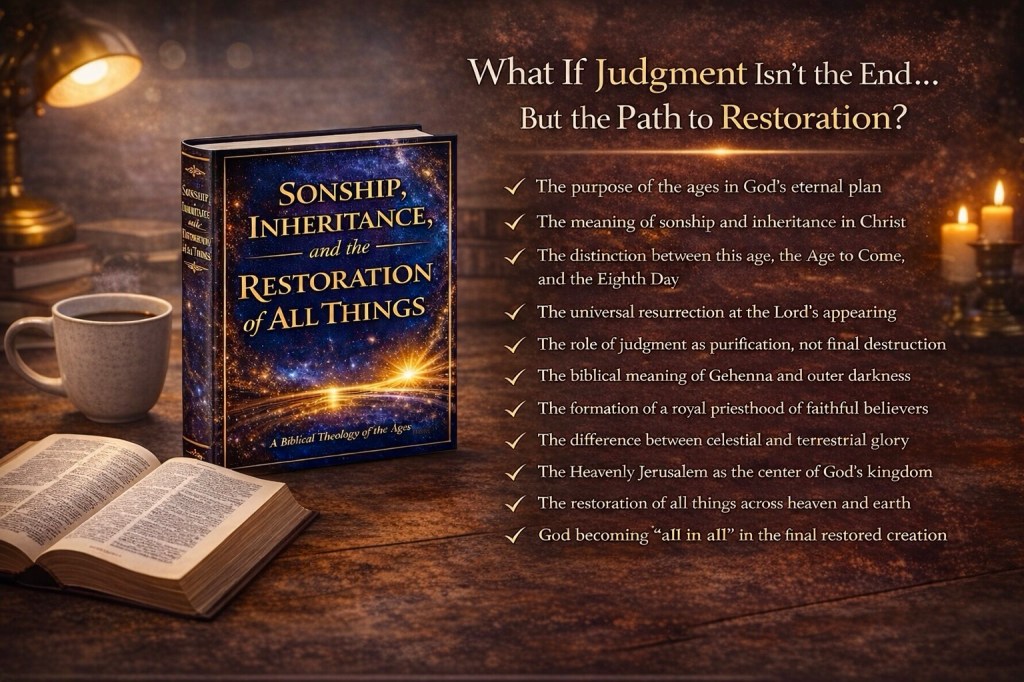
This teaching draws from the biblical theology developed in Sonship, Inheritance, and the Restoration of All Things: A Biblical Theology of the Ages.
Available to read free online:
https://restorationtheologypress.com
 Restoration Theology Press