
Updated 6/28/2026
Introduction: What the Fire Actually Tests
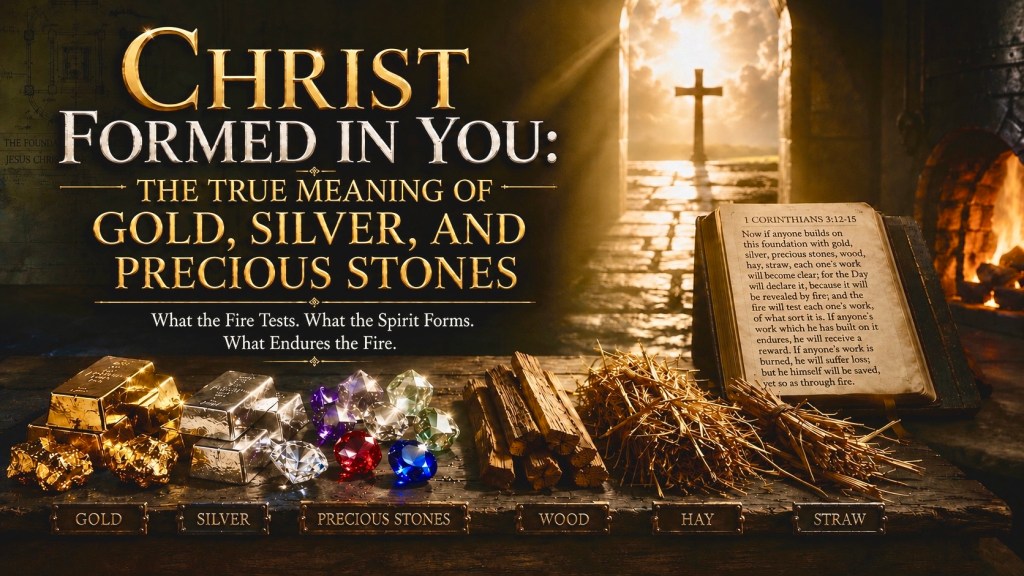
Most believers have heard a sermon on 1 Corinthians 3:12–15 at some point in their walk. The Apostle Paul writes: “Now if anyone builds on this foundation with gold, silver, precious stones, wood, hay, straw, each one’s work will become clear; for the Day will declare it, because it will be revealed by fire; and the fire will test each one’s work, of what sort it is. If anyone’s work which he has built on it endures, he will receive a reward. If anyone’s work is burned, he will suffer loss; but he himself will be saved, yet so as through fire” (1 Corinthians 3:12–15).
The typical teaching reduces these materials to a checklist of external behaviors—good deeds versus bad deeds, faithful service versus wasted time, spiritual activities versus worldly pursuits. Under this reading, the gold is your Bible study attendance and your charitable giving; the straw is your Netflix habit and your worldly ambitions. The fire comes, the good deeds survive, the bad deeds are burned, and the believer walks away with whatever reward is left over.
That reading is not wrong in every respect, but it is dangerously shallow. It turns Paul’s warning into a kind of spiritual accounting exercise—a tally sheet of behaviors sorted into two columns. What it misses entirely is what the rest of Scripture reveals about these images. When we follow the canonical thread from the Lord Jesus through the Apostles, a far deeper and more searching picture emerges. The building materials do not merely describe what the believer does. They describe what the believer becomes—the substance of the inner life, the character of the heart that is being formed on the foundation of Christ. Gold, silver, and precious stones are the evidence that Christ has been formed within. Wood, hay, and straw are the evidence that He has not.
The Soil Determines the Harvest
The Lord Jesus laid the groundwork for understanding this distinction long before Paul wrote to the Corinthians. In the Parable of the Sower, He describes four kinds of soil that receive the same seed—the word of the kingdom—and produce radically different results.
“But he who received the seed on stony places, this is he who hears the word and immediately receives it with joy; yet he has no root in himself, but endures only for a while. For when tribulation or persecution arises because of the word, immediately he stumbles. Now he who received seed among the thorns is he who hears the word, and the cares of this world and the deceitfulness of riches choke the word, and he becomes unfruitful. But he who received seed on the good ground is he who hears the word and understands it, who indeed bears fruit and produces: some a hundredfold, some sixty, some thirty” (Matthew 13:20–23).
Notice that the seed is always the same. The word of the kingdom does not change from soil to soil. What changes is the condition of the heart that receives it. The stony ground receives the word with genuine joy, but there is no depth—no root in the soul, no willingness to endure suffering for the word’s sake. The thorny ground receives the word as well, but the cares of this world and the deceitfulness of riches choke out whatever growth begins. Only the good ground—the heart that hears, understands, and perseveres—produces the lasting fruit of the kingdom.
The connection to Paul’s building materials is direct. The good soil produces gold, silver, and precious stones: the enduring character of Christ formed through understanding, obedience, and perseverance. The stony soil produces wood—real growth for a season, but shallow, rootless, and unable to withstand pressure. The thorny soil produces hay and straw—growth that was choked by competing loyalties, a divided heart that tried to serve both the kingdom and the age. In every case, the seed was genuine. The foundation was real. But what grew from it—what was built upon it—depended entirely on the condition of the soul.
This is the first and most fundamental lesson: the materials that Paul describes are not merely deeds added on top of a foundation. They are the organic harvest of a soul’s response to the word of God. The question is not “What did you do?” but “What kind of soil were you?”
Abiding: The Source of What Endures
The Lord Jesus takes this teaching deeper still in John 15. Here the image shifts from soil to vine, but the principle is the same—and the stakes are made even more explicit.
“I am the vine, you are the branches. He who abides in Me, and I in him, bears much fruit; for without Me you can do nothing. If anyone does not abide in Me, he is cast out as a branch and is withered; and they gather them and throw them into the fire, and they are burned” (John 15:5–6).
The Greek verb menō (μένω), translated “abide,” means to remain, to stay, to dwell. It describes not a one-time decision but a continual posture—the daily, moment-by-moment dependence of the branch upon the vine for its very life. Without the vine, the branch can do nothing. Not “very little.” Not “less than it might.” Nothing. Every particle of genuine fruit—the gold and silver, every precious stone—comes from the life of Christ flowing through a branch that remains connected to Him.
This means that gold, silver, and precious stones are not produced by human effort, talent, or religious energy. They are the fruit of abiding. They grow in the life of a believer who remains in Christ through trust, obedience, prayer, and yielded dependence on the Spirit. They are what the soul looks like when the life of the vine has been flowing through it unhindered—when the believer has been drawing sustenance not from his own resources but from Christ Himself.
Wood, hay, and straw, by contrast, are what the branch produces when it ceases to abide—when it attempts to bear fruit in its own energy, from its own reserves, apart from the living sap of the vine. The result may look like productivity for a time. A branch can put out leaves even after it has been severed, for a little while. But the material it produces is dead. It has no life of Christ in it. And the fire will expose its emptiness.
The Lord also reveals in this passage how the Father works to prevent the accumulation of worthless material in a life that is abiding: “Every branch in Me that does not bear fruit He takes away; and every branch that bears fruit He prunes, that it may bear more fruit” (John 15:2). The Father’s pruning—His discipline, His cutting away of what hinders fruitfulness—is the gracious provision by which He removes wood, hay, and straw from the believer’s life in this age, before the fire of the coming Day makes its own assessment. The pruning knife is painful, but it is incomparably gentler than the fire. Those who welcome the Father’s pruning in this age are being spared the severer testing of the age to come.
What Is Actually Being Formed
If the soil determines the harvest and abiding is the source of what endures, then what exactly are gold, silver, and precious stones? Paul gives us the answer in a passage that is rarely connected to 1 Corinthians 3, but which unlocks its deepest meaning.
Writing to the Galatians, Paul says: “My little children, for whom I labor in birth again until Christ is formed in you” (Galatians 4:19). The Greek verb morphoō (μορφόω) means to give shape, to form from within. Paul is not laboring until the Galatians behave better or attend more meetings or increase their giving. He is laboring until Christ’s own nature—His character, His mind, His holiness, His love—takes shape in the interior of their being. This is not external conformity. It is internal transformation.
But what is the mechanism by which Christ is formed within? The Apostolic witness reveals that when a person is begotten, God plants an incorruptible seed in the believer’s spirit—“not of corruptible seed but incorruptible, through the word of God which lives and abides forever” (1 Peter 1:23). John makes the source explicit: “Whoever has been born of God does not sin, for His seed remains in him” (1 John 3:9). The word “seed” is sperma (σπέρμα)—God’s own seed, the divine life-principle of the Lord Jesus deposited within the human spirit, belonging to the order of the heavenly Man rather than the order of the man of dust. This seed, planted in the spirit—the deepest ground of the person, the God-ward dimension of the heart—begins a transformation that will not be complete until the resurrection. The spirit is progressively changed from the earthly nature into the heavenly nature, “from glory to glory, just as by the Spirit of the Lord” (2 Corinthians 3:18).
This transformation operates as a threefold work. The flesh—the self-governing disposition that corrupted and ruled the soul—must be put to death. This is the clearing of the thorns, the removal of what chokes the seed. “Those who are Christ’s have crucified the flesh with its passions and desires” (Galatians 5:24). The spirit—where the divine seed was planted—must be transformed by that seed from the earthly nature into the heavenly nature. This is the growth of the gold, the forming of Christ within the deepest ground of the person. And the soul—the expressive dimension of the heart, the outward-facing aspect through which the person’s desires, affections, and will are manifested—must be purified as it is freed from the flesh’s governance and increasingly reflects the spirit’s growing celestial reality. “Since you have purified your souls in obeying the truth through the Spirit” (1 Peter 1:22). The soul does not need a separate transformation mechanism; it reflects the condition of the spirit. As the flesh is put to death and the spirit grows brighter, the soul reflects that brightness with increasing clarity—and what the fire of the coming Day tests is the substance of what has been formed through this threefold process. Gold is a spirit transformed by the divine seed, reflected through a purified soul. Straw is a spirit whose transformation stalled because the flesh was never put to death.
Gold, silver, and precious stones are therefore the visible evidence that this heavenly seed has been brought toward maturity in the spirit. They are the substance of a life in which Christ has been formed. They are the visible, testable evidence that the divine seed has been at work within the spirit and that the believer has cooperated with that work through the putting to death of the flesh and the purification of the soul. They are the fruit of a heart that has been ploughed, seeded, watered, and harvested by the Father’s patient cultivation. Wood, hay, and straw are the evidence that the flesh choked its growth—exactly as the thorny ground in the Lord’s parable received the seed but produced no lasting harvest because “the cares of this world and the deceitfulness of riches” strangled what had been planted (Matthew 13:22).
Paul describes the mechanism of this formation in Romans 12:1–2: “I beseech you therefore, brethren, by the mercies of God, that you present your bodies a living sacrifice, holy, acceptable to God, which is your reasonable service. And do not be conformed to this world, but be transformed by the renewing of your mind, that you may prove what is that good and acceptable and perfect will of God.”
The Greek verb metamorphoō (μεταμορφόω)—from which we derive “metamorphosis”—describes a change of form from within. It is the same word used of the Lord Jesus’ transfiguration on the mountain, when His inner glory shone through His outward form. Paul is telling the believer: present yourself as a living sacrifice, refuse the world’s mold, and allow the Spirit to transform you from the inside out.
Gold is not manufactured by religious activity. It is formed by divine fire working upon yielded material. The believer who presents his body as a living sacrifice—who places himself on the altar and refuses to climb back off—is positioning himself where the Spirit’s refining fire can do its deepest work. What emerges from that fire is gold: proven faith, tested character, the mind of Christ taking shape in the spirit and reflected through the purified soul. Peter confirms this with striking precision: “that the genuineness of your faith, being much more precious than gold that perishes, though it is tested by fire, may be found to praise, honor, and glory at the revelation of Jesus Christ” (1 Peter 1:7).
What is never placed on the altar—the areas of life withheld from the Spirit’s transforming work, the compromises retained, the patterns of the old nature left unchallenged—remains wood, hay, and straw. It may look productive in this age. It may fill buildings and attract followers and generate impressive results. But it was never placed on the altar. It was never submitted to the fire of transformation. And the Day will reveal what it truly is.
The Potter, the Vessel, and the Choice
Paul’s teaching in Romans 9 and 2 Timothy 2 adds a further dimension that holds together divine sovereignty and human responsibility without collapsing either one.
In Romans 9, Paul affirms the potter’s absolute right over the clay: “Does not the potter have power over the clay, from the same lump to make one vessel for honor and another for dishonor?” (Romans 9:21). The same lump. The same material. The difference lies in the potter’s purpose and the vessel’s formation.
But in 2 Timothy 2, Paul reveals something remarkable. After describing a great house containing vessels of gold and silver alongside vessels of wood and clay—“some for honor and some for dishonor”—he writes: “Therefore if anyone cleanses himself from the latter, he will be a vessel for honor, sanctified and useful for the Master, prepared for every good work” (2 Timothy 2:21).
The vessel is not passive. The potter shapes, but the vessel can cleanse itself. The believer who departs from iniquity, who flees youthful lusts, who pursues righteousness, faith, love, and peace, who avoids foolish disputes and profane babblings—this believer is cooperating with the potter’s purpose and becoming a vessel for honor. The gold and silver of 1 Corinthians 3 correspond precisely to the vessels of gold and silver in 2 Timothy 2. They represent the same reality seen from two angles: the quality of what is built on the foundation, and the quality of the vessel that is formed on the wheel.
The pastoral urgency here is that the cleansing is available now. The believer does not have to wait for the fire of the coming Day to expose the wood, hay, and straw in his life. The Father’s pruning knife is available now. The Spirit’s transforming power is available now. The Word’s cleansing work—“You are already clean because of the word which I have spoken to you” (John 15:3)—is available now. Every day in this present age is an opportunity to replace straw with gold, to cleanse the vessel, to cooperate with the Potter who is forming something that can endure the fire.
Building Into Others: The Corporate Dimension
There is one more dimension that must not be missed. Paul’s concern in 1 Corinthians 3 is not merely personal—it is ministerial and corporate. He is writing as a builder who laid a foundation in Corinth, and he is warning those who build after him to take care how they build on it. The “work” that the fire will test includes what has been built into the lives of others.
This is where Ephesians 4:11–16 enters the picture. The Lord gave apostles, prophets, evangelists, pastors, and teachers “for the equipping of the saints for the work of ministry, for the edifying of the body of Christ, till we all come to the unity of the faith and of the knowledge of the Son of God, to a perfect man, to the measure of the stature of the fullness of Christ” (Ephesians 4:12–13). The goal of all ministry is the formation of Christ in the corporate Body—the building of gold, silver, and precious stones into the lives of God’s people. Ministry that produces genuine maturity, that moves the Body toward the stature of the fullness of Christ, that equips saints to do the work of ministry themselves—this is building with gold.
Paul gives the negative counterpart in 2 Timothy 2. He warns Timothy to avoid “profane and idle babblings, for they will increase to more ungodliness. And their message will spread like cancer” (2 Timothy 2:16–17). He names Hymenaeus and Philetus, who taught that the resurrection was already past and overthrew the faith of some. This is building with wood, hay, and straw into the lives of others—and the damage is incalculable. A teacher who builds large audiences on shallow doctrine, personality-driven ministry, speculative theology, or the energy of the flesh may produce impressive results in this age. But the Day will reveal the quality of what was built. The fire will test not only the teacher’s personal character but the fruit of his ministry in the souls of those he taught.
Paul’s charge to Timothy is therefore a charge to build with gold: “Be diligent to present yourself approved to God, a worker who does not need to be ashamed, rightly dividing the word of truth” (2 Timothy 2:15). The worker who rightly handles the word of truth, who teaches with precision, who feeds the flock with the substance of Christ rather than the chaff of human opinion—this worker builds with imperishable materials.
Conclusion: The Fire Is Coming—But the Pruning Knife Is Here Now
The Apostle Paul concludes his teaching in 1 Corinthians 3 with a statement that is at once terrifying and deeply merciful: “If anyone’s work is burned, he will suffer loss; but he himself will be saved, yet so as through fire” (1 Corinthians 3:15).
The fire of God is real. The loss is real. The Greek verb zēmioō (ζημιόω) means to suffer forfeiture—to have something genuinely valued taken away. For the believer whose life was built with wood, hay, and straw, the loss is the reward, the inheritance, the portion that faithfulness would have secured. Yet the person is not destroyed. He is saved—but only by passing through the very fire that consumed everything he built.
This is the mercy embedded in the warning. The fire does not annihilate. It purifies. It removes what is worthless and exposes what is real. But the passage through fire is not gentle, and the loss is not trivial. To arrive on the other side of the Day stripped of everything you built—saved, but with nothing to show for a lifetime of opportunity—is a sober prospect that should move every believer to serious self-examination (2 Corinthians 13:5).
And this is precisely the pastoral heart of the entire teaching. The fire of the Day is coming, and its verdict will be set. But the Father, in His grace, has not left His children to wait helplessly for that Day. He has given His Spirit to transform from within. He has given His Word to cleanse and renew. He has given the pruning knife of discipline to cut away what hinders fruitfulness. He has given the potter’s wheel of circumstances to shape the vessel for honor. Every instrument of present formation is a merciful alternative to the future fire.
The question that remains is the one Paul pressed upon the Philippians: “Work out your own salvation with fear and trembling; for it is God who works in you both to will and to do for His good pleasure” (Philippians 2:12–13). God is at work in you. The question is whether you are working it out—whether you are yielding to the Potter, abiding in the Vine, receiving the seed into good soil, presenting yourself on the altar, and cooperating with the Spirit who is forming Christ within you.
What are you building on the foundation? Is it gold—the tested, proven, Spirit-formed character of Christ? Or is it straw—the impressive but lifeless product of human energy, worldly compromise, and neglected transformation?
The Day will declare it. The fire will test it. But the Father’s pruning knife is in His hand right now, and His invitation is open: submit to the shaping, welcome the discipline, yield to the Spirit—and build with what endures.
 Restoration Theology Press