
Updated 5/24/2026
Introduction: The Destination We Hold and the Journey We Have Missed
I believe in the restoration of all things. I believe that when Scripture says God will be “all in all” (1 Corinthians 15:28), it means exactly what it says, that no creature will remain beyond the reach of His mercy when the ages have run their course.
But over time I have become convinced that most of us who hold this hope are missing something enormous in the very Scriptures we love to cite. We have grasped the destination. We have not reckoned with the journey. We have not reckoned with the fact that Scripture, from Genesis to the Epistles, consistently distinguishes a faithful remnant within the people of God, takes judgment with far greater seriousness than we tend to, and orders the ages to come into real and enduring distinctions that universal restoration does not erase.
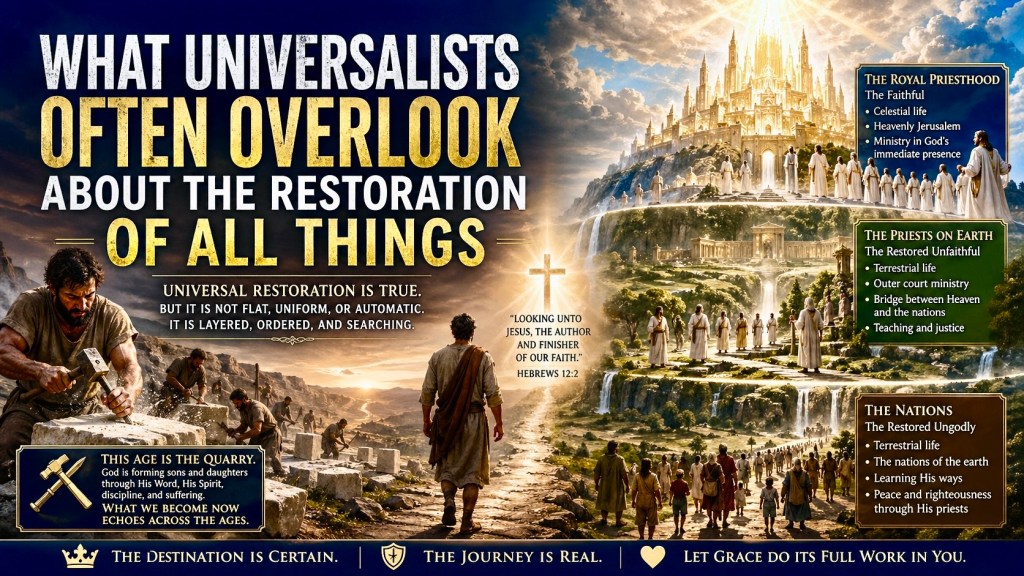
What follows is an attempt to lay out, in a single reading, seven things universalists often overlook, and why they matter. Universal restoration is true. But it is not flat, uniform, or automatic. It is layered, ordered, and searching. And the way we live in this present age carries a weight that echoes across the ages.
The Faithful Remnant of This Age
The first blind spot is the most foundational. Scripture consistently distinguishes a faithful remnant within the people of God, and this is not the old saved-versus-lost divide dressed in new clothes. It is something the Bible takes far more seriously than we tend to: the distinction between the faithful and the unfaithful among those who already belong to God.
The pattern appears almost immediately. Cain and Abel both bring offerings, but only Abel’s is accepted. Ishmael and Isaac are both Abraham’s sons, but only Isaac inherits the promise. Esau and Jacob share the same womb, but Esau despises his birthright for a single meal (Genesis 25:34; Hebrews 12:16). Reuben is Jacob’s firstborn but forfeits the preeminence through unfaithfulness (Genesis 49:3–4; 1 Chronicles 5:1–2). In every case, the issue is not who belongs to the family, they all do. The issue is who walks faithfully within it.
The pattern deepens at Sinai. All twelve tribes were redeemed from Egypt. All of them passed through the sea. All of them ate the manna. But when Moses came down from the mountain and found Israel worshiping the golden calf, he stood at the gate and cried, “Whoever is on the Lord’s side, come to me!” (Exodus 32:26). Only the sons of Levi rallied. They chose the Lord’s side when the cost was severe, and God gave them the priestly inheritance because of it (Exodus 32:29). The gift of redemption was the same for every tribe. The priestly inheritance went to those who responded with decisive faithfulness at the moment of crisis.
The Lord Jesus intensifies this rather than dissolving it. He speaks of a narrow way that few find (Matthew 7:14). He tells parables about servants entrusted with the same master’s goods who produce wildly different outcomes, some faithful, some negligent, some wicked (Matthew 25:14–30). He warns that many who say “Lord, Lord” will not enter the kingdom (Matthew 7:21–23). He distinguishes between the one who builds on rock and the one who builds on sand, though both heard the same words (Matthew 7:24–27).
Paul carries this forward without flinching. He describes believers who build on the foundation of Christ with gold, silver, and precious stones, and others who build with wood, hay, and straw. When the fire tests each one’s work, the second group suffers total loss: “He himself will be saved, yet so as through fire” (1 Corinthians 3:12–15). Saved, yes. But through fire. The writer of Hebrews warns believers, not the world, but the household of God, to fear falling short of the promised rest (Hebrews 4:1, 11). Paul himself says he disciplines his body and brings it into subjection, “lest, when I have preached to others, I myself should become disqualified” (1 Corinthians 9:27), not disqualified from salvation, but from the prize (Philippians 3:14).
If God restores all things, then this age, the one we are living in right now, is not a waiting room. It is the only age in which faithfulness can be tested, proven, and rewarded. The Father is forming sons and daughters now, through the Word, the Spirit, discipline, and suffering, shaping those who yield to Him into the likeness of His Son. Those who cooperate with the Spirit of grace in this age are being prepared for what Scripture describes as a share in the inheritance of the Firstborn Son, a priestly, kingly ministry with the Lord Jesus in the ages to come. Those who resist that formation do not cease to be His children. But they forfeit something real, and the consequences stretch across ages.
The restoration of all things is true. But it does not erase the significance of how we live now. The mercy of God is wide enough to reclaim every soul, and serious enough to distinguish between the son who walked faithfully and the son who despised his birthright.
The Nature of Judgment
The second blind spot follows directly from the first, and it may be the most uncomfortable subject for those who hold this hope: the nature of judgment itself.
In most universalist circles, judgment is treated as a footnote. A brief corrective. A slap on the wrist before the real story, universal glory, begins. Some treat it as almost metaphorical. Others acknowledge it but move past it quickly, as though the real theological work is proving that all are saved and everything else is detail.
But Scripture does not treat judgment as a footnote. It treats judgment as the road mercy travels to reach its destination.
Consider how the Lord Jesus speaks. He warns that the servant who knew his master’s will and did not do it “shall be beaten with many stripes,” while the one who did not know “shall be beaten with few” (Luke 12:47–48). This is not a generic, one-size-fits-all correction. It is graduated, proportional, and measured according to the light a person received and refused. The Lord is describing a judgment that takes into account the specific history of each soul, how much they knew, how much they resisted, and what they did with the grace entrusted to them.
He goes further. He warns that God is able to “destroy both soul and body in Gehenna” (Matthew 10:28). This is not symbolic language. The Lord is telling His own disciples, not the Pharisees, not the crowds, but His followers, to fear the One whose judgment reaches beyond the death of the body into the soul itself. This tells us something about the severity of Gehenna, it is serious enough that the Lord Jesus directed this warning not only to outsiders but to His own.
Paul picks up this thread without softening it. He describes the coming judgment in terms that should give every universalist pause: “indignation and wrath, tribulation and anguish, on every soul of man who does evil” (Romans 2:8–9). He tells the Thessalonians that the Lord Jesus will be “revealed from heaven with His mighty angels, in flaming fire taking vengeance on those who do not know God, and on those who do not obey the gospel” (2 Thessalonians 1:7–8). And he distinguishes within the household of faith between those whose works survive the fire and those whose works are burned up entirely, the second group is “saved, yet so as through fire” (1 Corinthians 3:15). Saved. But through fire.
What emerges from these texts is not the tidy, brief correction that most universalists imagine. It is an age-lasting, purposeful, searching judgment that differs in character depending on the person’s relationship to God.
For unfaithful believers, those who were truly in the Lord Jesus but resisted the Spirit’s work, neglected holiness, or squandered the grace given to them, the judgment is corrective. It is the chastening of sons, not the wrath reserved for enemies. The writer of Hebrews says, “Whom the Lord loves He chastens, and scourges every son whom He receives” (Hebrews 12:6). This chastening, refused in this age, must be endured in the age to come. It is severe. It is real. But it is fatherly, aimed at producing “the peaceable fruit of righteousness” in those who are trained by it (Hebrews 12:11).
For the ungodly, those who hardened themselves against whatever light they received, the judgment is punitive. It is the full weight of divine wrath against corruption and rebellion. Yet even this wrath is not endless rage. Isaiah reveals the principle that sets a boundary to all of God’s judgments: “For I will not contend forever, nor will I always be angry; for the spirit would fail before Me, and the souls which I have made” (Isaiah 57:16). God Himself limits His own wrath because His purpose is not to annihilate but to bring corruption to an end so that the spirit can be preserved for restoration.
This is the piece most universalists are missing. We rightly reject eternal torment, the idea that God punishes endlessly with no redemptive purpose. But many of us have swung to the opposite extreme and emptied judgment of its biblical weight. Scripture presents a judgment that is age-lasting, that distinguishes between the corrective discipline of sons and the punitive wrath upon the ungodly, that destroys the corrupt Adamic nature so that the spirit can be freed, and that does all of this within the boundary of mercy, not outside it.
Mercy does not cancel judgment. Mercy works through judgment. The fire is how mercy reaches what refuses to be reached any other way. The road to “God all in all” passes through a fire that even Paul feared, not because the destination is uncertain, but because the journey is searingly real.
The Gift and the Prize
The third blind spot is a distinction that changes everything once it is seen: the difference between the gift and the prize.
Most Christians, universalists included, treat salvation as one undifferentiated thing. You are either saved or you are not. But Scripture reveals salvation as something layered and progressive, with dimensions that unfold across the ages. And the failure to see these layers is one of the main reasons universalists flatten the significance of this present age.
The gift is the entire saving work of God applied to the believer in this age: forgiveness through the blood of Christ, regeneration by the Spirit, the indwelling Holy Spirit, justification, everything God freely gives to those who believe. Paul says we are “justified freely by His grace through the redemption that is in Christ Jesus” (Romans 3:24). None of this can be earned. It is pure grace from start to finish.
But the gift is not the finish line. The gift is given so that it may produce something, and what it produces, when received with a faithful heart, is the prize: entrance into the resurrection of life, participation in the Royal Priesthood ministry of the Lord Jesus in the ages to come, and a share in the inheritance of the Firstborn Son. The gift secures the prize. The same grace that forgives and regenerates also trains, disciplines, and empowers the believer to walk in the Spirit, endure testing, and cooperate with the Father’s transforming work. Paul says it plainly: “By the grace of God I am what I am, and His grace toward me was not in vain; but I labored more abundantly than they all, yet not I, but the grace of God which was with me” (1 Corinthians 15:10). His labor was the fruit of grace. The means to the prize is grace working in willing hearts; the prize itself is grace honoring what grace produced.
The bridge between the gift and the prize is what Scripture calls the salvation of the soul. The spirit is made alive by the Spirit, that is the gift. The body will be redeemed at the resurrection. But the soul, the inner life of desires, affections, will, and identity, is saved now, in this present age, through a life of obedience, repentance, and cooperation with the Holy Spirit. James tells believers to “receive with meekness the implanted word, which is able to save your souls” (James 1:21). Peter speaks of “receiving the end of your faith, the salvation of your souls” (1 Peter 1:9). The Lord Jesus Himself makes the soul the hinge of discipleship: “Whoever desires to save his life will lose it, but whoever loses his life for My sake will find it. For what profit is it to a man if he gains the whole world, and loses his own soul?” (Matthew 16:25–26).
This is not a second, optional blessing added to salvation. It is salvation working itself out to its intended end. When the soul is saved, purified, transformed, conformed to the image of Christ, it enters the resurrection of life in the age to come. When the soul is neglected, corrupted, or clung to in its Adamic state, the gift has been received in vain, and what awaits is not life but judgment.
This pattern appears as early as the Exodus. All twelve tribes were redeemed from Egypt by the blood of the lamb, the gift was the same for everyone. But when God appointed a tribe for the priestly inheritance, He chose the Levites, because at the golden calf, when the cost of faithfulness was severe, they alone rallied to Moses (Exodus 32:26–29). The gift of redemption was universal. The priestly inheritance went to those who let the gift produce faithfulness in them at the moment of testing.
Paul understood this as well as anyone. He presses “toward the goal for the prize of the upward call of God in Christ Jesus” (Philippians 3:14). He disciplines his body lest, having preached to others, he himself should become “disqualified” (1 Corinthians 9:27), disqualified from attaining the resurrection of life in the age to come. And he draws the sharpest picture in 1 Corinthians 3: some build on the foundation of Christ with gold, silver, and precious stones, while others build with wood, hay, and straw. The fire tests each one’s work. Those whose work endures receive a reward. Those whose work is burned up “suffer loss,” but they themselves are “saved, yet so as through fire” (1 Corinthians 3:14–15). Saved, yes. But through fire, not through glory.
If we only celebrate the gift, if we rejoice that all are saved and stop there, we have told half the story. The gift is not meant to sit idle. It is meant to save the soul, to transform us from within, to produce in us the faithfulness that leads to the resurrection of life. To settle for the bare reception of the gift while neglecting what it was given to produce is to do exactly what Esau did: treat the birthright as though it does not matter because the stew is right in front of you. God gives freely, and His giving is ordered toward a glorious end. The question is whether we will let the gift do its full work in us.
Three Orders, Not One
The fourth blind spot concerns the shape of the restored creation itself. Most universalists picture the end as a single, undifferentiated state: all are restored, all are equal, all are together. But the Torah already lays down a pattern that tells a very different story, and the rest of Scripture develops it.
Consider the arrangement of Israel’s camp in the wilderness. At the center stood the tabernacle, the dwelling place of God. Within it, Aaron and his sons served as the inner priesthood, ministering in the holy place and the most holy place, drawing nearest to the presence of God. Surrounding the tabernacle, the Levites formed a living ring, a wider priestly order given to Aaron and his sons to assist their ministry and to stand between the sanctuary and the rest of Israel: “You shall give the Levites to Aaron and his sons; they are given entirely to him from among the children of Israel” (Numbers 3:9). And beyond the Levites, the remaining eleven tribes of Israel were encamped, the people who received instruction, worship, and order through the priestly ministry of both orders.
Three concentric circles: the inner priesthood at the center, the assisting priesthood surrounding them, and the people dwelling under the ministry of both. This is not a historical footnote. It is a prophetic map of the restored creation.
In the age to come, Aaron and his sons find their fulfillment in the Lord Jesus and the faithful believers who share His Royal Priesthood ministry. Paul distinguishes between celestial and terrestrial glory: “There are also celestial bodies and terrestrial bodies; but the glory of the celestial is one, and the glory of the terrestrial is another” (1 Corinthians 15:40). The faithful, conformed to the image of the Firstborn Son in this age, enter the resurrection of life, receive celestial bodies, and serve in the Heavenly Jerusalem, the true sanctuary, the mountain of the Lord’s house that Isaiah saw would be “established as the highest of the mountains” (Isaiah 2:2). This is the Royal Priesthood, the Lord Jesus the Great High Priest and the faithful sons who share His ministry in the immediate presence of God.
The Levites find their fulfillment in the restored unfaithful believers. These were truly in the Lord Jesus in this age, they received the Spirit, tasted the powers of the age to come, yet they walked carelessly, resisted sanctification, or despised the Father’s discipline. They passed through the fires of judgment in the age to come, “saved, yet so as through fire” (1 Corinthians 3:15). In the new creation they are raised in incorruptible terrestrial bodies and take up a genuine priestly service on the renewed earth, not in the inner sanctuary, but in the outer court. Like the Levites who were stationed around the tabernacle, they form a living bridge between the heavenly city above and the peoples below, teaching the ways of God, mediating righteousness and justice, and transmitting the light they receive from the Royal Priesthood to the nations. Like Esau, they forfeited the firstborn portion, but they did not cease to be sons, and in mercy they were given a place of honored service.
The eleven tribes find their fulfillment in the restored nations, those who lived outside the covenant, who hardened themselves in unbelief and endured the full weight of divine wrath. Paul describes their portion as “indignation and wrath, tribulation and anguish, on every soul of man who does evil” (Romans 2:8–9). Yet when judgment completed its work—the flesh crucified and the soul involuntarily purified under the fire of God’s holiness—the purified heart returned to God who gave it (Ecclesiastes 12:7). In the final resurrection they are raised into incorruptible terrestrial bodies on a renewed earth where sin and death no longer reign. They are not priests. They are the nations whom the priests serve, the peoples who flow to the mountain of the Lord saying, “He will teach us His ways, and we shall walk in His paths” (Isaiah 2:3). Yet they are beloved, restored, and immortal. Isaiah saw this: “He will swallow up death forever, and the Lord God will wipe away tears from all faces” (Isaiah 25:8). All faces.
Together, these three orders display the full spectrum of divine mercy: mercy that formed the faithful through prior discipline in this age, mercy that corrected the unfaithful through severe chastening in the age to come, and mercy that reclaimed the ungodly through wrath unto restoration. The wilderness encampment was the shadow. The restored creation is the substance. Heaven and earth are joined. And God is all in all (1 Corinthians 15:28). This is not “everyone gets the same thing.” This is something far more glorious, and the pattern was in the Torah from the beginning.
What This Age Is For
The fifth blind spot is the hardest practical question this hope produces: if everyone is eventually restored, does it matter how we live now?
Most universalists would say yes, of course it matters. But in practice, the urgency drains away. If the destination is guaranteed, the journey starts to feel like a formality. This age becomes a waiting room, something to endure before the real story begins. Scripture sees it completely differently. This present age is not a waiting room. It is the only age in which the Father forms His firstborn heirs.
The Torah establishes this with a picture that should arrest every comfortable believer. After Israel was redeemed from Egypt, delivered by blood, carried through the sea, fed with manna, God led them into the wilderness. Not as punishment, but as preparation. Moses explained the purpose plainly: “The Lord your God led you all the way these forty years in the wilderness, to humble you and test you, to know what was in your heart, whether you would keep His commandments or not” (Deuteronomy 8:2). Three purposes governed the wilderness: humbling, testing, and the exposure of the heart. Every believer in this age is in that same wilderness.
And here is the part that should give us pause: all of Israel shared the same redemption. They all ate the manna. They all drank from the Rock. Paul says explicitly that “that Rock was Christ” (1 Corinthians 10:4). Yet “with most of them God was not well pleased; for their bodies were scattered in the wilderness” (1 Corinthians 10:5). He writes these things as a warning to us: “Now all these things happened to them as examples, and they were written for our admonition” (1 Corinthians 10:11). The gift was the same for everyone. The wilderness revealed who would cooperate with the Spirit of grace and who would not.
This is the pattern of this present age. The Father uses everything, His Word, His Spirit, discipline, suffering, circumstances, even opposition, to shape His sons into the likeness of the Lord Jesus. Every trial, every chiseling blow, every uncomfortable exposure of what is really in our hearts is His formative work. The writer of Hebrews says plainly: “No chastening seems to be joyful for the present, but painful; nevertheless, afterward it yields the peaceable fruit of righteousness to those who have been trained by it” (Hebrews 12:11). The key phrase is “those who have been trained by it.” Not everyone submits to the training. Not everyone yields to the chiseling. And the difference determines everything about the age to come.
Scripture uses a remarkable image to describe what is happening in this age. When Solomon built the Temple, “the temple, when it was being built, was built with stone finished at the quarry, so that no hammer or chisel or any iron tool was heard in the temple while it was being built” (1 Kings 6:7). Every stone was cut, measured, and perfected somewhere else, far from the Temple site, and then carried to Mount Moriah and set silently in its place. All the noise and dust belonged to the quarry. The Temple knew only the quiet assembly of completed stones.
This is the Father’s method. This present age is the quarry. The noise, the pain, the rough cutting, that is the formation of living stones for the Temple of God. Peter picks up this very image: “You also, as living stones, are being built up a spiritual house, a holy priesthood, to offer up spiritual sacrifices acceptable to God through Jesus Christ” (1 Peter 2:5). The present tense, “are being built up,” tells us the construction is ongoing. The Temple is not yet assembled. The stones are still being shaped.
The age to come is where the Temple is assembled and unveiled. The faithful who were formed in the quarry of this age are set in their places as the Royal Priesthood in the Heavenly Jerusalem. The quarry cannot be shortened, skipped, or repeated. This age is the only season of sowing, and Paul warns that “whatever a man sows, that he will also reap. For he who sows to his flesh will of the flesh reap corruption, but he who sows to the Spirit will of the Spirit reap life of the age” (Galatians 6:7–8, literal). Life in the age to come is a harvest, and the seeds are being sown right now.
The guarantee of universal restoration does not reduce the significance of this age. It increases it. If the Father is forming a company of priestly sons and daughters to share the ministry of the Lord Jesus in the ages to come, and if this age is the only quarry in which that formation occurs, then every act of obedience, every yielding to the Spirit, every painful submission to the Father’s discipline carries weight that echoes across the ages. And every act of resistance, every compromise, every refusal to let the chisel do its work carries consequences just as real. The destination is certain. God will be all in all. But what we are becoming in this age is being decided right now, in the ordinary, hidden, unglamorous pressures of today.
The Meaning of “Age-Lasting”
The sixth blind spot lies hidden inside one of the universalist’s most-used arguments. Most universalists already know that the Greek word aiōnios does not mean “eternal” the way most English Bibles suggest. It is one of the main pillars of the universalist case: if the punishment is not eternal, then the traditional doctrine of hell collapses. That is correct, as far as it goes. But the same word that reshapes our understanding of judgment also reshapes our understanding of life. And once that is seen, the implications are far more searching than most universalists realize.
The Greek noun aiōn means an age, a structured period of God’s administration with a beginning and an end. The adjective aiōnios, derived from it, means “of the age,” “age-lasting,” or “belonging to the age.” It does not mean “eternal” in the abstract philosophical sense. The Hebrew behind it is ʿōlām, whose root sense is “hidden,” a span whose boundaries are concealed but real. A servant who pledged himself to his master served “forever” (leʿōlām), meaning for the duration of his life, not for infinite time (Exodus 21:6). The Aaronic priesthood was called an “everlasting” priesthood, yet the writer of Hebrews shows it was superseded by the priesthood of the Lord Jesus (Hebrews 7:11–12). In each case, the word points to an age-long reality whose limits are determined by God’s purpose.
When this word entered Latin through Jerome and the Vulgate, something was lost. The Latin aeternus does not distinguish between “belonging to an age” and “without any end whatsoever.” What had been age-structured language in Hebrew and Greek became abstract infinity in Latin. From Latin it passed into English as “eternal” and “everlasting,” and the entire framework of the ages collapsed into a single flat horizon. Punishment “of the age” became “punishment without end.” Life “of the age” became a vague, timeless heaven.
Most universalists have done the work on the punishment side of this equation. We know that kolasis aiōnios in Matthew 25:46 means punishment belonging to the age to come, not punishment that never ends. We know the Lord chose the word kolasis, which in classical Greek carried the sense of corrective pruning, rather than timōria, which denoted retributive punishment for its own sake. We know that the Apostles had the word aïdios available to them when they wanted to describe something truly beyond all ages, Paul uses it of God’s “eternal power” in Romans 1:20, and they deliberately chose not to use it for punishment. These are powerful arguments, and they are right.
But most of us have stopped there. We have used the meaning of aiōnios to dismantle eternal torment, and then we have set the word aside as though its work is done. It is not.
When the Lord Jesus speaks of “life of the age” (zōē aiōnios), He is not describing a generic, timeless existence in heaven. He is describing a specific reality: life in the age to come, the resurrection life of the coming sabbath age, entered through the resurrection of life at His appearing. It is not automatic. It is a prize for the faithful. The Lord says that those who hear His word and believe in Him who sent Him “have life in the Age to Come, and shall not come into judgment, but have passed from death into life” (John 5:24, literal). He says it is better to cut off a hand or pluck out an eye than to miss entrance into this life (Matthew 18:8–9). Paul presses toward it as “the prize of the upward call of God in Christ Jesus” (Philippians 3:14). He tells the Galatians that “he who sows to the Spirit will of the Spirit reap life of the age” (Galatians 6:8, literal), life in the age to come is a harvest, reaped from what was sown in this present age.
This means that the same word universalists use to argue against eternal torment also argues against the assumption that everyone receives the same outcome. Life of the age and punishment of the age are both real, both belong to the same coming age, and both are awarded according to how a person responded to the grace and light entrusted to them. The adjective does not tell us that either one is philosophically endless. It tells us that both define what happens in the age to come, and the difference between the two is the difference between entering the resurrection of life with the Lord Jesus and entering the resurrection of judgment on an earth that has become the furnace of divine discipline.
If we have used aiōnios to dismantle hell, have we also let it restructure our understanding of life? Because once we do, the comfortable assumption that the timing and manner of restoration do not matter starts to fall apart. The age to come is real. What we enter it as, faithful or unfaithful, is being determined now.
Mercy That Refuses to Be Soft
The seventh and deepest blind spot is the nature of the mercy that makes restoration possible. Universalists love to talk about mercy, and rightly so, it is the supreme reality of Scripture. But in our circles, mercy tends to get reduced to something soft: God’s willingness to overlook, to let things go, to wave away the consequences of sin because He is too loving to do otherwise. This version of mercy sounds kind. But it is not the mercy of Scripture. And it cannot accomplish what needs to be accomplished. The mercy of Scripture does not cancel judgment. It works through judgment.
Consider what God revealed about Himself at Sinai, the foundational declaration of His own character. When Moses asked to see His glory, the Lord passed before him and proclaimed His name: “The Lord, the Lord God, merciful and gracious, longsuffering, and abounding in goodness and truth, keeping mercy for thousands, forgiving iniquity and transgression and sin, by no means clearing the guilty, visiting the iniquity of the fathers upon the children and the children’s children to the third and the fourth generation” (Exodus 34:6–7). Notice the proportions. Mercy is kept for thousands. Judgment extends to three and four generations. Mercy is the ocean; judgment is the shoreline. But both are real. God does not clear the guilty by pretending guilt does not exist. He forgives, and He visits. Mercy and severity belong to the same character.
The Prophets hold these two together without flinching. Hosea records the Lord’s anguish over unfaithful Israel: “How can I give you up, Ephraim? How can I hand you over, Israel?… My heart churns within Me; My sympathy is stirred” (Hosea 11:8). This is not a detached deity calculating outcomes. This is a Father whose heart is being turned inside out. And yet in the same book, the Lord says of Ephraim’s idolatry, “Let him alone” (Hosea 4:17), a judicial withdrawal of grace that is among the most severe acts in all of Scripture. The same God who cannot bear to give up His people is the God who hands them over to the consequences of their rebellion. Why? Because the only way mercy can reach what is corrupted is through judgment that exposes and destroys the corruption. And then, after the judgment, comes the most astonishing word: “I will heal their backsliding, I will love them freely, for My anger has turned away from him” (Hosea 14:4). The God who said “let him alone” becomes the God who says “I will love them freely.” His anger turns. His healing comes. But it comes after judgment, not instead of it.
Isaiah captures the proportions with breathtaking clarity: “For a mere moment I have forsaken you, but with great mercies I will gather you. With a little wrath I hid My face from you for a moment; but with kindness to the age I will have mercy on you” (Isaiah 54:7–8, literal). The wrath is “a mere moment.” The mercy is “to the age.” The ratio mirrors Sinai: judgment is bounded; mercy stretches across the ages. And Isaiah grounds this in the Noahic covenant itself, the same oath by which God swore never to destroy the earth again becomes the guarantee that His mercy will outlast His anger (Isaiah 54:9–10).
Lamentations, written from the ashes of Jerusalem, provides the most poignant witness. The city is destroyed. The temple is burned. The covenant appears shattered. And yet: “Through the Lord’s mercies we are not consumed, because His compassions fail not. They are new every morning; great is Your faithfulness” (Lamentations 3:22–23). If mercy survives the destruction of Jerusalem and the burning of the temple, then no judgment in any age can outlast it.
The writer of Hebrews brings this into the New Covenant with a single devastating sentence: “Whom the Lord loves He chastens, and scourges every son whom He receives” (Hebrews 12:6). The Greek noun for chastening is paideia, the training and discipline of a child. It is painful. It is severe. And it is the expression of fatherly love, because “if you are without chastening, of which all have become partakers, then you are illegitimate and not sons” (Hebrews 12:8). The chastening of this age, when embraced, “yields the peaceable fruit of righteousness to those who have been trained by it” (Hebrews 12:11). The chastening refused in this age must be endured in the age to come, in a far more severe form. But it remains mercy. Severe mercy. The mercy of a Father who will not leave His children in their corruption, even if that means fire.
Mercy without severity would cheapen grace. Severity without mercy would crush. But together they purify and restore. The God who tears is the God who heals. The God who strikes is the God who binds up (Hosea 6:1). The fire of the age to come is not the failure of mercy, it is mercy reaching what refused to be reached any other way. The deepest mercy is not the mercy that overlooks. It is the mercy that refuses to let go.
Conclusion: A Hope Worth Living For
What kind of life does this hope produce? That is the question everything in this teaching has been driving toward.
Here is the honest truth about much of what can be observed in universalist circles: the hope of universal restoration has become, for many, a reason for complacency. If everyone is restored eventually, then urgency fades. Holiness becomes optional. The warnings of the Lord Jesus get filed away as irrelevant. And the result is a theology that affirms something beautiful about God’s future while producing very little transformation in the present.
Scripture will not permit this. The same Paul who declared that God will be “all in all” (1 Corinthians 15:28) is the Paul who ran for the prize of the upward call (Philippians 3:14), who disciplined his body lest he be disqualified (1 Corinthians 9:27), and who at the end of his life could say, “I have fought the good fight, I have finished the race, I have kept the faith. Finally, there is laid up for me the crown of righteousness, which the Lord, the righteous Judge, will give to me on that Day, and not to me only but also to all who have loved His appearing” (2 Timothy 4:7–8). The crown belongs to those who finish. It must be run for. It must be fought for. It must be kept by faith. And it is given to all who have loved His appearing, all who lived with their eyes on the age to come.
Peter writes to believers who already share the divine nature and have obtained precious faith, and then urges them to add virtue, knowledge, self-control, perseverance, godliness, brotherly kindness, and love, so that they will not be barren or unfruitful. He warns that those who lack these things have forgotten that they were cleansed from their old sins. And then he gives the exhortation that should ring in every universalist’s ears: “Be even more diligent to make your call and election sure, for if you do these things you will never stumble; for so an entrance will be supplied to you abundantly into the kingdom of the age of our Lord and Savior Jesus Christ” (2 Peter 1:10–11, literal). An abundant entrance. Not a bare survival. Not a scraping through after the fire has burned everything away. An abundant entrance into the kingdom of the age to come.
The writer of Hebrews gathers the entire cloud of witnesses, Abel, Enoch, Noah, Abraham, Sarah, Moses, and then says to us: “Let us lay aside every weight, and the sin which so easily ensnares us, and let us run with endurance the race that is set before us, looking unto Jesus, the author and finisher of our faith” (Hebrews 12:1–2). The race is real. The weights are real. The sin that ensnares is real. And the One we are looking to is the Lord Jesus, the Firstborn Son who endured the cross and sat down at the right hand of the throne of God. He is not merely our Savior. He is our pattern. And those who follow His pattern in this age will share His ministry in the ages to come.
The Prophets saw this with stunning clarity. Hosea pleaded: “Sow for yourselves righteousness; reap in mercy; break up your fallow ground, for it is time to seek the Lord, till He comes and rains righteousness on you” (Hosea 10:12). Isaiah cried: “Seek the Lord while He may be found, call upon Him while He is near” (Isaiah 55:6). There is a “while” in both of those sentences. The door is open now. The Spirit is at work now. The Father’s formative hand is upon His sons and daughters now. This age will not last forever, and what it produces in them cannot be produced in any other season.
To believe God restores all things is to hold the most hopeful doctrine in all of theology. But hope without obedience is presumption. And presumption is exactly what the wilderness generation practiced when they assumed God’s faithfulness meant they could ignore His commands, and their bodies were scattered in the desert (1 Corinthians 10:5).
The restoration of all things is certain. The Father’s purpose cannot fail. Death will be abolished, mercy will triumph, and God will be all in all. Nothing in this teaching has questioned that for a moment. But within that certain purpose, there is a real and enduring difference between entering the resurrection of life and entering the resurrection of judgment. Between abundant entrance into the kingdom and sharing the firstborn inheritance in the Royal Priesthood and being saved only after the fires of the age to come have done their work.
The ages are ordered. The story is sure. The question is not whether we will be restored. The question is what the Father is doing in our lives right now, and whether we are yielding to it.
That is a hope worth living for.

