
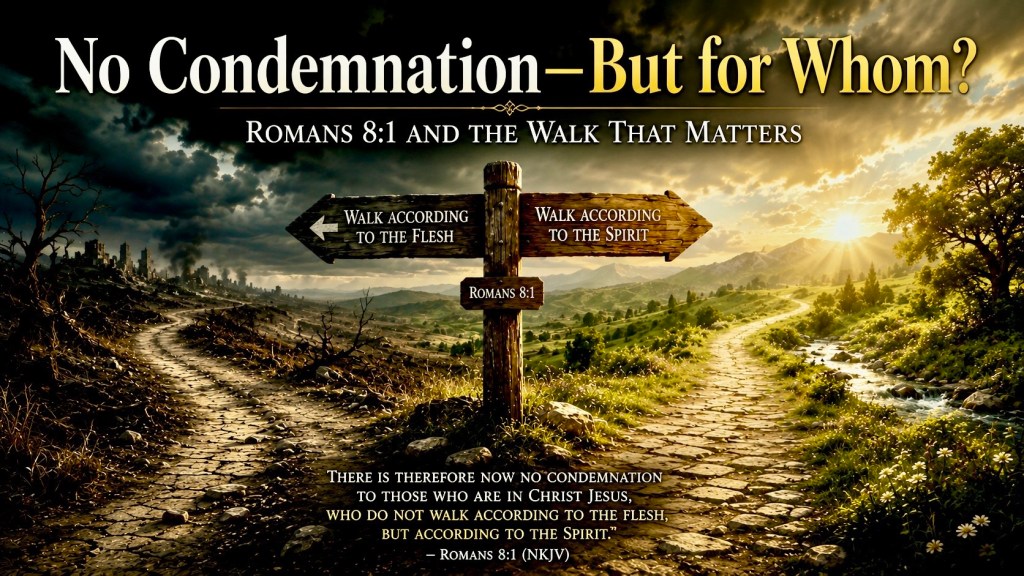
Romans 8:1 and the Walk That Matters
Introduction: The Verse That Ends Too Soon
“There is therefore now no condemnation to those who are in Christ Jesus.”
This is one of the most beloved sentences in the New Testament. It is quoted in songs, claimed in prayers, printed on coffee mugs, and preached from pulpits with triumphant certainty. And every word of it is true. But in most churches, the verse ends there—and that is precisely where the problem begins.
The full verse, as preserved in the Textus Receptus and the Majority Text, reads: “There is therefore now no condemnation to those who are in Christ Jesus, who do not walk according to the flesh, but according to the Spirit” (Romans 8:1). Some scholars note that this qualifying clause may have been drawn from Romans 8:4 by later copyists, since it is absent from the earliest manuscripts. But whether the clause is original to verse 1 or not, the reality it names is beyond dispute—because Paul himself states it without any textual question three verses later: “that the righteous requirement of the law might be fulfilled in us who do not walk according to the flesh but according to the Spirit” (Romans 8:4). And the argument of Romans 8:1–13 as a whole makes the same case with relentless clarity: life belongs to those who walk in the Spirit, and death belongs to those who walk in the flesh (Romans 8:5–6, 13). The teaching that follows rests on the full argument of Romans 8, not on any single disputed clause.
That qualifying reality changes everything. It does not undo the promise. It does not weaken the grace. It does not turn the gospel into a performance contract. But it does something that the modern church desperately needs to hear: it ties the absence of condemnation to the manner of the believer’s walk. The “no condemnation” is real—gloriously, unshakably real—but it belongs to those who walk in the provision of the Spirit of grace, not to those who claim the position while living in the flesh.
This teaching traces the full Apostolic witness on condemnation and no condemnation—not to take away assurance, but to restore the kind of assurance the Apostles actually offered: an assurance grounded in the walk, proven by the fruit, and secured by the Spirit’s ongoing work in the willing heart.
The Two Walks—Romans 8:1–13
Paul’s argument in Romans 8 is not a single declaration followed by silence. It is a sustained argument that unfolds across thirteen verses, and the argument has two sides—two walks, two outcomes, two destinies.
The chapter opens with the promise: “There is therefore now no condemnation to those who are in Christ Jesus” (v. 1). The word “therefore”—ara (ἄρα)—connects this declaration to everything Paul has argued in Romans 6 and 7: the believer’s death with the Lord Jesus in baptism, the burial of the old man, the release from the law of sin and death, and the cry of deliverance in Romans 7:24–25. And verse 4 immediately reveals the purpose of this freedom: “that the righteous requirement of the law might be fulfilled in us who do not walk according to the flesh but according to the Spirit.” The “no condemnation” stands on the foundation of co-crucifixion with Christ and walking in the power of the Spirit—not on a bare legal fiction detached from the believer’s actual life.
Paul immediately explains why there is no condemnation: “For the law of the Spirit of life in Christ Jesus has made me free from the law of sin and death” (v. 2). Two laws are named—the law of the Spirit of life and the law of sin and death. The believer is free from the second because the first has overcome it. But the freedom is not automatic. It is the freedom of a person walking under a new law—the Spirit’s law—rather than living under the old one.
Then Paul draws the line between the two walks with a precision that leaves no room for misunderstanding. “For those who live according to the flesh set their minds on the things of the flesh, but those who live according to the Spirit, the things of the Spirit” (v. 5). Two categories of people. Two orientations of mind. Two directions of life. And then the verdict: “For to be carnally minded is death, but to be spiritually minded is life and peace. Because the carnal mind is enmity against God; for it is not subject to the law of God, nor indeed can be. So then, those who are in the flesh cannot please God” (vv. 6–8).
“To be carnally minded is death.” Not might lead to death. Not risks death. Is death. The carnal mind—the phronēma tēs sarkos (φρόνημα τῆς σαρκός), the settled disposition of the flesh—is already in the realm of death. It is enmity against God. It cannot be subject to His law. And the person who lives under its governance cannot please God—regardless of his confession, regardless of his doctrinal statement, regardless of the prayer he prayed at the altar.
Paul then addresses the believer directly: “But you are not in the flesh but in the Spirit, if indeed the Spirit of God dwells in you” (v. 9). The little word “if”—eiper (εἴπερ)—is a condition of fact: “if, as is the case.” Paul assumes that his readers do have the Spirit. But the assumption carries a warning embedded in its grammar: the Spirit’s indwelling is not an abstract status. It is a present reality that manifests in the walk.
And then comes the decisive exhortation: “Therefore, brethren, we are debtors—not to the flesh, to live according to the flesh. For if you live according to the flesh you will die; but if by the Spirit you put to death the deeds of the body, you will live” (vv. 12–13). Paul is writing to brethren—believers, the justified, those who are “in Christ Jesus.” And he tells them plainly: if you live according to the flesh, you will die. The “if” is real. The death is real. The choice is real.
The death in view is eschatological loss—the ruin that comes upon the soul-life that remains under the flesh’s governance. It is the destruction of body and soul in Gehenna (Matthew 10:28), where the fire crucifies the flesh involuntarily, purifies the soul through judgment, and frees the spirit that returns to God (Ecclesiastes 12:7). And the life in view is the life of the Age to Come—the resurrection of life, celestial glory, the firstborn inheritance.
But a distinction must be drawn here that the teaching of Romans 8 demands and that many believers desperately need to hear. The settled disposition of the flesh—the phronēma tēs sarkos that Paul describes in verses 6–7—is not the same thing as the painful struggle of a believer who fights the flesh daily and sometimes falls. The believer who battles the flesh by the Spirit is not walking according to the flesh; the battle itself is evidence that the Spirit’s governance is active. Romans 7:15–25 is the cry of a person at war: “What I will to do, that I do not practice; but what I hate, that I do” (Romans 7:15). That warfare—the hating of sin, the willing of good, the groaning under the weight of the Adamic condition—is proof that the Spirit is at work. Paul’s warning in Romans 8:13 is directed not at the struggling believer but at the one who has surrendered the territory entirely—who has ceased to fight, who has yielded to the flesh as a settled way of life, who lives under its governance without resistance and without repentance. The walk according to the flesh is a settled direction, not a momentary failure. Romans 8:1 is not a bare legal pronouncement hovering above the believer’s actual life. It is the opening statement of an argument that demands a walk. No condemnation belongs to those who walk in the Spirit. Death belongs to those who walk in the flesh. Both are addressed to the same people—believers, brethren, those who are in Christ Jesus.
The Two Harvests—Galatians 6:7–8
Paul states the same reality in Galatians with the imagery of agriculture: “Do not be deceived, God is not mocked; for whatever a man sows, that he will also reap. For he who sows to his flesh will of the flesh reap corruption, but he who sows to the Spirit will of the Spirit reap life of the age” (Galatians 6:7–8 literally life in the Age to Come).
Two sowings. Two harvests. And both categories are addressed to believers within the Galatian churches—not to the world at large. The warning “do not be deceived”—mē planasthe (μὴ πλανᾶσθε)—is directed at people who might suppose that the grace they received at conversion exempts them from the consequences of how they live afterward. Paul says bluntly: God is not mocked. The law of sowing and reaping is not suspended for believers. Whatever a man sows, that he will reap.
The one who sows to the flesh reaps corruption—phthora (φθορά)—the decomposition, the progressive ruin, the eschatological loss that falls on the soul-life that remained under the flesh’s governance. This is not the loss of the justification of past sins, which stands permanently on the blood of the Lord Jesus (Romans 3:25). It is the forfeiture of what was entrusted—the withering of the fruit that the gift was given to produce.
The one who sows to the Spirit reaps “life of the age”—zōē aiōnios in its full resurrection sense: entrance into the resurrection of life, celestial glory, the firstborn inheritance. This is the no condemnation of Romans 8:1—the harvest that belongs to those who walk according to the Spirit and produce the fruit that the Spirit cultivates.
The two harvests of Galatians 6:8 correspond exactly to the two walks of Romans 8. The flesh produces death and corruption. The Spirit produces life and peace. And both outcomes are set before believers, not before the unsaved. The gift—the Holy Spirit Himself—is irrevocable; the gifts and the calling of God are never withdrawn (Romans 11:29). But the fruit of the gift—the new spirit being formed by the divine seed, the transformation that the Spirit’s indwelling makes possible—can wither when the flesh chokes it, just as the thorny ground in the Lord’s parable received the seed but produced no harvest (Mark 4:18–19). The talent entrusted by the master can be buried and produce nothing (Matthew 25:24–28). The talent is the divine seed—the sperma of God planted in the old spirit at the begetting—and when the seed is buried and produces no fruit, it is formally forfeited at the judgment seat and given to the one who bore fruit (1 Peter 1:23; 1 John 3:9). The Holy Spirit—the gift, the sustaining Presence—remains; but the seed is lost, and with it the firstborn inheritance: having Christ formed within, being made like the Lord Jesus, receiving a celestial body at His appearing (1 John 3:2; Philippians 3:21). The harvest is determined by the sowing.
Judgment According to Deeds—Romans 2:1–11
If Romans 8:1 and Galatians 6:8 establish the two walks and the two harvests, the broader Apostolic witness reveals the judgment at which these harvests are weighed—and it distinguishes carefully between three categories of persons, not two.
The first category is the faithful—those who walk according to the Spirit, who sow to the Spirit, who by patient continuance in doing good seek for glory, honor, and immortality. Paul describes their harvest: “life of the age” (Romans 2:7, literally life in the Age to Come)—the resurrection of life, celestial glory, no condemnation. These are the ones who have passed from death to life (John 5:24). At the judgment seat of Christ, their works endure the fire, and they receive the reward—the firstborn inheritance, the prize laid up for those who loved His appearing (1 Corinthians 3:11-15).
The second category is the unfaithful—genuine believers who received the gift of the Holy Spirit, who were begotten from above, but who refused to crucify the flesh—who clung to the self-governing soul-life and would not let the Spirit’s work displace it. They sowed to the flesh. They grieved and quenched the Spirit. They buried the talent. The Lord Jesus describes their judgment with devastating precision: “And that servant who knew his master’s will, and did not prepare himself or do according to his will, shall be beaten with many stripes. But he who did not know, yet committed things deserving of stripes, shall be beaten with few stripes. For everyone to whom much is given, from him much will be required; and to whom much has been committed, of him they will ask the more” (Luke 12:47–48). The stripes are many or few—proportional to the light they had and the faithfulness they refused. But they are the stripes of a Father’s hand. The unfaithful are chastened as sons (Hebrews 12:6–8), not as enemies. Their judgment is severe but measured, corrective in purpose, aimed at the crucifixion of the flesh and the purification of the soul—the work that voluntary obedience, empowered by the Spirit of grace, would have accomplished in this present age.
The third category is the ungodly—those who never received the gospel, who hardened themselves in rebellion, who lived entirely within the Adamic order. Paul describes their harvest in Romans 2:8–9: “But to those who are self-seeking and do not obey the truth, but obey unrighteousness—indignation and wrath, tribulation and anguish, on every soul of man who does evil.” The language here is not fatherly discipline. It is wrath—orgē (ὀργή)—the full weight of divine justice against rebellion. The ungodly do not receive the measured stripes of sons. They receive the indignation and anguish of those who rejected the light entirely.
Yet even here, Paul adds the word that holds the door open: “on every soul of man who does evil.” The judgment falls on the soul—the soul-life governed by the flesh, the entire Adamic constitution of the person as an embodied creature. In Gehenna, the body is consumed by the fire. The flesh—the self-governing disposition that corrupted the soul since the fall—is crucified involuntarily through the fire of divine holiness. The soul is purified through judgment as the flesh’s governance is destroyed. And the spirit—the deepest enduring ground of the person, which came from God’s neshāmâh and remains God’s handiwork—endures, freed from the corruption it carried (2 Corinthians 7:1), and returns to God who gave it (Ecclesiastes 12:7). And in the Eighth Day, mercy triumphs over judgment, and the God who reconciles all things through the blood of the Lord Jesus (Colossians 1:20) raises even the ungodly into terrestrial restoration.
The three categories are distinct—the faithful, the unfaithful, and the ungodly—and the nature of the judgment differs for each. But the principle that governs all three is the same: “God will render to each one according to his deeds” (Romans 2:6). No partiality. No exemptions. The faithful receive life. The unfaithful receive discipline. The ungodly receive wrath. The no-condemnation verdict is confirmed in those who continue walking according to the Spirit and bear the fruit that the Spirit produces.
The Present Deliverance—How the Lord Jesus Is Saving Us Now
The no condemnation of Romans 8:1 is not only a future verdict that will be pronounced at the judgment seat. It is a present reality being worked out in the believer’s life right now—because the risen Lord Jesus is actively, presently delivering His people from the wrath to come by sanctifying them in this age.
Paul describes the Thessalonian believers as those who “wait for His Son from heaven, whom He raised from the dead—Jesus who delivers us from the wrath to come” (1 Thessalonians 1:10). The present participle “delivers”—rhuomenon (ῥυόμενον)—indicates an ongoing deliverance. The Lord Jesus is not merely waiting to rescue His people at the last moment. He is presently delivering them from the wrath to come—by sanctifying, cleansing, and transforming them now.
Paul tells husbands to love their wives “just as Christ also loved the church and gave Himself for her, that He might sanctify and cleanse her with the washing of water by the word, that He might present her to Himself a glorious church, not having spot or wrinkle or any such thing, but that she should be holy and without blemish” (Ephesians 5:25–27). The Lord Jesus is actively sanctifying and cleansing the church—right now—by the washing of the word, so that at His appearing the church is presentable, without spot or wrinkle. That present-tense sanctifying work is the delivering from the wrath to come. He is making His people into the kind of people who will not face condemnation.
The grace of God is not passive. It is actively teaching the believer to deny ungodliness: “For the grace of God that brings salvation has appeared to all men, teaching us that, denying ungodliness and worldly lusts, we should live soberly, righteously, and godly in the present age, looking for the blessed hope and glorious appearing of our great God and Savior Jesus Christ, who gave Himself for us, that He might redeem us from every lawless deed and purify for Himself His own special people, zealous for good works” (Titus 2:11–14). The redemption from lawlessness and the purification of a people are present-tense works aimed at the Day of His return. He is delivering us from the wrath by redeeming us from the very lawlessness that would bring the wrath upon us.
And John confirms the ongoing nature of this cleansing: “If we walk in the light as He is in the light, we have fellowship with one another, and the blood of Jesus Christ His Son cleanses us from all sin” (1 John 1:7). The verb “cleanses” is katharizei (καθαρίζει)—present tense, continuous action. The blood keeps on cleansing as the believer keeps walking in the light. That ongoing cleansing is the present deliverance from wrath, because the sin that would bring condemnation is being dealt with now, through confession and the blood, rather than being stored up for the Day of judgment.
The no condemnation of Romans 8:1 is not a once-for-all legal stamp that makes the walk irrelevant. It is the standing of those in whom the Lord Jesus’ present-tense sanctifying work is being received and cooperated with—those who are being delivered from the inside out, so that when the Day breaks, they are found ready.
Judge Yourself Now, or Be Judged Then—1 Corinthians 11:31–32
Paul gives the principle with crystalline simplicity: “For if we would judge ourselves, we would not be judged. But when we are judged, we are chastened by the Lord, that we may not be condemned with the world” (1 Corinthians 11:31–32).
Two options. Two timings. The same fire.
If we judge ourselves now—if we consent to the Spirit’s work of exposing, convicting, and putting to death the deeds of the flesh in this present age—we will not be judged then. The self-judgment that the Spirit empowers in this age is the deliverance from judgment in the Age to Come. The believer who welcomes the word’s dividing work, who confesses sin, who allows the blood to cleanse the conscience, who by the Spirit puts to death the deeds of the body—that believer has already undergone the judgment. The fire has already done its work. At the judgment seat, there is nothing left to condemn.
But when we refuse to judge ourselves—when we harden our hearts, grieve the Spirit, and cling to the flesh’s governance—refusing to surrender the self-ruled soul-life that the cross was given to crucify—”we are chastened by the Lord, that we may not be condemned with the world” (1 Corinthians 11:32). This is the Lord’s preventive discipline in this present age—conviction, correction, trials, the measured hand of a Father who chastens those He loves so that they will repent before the judgment arrives. The chastening is severe but purposeful: it aims to bring the believer back to the narrow way while there is still time.
But if the chastening is refused—if the believer persists in the flesh, quenches the Spirit, and buries the seed—the Lord’s preventive discipline has not failed in its design, but the believer has failed to respond. And at His appearing, the unfaithful do not escape condemnation. The Lord Jesus made this explicit: “The master of that servant will come on a day when he is not looking for him, and at an hour when he is not aware, and will cut him in two and appoint him his portion with the unbelievers. And that servant who knew his master’s will, and did not prepare himself or do according to his will, shall be beaten with many stripes” (Luke 12:46–47). The unfaithful servant is not treated as the ungodly—he is not under the full weight of retributive wrath, “indignation and wrath, tribulation and anguish” (Romans 2:8–9). But he is appointed his portion with the unbelievers. He enters condemnation. He is beaten with stripes proportioned to the light he received and refused. The condemnation of the unfaithful is corrective, measured, and within the household—but it is condemnation nonetheless, and the firstborn inheritance is forfeited.
The choice is not whether the fire comes. The choice is whether it comes now, voluntarily, through the Spirit’s sanctifying work in this present age—or later, involuntarily, through the corrective fires of the Age to Come. The no condemnation of Romans 8:1 belongs to those who chose the refining fire now.
The Judge Is at the Door—James 5:9 and 1 Peter 4:17
James drives the urgency home with a warning that should stop every believer in his tracks: “Do not grumble against one another, brethren, lest you be condemned. Behold, the Judge is standing at the door!” (James 5:9).
James is writing to brethren—believers, the household of God. And he tells them not to grumble against one another lest they be condemned. The word is katakrinō (κατακρίνω)—to judge against, to pass sentence upon. The condemnation James warns of is not the loss of the justification of past sins—the forgiveness applied at conversion through the blood stands. It is the judgment that falls on the soul-life governed by the flesh—even in things as seemingly small as grumbling against a brother. And the reason for the urgency? “The Judge is standing at the door.” The Lord Jesus, the righteous Judge, is about to appear. The judgment seat is imminent. And at that seat, the works of every believer will be weighed—including the things that most Christians consider too trivial to matter.
Peter adds the complementary word: “For the time has come for judgment to begin at the house of God; and if it begins with us first, what will be the end of those who do not obey the gospel of God?” (1 Peter 4:17). Judgment begins at the house of God—not at the world. The Lord Jesus is refining His own people first, in this present age, through the sanctifying work of His Spirit, the cleansing power of His blood, the washing of His word, and the trials that test and strengthen faith.
This present refining is the deliverance. The Father’s discipline in this age is not punishment—it is preparation. He judges His own house first so that His children will be ready when the Day comes. Those who submit to His refining now will not face condemnation then. Those who resist it will discover that the same fire that could have refined them gently through the Spirit’s work in this age must now do its work through the corrective fires of the Age to Come.
Passed from Death to Life—The Standing of the Faithful
After all these warnings, the Lord Jesus gives the most remarkable promise in the entire New Testament: “Most assuredly, I say to you, he who hears My word and believes in Him who sent Me has life in the Age to Come, and shall not come into judgment, but has passed from death into life” (John 5:24).
“Shall not come into judgment.” How can this be true when Paul says all must appear before the judgment seat of Christ (2 Corinthians 5:10)?
The answer is in the distinction between the judgment seat—the bēma (βῆμα), the platform where the Lord evaluates every life—and the adverse judgment—the krisis (κρίσις), the condemnatory verdict that assigns some to the resurrection of judgment. All will appear before the bēma. All will be evaluated. All will have their works weighed. But those who hear the Lord’s word and believe—those who walk according to the Spirit, who sow to the Spirit, who by the Spirit put to death the deeds of the body—will not come into the krisis. They have already passed from death into life. The fire that tests their works will find gold, silver, and precious stones—and the Lord’s word will be fulfilled: “no condemnation.”
This is the assurance the Apostles actually offer. It is not the assurance of a blank check that covers the believer regardless of how he lives. It is the assurance of a walk—a walk empowered by the Spirit, sustained by the blood, nourished by the word, tested by trials, and proven by fruit. The one who walks in the Spirit has nothing to fear from the judgment seat, because the judgment has already done its work in him. He has judged himself. He has submitted to the Father’s refining. He has put to death the deeds of the body. And at the judgment seat, the Lord’s verdict confirms what the Spirit’s work has already accomplished: no condemnation.
The no condemnation of Romans 8:1 is not a theological abstraction. It is the lived reality of the believer who walks in the Spirit’s provision—who lets the word divide soul from spirit, who lets the blood cleanse the conscience, who lets the fire do its work now rather than later, and who arrives at the judgment seat with nothing left to condemn.
Conclusion: The Walk That Proves the Standing
The church has turned Romans 8:1 into a bumper sticker. It has isolated the declaration from the argument that surrounds it—from Romans 8:4, where Paul ties the no condemnation to those who walk according to the Spirit, from 8:5–8, where the carnal mind is death and enmity against God, and from 8:13, where those who live according to the flesh will die—and turned the most searching statement in the Apostolic witness into a blanket reassurance that requires nothing of the one who claims it. And in doing so, it has made the warning passages of the New Testament incomprehensible. If no condemnation is unconditional, then why does Paul warn believers they will die if they live according to the flesh? Why does James tell brethren they will be condemned for grumbling? Why does Peter say judgment begins at the house of God? Why does Paul say God will render to each one according to his deeds?
The answer is that the Apostles never separate the standing from the walk. The no condemnation is real—it is the standing of those who are in Christ Jesus. But it belongs to those who walk in the provision of the Spirit, not to those who claim the position while living in the flesh. The grace that justified the believer is the same grace that teaches him to deny ungodliness. The Spirit who planted the incorruptible seed is the same Spirit who empowers the walk. The blood that covered past sins is the same blood that cleanses the ongoing conscience. The word that planted the seed is the same word that divides soul from spirit. Everything God provides for the standing, He also provides for the walk. The standing and the walk are not two separate realities—they are two dimensions of the same grace, and neither exists without the other.
The Lord Jesus is presently delivering His people from the wrath to come—not by setting them aside to be rescued later, but by crucifying the flesh now, purifying the soul now, transforming the spirit now, teaching them, refining them through trials—so that when the Day comes, the wrath has nothing left to address. Those who cooperate with this present work will hear “no condemnation.” Those who resist it will hear the verdict that their own sowing produced.
The question Paul presses is not merely whether you claim to be in Christ Jesus, but whether your walk bears witness to the Spirit’s governance. If you have repented, believed, and been baptized into His death, you are in Christ Jesus. But Paul’s argument demands more than position—it demands a walk. Are you walking according to the Spirit or according to the flesh? Are you sowing to the Spirit or to the flesh? Are you judging yourself now, or storing up judgment for later? Are you submitting to the Father’s refining, or hardening your heart against His work?
The no condemnation is for those who walk. The Spirit is ready. The blood is sufficient. The word is living and powerful. The provision is complete. The walk is yours to take.
“There is therefore now no condemnation to those who are in Christ Jesus, who do not walk according to the flesh, but according to the Spirit.”—Romans 8:1 NKJV
 Restoration Theology Press