
CHAPTER 2
The Purpose of Creation and the Destiny of Humanity
Creation as the Pattern of the Ages, the Priesthood, and the New Creation Man
Introduction
Creation as the Prophetic Pattern of Human Destiny
The Scriptures reveal that creation did not emerge from chaos, randomness, or cosmic accident. The opening declaration, “In the beginning God created the heavens and the earth” (Genesis 1:1), introduces not merely the start of history, but the unveiling of the first stage in “the purpose of the ages”—the counsel of God by which He accomplishes His plan in Christ (Ephesians 3:10–11, literal). Creation is the deliberate expression of divine wisdom, intention, and glory—the arena in which the counsel conceived before the foundation of the world begins to unfold in visible form (Ephesians 1:4). Nothing about creation is incidental. From the beginning, God designed the heavens and the earth as the setting in which He would bring forth His sons and daughters, display His manifold wisdom, and move all things toward the restoration He has spoken by the prophets and established through the Son (Romans 8:19–23; Acts 3:21; Colossians 1:16–20).
This typological method is not an interpretive device we impose upon the text; it is the method the Apostles themselves model and the Spirit authorizes. Paul declares that Adam “is a type of Him who was to come” (Romans 5:14), using the Greek word typos (τύπος)—a pattern that anticipates a later reality. The first Adam is not merely a historical figure but a divinely appointed pattern whose existence points forward to the Last Adam. Paul quotes Genesis 2:24 concerning Adam and Eve and then says, “This is a great mystery, but I speak concerning Christ and the church” (Ephesians 5:31–32), treating the first marriage as both actual history and embedded mystery. The writer to the Hebrews states that the tabernacle was built “according to the pattern” shown to Moses on the mountain and is “a copy and shadow of the heavenly things” (Hebrews 8:5; 10:1). Paul says that Israel’s wilderness events “happened to them as types, and they were written for our admonition, upon whom the ends of the ages have come” (1 Corinthians 10:11, literal). The Spirit thus teaches us to receive Genesis not only as the record of what God did, but as the first pattern of what He will do in Christ, the church of the firstborn, and the ages to come.
Because Scripture itself teaches that God speaks through patterns, types, and shadows, Genesis 1–2 must be received as more than a literal historical account. The creation narrative is actual history and also a prophetic design—real works of God that carry within them seed-form revelation of what He will later unveil in Christ (1 Corinthians 10:11; Hebrews 8:5; Colossians 2:16–17). Typology is not allegory, nor a denial of the literal interpretation. It is the recognition that the God who works all things according to the counsel of His will designed earlier realities to foreshadow later ones, so that His hidden wisdom might be made known in the ages to come (Ephesians 1:11; 1 Corinthians 2:7).
For this reason, the story of Scripture cannot be understood apart from the purpose embedded in creation itself. In the creation account, God inscribes in advance the ordered sequence of the ages (Galatians 1:4; Mark 10:30; Ephesians 2:7), the distinction between the created cosmos and the Heavenly Sanctuary that is “not of this creation” (Hebrews 9:11; 12:22–24), the tabernacle-pattern of heaven as God’s throne and earth as His footstool (Isaiah 66:1), the formation of Adam as a type of the Last Adam (Romans 5:14; 1 Corinthians 15:45–49), the union of Adam and Eve as a pattern of Christ and the church of the firstborn (Ephesians 5:31–32; Hebrews 12:23), and the creation week itself—six days followed by the sanctified seventh day—foreshadowing the present evil age, the Seventh Day, and even hinting at the Eighth Day of new creation (Genesis 2:1–3; Hebrews 4:4–11; Isaiah 25:8; Isaiah 65:17–19; 1 Corinthians 15:24–28).
Genesis therefore stands at the head of Scripture not merely as a record of origins, but as the first unveiling of God’s ordered counsel. What appears in seed-form in creation will later be unfolded by the Prophets, clarified by the Lord Jesus, and brought into full light by the Apostles. In this chapter, we listen to Genesis 1–2 in that way—receiving its literal history and following its Spirit-given patterns—so that the purpose of creation and the destiny of humanity may be seen within the larger purpose of the ages.
The Lord Jesus’ redemption also clarifies a distinction that must not be blurred. The “new creation Man” in the full sense belongs to Christ and to the church of the firstborn united to Him in this age—the called-out assembly formed as “one new Man” in Him (Ephesians 2:15–16; Hebrews 12:23). These faithful ones will be glorified and become like the Lord Jesus, receiving celestial bodies conformed to His glorious body (Philippians 3:21; 1 John 3:2). In the fullness of the times God will also gather together in one all things in Christ (Ephesians 1:10), restoring the nations under His headship through the measured judgments of Gehenna.
Yet Scripture does not teach that all humanity becomes the church of the firstborn, the bride, or the body of Christ. Rather, it shows that God establishes ordered outcomes and distinct ministries according to His purpose—inner-sanctuary sons, priestly service in the renewed creation, and restored nations walking in the light that proceeds from His dwelling.
Election in the Separation of Light from the Darkness
Having learned from Scripture that Genesis is both actual history and prophetic design, we may now read its opening scenes in the way the canon itself trains us to read them: first in their literal sense, and then in their Spirit-given pattern. “In the beginning God created the heavens and the earth” (Genesis 1:1). Literally, this is the foundational declaration of creation. Yet the narrative immediately shows that what God declares as His whole work is brought into manifest order by successive acts of His spoken word. The very next verse says, “The earth was without form, and void; and darkness was on the face of the deep. And the Spirit of God was hovering over the face of the waters” (Genesis 1:2). The dry land does not yet appear; God speaks it on the third day (Genesis 1:9–10). Thus Genesis teaches us to distinguish between God’s settled intent and His day-by-day acts of bringing that intent into visible form: “Then God said… and it was so” (Genesis 1:3).
This is why Scripture can say that God “declares the end from the beginning” (Isaiah 46:10). He does not discover His plan as history unfolds; He purposes the whole, and then He brings that purpose into manifestation through His spoken works. In this sense—without denying the literal meaning—Genesis 1:1 can be heard as the Torah’s first witness to what the Apostles later state explicitly. Before the foundation of the world, before the ages are framed and ordered, the entire “purpose of the ages” already stands complete in the counsel of God in Christ. Paul names this when he writes that the Father “chose us in Him before the foundation of the world, that we should be holy and without blame before Him in love” (Ephesians 1:4), and again when he speaks of “the purpose of the ages which He accomplished in Christ Jesus our Lord” (Ephesians 3:11, literal). Hebrews confirms the same pattern: “By faith we understand that the ages have been framed by the word of God, so that what is seen has not come into being from things that are visible” (Hebrews 11:3, literal). Genesis 1:1–3 thus shows us, in narrative form, that God first determines the whole in His counsel, and then, beginning with “Let there be light,” He brings that counsel forth day by day by His word.
Immediately, however, the Spirit shows us darkness: “darkness was on the face of the deep” (Genesis 1:2). Literally, the verse describes creation before God’s ordering light and forming word. Yet because Genesis is also a prophetic design, this picture provides seed-form revelation of humanity’s condition after the fall: ignorance, fear, and death apart from the light of God. Later Scripture uses this very vocabulary for the human condition—those who sit “in darkness and the shadow of death” (Matthew 4:16; Luke 1:79). At the same time, Genesis reveals the Spirit hovering—not absent, not defeated, but brooding over the deep in view of what God is about to speak. This is the pattern of the gospel itself: humanity in darkness, the Spirit moving, and the word of Christ bringing light (John 1:4–5; 2 Corinthians 4:6).
Into this darkness God speaks: “Then God said, ‘Let there be light’; and there was light” (Genesis 1:3). The New Testament repeatedly identifies this cardinal act with the revelation of Christ Himself. “In Him was life, and the life was the light of men… That was the true Light which gives light to every man coming into the world” (John 1:4, 9). The first light that pierces the darkness of the deep therefore stands, in prophetic pattern, as the appearing of the Son in whom God makes His purpose known and calls His people out of darkness into His marvelous light (1 Peter 2:9).
God then separates the light from the darkness and calls the light “day” and the darkness “night” (Genesis 1:4–5). Literally, this is the ordering of creation’s cycle. In pattern, it foreshadows the distinction God draws between those who come into the light and those who remain in darkness. Scripture will later speak of “children of light” and “children of the day” in contrast to those for whom the Day of the Lord comes as a thief in the night (1 Thessalonians 5:4–8).
Here, in seed-form, we glimpse the mystery of election: God calling a people into His light, not because they were already different in themselves, but because His mercy shines in the midst of a common darkness. Even when Scripture speaks of “vessels of mercy” and “vessels of wrath” (Romans 9:22–24), it does so within this larger pattern: all begin in darkness; mercy shines; some receive the light unto glory in this age, while others remain under darkness and judgment for a time so that, through the ages and the judgments He has appointed, God may display both the severity and the kindness that lead to restoration. Election, seen through the first day, is God’s purposeful bringing of light where only darkness lay, in view of a goal that is as large as creation itself.
At the same time, this pattern guards us from imagining an eternal dualism of light and darkness locked forever in opposition. The separation of day and night is real and searching, but darkness is not a co-eternal rival to the light. Those who receive the light in this present evil age and walk in it are prepared for the resurrection of life and the firstborn inheritance in the Age to Come. Those who refuse the light, or receive it and then walk again in darkness, remain under judgment and pass into the resurrection of judgment. Yet even there, the darkness they chose becomes the realm in which God’s purifying judgments run their appointed course, until the creature is fitted for a lesser yet real place in the restored creation. Election to firstborn status is therefore not a sentence of eternal exclusion for the rest, but the appointment of a first portion through whom God will, in the ordered ages, work His mercy toward all.
Creation as Cosmic Sanctuary and Womb for Sons and Daughters
Genesis does not ask us to imagine a lonely planet suspended in empty space. It sets before us a cosmos shaped by God’s hand as an enclosed space, a hollowed-out chamber amid the waters, prepared as the realm in which His purpose for sons and daughters will unfold. “God made the firmament, and divided the waters which were under the firmament from the waters which were above the firmament” (Genesis 1:7). Above the firmament lie the “waters above,” and beneath it the “waters below,” the great deep. Within this enclosed space the dry land rises, the seas are gathered and mountains stand. The Psalms and prophets speak the same way: of the “heaven of heavens” above the skies, of the “windows of heaven” that can be opened, of the earth set on “foundations” above the seas and the deep (Deuteronomy 10:14; Psalm 104:2–6; Psalm 148:4; Isaiah 24:18). We inhabit a carefully fashioned chamber between upper and lower waters, enclosed by the firmament like an arching vault.
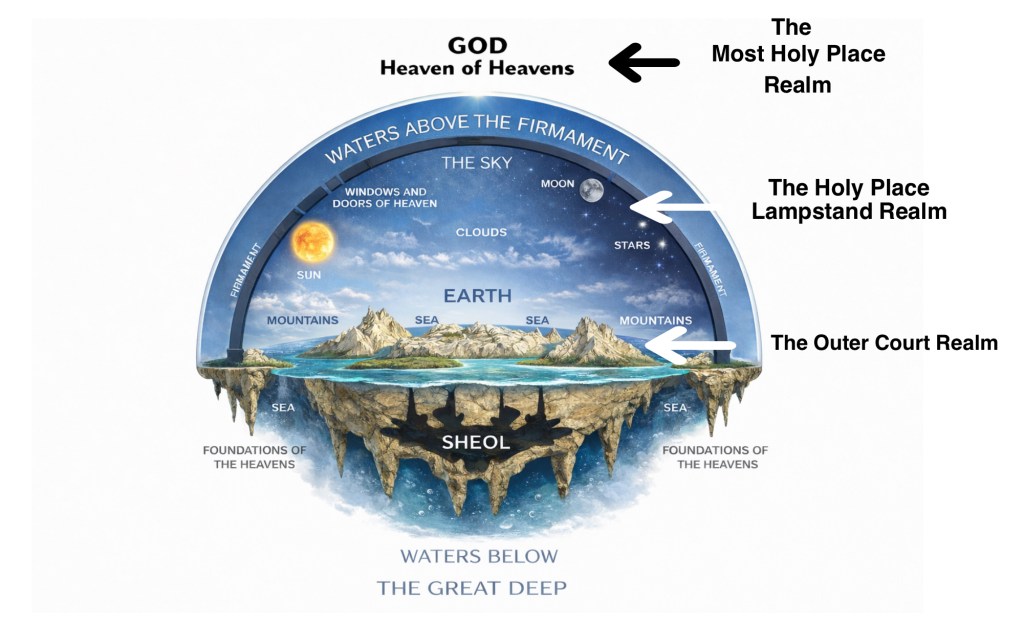
This created world is first a sanctuary. “Heaven is My throne, and earth is My footstool” (Isaiah 66:1; Acts 7:49). Above the firmament is the heaven of heavens, the throne-room of God, and the Heavenly Jerusalem; beneath the firmament stretches the visible sky with its sun, moon, and stars; below that sky rise the seas and the dry land, called “earth.” The structure is temple-like. The highest heaven beyond the firmament corresponds to the most holy place where the city of God and His throne stands. The visible heavens, with their lights set in the firmament, correspond to the holy place where priestly lamps shine. The earth beneath, with its seas and lands and peoples, corresponds to the outer court where creation draws near. The tabernacle is not an architectural invention but a miniature copy of this already-given pattern: a veiled realm above, a lamp-filled inner space, and an outer court on earth (Exodus 25:8–9; 1 Kings 8:27; Hebrews 8:5). From the beginning, then, the cosmos is arranged as a tabernacle in which God will dwell with His sons and daughters along with all His creatures—a cosmic sanctuary ordered for His presence.
Here we are viewing the tabernacle pattern at the widest, cosmic scale: the heaven of heavens as the most holy place, the visible heavens as the holy place, and the earth as the outer court of God’s great house. Within this highest heaven stands the Heavenly Jerusalem, “the city of the living God,” the concentrated center of His dwelling and government (Hebrews 12:22–23). Just as the temple in earthly Jerusalem contained the most holy place where God’s glory dwelt between the cherubim, so the heaven of heavens—the Third Heaven—houses the Heavenly Jerusalem as the true sanctuary of His throne. The Royal Priesthood will not simply enter “heaven” in a vague sense, but the specific city where the throne of God stands and where the church of the firstborn is enrolled. In the Eighth Day this city will be revealed as the chief mountain above all mountains, the center from which law and light go forth to the renewed earth (Isaiah 2:2–3).
Yet this sanctuary is also a womb. When God divides the waters and establishes the firmament in their midst, He forms a hollow, protective chamber in which life can be conceived, nurtured, and brought to birth. The “great deep” surrounds creation like waters around a child, while the firmament arches over it like a protective membrane. Scripture itself reaches for birth language to describe God’s work with the world. The sea is pictured as a newborn pushed out from the womb and wrapped in clouds as swaddling cloths (Job 38:8–9). Israel is warned not to forget “the God who fathered you” and “the God who gave you birth” (Deuteronomy 32:18). The prophets liken Zion to a woman in labor and speak of the earth casting out the dead as from a womb (Isaiah 26:17–19; 66:7–9). The Apostle says that “the whole creation groans and labors with birth pangs together until now,” waiting for “the revealing of the sons of God” (Romans 8:19–22). The Lord Jesus Himself compares the anguish of the present time to a woman in travail whose sorrow turns to joy when “a human being has been born into the world” (John 16:21).
Isaiah sees this womb-sanctuary brought to its decisive moment when Zion’s labor suddenly gives way to birth: “Before she was in labor, she gave birth; before her pain came, she delivered a male child.… Shall the earth be made to give birth in one day? Or shall a nation be born at once?” (Isaiah 66:7–8). In the light of the Lord’s words about the “hour” when all who are in the graves will hear His voice and come forth (John 5:28–29), this prophecy points to the resurrection of life as the moment when a holy nation is brought forth in a single divine act (1 Peter 2:9). In one hour of resurrection, the sons and daughters whom God has been forming in the hidden womb of this present evil age are openly born into the upper sanctuary, and the womb of creation begins to yield the firstfruits of the new creation.
When we place these witnesses alongside Genesis 1, the imagery coheres. The world between the waters is a holy place in which God walks with His creatures, and at the same time a sheltered inner chamber in which He forms sons and daughters for Himself. Within this womb-sanctuary the Father orders the ages, governs their events, and permits even suffering and groaning as birth pangs, in view of a coming delivery. In this present evil age, the sons are being inwardly conceived and fashioned in Christ; at the appearing of the Lord Jesus, in the universal resurrection, they will be brought forth openly. Those who have yielded to His forming work in this age will be ‘born’ through the resurrection of life into the upper, heavenly realm—into the true inner sanctuary of the Heavenly Jerusalem in the heaven of heavens. Those who resisted His work will still be brought forth in that same hour, but into the resurrection of judgment, remaining within the lower regions of the creation-womb until the sabbath fire has done its purifying work.
Thus creation is not a neutral backdrop but a living pattern. As sanctuary, it tells us that God intends to dwell with His creatures and to order everything around His throne. As womb, it tells us that the story of the ages is a story of gestation and birth, of sons and daughters being formed in concealment and then revealed in glory. We are children carried within a God-formed chamber between the waters, awaiting the day when the labor of the ages will give way to the joy of the new creation.
Eden as Garden-Sanctuary and Microcosm of the Heavenly Jerusalem
Within this created order, Scripture shows that the Father’s purpose comes into focus not in the stars or seas themselves, but in a son. After telling us that God made “the heavens and the earth,” Genesis narrows its gaze to a single man formed from the ground and then set in a garden at the center of the world. The genealogy of the Lord Jesus reaches back to this man and names him “Adam, the son of God” (Luke 3:38), confirming that creation was fashioned as the realm entrusted to a son. The heavens and the earth are first ordered as the works of His hands; then a son is placed within them to bear His image, keep charge of His dwelling, and exercise royal-priestly care over what He has made.
Genesis 2 then shows where this son is set to live and serve. “The LORD God planted a garden eastward in Eden, and there He put the man whom He had formed” (Genesis 2:8). Eden is not merely a pleasant orchard; it is a garden-sanctuary where God walks, speaks, and communes with Adam and Eve in unbroken fellowship (Genesis 3:8). A river flows out of Eden to water the garden and then divides, echoing later images of “a river whose streams shall make glad the city of God, the holy place of the tabernacle of the Most High” (Psalm 46:4). Trees pleasant to the sight and good for food grow there, including the tree of life in the midst of the garden (Genesis 2:9).
This river motif is itself part of the sanctuary pattern. The river that flows from Eden to water the garden and then divides into four heads (Genesis 2:10–14) anticipates the river that flows from under the threshold of the temple in Ezekiel’s vision, deepening as it goes and bringing life and healing wherever it turns (Ezekiel 47:1–12). In both scenes the source is the place of God’s presence, and the river carries the life of that presence outward to the wider world. Eden, the temple, and the Heavenly Jerusalem thus share a single design: God dwells in the midst, and from His dwelling a river of life goes forth to renew creation.
This garden is the first earthly microcosm of the Heavenly Jerusalem—the place where God’s presence, life, and rule are concentrated. The temple later built in Jerusalem takes up Edenic imagery: carved palm trees and cherubim, lampstands like almond trees, a most holy place guarded by cherubim (1 Kings 6–7). The prophets, in turn, describe the future dwelling of God with His people in Edenic terms—abundant water, fruitful trees, and the removal of curse. Eden is therefore both a real historical garden and a seed-form glimpse of the Heavenly Jerusalem, which will one day stand as the chief mountain above the mountains of the renewed earth in the Eighth Day (Isaiah 2:2).
The guarded structure of Eden also anticipates the distinction between life and judgment that runs through Scripture. After the fall, cherubim with a flaming sword guard the way to the tree of life (Genesis 3:24). Access to life is not denied forever, but it is closed to the corrupted state of Adamic flesh. This guarded way foreshadows what the Lord Jesus later calls “entering into life” and what He contrasts with being “cast out” or consigned to “outer darkness” (Matthew 7:14; 8:12). In seed-form, Eden shows that entrance into God’s immediate presence is both gift and responsibility; those who would dwell in the inner sanctuary must be conformed to the holiness of the One who dwells there.
Eden thus stands as the first earthly reflection of the Heavenly Jerusalem and as a pattern of the inner and outer realms that will later be seen in the tabernacle, the temple, and, in the Eighth Day, the renewed earth under the light of the heavenly city of God.
Adam and Eve as Prototype of Christ and the Church of the Firstborn
Genesis 1–2 presents humanity not as an afterthought, but as the crown of creation. “Then God said, ‘Let Us make man in Our image, according to Our likeness; let them have dominion…’” (Genesis 1:26). Adam is formed from the dust of the ground, and God breathes into his nostrils the breath of life, and he becomes a living soul (Genesis 2:7). Eve is then fashioned from Adam’s side and brought to him as a partner fit for him (Genesis 2:21–23). In their literal history, Adam and Eve are the first husband and wife, given a mandate to be fruitful, multiply, fill the earth, and exercise dominion under God (Genesis 1:28).
The Apostles, however, teach us to see more. Adam is a “type of Him who was to come” (Romans 5:14), and the Lord Jesus is the “Last Adam” and the “second Man” (1 Corinthians 15:45–49). Eve, taken from Adam and brought back to him, foreshadows the church of the firstborn, taken from Christ and united to Him bone of His bones and flesh of His flesh. Paul explicitly cites Genesis 2:24 and says that this “is a great mystery, but I speak concerning Christ and the church” (Ephesians 5:31–32; Hebrews 12:23). In Adam we see, in seed-form, the royal-priestly head who is meant to bear the image of God and mediate His rule to creation. In Eve we see, in seed-form, the corporate bride who is to share his life and vocation. The Lord Jesus, as the faithful Last Adam, fulfills what the first Adam failed to complete. The church of the firstborn, formed in this age by the Spirit’s work, becomes the corporate “Eve” joined to Him in resurrection and glory. Yet, as noted earlier, not all humanity becomes this firstborn assembly; the nations will be restored under His headship without all being made the bride or the inner-sanctuary body.
Adam and Eve therefore function as the prototype of Christ and the church of the firstborn. Their story anticipates both the tragedy of the fall and the greater glory of the One who will come, obey, suffer, die, rise, and be joined to a people who share His nature and His priestly work in the ages to come.
The Image of God: Identity and Vocation
The declaration that humanity is made “in the image of God, according to His likeness” (Genesis 1:26–27) stands at the center of this pattern. The image has both an ontological and a functional aspect. Ontologically, it speaks of what humanity is—a creature uniquely fashioned to reflect and represent the Creator. Other creatures are made “according to their kind” (Genesis 1:24–25), but humanity is made according to God’s likeness. This does not mean that humans are divine, but that they are designed to mirror the divine character in a way no other earthly creature does.
Functionally, the image speaks of what humanity is called to do. The very verse that declares the image immediately speaks of dominion: “let them have dominion…” (Genesis 1:26). Humanity bears God’s image in order to exercise God’s rule under Him. As God governs the cosmos, so humanity is called to govern the earth as His vice-regent, stewarding creation according to His wisdom and righteousness (Psalm 8:4–6). The royal and priestly vocation we have traced is thus grounded in the image: to be the image is to represent the King and to mediate His presence to creation.
The fall mars but does not erase the image. After the flood God says, “Whoever sheds man’s blood, by man his blood shall be shed; for in the image of God He made man” (Genesis 9:6). James warns against cursing “men, who have been made in the likeness of God” (James 3:9). Even in its fallen state, humanity retains enough of the image to require reverent regard and to bear responsibility. The mirror is cracked, but it still reflects.
The goal of redemption is the restoration and perfection of the image in Christ. He is “the image of the invisible God” (Colossians 1:15), the perfect representation of the Father that Adam was meant to be and failed to become. Those whom God foreknew He “predestined to be conformed to the image of His Son, that He might be the firstborn among many brethren” (Romans 8:29). As believers behold the glory of the Lord, they “are being transformed into the same image from glory to glory” by the Spirit (2 Corinthians 3:18). In the resurrection of life this transformation is completed; the faithful bear “the image of the heavenly Man” (1 Corinthians 15:49) and exercise the royal-priestly vocation that Adam forfeited, not as isolated individuals but as the corporate new Man in Christ.
The Church’s Royal and Priestly Vocation
The purpose of creation cannot be separated from the vocation given to Adam. From the outset, humanity is created to be both royal and priestly. On the sixth day God says, “Let Us make man in Our image, according to Our likeness; let them have dominion” (Genesis 1:26), and He blesses the man and the woman with the mandate to “be fruitful and multiply; fill the earth and subdue it; have dominion” (Genesis 1:28). These words establish Adam and Eve as royal image-bearers, exercising dominion that reflects God’s character. Dominion is not licensed tyranny; it is stewardship under God, representing His righteous rule over the works of His hands (Psalm 8:4–6). Humanity was created to shape the world according to divine wisdom, to order creation in harmony with God’s will, and to reflect His likeness throughout the earth.
At the same time, Genesis 2 presents humanity in priestly terms. Adam and Eve are placed in the garden “to work it and to guard it” (Genesis 2:15, literal). The Hebrew verbs “tend” or “serve” (ʿābad) and “keep” or “guard” (shāmar) later appear together in the Levitical calling: the Levites “shall attend to the needs… before the tabernacle of meeting, to do the work of the tabernacle… and… keep all the furnishings” (Numbers 3:7–8). In the Levitical order these verbs describe a priestly ministry of service and guardianship in God’s tabernacle; the Levites serve and guard, but they are not given dominion over Israel or the nations. The royal dimension of humanity’s calling appears instead in the commission to “subdue” the earth and “have dominion” (Genesis 1:28), language that later rests on the kingly line in the tribe of Judah rather than on the tribe of Levi. Thus, in Adam, the two strands are present together in seed-form: priestly service and guardianship in God’s sanctuary, and royal dominion over the earth. The Levitical priesthood temporarily carries the priestly strand, and the kingship in Judah carries the royal strand. Taken together, these creation mandates foreshadow the Melchizedekian Priesthood brought to fullness in the Last Adam, the Lord Jesus—the true Priest and King—in whom the Royal Priesthood is formed (Psalm 110:4; 1 Peter 2:9).
This priestly reading of Genesis also clarifies the weight of Adam’s failure. He is not merely a private individual disobeying a command; he is the first priest of the cosmic sanctuary, charged to guard the garden from defilement. When the serpent enters and speaks, Adam is “with” his wife (Genesis 3:6); he hears the intrusion and does not silence it. He does not guard the sanctuary, does not protect his bride, does not preserve the holiness of God’s dwelling. The priest fails at the very point of his calling. In response, God appoints other guardians: “He placed cherubim at the east of the garden of Eden, and a flaming sword which turned every way, to guard the way to the tree of life” (Genesis 3:24). The same verb shāmar is used; the cherubim now guard what Adam failed to guard. The way to the tree of life remains real but is closed to Adamic corruption until a faithful Priest opens it again. The Lord Jesus, the Last Adam and true High Priest, keeps perfectly what the Father commits to Him: “Of those whom You gave Me I have lost none” (John 18:9). Where Adam’s unfaithfulness closed the way, His obedience opens it.
Genesis not only tells us what Adam was to do in the garden; it also shows us how he came to stand there. The LORD first formed Adam from the dust of the ground, and only afterward did He take the man and place him in the garden of Eden “to serve it and to guard it.” In this movement—from formation out of the ground to placement within the sanctuary—God discloses the pattern of sonship and inheritance. The man is taken from the realm in which he was formed and then set within the set-apart garden to bear God’s image, exercise His rule, and guard His sacred garden-sanctuary. In seed-form, this is a picture of huiothesia (υἱοθεσία), the placement of a son—commonly rendered “adoption”—into his appointed inheritance. Adam, formed from the dust of the ground and placed into the garden-sanctuary, anticipates the greater mystery in Christ, in whom faithful believers will be taken out of Adamic humanity, formed anew in Christ by the Holy Spirit, and, at the resurrection of life, placed in the Heavenly Jerusalem as sons and daughters with priestly responsibility for the creation.
The timing of Adam’s formation and commission also carries a quiet prophecy. Adam is formed on the sixth day, at the climax of God’s work (Genesis 1:26–31), and then God sanctifies the seventh day as His rest (Genesis 2:1–3). In this sequence, Adam’s charge to work and guard the garden stands on the far side of the completed creation week: he is formed on the sixth day, brought into God’s sabbath rest on the seventh, and then set to his priestly task as a new week begins, hinting at the Eighth Day. In seed-form, this foreshadows the greater mystery revealed in Christ and the church of the firstborn: across the “sixth day” of this present evil age the Last Adam is completing His body; the church of the firstborn will enter God’s sabbath rest in the Seventh Day; and then, when that Day has completed its purifying and ordering work, they will step into the full exercise of royal-priestly ministry toward the nations in the Eighth Day (typology in Leviticus 8–9), ministering before God in the Heavenly Jerusalem and serving in the renewed creation (Ephesians 5:23–32; Hebrews 12:23).
This hint of the Eighth Day is also completed in the crucifixion and resurrection of the Lord Jesus. It is no accident that John tells us, “Now in the place where He was crucified there was a garden, and in the garden a new tomb” (John 19:41). Adam was expelled from the first garden because he reached out his hand to a tree in disobedience, and from that moment the way to the tree of life was guarded and closed. The Lord Jesus, the Last Adam, is lifted up on a tree in a garden, not to grasp but to obey, bearing in His own body the sin and curse that the first man brought in. In Eden, garden and tree became the place of fall, death, and exile; at Golgotha, garden and tree become the place where sin is judged, death is entered and overcome, and the way to Paradise is opened again. There, in a garden and on a tree, the Last Adam reverses the story of the first. He dies in a garden and is laid in a new tomb so that on the first day of the week—a day that both begins a new week and anticipates the Eighth Day—a new creation may begin, with a new Man in a garden, and with the promise that those who belong to Him will one day be placed not merely in an earthly Eden, but in the Paradise of God and the Heavenly Jerusalem.
John adds a detail that deepens this pattern. When Mary Magdalene encounters the risen Lord near the tomb, “she, supposing Him to be the gardener,” speaks to Him without recognizing who He is (John 20:15). In one sense she is mistaken; in another, her words are truer than she knows. The first Adam was set in a garden to tend and guard it and failed; the Last Adam rises in a garden as the true Gardener, the One who will tend and keep the new creation and will bring His people into participation in His own life—the very life that the tree of life in Eden foreshadowed. Likewise, when He says to the repentant thief, “Today you will be with Me in Paradise” (Luke 23:43), He uses the word that in the Greek Old Testament names the garden of Eden. On the very day He dies, the Lord opens the way back to the Paradise that was closed in Genesis 3. In this way, the garden of Eden, the garden of the tomb, and the Paradise of God belong to one story, and the Last Adam stands at their center.
Humanity was created to function as the priesthood of creation, serving before God, shaping the world according to divine wisdom, and reflecting His image throughout creation. Yet this ancient royal and priestly vocation, entrusted to humanity as a whole, is shattered by the fall. Adam does not keep the garden; he fails to guard its holiness and to silence the serpent’s voice. The priest of creation becomes disqualified, and the royal image is marred. From that point onward, Scripture shows God narrowing and restructuring this calling: first in Israel, called to be “a kingdom of priests and a holy nation” (Exodus 19:6), and finally in the Lord Jesus Himself, the faithful Last Adam and true Firstborn. In Him the royal and priestly vocation is not merely restored but elevated. He becomes “the firstborn from the dead” and the head of a new creation (Colossians 1:18; 1 Corinthians 15:45–49).
The church of the firstborn, united to Christ in this present evil age, is therefore the first and highest outworking of humanity’s ancient calling. Those who answer the upward call of God in Christ Jesus (Philippians 3:14) and persevere in obedient faith do not merely regain what Adam lost; they receive the firstborn inheritance together with the Lord Jesus. They are formed as a celestial Royal Priesthood—an inner-sanctuary people who will share the Lord’s priestly and kingly ministry in the Heavenly Jerusalem and serve toward the restored creation in the Eighth Day (Hebrews 12:22–23; 1 Peter 2:9–10). By contrast, those who neglect or despise this upward call in this age forfeit the firstborn portion, as Esau traded his birthright for a single meal and afterward “found no place for repentance, though he sought it diligently with tears” (Hebrews 12:16–17). Their story is not annihilation but loss: the loss of the firstborn inheritance, the inner-court priesthood in union with the Firstborn.
Later chapters will show that God nevertheless restores the unfaithful through the measured judgments of the Seventh Day and appoints them to a terrestrial priestly service in the Eighth Day, corresponding to the outer-court priests typified in the Levitical order, while the renewed nations receive life and instruction through this priestly ministry. But the pattern begins here in seed-form. Creation reveals humanity’s original royal and priestly identity; the fall reveals the forfeiture of the unblemished firstborn portion; and the gospel reveals that in Christ the Father is forming, in this age, a church of the firstborn who will bear the inner-sanctuary Royal Priesthood in the Eighth Day.
Creation Week as Prophecy of the Ages
Creation itself establishes the architecture of the ages. God formed the world in six days and rested on the seventh (Genesis 2:2–3). Unlike the first six days, the seventh day is never closed with the formula “and the evening and the morning,” signaling that God’s rest extends beyond ordinary temporal boundaries. Its open ending anticipates the Eighth Day of new creation—when night will be no more and creation will enter unfading light.
This sabbath pattern reveals not merely a weekly rhythm but the divine pattern of history. Scripture speaks of “this present evil age” (Galatians 1:4) and of “the ages to come” in which God will show the exceeding riches of His grace (Ephesians 2:7). When the creation week is heard in this light, it foreshadows six long days of human labor and testing, followed by the Seventh Day as an age of rest and judgment, and finally the Eighth Day of new creation when death is abolished and God is all in all (1 Corinthians 15:24–28). The six days of work, the sanctified seventh day, and the hinted Eighth Day together form the pattern by which God brings His purpose to completion.
The Torah’s sabbath ultimately points to the Lord Jesus, who is Himself our Sabbath rest. Those who, in this age, enter His rest through persevering faith, obedient love, and the crucifixion of the flesh by the Spirit (Romans 8:13; Galatians 5:24) will enter the rest of God in the Seventh Day. These are the ones who “cease from their works as God did from His” (Hebrews 4:10), for they have learned to abide in the Lord Jesus and to walk in the Spirit rather than in the passions of the old man. Having entered His rest, they will never again encounter the darkness of night, for their inheritance is the glory of the Heavenly Jerusalem above.
By contrast, those who refuse this rest—who cling to the flesh, love the present world, and resist the sanctifying work of the Spirit—will experience the “outer darkness” during the Seventh Day. Their refusal to enter Christ’s rest in this age leaves them unprepared for the rest of God in the Age to Come. They remain on the earth below, outside the light of the Heavenly Jerusalem, undergoing the corrective judgment appointed for the unfaithful and ungodly. In that realm of “outer darkness” and fire, the Adamic corruption they refused to crucify is finally purged, for the holiness of God requires that nothing unclean enter His new creation (Matthew 10:28).
The Torah’s rituals further develop this pattern. Circumcision on the eighth day (Genesis 17:12) foreshadows the decisive cutting away of the Adamic nature in the Eighth Day, when all corruption is removed and restored humanity receives incorruptible terrestrial bodies. The consecration of Aaron and his sons for seven days, followed by their entrance into ministry on the eighth (Leviticus 8–9), prefigures the faithful who, after receiving glorified celestial bodies at the appearing of the Lord Jesus, complete their sevenfold consecration pattern in the sabbath rest of the Seventh Day and then enter their Royal Priesthood toward the nations in the Eighth. The cleansing and reentry of the leper on the eighth day (Leviticus 14), along with the laws regarding bodily impurities that require an eighth-day ritual (Leviticus 15), reinforce the symbolism: the Eighth Day is the day of full restoration, cleansing, and reintegration into God’s kingdom.
The Sixth Day and the New Creation Man
Adam is created on the sixth day, at the climax of God’s work (Genesis 1:26–31). In seed-form, this foreshadows the formation of the church of the firstborn in this present age, as the Spirit conforms a people called out from this world to the image of Christ (Romans 8:29; Galatians 4:19). The Lord Jesus repeatedly speaks of raising His own “at the last day” (John 6:39–40, 44, 54) and declares that in the resurrection “hour” all who are in the graves will hear His voice and come forth—those who have done good to the resurrection of life, and those who have done evil to the resurrection of judgment (John 5:28–29).
As Adam was formed on the sixth day and then entered God’s rest on the seventh, so the faithful are formed in Christ in this present age and, at its close, are raised in the resurrection of life and gathered into the sabbath rest of the Seventh Day (Hebrews 4:4–11; Philippians 3:20–21). In that same “hour” the unfaithful and the ungodly also rise, but not into sabbath rest; they enter the resurrection of judgment and undergo the searching fire of the Age to Come. The resurrection therefore reveals the full stature of the “new creation Man” in the strict sense—the Lord Jesus and the faithful joined to Him—while also exposing and beginning to purge, through the judgments of the Seventh Day, the corruption that still clings to those who refused His sanctifying work in this present evil age.
Thus the sixth day foreshadows both the formation of the faithful and the threshold of the universal resurrection. What God completes at the end of the sixth day, He brings into rest on the seventh. What He forms in Christ in this age, He brings into glory—and, for the unfaithful and ungodly, into refining judgment—at the dawning of the Age to Come.
Creation’s Groaning and the Destiny of Humanity
Creation was never intended to remain under corruption. Paul writes that creation “was subjected to futility… in hope,” and that it will be delivered into “the freedom of the glory of the children of God” (Romans 8:20–21). That hope is not escape from creation, but the liberation and renewal of creation. The destiny of the created order is bound up with the destiny of Adam’s race, and above all with the faithful sons whom God brings to glory (Romans 8:19–23; Hebrews 2:10).
From the beginning, humanity was created to be God’s dwelling place and temple in creation. The Lord Jesus identified His body as the true temple (John 2:21), and the Apostles call both the individual believer and the corporate church the temple and dwelling place of God in the Spirit (1 Corinthians 6:19–20; 2 Corinthians 6:16; Ephesians 2:20–22). Scripture also distinguishes the threefold structure of human existence: “spirit and soul and body” (1 Thessalonians 5:23), and the Word of God pierces “even to the division of soul and spirit” (Hebrews 4:12). In the light of the tabernacle pattern, this threefold structure may be seen in priestly and eschatological relation to the sanctuary. The body, fashioned from dust (Genesis 2:7), corresponds to the outer court—the visible aspect of our existence that engages creation. The soul corresponds to the holy place—the inward chamber of thought, desire, and affection. The spirit corresponds to the most holy place—the Godward depth in which the Spirit bears witness that we are children of God (Romans 8:16).
Just as Eden was the first garden-sanctuary set upon the earth, so the human person is a living sanctuary in miniature, a living stone called to be built together with others into the true Temple of God in the Age to Come (Ephesians 2:20–22). The fall corrupts this structure but does not erase the design. In this present evil age, God begins His restoring work inwardly: He first begets and renews the spirit by the regeneration of the Holy Spirit, washing, sanctifying, and justifying the believer freely in Christ (John 3:3–6; Titus 3:5; 1 Corinthians 6:11). On the foundation of this free gift, He then works—through the Spirit of grace and our obedient cooperation—to save the soul, reshaping the mind, affections, and will into the likeness of His Son (Romans 8:29–30; James 1:21; 1 Peter 1:9). At the appearing of Christ, the faithful, whose spirits have been begotten and whose souls have been transformed through endurance and obedience, are raised in the resurrection of life; their whole spirit and soul and body are conformed to His image and made a fit inner sanctuary (naos) to be filled with the fullness of God in the Seventh Day (Philippians 3:20–21; 1 Corinthians 15:49–53; Ephesians 3:19; 1 Thessalonians 5:23).
In accordance with the sanctuary pattern revealed in the Torah, God brings about an ordered restoration. The faithful, raised in the resurrection of life, enter glory in the Seventh Day as celestial sons and become the inner sanctuary (naos) of the true Temple of God, forming the Royal Priesthood (Ephesians 2:20–22; Philippians 3:20–21; 1 Peter 2:4–10). The unfaithful believers restored from judgment are appointed to a terrestrial priestly service in the Eighth Day, corresponding to outer-court priests typified by the Levitical ministry given to the sons of Aaron (Numbers 3:9; 8:19), while the restored nations dwell upon the renewed earth and receive life, light, and instruction through this priestly order (Isaiah 2:2–4; Isaiah 60:1–3; Romans 8:21). Paul’s distinction between “celestial bodies” and “terrestrial bodies,” each with its own glory (1 Corinthians 15:40–42), confirms that resurrection itself admits of differing orders; both are real, both are immortal, but the glory and sphere of service differ according to God’s wise appointment. These priestly distinctions arise not from speculation but from the design of the tabernacle of Moses and the arrangement of the encampment around it: to Aaron and his sons the inner ministry is given, to the Levites the outer-court service, and around them the tribes foreshadow the restored nations on the renewed earth.
In this way, creation’s groaning is not a sign that God’s purpose has failed, but that it is still in process. The same order that was inscribed in the first chapters of Genesis is brought to its goal through the resurrection of life, the resurrection of judgment, the sabbath fire of the Seventh Day, and the full restoration of the Eighth. When, at last, death is abolished and God is all in all, the renewed creation—populated by celestial sons, terrestrial priests, and restored nations—will stand as a living testimony that His judgments were precise, His compassion unfailing, and His purpose of restoration unwavering.
Apostolic Witness: Ephesians and the Purpose of Creation
When we turn from Genesis to the Apostolic writings, we find that the Spirit does not set aside the creation pattern, but brings its hidden meaning into the open. What this chapter has traced in seed-form from Genesis 1–2, the letter to the Ephesians declares in plain speech. The counsel that stands behind “In the beginning God created the heavens and the earth” (Genesis 1:1) is the same counsel Paul describes when he says that God “chose us in Him before the foundation of the world” and works “all things according to the counsel of His will” (Ephesians 1:4, 11). Before the ages are framed and ordered in history, the “purpose of the ages” already stands complete in the heart of God, centered in His Firstborn.
Ephesians also confirms that this purpose is not vague or impersonal. The same God who by His word said, “Let there be light” (Genesis 1:3), has shone in our hearts in Christ. Paul blesses “the God and Father of our Lord Jesus Christ, who has blessed us with every spiritual blessing in the heavenly places in Christ” (Ephesians 1:3), and then unfolds what Genesis showed in picture: those who once walked “according to the course of this world” and were “darkness” are now “light in the Lord” and are called to walk as “children of light” (Ephesians 2:2; 5:8). The separation of light from darkness on the first day finds its fulfillment as God calls a people out of the night of this age and into the light of His Son.
The creation account also set before us humanity as the royal-priestly head of creation in Adam, and the mystery of the bride taken from his side in Eve. Ephesians takes up this pattern directly. Christ is exalted as “head over all things to the church, which is His body” (Ephesians 1:22–23), and the union of husband and wife in Genesis 2:24 is called “a great mystery… concerning Christ and the church” (Ephesians 5:31–32). What appeared in the garden as one man and one woman, given a shared vocation to bear God’s image and exercise His rule, is revealed in Ephesians as the Last Adam and the church of the firstborn, the one new Man formed in Him (Ephesians 2:15–16).
In Genesis, the cosmos was ordered as a sanctuary—a throne above, a footstool below—into which God would place a priestly people. Ephesians declares that this design now comes to fulfillment in Christ and His body. Believers are seated with Christ “in the heavenly places” (Ephesians 2:6), and the church is being built together as “a holy temple in the Lord… a dwelling place of God in the Spirit” (Ephesians 2:21–22). The heavenly sanctuary hinted at in the distinction between the “heaven of heavens” and the earth (Deuteronomy 10:14) is now revealed as the realm in which the Lord Jesus ministers as High Priest and into which the faithful will be gathered as His Royal Priesthood.
Finally, Ephesians confirms that the creation week truly was the pattern of the ages. Paul speaks of “this present evil age” elsewhere (Galatians 1:4), but in Ephesians he looks ahead to “the ages to come” in which God will show “the exceeding riches of His grace in His kindness toward us in Christ Jesus” (Ephesians 2:7). He speaks of a “dispensation of the fullness of the times” in which God will “gather together in one all things in Christ” (Ephesians 1:10), and of the “purpose of the ages” accomplished in Him (Ephesians 3:11, literal). These phrases take up what Genesis declared in figure by six days of work, the sanctified seventh day, and the hinted Eighth Day beyond that rest: an ordered history in which God brings His sons and daughters to glory, restores creation, and displays His manifold wisdom “to the principalities and powers in the heavenly places” by the church (Ephesians 3:10).
Seen together, Genesis and Ephesians speak with one voice. Genesis 1–2 draw the blueprint in seed-form through works and patterns; Ephesians opens the scroll and reads that blueprint aloud. The Apostolic witness does not contradict the seed-forms traced in this chapter; it confirms and deepens them. It shows that the purpose of creation, the calling of humanity, the pattern of the ages, and the destiny of the church of the firstborn were present in God’s counsel from the beginning and are now being brought to light in Christ.
Conclusion
The Purpose of Creation as the Pattern of the Ages
Creation reveals humanity’s identity, purpose, and destiny. It establishes the earth as the footstool-realm of God’s cosmic sanctuary, destined to become the outer-court realm of His renewed order in the Eighth Day (Isaiah 66:1; Acts 7:49; 2 Peter 3:13). It presents Eden as a garden-sanctuary where Adam is placed to serve God as royal-priestly representative (Genesis 2:15; Numbers 3:7–8). It unveils Adam as the type of the Last Adam and Eve as the type of the church of the firstborn, taken from Adam and brought to him, destined to share his royal-priestly vocation (Romans 5:14; 1 Corinthians 15:45–49; Ephesians 5:31–32; Hebrews 12:23). It inscribes in the six days and the sanctified seventh the pattern of the ages, hinting at the Eighth Day of new creation beyond death and corruption (Genesis 2:1–3; Hebrews 4:4–11; Isaiah 25:8; 1 Corinthians 15:24–28). And it shows that creation itself is a cosmic womb in which God forms and reveals His sons and daughters through the purposed ages conceived in His counsel before the foundation of the world (Romans 8:19–23; Ephesians 1:4; Hebrews 2:10).
Understanding creation in this way is essential for every doctrine in Scripture. Without this typological pattern, resurrection, judgment, salvation, priesthood, Gehenna, and restoration become disjointed and confused. But when creation is seen as the first unveiling of the purpose of the ages, the narrative becomes coherent. From before the foundation of the world, the Father purposed to form a family of priestly sons and daughters in His Firstborn, to bring creation into harmony with His character, and to display His manifold wisdom to the heavenly powers through the church (Ephesians 1:4; Ephesians 3:10; Romans 8:29; Hebrews 2:10).
Yet the story does not remain in the innocence of Eden. Before the destiny foreshadowed in creation can be fulfilled, Scripture reveals the catastrophic rupture introduced through Adam’s disobedience. The purpose embedded in creation’s design comes into clearest focus when we see the depth of the fall, the corruption of the earth, and the rise of satanic rule. Only then do the redemptive ages—the present evil age, the Seventh Day of rest and judgment, and the Eighth Day of new creation—appear in their true necessity and glory.
The next chapter therefore turns to the fall and its consequences, pressing three questions. How deep is the corruption that Adam introduced—does it touch only human behavior, or does it reach the very structure of human nature and the creation entrusted to him? What powers now rule this present evil age, and by what right do they exercise their dominion? And why are the measured judgments of the Seventh Day necessary before the restoration of the Eighth Day can be complete? Only when we have faced the ruin in its full extent will we be prepared to understand the remedy, and to see how the God who inscribed His purpose in creation will overturn the rebellion of the beginning and bring His design to its appointed end.
 Restoration Theology Press