
Updated 5/25/2026
The Gift, the Prize, and the Urgency of Faithfulness in This Present Age
If everyone is eventually restored—and Scripture teaches that they are—then why does that same Scripture place such an urgent emphasis on faithfulness in this present age?
This is a question many who affirm universal restoration have never seriously reckoned with. And the answer Scripture gives is far more searching than most expect.
God is not simply saving everyone now. He is calling out a faithful firstfruits company of sons and daughters, conformed to the image of His faithful Firstborn Son (Romans 8:29), right now, in the midst of this present evil age, for a glorious purpose (1 Peter 2:9).
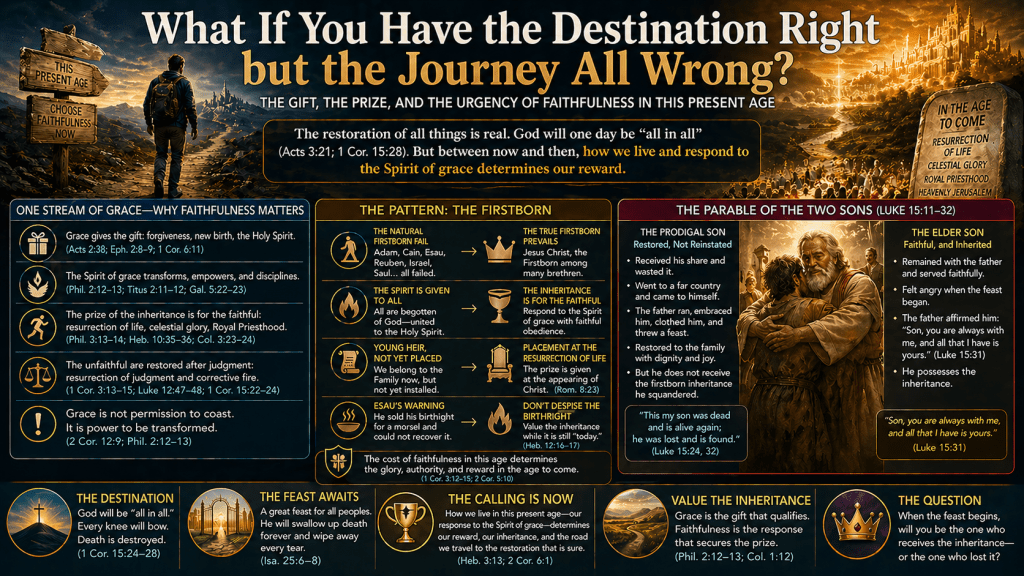
The restoration of all things is real. God will one day be “all in all” (Acts 3:21; 1 Corinthians 15:28). But so is the calling. So is the prize. Scripture speaks not only of salvation as a free gift—the forgiveness of sins, the begetting of the spirit, and the indwelling of the Holy Spirit freely given (Acts 2:38; Ephesians 2:8–9; 1 Corinthians 6:11)—but of the prize of the inheritance: the resurrection of life, celestial glory, and participation in the Royal Priesthood at the Heavenly Jerusalem (Philippians 3:13–14; Colossians 3:23–24; Hebrews 10:35–36). The gift is what God does for us and in us in this present age that qualifies us for the inheritance (Colossians 1:12). The prize is what the faithful receive at His appearing in the Age to Come based on their response to God’s transforming work of grace. And between the two stands the salvation of the soul—the present work of the Spirit transforming believers from within—which determines whether they enter the resurrection of life or arrive at restoration by the far harder road of the resurrection of judgment (Matthew 16:25–26; 1 Peter 1:9; James 1:21; Hebrews 10:39; John 5:28–29).
There is a distinction between those who respond to the Spirit of grace with faithful obedience and those who presume upon mercy while bearing no fruit (John 15:1–6; 2 Corinthians 6:1). The Lord Jesus Himself warned that of the many who are called, only a few are chosen (Matthew 22:14), and Paul pressed forward toward the goal precisely because he knew the prize was not automatic (1 Corinthians 9:24–27).
Universal restoration is not the whole story. It is the end of the story. But between now and then, there is a calling that demands everything, and how each person lives and responds to the Spirit of grace in this age determines whether they stand among that firstfruits company or arrive at restoration only after passing through the fires of divine correction (1 Corinthians 3:13–15).
Grace is not permission to coast. It is power to be transformed (2 Corinthians 12:9; Titus 2:11–12). The Spirit of grace is working in believers “both to will and to do for His good pleasure” (Philippians 2:13), but they must work out their salvation with fear and trembling (Philippians 2:12).
If your universalism has no urgency, no calling, no cost—you may have the destination right but the journey all wrong.
One Stream of Grace—So Why Does Faithfulness Matter?
If it is all grace, why does our response matter? This is where most universalists—and most Christians generally—get confused. They assume that if God’s grace is doing the work, then faithfulness is either irrelevant or it is legalism. But Scripture presents something far more nuanced and far more serious than either of those options.
From beginning to end, there is one stream of grace. The same grace that called Israel out of Egypt was meant to bring them into the promised land. The same grace that calls believers out of this present evil age is meant to bring them into the resurrection of life. There are not two systems—a “grace part” and a “works part.” There is one divine purpose flowing from the Father’s initiative before the foundation of the world: to form sons and daughters conformed to the image of His Firstborn Son, and to bring them to their placement as mature heirs in the resurrection of life (Romans 8:29; Ephesians 1:4–5; 2 Timothy 1:9).
The precision of Scripture on this point is remarkable. God does not merely regenerate the spirit and then leave the believer to wait for the age to come. He gives the Holy Spirit, and the Spirit’s work is transforming power—not merely a ticket to heaven. The Spirit convicts, renews, disciplines, and empowers. He writes the law of God on the heart (Hebrews 8:10). He produces the fruit of love, joy, peace, patience, kindness, goodness, faithfulness, gentleness, and self-control (Galatians 5:22–23). He trains believers to deny ungodliness and worldly lusts, and to live soberly, righteously, and godly in this present age (Titus 2:11–12). Grace is the Lord Jesus Himself working in us by His Spirit—”it is God who works in you both to will and to do for His good pleasure” (Philippians 2:13).
And yet—and this is the point that should land with weight—the gift of the Spirit empowers obedience, but it does not compel it. Believers may still grieve the Spirit, resist His work, and refuse the transformation He offers. The gift makes the prize attainable; it does not make it inevitable. Paul himself testified: “By the grace of God I am what I am, and His grace toward me was not in vain; but I labored more abundantly than they all, yet not I, but the grace of God which was with me” (1 Corinthians 15:10). He ran, fought, and disciplined himself—not to earn something apart from grace, but because grace was working in him and he refused to receive it in vain (2 Corinthians 6:1).
This is why the Lord Jesus repeatedly spoke of reward for the faithful, and reward is not the same as the regeneration of the spirit, nor is it the same as the restoration that comes through fire during the Age to Come. The Greek noun misthos (μισθός), meaning “reward” or “wages,” appears throughout His teaching. He tells His persecuted disciples, “Rejoice and be exceedingly glad, for great is your reward in heaven” (Matthew 5:12). He warns against performing acts of righteousness to be seen by men—”otherwise you have no reward from your Father in heaven” (Matthew 6:1). He promises that the one who gives even a cup of cold water in the name of a disciple “shall by no means lose his reward” (Matthew 10:42). In each case, the reward is not the new spirit begotten by the Holy Spirit—that is given freely. It is not the eventual restoration of all things—that is the Father’s purpose for the ages. The reward is something given in response to faithful conduct within the life of grace. It is the measure of glory, responsibility, and honor that the faithful receive at the Lord’s appearing according to what they did with the gift they were given.
Paul connects this directly to the inheritance: “Whatever you do, do it heartily, as to the Lord and not to men, knowing that from the Lord you will receive the reward of the inheritance; for you serve the Lord Christ” (Colossians 3:23–24). The inheritance is the prize. The reward is given for faithful service. And both are received from the Lord. Grace gives the calling; faithfulness, empowered by grace, secures the inheritance.
So what happens to those who receive the gift but resist the transformation? Scripture does not leave this unanswered. They do not lose the regeneration of their spirits—God’s seed remains in them (1 John 3:9). But they forfeit the firstborn inheritance. They will not stand among the Royal Priesthood. They will not share the firstborn’s portion of celestial glory and priestly kingship. Instead, they will pass through the resurrection of judgment and the corrective fires of the Age to Come—not because God has abandoned them, but because what they refused to let grace do willingly in this age must be done through discipline in the next (1 Corinthians 3:13–15).
This is not legalism. This is the very heart of grace rightly understood. Grace is not God lowering His standard—it is the Lord Jesus meeting the divine standard in us. Grace begins by pardoning, but it does not stop there. It presses toward maturity, toward the image of the Firstborn, toward the prize of the upward call (Philippians 3:14). The gift is the Holy Spirit Himself, who regenerates the spirit of the believer and unites it to Himself in living union. He is the Spirit of grace (Hebrews 10:29), and as the Spirit of grace He empowers the obedience by which the prize of the inheritance is secured. To receive the gift while refusing the obedience it empowers is to misunderstand grace itself.
Peter puts it with unmistakable clarity: add to your faith virtue, knowledge, self-control, perseverance, godliness, brotherly kindness, and love—”for if you do these things you will never stumble; for so an entrance will be supplied to you abundantly into the kingdom of the age [into the kingdom in the age to come] of our Lord and Savior Jesus Christ” (2 Peter 1:5–11, literal).
Grace is not permission to coast. Grace is power to be transformed. And how believers respond to that power determines not whether they belong to God, but what they receive from His hand when the Lord Jesus appears.
The Pattern Scripture Keeps Repeating That Most People Miss
There is a pattern woven through the entire Bible that most Christians—including most universalists—have never been taught to see. It is the pattern of the firstborn.
In Scripture, the firstborn belongs to God. He bears the father’s name, receives the double portion of inheritance, and carries representative responsibility for the household (Exodus 13:2; Deuteronomy 21:17). But what makes this pattern so striking and so sobering is that the natural firstborn almost always fails.
Adam, the first man, lost his dominion through disobedience (Genesis 3:17–19). Cain, the firstborn of Adam and Eve, rejected righteousness and murdered his brother (Genesis 4:8). Esau despised his birthright for a single meal (Genesis 25:29–34; Hebrews 12:16). Reuben, Jacob’s firstborn, defiled his father’s bed and lost the preeminence (Genesis 49:3–4; 1 Chronicles 5:1–2). Israel, called “My son, My firstborn” (Exodus 4:22), turned to idolatry and rejected the prophets. Saul, the first king, proved disobedient and was replaced by David, a man after God’s own heart (1 Samuel 13:14).
Again and again the same story: the firstborn is called and consecrated, tested under responsibility, fails, and the inheritance passes to another who walks by faith. The pattern raises a question the whole Bible is building toward: Will there ever be a faithful Firstborn who does not fail?
The answer is the Lord Jesus Christ—”the firstborn among many brethren” (Romans 8:29), “the firstborn over all creation” (Colossians 1:15), “the firstborn from the dead” (Colossians 1:18). Where every natural firstborn failed, He succeeded. Where Adam fell, He obeyed. Where Israel broke the covenant, He fulfilled it. He is the true Firstborn, and through His death and resurrection He opened the way for a company of sons and daughters to share the firstborn inheritance by grace.
But the inheritance is not automatic.
The word most English Bibles translate “adoption” is the Greek huiothesia (υἱοθεσία), and it does not mean what most people think. It literally means “the placement of a son” as a mature heir. Paul says believers are “eagerly waiting for the placement as sons, the redemption of our body” (Romans 8:23, literal). Every believer is truly begotten of God now—the Holy Spirit has regenerated the spirit and united it to Himself. But the placement, the public installation as a mature heir into the firstborn inheritance, happens at the resurrection of life, and it is given to those who have yielded to the Spirit of grace and allowed Him to save their souls in this present age (1 Peter 1:9; Hebrews 10:39).
A young heir may legally own the entire estate, but he lives no differently from a servant until the father determines the time for his installation has come (Galatians 4:1–5). This present age is the time of formation—the period in which the Spirit of grace is doing the work of transforming believers from the inside out. The appearing of Christ is the day of placement. And what determines which sons are placed as firstborn heirs is the same thing that determined it throughout the Torah: faithfulness under testing.
The Levites received the priestly inheritance not because they were naturally superior, but because when Israel worshiped the golden calf and the cost of faithfulness became severe, they alone rallied to the Lord’s side (Exodus 32:26–29). Joshua and Caleb entered the promised land not because they were stronger, but because they followed God fully when the rest drew back in unbelief (Numbers 14:24, 30). In the New Covenant, the pattern is the same: the Holy Spirit is given to all, but the firstborn inheritance goes to those who respond to the Spirit of grace with faithful obedience.
Esau’s warning stands over every believer. The writer to the Hebrews applies his story directly to those in the New Covenant: “Lest there be any profane person like Esau, who for one morsel of food sold his birthright. For you know that afterward, when he wanted to inherit the blessing, he was rejected, for he found no place for repentance, though he sought it diligently with tears” (Hebrews 12:16–17). Esau did not cease to be Isaac’s son when he sold his birthright. But the firstborn portion, once despised, could not be recovered by weeping. His sin was not a single act of weakness—it was the expression of a profane heart that valued the immediate over the promised, the appetite of the flesh over the birthright of the Spirit.
And this is where the failed firstborn pattern speaks directly to those who believe in the restoration of all things. The unfaithful do not lose their sonship—God’s seed remains in them (1 John 3:9). They will be restored. But they forfeit the firstborn inheritance. They will not stand among the Royal Priesthood in the Heavenly Jerusalem. They will not share the firstborn’s portion of celestial glory and priestly kingship. Instead, they will pass through the resurrection of judgment and the corrective fires of the Age to Come, where what they refused to let the Spirit of grace do willingly in this age must be done through the Father’s severe discipline in the next. They arrive at restoration—but without the firstborn portion they might have possessed, and only after enduring the very transformation they resisted in this life.
The failed firstborn pattern is not ancient history. It is a mirror held up to every believer right now. God is forming a Royal Priesthood—a company of sons and daughters conformed to the image of the Firstborn Son, prepared for celestial glory and priestly kingship in the Age to Come (1 Peter 2:9; Hebrews 2:10). The Holy Spirit has been given. The Spirit of grace is at work. The question is the same one it has always been: Will you be a faithful firstborn who yields to the Spirit’s transforming work and secures the prize of the inheritance? Or will you despise the birthright and arrive at restoration only after passing through the fires of divine correction?
The time to value the inheritance is now—while it is still called “today” (Hebrews 3:13).
The Parable Most Universalists Think They Understand
The parable of the prodigal son (Luke 15:11–32) is one of the most beloved stories the Lord Jesus ever told. Most people read it as a simple picture of repentance and welcome: a sinner leaves, hits bottom, comes home, and God throws a party. That reading is true—but it is not the whole truth. The parable does not have one son. It has two. And what happens to each of them reveals the very framework this entire teaching has been building toward.
A father has two sons. Both are sons from the beginning—neither earns his place in the family. The younger son asks for his share of the inheritance early, receives it freely, and departs into a far country where he wastes everything (Luke 15:12–13). The elder son remains with the father, serves faithfully, and never leaves.
The younger son’s journey is a picture of devastation. He squanders his inheritance, ends up feeding swine—an image of utter defilement for a Jewish audience—and is starving, degraded, and alone. And then, in that far country, he “comes to himself” (Luke 15:17). He remembers his father’s house. He returns, not expecting to be restored as a son, but hoping to be received as a hired servant.
But the father does something astonishing. He sees his son “a great way off” and runs to meet him. He falls on his neck and kisses him. Before the son can finish his prepared speech, the father commands the servants: bring the best robe, put a ring on his hand, sandals on his feet, and kill the fatted calf—”for this my son was dead and is alive again; he was lost and is found” (Luke 15:22–24). And they begin to celebrate.
Now notice something most people miss. The father restores the prodigal to the household. He gives him dignity—the robe, the ring, the sandals are symbols of restored sonship, authority, and belonging. He throws a feast. But the father does not reinstate him as the firstborn heir. The inheritance the prodigal received has already been squandered. It is gone. What remains—the father’s estate, the firstborn portion, everything—belongs to the elder son.
And the father says so explicitly. When the elder son protests, the father responds: “Son, you are always with me, and all that I have is yours” (Luke 15:31).
Both sons are sons. Both are in the family. But the inheritance belongs to the one who remained faithful.
This is exactly the pattern traced through the whole of Scripture. The Holy Spirit is given freely—He regenerates the spirit, unites Himself to the believer, and empowers obedience as the Spirit of grace. That is the gift. It is the prodigal’s share—everything the Father gives at the beginning. But the prize of the inheritance—the firstborn portion, the Royal Priesthood, celestial glory, participation in the Heavenly Jerusalem—belongs to those who respond to the Spirit of grace with faithful obedience in this present age. The prodigal received the gift and wasted it. The elder son received the gift and remained.
The prodigal’s return is real restoration. The father’s embrace is genuine. The feast is not a formality—it is the Father’s heart overflowing with joy that a son who “was dead is alive again.” The language the father uses is resurrection language: “this my son was dead and is alive again” (Luke 15:24, 32). This echoes the pattern Scripture traces everywhere: the unfaithful pass through the involuntary crucifixion of the flesh and the purification of the soul in the corrective fires of the Age to Come, and are raised in the resurrection “of the end” to be restored to the Father’s house. The feast the father throws anticipates the great feast Isaiah prophesied: “In this mountain the LORD of hosts will make for all peoples a feast of choice pieces… He will swallow up death forever, and the Lord GOD will wipe away tears from all faces” (Isaiah 25:6–8). The prodigal’s feast is a shadow of that final celebration—the joy of restoration after judgment has done its purifying work.
But notice: when the feast begins, the elder son is out in the field, still serving, still faithful. He hears the music and dancing, and he is angry. He refuses to go in. He complains to his father: “Lo, these many years I have been serving you; I never transgressed your commandment at any time; and yet you never gave me a young goat, that I might make merry with my friends. But as soon as this son of yours came, who has devoured your livelihood with harlots, you killed the fatted calf for him” (Luke 15:29–30).
Why does the Lord Jesus include this detail? Because He is speaking directly to the Pharisees and scribes who “complained, saying, ‘This Man receives sinners and eats with them’” (Luke 15:2). The elder son’s anger is a mirror held up to those who think faithfulness entitles them to exclusivity rather than generosity. It exposes the danger of an obedience that has produced self-righteousness instead of mercy—a son who stayed in the Father’s house but whose heart never entered the Father’s joy.
The father’s response to the elder son is not a rebuke. It is a tender correction: “Son, you are always with me, and all that I have is yours. It was right that we should make merry and be glad, for your brother was dead and is alive again, and was lost and is found” (Luke 15:31–32). The father does not take the inheritance from the faithful son and give it to the prodigal. He affirms the elder son’s portion—”all that I have is yours”—and then invites him to share the Father’s heart of mercy toward the one who was restored.
This is the complete picture. The faithful son possesses the inheritance. The prodigal is restored to the family but without the firstborn portion he squandered. And the Father’s heart rejoices over both—over the faithful son who remained, and over the lost son who has come home. The feast is real. The restoration is real. But the inheritance belongs to the one who valued it.
The Destination and the Journey
For those who believe that God will one day be “all in all” (1 Corinthians 15:28), everything in this teaching should shape how that hope is held. The restoration of all things is the feast at the end of the story—the Father running to embrace sons and daughters who wasted everything and finally came home. But between now and then, there is an inheritance to be valued or squandered, a Spirit of grace to be yielded to or resisted, and a firstborn portion that once forfeited cannot be recovered by tears (Hebrews 12:16–17).
The question this parable leaves with every reader is not whether the Father’s house has room. It does. The question is: when the feast begins, will you be the son who receives the inheritance, or the son who lost it and arrived home with nothing but the Father’s mercy?
Both sons are loved. Both are restored. But only one has everything the Father possesses.
“Son, you are always with me, and all that I have is yours.”

