

If you read my last post and agreed that God is calling out a first-fruits company of sons and daughters in this present age, you may be asking the obvious next question: If it’s all grace, why does our response matter?
This is where most universalists, and most Christians generally, get confused. They assume that if God’s grace is doing the work, then faithfulness is either irrelevant or it’s legalism. But Scripture presents something far more nuanced and far more serious than either of those options.
From beginning to end, there is one stream of grace. The same grace that called Israel out of Egypt was meant to bring them into the promised land. The same grace that calls us out of this present evil age is meant to bring us into the resurrection of life. There are not two systems, a “grace part” and a “works part.” There is one divine purpose flowing from the Father’s initiative before the foundation of the world: to form sons and daughters conformed to the image of His Firstborn Son, and to bring them to their placement as mature heirs in the resurrection of life (Romans 8:29; Ephesians 1:4–5; 2 Timothy 1:9).
But notice the precision of Scripture here. God does not merely regenerate our spirits and then leave us to wait for eternity. He gives us the Holy Spirit, and the Spirit’s work in us is transforming power, not just a ticket to heaven. The Spirit convicts, renews, disciplines, and empowers. He writes the law of God on the heart (Hebrews 8:10). He produces the fruit of love, joy, peace, patience, kindness, goodness, faithfulness, gentleness, and self-control (Galatians 5:22–23). He trains us to deny ungodliness and worldly lusts and to live soberly, righteously, and godly in this present age (Titus 2:11–12). Grace is the Lord Jesus Himself working in us by His Spirit, “it is God who works in you both to will and to do for His good pleasure” (Philippians 2:13).
And yet, and this is the point that should land with weight, the gift of the Spirit empowers obedience, but it does not compel it. Believers may still grieve the Spirit, resist His work, and refuse the transformation He offers. The gift makes the prize attainable; it does not make it inevitable. Paul himself testified, “By the grace of God I am what I am, and His grace toward me was not in vain; but I labored more abundantly than they all, yet not I, but the grace of God which was with me” (1 Corinthians 15:10). He ran, fought, and disciplined himself, not to earn something apart from grace, but because grace was working in him and he refused to receive it in vain (2 Corinthians 6:1).
This is why the Lord Jesus repeatedly spoke of reward for the faithful, and reward is not the same as the regeneration of our spirit, nor is it the same as the restoration that comes through fire during the age to come. The Greek noun misthos, meaning “reward” or “wages,” appears throughout His teaching. He tells His persecuted disciples, “Rejoice and be exceedingly glad, for great is your reward in heaven” (Matthew 5:12). He warns against performing acts of righteousness to be seen by men, “otherwise you have no reward from your Father in heaven” (Matthew 6:1). He promises that the one who gives even a cup of cold water in the name of a disciple “shall by no means lose his reward” (Matthew 10:42). In each case, the reward is not our new spirit begotten by the Holy Spirit—that is given freely. It is not the eventual restoration of all things—that is the Father’s purpose for the ages. The reward is something given in response to faithful conduct within the life of grace. It is the measure of glory, responsibility, and honor that the faithful receive at the Lord’s appearing according to what they did with the gift they were given.
Paul connects this directly to the inheritance: “Whatever you do, do it heartily, as to the Lord and not to men, knowing that from the Lord you will receive the reward of the inheritance; for you serve the Lord Christ” (Colossians 3:23–24). The inheritance is the prize. The reward is given for faithful service. And both are received from the Lord. Grace gives the calling; faithfulness, empowered by grace, secures the inheritance.
So what happens to those who receive the gift but resist the transformation? Scripture does not leave this unanswered. They do not lose the regeneration of their spirits, God’s seed remains in them (1 John 3:9). But they forfeit the firstborn inheritance. They will not stand among the Royal Priesthood. They will not share the firstborn’s portion of celestial glory and priestly kingship. Instead, they will pass through the resurrection of judgment and the corrective fires of the age to come, not because God has abandoned them, but because what they refused to let grace do willingly in this age must be done through discipline in the next (1 Corinthians 3:13–15).
This is not legalism. This is the very heart of grace rightly understood. Grace is not God lowering His standard, it is the Lord Jesus meeting the divine standard in us. Grace begins by pardoning, but it does not stop there. It presses us toward maturity, toward the image of the Firstborn, toward the prize of the upward call (Philippians 3:14). The gift is the Holy Spirit Himself, who regenerates the spirit of the believer and unites it to Himself in living union. He is the Spirit of grace (Hebrews 10:29), and as the Spirit of grace He empowers the obedience by which the prize of the inheritance is secured. To receive the gift while refusing the obedience it empowers is to misunderstand grace itself.
Peter puts it with unmistakable clarity: add to your faith virtue, knowledge, self-control, perseverance, godliness, brotherly kindness, and love, “for if you do these things you will never stumble; for so an entrance will be supplied to you abundantly into the kingdom of the age of our Lord and Savior Jesus Christ” (2 Peter 1:5–11 literal).
Grace is not permission to coast. Grace is power to be transformed. And how we respond to that power determines not whether we belong to God, but what we receive from His hand when the Lord Jesus appears.
Continue the Series:
Part 1 of 4 – What If You Have the Destination Right but the Journey All Wrong?
Part 2 of 4 – One Stream of Grace, So Why Does Faithfulness Matter?
Part 3 of 4 – The Pattern Scripture Keeps Repeating That Most People Miss
Part 4 of 4 – The Parable Most Universalists Think They Understand
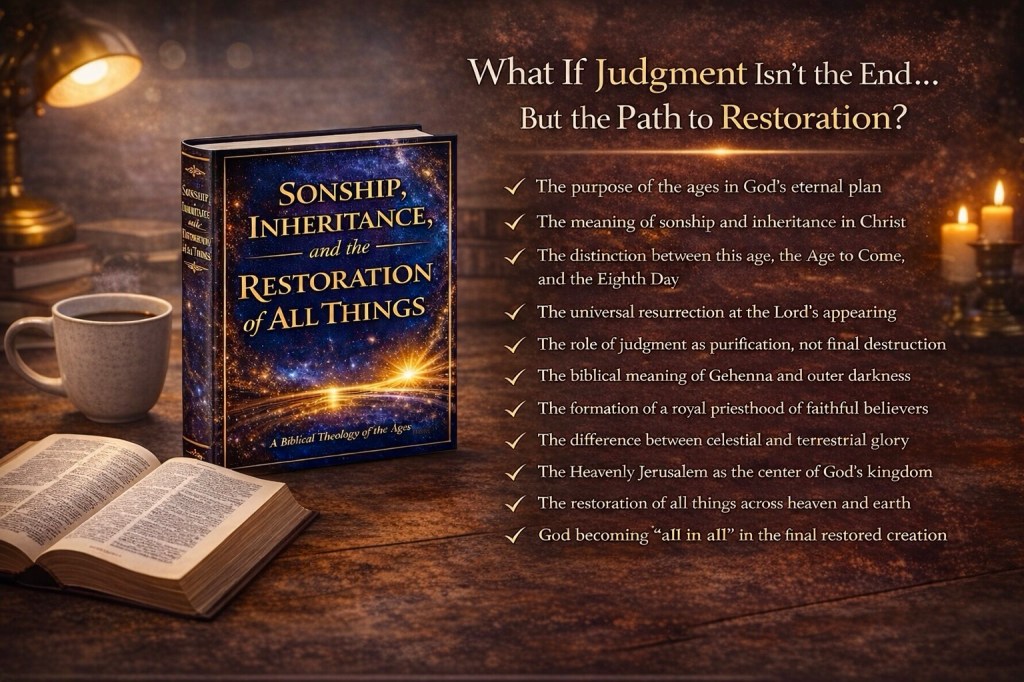
If you’re interested in reading the book: Sonship, Inheritance, and the Restoration of All Things from which this series originates, you can find it here: https://restorationtheologypress.com.
 Restoration Theology Press