

There is a pattern woven through the entire Bible that most Christians, including most universalists, have never been taught to see. It’s the pattern of the firstborn.
In Scripture, the firstborn belongs to God. He bears the father’s name, receives the double portion of inheritance, and carries representative responsibility for the household (Exodus 13:2; Deuteronomy 21:17). But here’s what makes this pattern so striking and so sobering: the natural firstborn almost always fails.
Adam, the first man, lost his dominion through disobedience (Genesis 3:17–19). Cain, the firstborn of Adam and Eve, rejected righteousness and murdered his brother (Genesis 4:8). Esau despised his birthright for a single meal (Genesis 25:29–34; Hebrews 12:16). Reuben, Jacob’s firstborn, defiled his father’s bed and lost the preeminence (Genesis 49:3–4; 1 Chronicles 5:1–2). Israel, called “My son, My firstborn” (Exodus 4:22), turned to idolatry and rejected the prophets. Saul, the first king, proved disobedient and was replaced by David, a man after God’s own heart (1 Samuel 13:14).
Again and again the same story: the firstborn is called and consecrated, tested under responsibility, fails, and the inheritance passes to another who walks by faith. The pattern raises a question the whole Bible is building toward: Will there ever be a faithful Firstborn who doesn’t fail?
The answer is the Lord Jesus Christ, “the firstborn among many brethren” (Romans 8:29), “the firstborn over all creation” (Colossians 1:15), “the firstborn from the dead” (Colossians 1:18). Where every natural firstborn failed, He succeeded. Where Adam fell, He obeyed. Where Israel broke the covenant, He fulfilled it. He is the true Firstborn, and through His death and resurrection He opened the way for a company of sons and daughters to share the firstborn inheritance by grace.
But here’s the part that should stop us in our tracks: the inheritance is not automatic.
The word most English Bibles translate “adoption” is the Greek huiothesia, and it doesn’t mean what most people think. It literally means “the placement of a son” as a mature heir. Paul says we are “eagerly waiting for the placement as sons, the redemption of our body” (Romans 8:23, literal). Every believer is truly begotten of God now, the Holy Spirit has regenerated the spirit and united it to Himself. But the placement, the public installation as a mature heir into the firstborn inheritance, happens at the resurrection of life, and it is given to those who have yielded to the Spirit of grace and allowed Him to save their souls in this present age (1 Peter 1:9; Hebrews 10:39).
Think of it this way: a young heir may legally own the entire estate, but he lives no differently from a servant until the father determines the time for his installation has come (Galatians 4:1–5). This present age is the time of formation, the period in which the Spirit of grace is doing the work of transforming us from the inside out. The appearing of Christ is the day of placement. And what determines which sons are placed as firstborn heirs is the same thing that determined it throughout the Torah: faithfulness under testing.
The Levites received the priestly inheritance not because they were naturally superior, but because when Israel worshiped the golden calf and the cost of faithfulness became severe, they alone rallied to the Lord’s side (Exodus 32:26–29). Joshua and Caleb entered the promised land not because they were stronger, but because they followed God fully when the rest drew back in unbelief (Numbers 14:24, 30). In the New Covenant, the pattern is always the same: the Holy Spirit is given to all, but the firstborn inheritance goes to those who respond to the Spirit of grace with faithful obedience.
Esau’s warning stands over every one of us. The writer to the Hebrews applies his story directly to believers in the New Covenant: “Lest there be any profane person like Esau, who for one morsel of food sold his birthright. For you know that afterward, when he wanted to inherit the blessing, he was rejected, for he found no place for repentance, though he sought it diligently with tears” (Hebrews 12:16–17). Esau did not cease to be Isaac’s son when he sold his birthright. But the firstborn portion, once despised, could not be recovered by weeping. His sin was not a single act of weakness, it was the expression of a profane heart that valued the immediate over the promised, the appetite of the flesh over the birthright of the Spirit.
And this is where the failed firstborn pattern speaks directly to those of us who believe in the restoration of all things. The unfaithful sons do not lose their sonship, God’s seed remains in them (1 John 3:9). They will be restored. But they forfeit the firstborn inheritance. They will not stand among the Royal Priesthood in the Heavenly Jerusalem. They will not share the firstborn’s portion of celestial glory and priestly kingship. Instead, they will pass through the resurrection of judgment and the corrective fires of the age to come, where what they refused to let the Spirit of grace do willingly in this age must be done through the Father’s severe discipline in the next. They arrive at restoration, but without the firstborn portion they might have possessed, and only after enduring the very transformation they resisted in this life.
The failed firstborn pattern isn’t just ancient history. It’s a mirror held up to every one of us right now. God is forming a Royal Priesthood, a company of sons and daughters conformed to the image of the Firstborn Son, prepared for celestial glory and priestly kingship in the age to come (1 Peter 2:9; Hebrews 2:10). The Holy Spirit has been given. The Spirit of grace is at work. The question is the same one it has always been: Will you be a faithful firstborn who yields to the Spirit’s transforming work and secures the prize of the inheritance? Or will you despise the birthright, and arrive at restoration only after passing through the fires of divine correction?
The time to value the inheritance is now, while it is still called “today” (Hebrews 3:13).
Continue the Series:
Part 1 of 4 – What If You Have the Destination Right but the Journey All Wrong?
Part 2 of 4 – One Stream of Grace, So Why Does Faithfulness Matter?
Part 3 of 4 – The Pattern Scripture Keeps Repeating That Most People Miss
Part 4 of 4 – The Parable Most Universalists Think They Understand
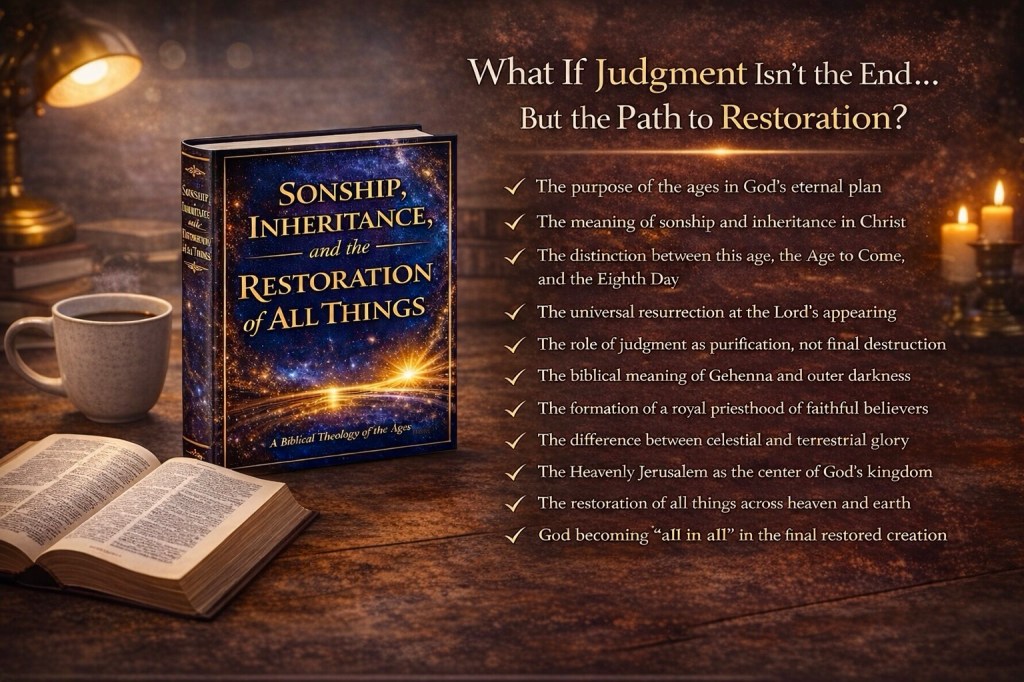
If you’re interested in reading the book: Sonship, Inheritance, and the Restoration of All Things from which this series originates, you can find it here: https://restorationtheologypress.com.
 Restoration Theology Press