

If you’ve been following this series, we’ve covered a lot of ground. The urgency of faithfulness in this present age. The one stream of grace that empowers obedience but does not compel it. The failed firstborn pattern that runs through the entire Bible. Now I want to turn to a parable that most universalists claim as their own, and show you that it teaches far more than you may have realized.
The parable of the prodigal son (Luke 15:11–32) is one of the most beloved stories the Lord Jesus ever told. And most people read it as a simple picture of repentance and welcome: a sinner leaves, hits bottom, comes home, and God throws a party. That’s true, but it’s not the whole truth. Because the parable doesn’t have one son. It has two. And what happens to each of them reveals the very framework we’ve been tracing through this entire series.
Notice the structure. A father has two sons. Both are sons from the beginning, neither one earns his place in the family. The younger son asks for his share of the inheritance early, receives it freely, and departs into a far country where he wastes everything (Luke 15:12–13). The elder son remains with the father, serves faithfully, and never leaves.
The younger son’s journey is a picture of devastation. He squanders his inheritance. He ends up feeding swine, an image of utter defilement for a Jewish audience. He is starving, degraded, and alone. And then, in that far country, he “comes to himself” (Luke 15:17). He remembers his father’s house. He returns, not expecting to be restored as a son, but hoping to be received as a hired servant.
But the father does something astonishing. He sees his son “a great way off” and runs to meet him. He falls on his neck and kisses him. Before the son can finish his prepared speech, the father commands the servants: bring the best robe, put a ring on his hand, sandals on his feet, and kill the fatted calf, “for this my son was dead and is alive again; he was lost and is found” (Luke 15:22–24). And they begin to celebrate.
Now pause here and notice something most people miss. The father restores the prodigal to the household. He gives him dignity, the robe, the ring, the sandals are symbols of restored sonship, authority, and belonging. He throws a feast. But the father does not reinstate him as the firstborn heir. The inheritance the prodigal received has already been squandered. It is gone. What remains, the father’s estate, the firstborn portion, everything, belongs to the elder son.
And the father says so explicitly. When the elder son protests, the father responds: “Son, you are always with me, and all that I have is yours” (Luke 15:31).
Do you see it? Both sons are sons. Both are in the family. But the inheritance belongs to the one who remained faithful.
This is exactly the pattern we’ve been tracing. The Holy Spirit is given freely, He regenerates the spirit, unites Himself to the believer, and empowers obedience as the Spirit of grace. That is the gift. It is the prodigal’s share, everything the Father gives at the beginning. But the prize of the inheritance, the firstborn portion, the Royal Priesthood, celestial glory, participation in the Heavenly Jerusalem, belongs to those who respond to the Spirit of grace with faithful obedience in this present age. The prodigal received the gift and wasted it. The elder son received the gift and remained.
The prodigal’s return is real restoration. The father’s embrace is genuine. The feast is not a formality, it is the Father’s heart overflowing with joy that a son who “was dead is alive again.” And this is where the parable speaks directly to those of us who believe in the restoration of all things. The restoration is real. The unfaithful will be restored to the family. God’s seed remains in them (1 John 3:9), and the Father’s mercy will bring them home, but only after they have reaped the consequences of what they squandered, only after the far country has done its devastating work.
The language the father uses is resurrection language: “this my son was dead and is alive again” (Luke 15:24, 32). This echoes the pattern the book traces throughout Scripture, the unfaithful pass through the death of the soul in the corrective fires of the age to come, and are raised in the resurrection “of the end” to be restored to the Father’s house. The feast the father throws anticipates the great feast Isaiah prophesied: “In this mountain the LORD of hosts will make for all peoples a feast of choice pieces… He will swallow up death forever, and the Lord GOD will wipe away tears from all faces” (Isaiah 25:6–8). The prodigal’s feast is a shadow of that final celebration, the joy of restoration after judgment has done its purifying work.
But notice: when the feast begins, the elder son is out in the field, still serving, still faithful. He hears the music and dancing, and he is angry. He refuses to go in. He complains to his father: “Lo, these many years I have been serving you; I never transgressed your commandment at any time; and yet you never gave me a young goat, that I might make merry with my friends. But as soon as this son of yours came, who has devoured your livelihood with harlots, you killed the fatted calf for him” (Luke 15:29–30).
Why does the Lord Jesus include this detail? Because He is speaking directly to the Pharisees and scribes who “complained, saying, ‘This Man receives sinners and eats with them’” (Luke 15:2). The elder son’s anger is a mirror held up to those who think faithfulness entitles them to exclusivity rather than generosity. It exposes the danger of an obedience that has produced self-righteousness instead of mercy, a son who stayed in the Father’s house but whose heart never entered the Father’s joy.
The father’s response to the elder son is not a rebuke. It is a tender correction: “Son, you are always with me, and all that I have is yours. It was right that we should make merry and be glad, for your brother was dead and is alive again, and was lost and is found” (Luke 15:31–32). The father does not take the inheritance from the faithful son and give it to the prodigal. He affirms the elder son’s portion, “all that I have is yours”, and then invites him to share the Father’s heart of mercy toward the one who was restored.
This is the complete picture. The faithful son possesses the inheritance. The prodigal is restored to the family but without the firstborn portion he squandered. And the Father’s heart rejoices over both, over the faithful son who remained, and over the lost son who has come home. The feast is real. The restoration is real. But the inheritance belongs to the one who valued it.
For those of us who believe that God will one day be “all in all” (1 Corinthians 15:28), this parable should shape how we hold that hope. The restoration of all things is the feast at the end of the story, the Father running to embrace sons and daughters who wasted everything and finally came home. But between now and then, there is an inheritance to be valued or squandered, a Spirit of grace to be yielded to or resisted, and a firstborn portion that once forfeited cannot be recovered by tears (Hebrews 12:16–17).
The question this parable leaves with every one of us is not whether the Father’s house has room for you. It does. The question is: when the feast begins, will you be the son who receives the inheritance, or the son who lost it and arrived home with nothing but the Father’s mercy?
Both sons are loved. Both are restored. But only one has everything the Father possesses.
“Son, you are always with me, and all that I have is yours.”
Continue the Series:
Part 1 of 4 – What If You Have the Destination Right but the Journey All Wrong?
Part 2 of 4 – One Stream of Grace, So Why Does Faithfulness Matter?
Part 3 of 4 – The Pattern Scripture Keeps Repeating That Most People Miss
Part 4 of 4 – The Parable Most Universalists Think They Understand
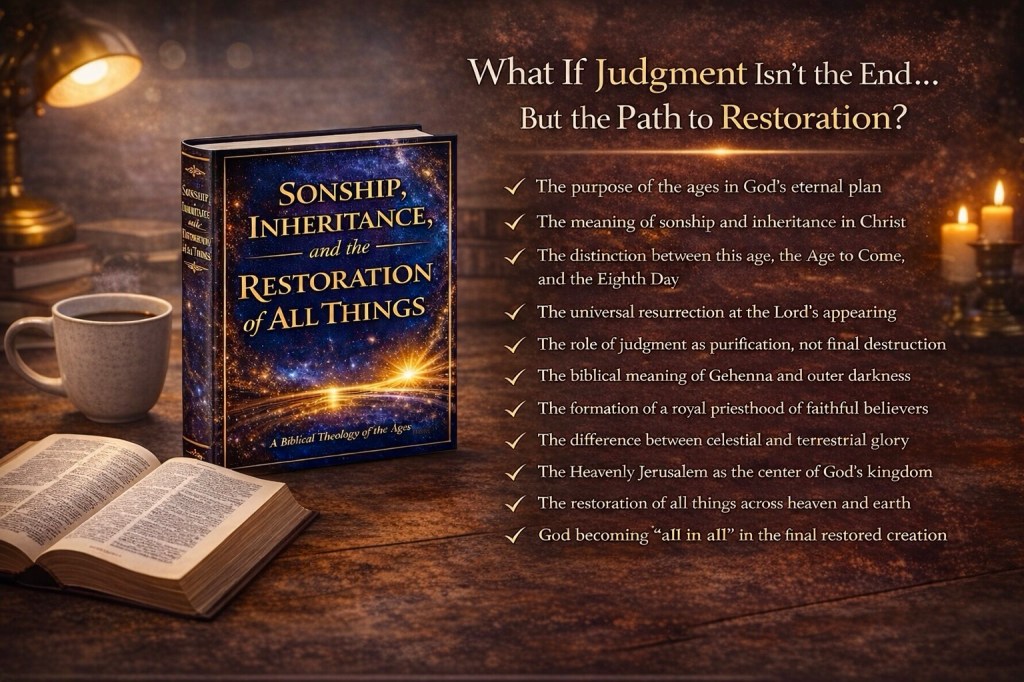
If you’re interested in reading the book: Sonship, Inheritance, and the Restoration of All Things from which this series originates, you can find it here: https://restorationtheologypress.com.
 Restoration Theology Press