
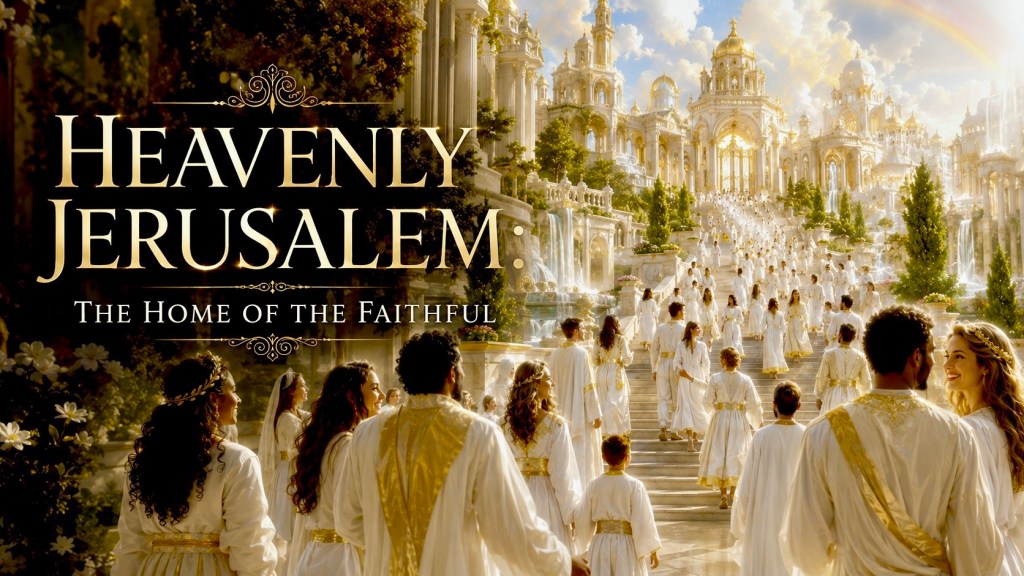
Updated 6/27/2026
A Teaching on the Heavenly City Destined for Those Counted Worthy of the Age to Come
Introduction: The City Awaits, the Sons Counted Worthy
Among the great themes of Scripture, few are spoken of with greater longing than the city of God. From the patriarchs who confessed themselves strangers and pilgrims on the earth, to the prophets who saw the mountain of the Lord’s house exalted above the hills, to the Apostles who declared that our citizenship is in heaven, the Scriptures testify with one voice that there is a real heavenly city above into which the faithful will be brought when the Lord appears.
This city has many names in the canonical witness of the Torah, the Prophets, the Lord Jesus, and the Apostles. It is called Mount Zion, the city of the living God, the Jerusalem above, Paradise, the heavenly country, the city with foundations, and the true tabernacle not made with hands. These are not different cities, nor different hopes; they converge upon a single reality—the holy garden-city on the holy mountain of God in the Third Heaven, the dwelling-place of God, the seat of the Royal Priesthood, and the home of those who in this present age have been counted worthy.
The purpose of this teaching is to bring the city and its citizens into clear view. We will trace what the Torah reveals in seed-form through the garden-sanctuary of Eden and the tabernacle of Moses. We will see how the Prophets expanded this pattern through the mountain of the Lord, the feast, the canopy of glory, and the river flowing from the sanctuary. We will hear the Lord Jesus reveal Himself as the substance of the tree of life and the river, disclose the True Temple of His Body, and display the coming glory on the mount of the Transfiguration. And we will listen as the Apostles disclose the full reality of the Heavenly Jerusalem—what she is, why she already exists, who dwells within her, and what happens on the day the Lord Jesus appears and gathers His faithful home. Finally, we will see that the call to walk now as citizens of that city is the most practical and most urgent application of all biblical theology.
The Torah: The Garden, the Tabernacle, and the First Shadows of the City
The Scriptures do not introduce the Heavenly Jerusalem by name in the Torah, but they do something no less important: they lay down the pattern. From the very beginning, God reveals through earthly shadows the heavenly reality that will later be named.
The garden of Eden is the first earthly glimpse of the Heavenly Jerusalem. God planted a garden eastward in Eden and placed the man He had formed there to tend and guard it (Genesis 2:8, 15). This garden was no mere orchard. It was a sanctuary where God walked in the cool of the day, where He communed with Adam and Eve in unbroken fellowship (Genesis 3:8). Ezekiel later calls this same garden “Eden, the garden of God,” and places the anointed cherub “on the holy mountain of God” (Ezekiel 28:13–14), joining garden and mountain into one sanctuary of God’s presence. Eden was a garden-sanctuary on a mountain—the earthly microcosm of the Heavenly Jerusalem.
In the midst of the garden stood the tree of life (Genesis 2:9). The tree of life is not merely a botanical feature of a vanished landscape; it is a Torah shadow whose promised life finds its substance in Christ, who declares, “I am the resurrection and the life” (John 11:25). What the tree of life foreshadowed, Adam never attained. He was mortal, formed from dust, animated by divine breath, but not yet clothed with the incorruptible life that belongs to the ages to come. After the fall, God stationed cherubim at the east of the garden with a flaming sword that turned every way “to guard the way to the tree of life” (Genesis 3:24). The way to life was not destroyed; it was guarded. Access was closed to the corrupted state of the flesh, but the flaming sword pointed forward to a truth the rest of Scripture would unfold: the way to life passes through judgment. The cherubim who guarded the way in Eden reappear on the lid of the ark of the covenant, overshadowing the mercy seat where the blood of atonement was sprinkled (Exodus 25:18–22). The flaming sword foreshadows the fire of God’s holiness that both excludes and purifies—the fire that burns on the altar, descended on Sinai, and will burn as the purifying fires of the Seventh Day. From the very beginning of the Torah, the pattern is set: to reach the life the tree of life represented—the life of the Heavenly Jerusalem—one must pass through the judgment of God, and only by the blood of atonement and the power of the Spirit can anyone enter.
A river flowed out of Eden to water the garden and then divided into four heads reaching distant lands (Genesis 2:10–14). The source of the river was the place of God’s presence; the river carried the life of that presence outward to the wider world. This design—life flowing from the sanctuary of God to the surrounding creation—is the foundational pattern that Scripture will progressively unfold as a figure of the Spirit of God. The river in Eden was real water in a real garden, yet it is a Torah shadow whose substance is revealed when the Lord Jesus declares, “If anyone thirsts, let him come to Me and drink. He who believes in Me, as the Scripture has said, out of his heart will flow rivers of living water” (John 7:37–38), and John explains, “But this He spoke concerning the Spirit” (John 7:39). The river of Eden pointed forward to the Holy Spirit flowing from the glorified Christ through the heavenly sanctuary to the ends of the earth.
The arrangement of Israel around the tabernacle deepens the pattern further. The tabernacle stood at the center of the camp. The Levites camped nearest, surrounding the tent of meeting. The twelve tribes gathered in four ordered groups beyond them (Numbers 2; 3:5–10). God dwelt in their midst. His people encamped around Him. The camp took its form from His presence. The tabernacle, with its Levites and tribes, thus pictures the Heavenly Jerusalem: God’s sanctuary at the center, at the summit of His holy mountain; His people in the city spreading over its slopes; and the outer court as His footstool on earth. And when God commanded Moses to build the tabernacle, He said, “See that you make all things according to the pattern shown you on the mountain” (Hebrews 8:5; cf. Exodus 25:9, 40). Moses did not invent the tabernacle’s design; he copied a heavenly original. That heavenly original belongs to the sanctuary-reality of the Heavenly Jerusalem, where the Lord Jesus now ministers as High Priest after the order of Melchizedek (Hebrews 8:1–2; 9:24).
The Torah gives further hints of this same pattern in the lives of the patriarchs. Abraham was led to the land of Moriah, where he offered Isaac on the Mount of the Lord, where it is said, “In the Mount of the LORD it shall be provided” (Genesis 22:2, 14). This “Mount of the LORD” is later revealed as Mount Zion in Jerusalem, where God’s earthly sanctuary was built. Jacob, seeing the ladder with angels ascending and descending, named the place Bethel, “house of God,” and said, “this is… the gate of heaven” (Genesis 28:17). This glimpse revealed a city and a sanctuary that join heaven and earth. Deuteronomy repeatedly mentions “the place where the LORD your God chooses to make His name dwell” (Deuteronomy 12:5, 11), pointing to Jerusalem, which is itself a shadow of the Heavenly Jerusalem. The Torah thus introduces the key elements that Scripture later names: a heavenly sanctuary in the Third Heaven, an earthly Paradise that foreshadows the Paradise above, a tree of life whose promised life finds its substance in Christ, a river of life flowing from God’s dwelling, a guarded way that passes through judgment, and a tabernacle copied from a heavenly pattern. The Heavenly Jerusalem is the unveiled form of this Torah pattern—the true city-mountain-Paradise and sanctuary of God.
The Prophets: The Holy Mountain, the Feast, the River, and the Canopy of Glory
The Prophets expand the Torah’s seed-form into a panoramic vision of the city and mountain of God. They do not invent new hopes; they amplify the patterns already planted in Eden and the tabernacle, using the language of Zion, Jerusalem, and the mountain of the Lord.
Isaiah promises that Zion will be redeemed with justice and Jerusalem called “the city of righteousness, the faithful city” (Isaiah 1:26–27). Zechariah records the Lord’s words: “I will return to Zion, and dwell in the midst of Jerusalem. Jerusalem shall be called the City of Truth, the Mountain of the LORD of hosts, the Holy Mountain” (Zechariah 8:3). Here mountain and city are joined; Jerusalem is the City of Truth and at the same time the Mountain of the Lord, His Holy Mountain. The Psalms celebrate this same reality: “Great is the LORD, and greatly to be praised in the city of our God, in His holy mountain. Beautiful in elevation, the joy of the whole earth, is Mount Zion on the sides of the north, the city of the great King” (Psalm 48:1–2). The holy mountain, Mount Zion, and the city of the great King are three names for one heavenly reality in which God dwells.
Isaiah 2 prophesies that “in the latter days the mountain of the house of the LORD shall be established as the highest of the mountains, and shall be lifted up above the hills; and all the nations shall flow to it” (Isaiah 2:2 ESV). Micah echoes the promise in virtually identical language and adds the pastoral image of the peace that flows from the mountain: “Everyone shall sit under his vine and under his fig tree, and no one shall make them afraid; for the mouth of the LORD of hosts has spoken” (Micah 4:4). The mountain is not only the seat of God’s law and word; it is the source of peace and safety for every household beneath its shelter.
Isaiah 25 gathers together the mountain, the nations, and the abolition of death in one breathtaking prophecy: “And in this mountain the LORD of hosts will make for all peoples a feast of choice pieces, a feast of wines on the lees, of fat things full of marrow, of well-refined wines on the lees. And He will destroy on this mountain the surface of the covering cast over all people, and the veil that is spread over all nations. He will swallow up death forever, and the Lord GOD will wipe away tears from all faces” (Isaiah 25:6–8). The feast is for all peoples; the veil is over all nations; the tears are wiped from all faces. Death itself is abolished—not merely for the faithful, but for every nation. Paul directly cites this prophecy when he declares, “Death is swallowed up in victory” (1 Corinthians 15:54). The mountain of Isaiah 25 is, in the light of the Apostolic witness, the Heavenly Jerusalem, the city of the living God (Hebrews 12:22), and the feast upon that mountain is the consummation of the Father’s purpose to gather all things in Christ in the glorious Eighth Day.
Isaiah 4 adds a detail of extraordinary intimacy that connects the Prophetic vision of Zion to the Sinai theophany and to the deepest mystery of the gospel. After speaking of the branch of the Lord and the survivors of Zion who are called holy, the prophet declares, “Then the LORD will create above every dwelling place of Mount Zion, and above her assemblies, a cloud and smoke by day and the shining of a flaming fire by night. For over all the glory there will be a covering” (Isaiah 4:5). The Hebrew word for “covering” here is chuppah (חֻפָּה)—not merely a canopy, but a bridal chamber, the covering under which bridegroom and bride are united. The cloud and fire recall Sinai, but the application is transformed. At Sinai, the cloud and fire kept the people at a distance; the mountain burned and the people trembled at the foot (Exodus 19:16–18; Hebrews 12:18–21). Here on heavenly Mount Zion, the cloud and fire rest over every dwelling and every assembly. What was once unapproachable is now intimate. And the word Isaiah chooses for that intimacy is the word for a bridal canopy.
The faithful on the mountain already shine with celestial glory—conformed to the image of the Son, clothed in glorified bodies, radiant with the glory of the Transfiguration (Colossians 3:4; Philippians 3:21; Matthew 17:2). And then, over all of that glory, the chuppah of God’s own presence rests. Notice what the text says: “For over all the glory there will be a covering.” Their glory is engulfed by His greater glory. They are not merely standing near the presence of God; they are enveloped in it, covered by it, as a bride is covered by the canopy under which the bridegroom receives her.
This is the bridal dimension of the Heavenly Jerusalem—the dimension Paul reveals when he writes that the Lord Jesus “loved the church and gave Himself for her, that He might sanctify and cleanse her with the washing of water by the word, that He might present her to Himself a glorious church, not having spot or wrinkle or any such thing, but that she should be holy and without blemish” (Ephesians 5:25–27). The faithful are the Bride whom the Bridegroom has presented to Himself in glory. Isaiah 4:5 shows us what that presentation looks like from the prophetic vantage point: every dwelling on the mountain, every assembly of the faithful, covered by the cloud and fire of God’s manifest presence, with a chuppah—a bridal canopy—resting over all the glory. The Bridegroom has received His Bride, and He has covered her with the canopy of Himself.
Isaiah 60 reveals the contrast between the glory of God’s city and the darkness of the world under judgment. “Arise, shine; for your light has come! And the glory of the LORD is risen upon you. For behold, the darkness shall cover the earth, and deep darkness the people; but the LORD will arise over you, and His glory will be seen upon you” (Isaiah 60:1–2). This is not merely a comforting word for the present age. It is the prophetic picture of the Seventh Day: the glory of the Lord resting upon His faithful sons and daughters in the Heavenly Jerusalem above, while darkness and deep darkness cover the earth below, where the unfaithful and ungodly pass through the fires of Gehenna. The same prophecy warns that “the nation and kingdom which will not serve you shall perish, and those nations shall be utterly ruined” (Isaiah 60:12). Above, the sabbath rest of God and the glory of the Royal Priesthood; below, the furnace of divine holiness in which every remaining corruption is removed. This is the prophetic backdrop to the Lord Jesus’ own language of “outer darkness” (Matthew 8:12; 22:13; 25:30)—the darkness is the earth-Gehenna of the Seventh Day, and the light is the Heavenly Jerusalem unveiled above it.
Yet Isaiah’s vision reaches beyond the Seventh Day into the Eighth. “The Gentiles shall come to your light, and kings to the brightness of your rising” (Isaiah 60:3). And later: “The sun shall no longer be your light by day, nor for brightness shall the moon give light to you; but the LORD will be to you an everlasting light, and your God your glory” (Isaiah 60:19). This cannot be describing the general condition of the renewed earth, because Isaiah elsewhere describes that earth as a place where the sun and moon still shine—indeed, shine with intensified glory: “Moreover, the light of the moon will be as the light of the sun, and the light of the sun will be sevenfold, as the light of seven days, in the day when the LORD binds up the brokenness of his people, and heals the wounds inflicted by his blow” (Isaiah 30:26 ESV). In the Eighth Day the sun and moon are not removed from the renewed creation; they are glorified. The nations on the renewed earth still walk by the sevenfold sun and the glorified moon. But the faithful in the Heavenly Jerusalem walk by a greater light—the Lord Himself, whose presence surpasses and replaces the need for sun and moon entirely. Isaiah himself thus distinguishes between the terrestrial realm of the renewed earth below and the celestial realm of the faithful above, where God is their everlasting light and their glory.
The Prophets also carry forward the river motif first planted in Eden. Ezekiel’s temple vision concludes with a river flowing from under the threshold of the temple, heading eastward. The prophet is led through the water as it deepens from ankle-depth to knee-depth, to waist-depth, to a river that cannot be crossed. Along its banks grow trees whose leaves do not wither and whose fruit does not fail, “because their water flows from the sanctuary. Their fruit will be for food, and their leaves for medicine” (Ezekiel 47:1–12). No natural river behaves this way—deepening supernaturally without tributaries, healing the Dead Sea, producing trees that never fail. The river’s source is the sanctuary, the place of God’s presence, and its effect is life, healing, and fruitfulness wherever it reaches. Joel speaks of the same river: “A fountain shall flow from the house of the LORD” (Joel 3:18). Zechariah adds that “in that day… living waters shall flow from Jerusalem, half of them toward the eastern sea and half of them toward the western sea; in both summer and winter it shall occur” (Zechariah 14:8). That the waters flow year-round, defying the natural dry season, confirms that this is no ordinary watercourse. These Prophetic texts together reveal that the Heavenly Jerusalem is not only the dwelling of God but the sanctuary from which the Spirit of God flows to renew creation—the reality toward which Eden’s river pointed from the beginning.
Jeremiah speaks of a time when Jerusalem shall be called “the throne of the LORD” and all the nations shall be gathered to it (Jeremiah 3:17). Ezekiel ends his temple vision with the words, “the name of the city from that day shall be: THE LORD IS THERE” (Ezekiel 48:35). Isaiah 24, after describing the shaking of the earth and the judgment of kings and hosts, concludes, “Then the moon will be disgraced and the sun ashamed; for the LORD of hosts will reign on Mount Zion and in Jerusalem and before His elders, gloriously” (Isaiah 24:23). The Lord reigns on Mount Zion, in Jerusalem, before His elders. This is the heavenly court, the throne-city from which God governs in judgment during the Seventh Day—a picture that Daniel expands when he sees the Ancient of Days seated, the court assembled, and the books opened (Daniel 7:9–10).
In this way, the Prophets foreshadow what the Apostles later call the heavenly country and the Heavenly Jerusalem. The mountain is the seat of the feast and the swallowing up of death; it is covered by the canopy of God’s glory; it shines as the light of the nations; and it is the throne of the Lord.
The Lord Jesus: The True Temple, the Tree of Life, and the Coming Glory
When the Lord Jesus comes, He does not replace the hope of Zion and Jerusalem; He reveals its heavenly depth. He speaks of Jerusalem as “the city of the great King” (Matthew 5:35), echoing the Psalms. He spoke of going to the Father and of being seated at the right hand of the Power in heaven (John 16:28; Matthew 26:64).
He also revealed something the Torah and the Prophets had not yet fully disclosed: the True Temple—the living Body through which the Father would manifest His fullness to all creation. In John 2, the Lord Jesus cleansed the earthly temple and called it “My Father’s house” (John 2:16). Then, within the same scene, He declared, “Destroy this temple, and in three days I will raise it up”—and John tells us, “But He was speaking of the temple of His body” (John 2:19, 21). In a single passage, the Father’s house was identified as the temple, and the temple was identified as His body. This identification is decisive for how we hear the Lord’s later words. When He says, “In My Father’s house are many dwelling places; if it were not so, I would have told you. I go to prepare a place for you” (John 14:2 literal), the reader who has followed John’s gospel already knows that the Father’s house is the temple, and the temple is the Lord’s body. The “place prepared” is therefore a place in the Body—the corporate True Temple that He went to prepare through His cross, resurrection, ascension, and the sending of the Spirit. This is confirmed within the same discourse, when He uses the same word, monē (μονή), “dwelling place,” twenty-one verses later: “If anyone loves Me, he will keep My word; and My Father will love him, and We will come to him and make Our home (monē) with him” (John 14:23). The dwelling-places in the Father’s house should not be reduced to rooms in a celestial structure; in John’s own context, they are bound to the indwelling presence of the Father and the Son among the faithful. The Father’s house is the Body of Christ. The monai are the dwellings within it.
The Heavenly Jerusalem did not need preparation. She already stood. She already housed the angelic host, and would soon receive the spirits of just men made perfect when the Lord ascended. What needed preparation was the way for sinful, mortal men to be incorporated into the divine Son as members of His Body. That preparation was His work—His descent, His cross, His resurrection, His ascension, and the sending of the Spirit at Pentecost. By that finished work He prepared the naos (ναός) of His Body and the way for living stones to be built into it. The faithful, joined to Him by the Spirit, are placed into the Body now. They are members of the household of God now. They are the temple of the living God now (Ephesians 2:19–22; 1 Peter 2:4–10; 1 Corinthians 3:16; 2 Corinthians 6:16). And on the day He appears, the Body that has been formed in the quarry of this present age will be glorified, gathered, and ascended—taking its place in the Heavenly Jerusalem, where the High Priest already ministers in the true tabernacle (σκηνή, skēnē) not made with hands (Hebrews 8:1–2; 9:11). The Heavenly Jerusalem is the location in which the True Temple finally stands in glory; but the place the Lord Jesus went to prepare is the place within the Body itself. The two realities—the heavenly tabernacle where He ministers and the living Temple of His people—are distinct but coordinated, and the Apostles never collapse them.
He also revealed Himself as the true substance of the tree of life. “I am the resurrection and the life,” He declared; “he who believes in Me, though he may die, he shall live” (John 11:25). What the tree in Eden foreshadowed, the Lord Jesus is. He cried out at the Feast of Tabernacles, “If anyone thirsts, let him come to Me and drink. He who believes in Me, as the Scripture has said, out of his heart will flow rivers of living water” (John 7:37–38), and John explains, “But this He spoke concerning the Spirit” (John 7:39). In this single declaration, the Lord Jesus gathered up the entire river motif—from Eden’s river to the Prophets’ living waters—and revealed its substance: the Holy Spirit flowing from Him to those who believe.
On the mount of the Transfiguration, the Lord Jesus gave His closest disciples a glimpse of the glory that will be shared by the faithful in the Age to Come. “His face shone like the sun, and His clothes became as white as the light” (Matthew 17:2). Peter, James, and John saw what the faithful will become: men and women transformed into the likeness of the Firstborn Son, shining with the glory of the Heavenly Jerusalem. This is the glory Paul speaks of when he writes, “When Christ who is our life appears, then you also will appear with Him in glory” (Colossians 3:4), and that Moses dimly foreshadowed when his face shone after he descended from the mountain of God’s presence (Exodus 34:29–30).
The City That Already Is—Names, Reality, and Place
The Apostles bring the Heavenly Jerusalem from shadow into full light. They do not present her as a metaphor or a poetic flourish; they name her, describe her inhabitants, and declare that believers have already drawn near to her in spirit.
To the writer of Hebrews she is “Mount Zion and the city of the living God, the heavenly Jerusalem” (Hebrews 12:22). To Paul she is “the Jerusalem above,” who “is free, which is the mother of us all” (Galatians 4:26). To the patriarchs she was “the city which has foundations, whose builder and maker is God” (Hebrews 11:10), and the heart of “a heavenly country” they desired more than the lands they wandered (Hebrews 11:16). To Paul again, when caught up in vision, she is “Paradise”—a name that recalls Eden as the first earthly delight and reveals that the original garden-sanctuary was itself a foreshadowing of the Paradise above (2 Corinthians 12:2–4). She is the Third Heaven, the heaven of heavens, the highest created realm beyond the visible firmament, where the throne of God is set and the angelic host stands before Him in worship and service. She is also called the true tabernacle, “which the Lord erected, and not man” (Hebrews 8:2)—the heavenly sanctuary “not made with hands, that is, not of this creation” (Hebrews 9:11). The earthly tabernacle of Moses was patterned after this heavenly reality; Moses did not invent the tabernacle’s design but copied a heavenly original. That heavenly original belongs to the sanctuary-reality of the Heavenly Jerusalem, where the Lord Jesus now ministers as High Priest after the order of Melchizedek (Hebrews 8:1–2; 9:24).
These names are not contradictions or competing pictures. They converge upon a single, glorious reality: the holy city, the holy mountain in the highest heaven. She is at once a city and Paradise, because she is the gathered dwelling-place of God, His angels, and the assembly of the firstborn; and a mountain, because she is the high place of God’s presence and the seat of His government.
The present tense of the Apostolic witness is decisive. The writer of Hebrews does not say believers will one day come to Mount Zion; he says, “But you have come to Mount Zion and to the city of the living God, the heavenly Jerusalem, to an innumerable company of angels, to the general assembly and church of the firstborn who are registered in heaven, to God the Judge of all, to the spirits of just men made perfect” (Hebrews 12:22–23). The verbs are present tense. The angels are already innumerable. The church of the firstborn is already registered. The spirits of just men made perfect are already there. The faithful, in spirit, have already drawn near.
Paul says the same of the Jerusalem above: “She is free, which is the mother of us all” (Galatians 4:26). He does not say she will be the mother; he says she is the mother, present tense, the mother-city of every believer born from above. Abraham did not look forward to the building of a city; he “waited for the city which has foundations, whose builder and maker is God”—a city already founded, already standing, only waiting to be revealed and inherited (Hebrews 11:10).
Not of This Creation
Here we must pause to make a careful distinction. The canonical Scriptures—from the Torah through the Prophets, the Lord Jesus, and the Apostles—do not speak of the heavenly city as something yet to be made. They speak of her as already existing and already populated.
This is why the writer of Hebrews can describe the heavenly tabernacle as “not of this creation” (Hebrews 9:11). The Heavenly Jerusalem is not part of the present created order that has been subjected to corruption. She existed before this creation and does not belong to the heavens and earth that will one day be shaken and removed (Hebrews 12:26–27). She is, although a created reality, not of this creation—for only God is uncreated, and “you alone are the LORD; you have made heaven, the heaven of heavens, with all their host, the earth and everything on it, the seas and all that is in them, and you preserve them all” (Nehemiah 9:6). She is a created reality of a different order: the higher heaven, the heaven of heavens, the realm “not of this creation” that does not share in the corruption and dissolution of the visible cosmos. She therefore does not need to be made new in the Eighth Day. She is already what she has always been. What becomes new in the Eighth Day is the atmospheric heaven and the earth themselves, not the holy city of God (2 Peter 3:13; Isaiah 65:17). The Heavenly Jerusalem does not need renewal; she will in the Eighth Day become “established as the highest of the mountains” within the renewed earth.
We must also be careful not to ascribe to the city a strict eternality that belongs to God alone. The heaven of heavens, glorious as she is, is still a work of God’s hands. Even Solomon, when he dedicated the earthly temple, confessed, “But will God indeed dwell with men on the earth? Behold, heaven and the heaven of heavens cannot contain You” (2 Chronicles 6:18). The highest created realm cannot hold the living God; only God is eternal in the absolute sense (Romans 1:20). Yet the Heavenly Jerusalem, though created, was prepared from before the foundation of the world for the sons and daughters of God, and she stands as the unshakable city at the heart of the unshakable kingdom (Hebrews 12:28).
This is why the Heavenly Jerusalem must not be confused with the later apocalyptic imagery of a “New Jerusalem” descending for the first time in the Book of Revelation. The adjective “new” (kainē, καινή) is not used of the Heavenly Jerusalem in the Torah, the Prophets, the Lord Jesus, or the Apostolic writings but only the book of Revelation. Within this canonical sequence, the city is not presented as new, but as already existing above: the city of the living God, the Jerusalem above, the heavenly country, and the true tabernacle not of this creation. The Prophets speak of God’s existing city being revealed, established, and exalted in relation to a renewed earth; the Apostles speak of her as the already-present city of the living God, the Jerusalem above, the heavenly country, the true tabernacle, and the prepared dwelling of the faithful. What becomes new in the Eighth Day is the heavens and the earth themselves, which undergo renewal because they belong to the created order subjected to corruption. The city does not come into being at the end of the ages. She is unveiled, inherited, and established in her rightful place over the renewed creation. The adjective “new” (kainē, καινή) applied to the city is an innovation of Revelation, not a feature of the canonical witness that precedes it. The Torah, the Prophets, the Lord Jesus, and the Apostles know only one Jerusalem above—and she already is.
This distinction matters profoundly. Because the canonical witness affirms that the city already exists and is not in need of renewal, the call of the gospel is not to wait for a city to be built. The city has been ready for the faithful sons and daughters since before the foundations of the world. The call is to be made ready for the city that already stands.
The Spirits of Just Men Made Perfect—The Faithful Dead Already Dwell in the City
If the Heavenly Jerusalem already exists, then she already has inhabitants. The writer of Hebrews names them: among those who dwell in the city are “the spirits of just men made perfect” (Hebrews 12:23). These are not angels, nor merely the living church on earth; they are the righteous who have died and whose spirits have been brought to completion by the one offering of Christ.
Before the cross, the faithful dead were held in a place of comfort the Lord Jesus called “Abraham’s bosom” (Luke 16:22). Abraham, Abel, Enoch, Noah, Moses, David, and the prophets—all waited there, held not in torment but in expectation, their faith credited as righteousness, yet their spirits not yet perfected by the offering that had not yet been made. They were comforted, but they had not yet entered the Heavenly Jerusalem.
After His crucifixion, the Lord Jesus “descended into the lower parts of the earth” (Ephesians 4:9). Paul writes, “When He ascended on high, He led captivity captive, and gave gifts to men” (Ephesians 4:8). The captivity He led captive is the company of the righteous dead who had been held in the underworld—not in torment, but in expectation. When He ascended, He brought them with Him as the spoil of His victory, no longer in Sheol but gathered around Him in the heavenly realm. The long expectation of the faithful, stretching from Abel’s blood crying out from the ground to the last righteous soul who died before the cross, was answered in a single triumphant act: the Lord descended, claimed His own, and carried them into the city of the living God.
Hebrews 12 shows us the present result of this descent and ascent. Abel is there, whose blood spoke better things even from the ground (Hebrews 12:24; 11:4). Abraham is there, who “waited for the city which has foundations, whose builder and maker is God” (Hebrews 11:10)—now gathered in spirit to the city for which he waited, though still awaiting with us the bodily perfection of the resurrection. Moses is there, who esteemed the reproach of Christ greater riches than the treasures of Egypt (Hebrews 11:26). Their bodies still await resurrection, but their spirits now dwell in the Heavenly Jerusalem, perfected in their standing before God, gathered around the Mediator of the new covenant whose blood accomplished what the blood of bulls and goats never could.
When faithful believers die in this present age, they join this same assembly. Their spirits go to be “with Christ, which is far better” (Philippians 1:23)—not in some vague or undefined heaven, but in the Heavenly Jerusalem described in Hebrews 12, among the angels, the enrolled church of the firstborn, and the spirits of the righteous who have gone before. Paul writes to the Corinthians, “We are confident, yes, well pleased rather to be absent from the body and to be present with the Lord” (2 Corinthians 5:8). The Lord is in the Heavenly Jerusalem, seated at the right hand of the Majesty in the heavens; to be with Him is to be in the city.
They, together with us, still await the universal resurrection. Their perfection is spiritual and covenantal now; it will be completed bodily at the appearing of the Lord Jesus, when the faithful are raised in celestial glory to inherit the kingdom in the Age to Come. But even before that day, this passage assures us that the righteous dead are not in some shadowy limbo. They are home in spirit—home in the city of the living God, in the company of angels, under the ministry of the Mediator whose blood speaks better things than the blood of Abel—while their bodies await the resurrection. For those who grieve for faithful loved ones who have died, this is not a vague comfort. It is a location, a company, and a Mediator. They are already where we are going.
The Faithful and the Saved Soul
If the Heavenly Jerusalem is the home of the faithful, we must ask plainly: who are the faithful? The Apostolic writings answer this question with a clarity that modern Christianity has too often softened. The faithful are not merely those who have been forgiven, nor merely those who have received the gift of the Holy Spirit and been begotten from above with a new spirit. The faithful are those who, having received the gift, have cooperated with the Spirit of grace in the salvation of their souls.
This is the neglected doctrine at the center of the Apostolic gospel. James writes, “Lay aside all filthiness and overflow of wickedness, and receive with meekness the implanted word, which is able to save your souls” (James 1:21). Peter writes, “receiving the end of your faith—the salvation of your souls” (1 Peter 1:9), and tells believers they have “purified your souls in obeying the truth through the Spirit” (1 Peter 1:22). The writer of Hebrews speaks of those “who believe to the saving of the soul” (Hebrews 10:39). The Lord Jesus Himself warned His disciples that the soul could be saved or lost, declaring, “Do not fear those who kill the body but cannot kill the soul. But rather fear Him who is able to destroy both soul and body in Gehenna” (Matthew 10:28 literal). The Greek verb translated “destroy” is apollumi (ἀπόλλυμι), which means to ruin and bring to loss, not to annihilate. The soul that suffers loss in Gehenna is not extinguished; it is ruined in respect of the prize it might have gained in this age, and it is purified through the judgment of that Day. The warning is real and weighty—but it is a warning of loss, not of the soul’s end.
Scripture distinguishes the spirit, the soul, and the body, and presents them as the three dimensions of the unified person (1 Thessalonians 5:23). The spirit is washed, sanctified, and justified at the beginning (1 Corinthians 6:11), and the Holy Spirit—the free gift of God—indwells the believer and plants the incorruptible seed of God in the believer’s spirit (John 3:6; 1 Peter 1:23; 1 John 3:9). That same spirit, not replaced but transformed, is changed from within—from the earthly order into the heavenly—progressively, from glory to glory (2 Corinthians 3:18). The Holy Spirit Himself, the free gift of God, is the down payment of life in the Age to Come (Ephesians 1:13–14). The body will be redeemed at the resurrection, when the Lord Jesus appears (Romans 8:23; Philippians 3:21). The soul, however, is saved now—through obedience, repentance, the implanted word, holiness, and the active cooperation of the believer with the Spirit of grace.
This is why the Lord Jesus did not promise the resurrection of life to every believer indiscriminately. He spoke instead of those “counted worthy to attain that age, and the resurrection from the dead” (Luke 20:35). Paul spoke of running the race so as to obtain the prize (cf. 1 Corinthians 9:24). The Lord Jesus also warned His own disciples that many would say to Him on that Day, “Lord, Lord, have we not prophesied in Your name…?” only to hear, “I never knew you; depart from Me, you who practice lawlessness” (Matthew 7:21–23). He warned of servants in His own household who would be assigned a portion with the unbelievers (Luke 12:46). The Apostles echoed these warnings without softening them: Paul feared that he himself, after preaching to others, might become “disqualified” from the prize (1 Corinthians 9:27); Hebrews warns believers that they may “fall short” of entering God’s rest (Hebrews 4:1); Peter urges, “Be even more diligent to make your call and election sure” (2 Peter 1:10).
The faithful, then, are those who have received the gift and have not despised it. They have embraced the cross, walked by the Spirit, mortified the deeds of the body, endured trial and discipline, and pursued holiness “without which no one will see the Lord” (Hebrews 12:14). They have not, like Esau, sold the firstborn portion for the bread and stew of this present age; they have, like Enoch, walked with God until they were pleasing to Him in the deep interior of the soul (Genesis 5:22, 24; Hebrews 11:5). They are those whom the Father, by His Spirit, has formed into the image of His Son (Romans 8:29).
This is the company that will inherit the Heavenly Jerusalem. Not because they have earned a place by works, but because the grace they received was not received in vain—it produced its proper fruit in the salvation of the soul. The begetting of the spirit at conversion does not yet make a faithful son; it makes a child of God. The salvation of the soul, accomplished in cooperation with the Spirit through this present age, is what brings that child to maturity, that he may inherit. The faithful are, in the language of Hebrews, “the church of the firstborn who are registered in heaven”—those whose names stand written in the city, awaiting the day they will enter her in glorified bodies and take up their place with their Lord.
The Day of the Lord’s Appearing and the Ascent of the Faithful
The day on which the faithful enter the Heavenly Jerusalem is the day of the Lord’s appearing—the single, sudden, visible, universally recognizable revelation of the Lord Jesus from heaven. He Himself described it as lightning flashing from east to west (Matthew 24:27), and as the breaking-in of judgment upon a world absorbed in ordinary daily life: eating, drinking, marrying, building, planting, buying, and selling, until the day Noah entered the ark and the day Lot fled Sodom (Matthew 24:37–39; Luke 17:26–30). The New Testament speaks with one voice of a single appearing, a single trumpet, a single resurrection hour in which all who are in the graves hear His voice and come forth—some to the resurrection of life, and some to the resurrection of judgment (John 5:28–29 literal; 1 Thessalonians 4:16; 1 Corinthians 15:23).
At that voice, all the dead rise to life in the same hour, just as the Lord Jesus declared: “the hour is coming in which all who are in the graves will hear His voice and come forth” (John 5:28–29). Yet within that one universal resurrection, an order (τάγμα, tagma) unfolds, as the Apostle writes: “each one in his own order: Christ the firstfruits, afterward those who are Christ’s at His coming, then comes the end” (1 Corinthians 15:23–24). The dead in Christ rise first to meet the Lord in the air, followed by the faithful who are alive at His appearing, who are likewise transformed at the sounding of the last trumpet into glorified, celestial bodies like His own glorious body (Philippians 3:21; 1 Corinthians 15:42–44, 52; 1 Thessalonians 4:16–17). Paul uses the term ἀπάντησις (apantēsis), a word commonly used in the ancient world for a delegation going out to meet an arriving ruler or honored guest and then accompanying him in a formal procession. Yet in the Pauline picture, the movement is not a descent to inaugurate an earthly kingdom; the Lord is not entering a city below as a king returning to reign, but receiving His own into the realm above. The faithful, as ambassadors whose service in the foreign country of this present evil age has been completed (Galatians 1:4; 2 Corinthians 5:20), are gathered to Him and escorted toward the Heavenly Jerusalem. They do not follow Him downward to a renewed earthly order, but ascend with Him toward the heavenly city—the Jerusalem above (Galatians 4:26).
But before they enter the city the tares are bound. The Lord Jesus said it Himself: “First gather together the tares and bind them in bundles to burn them, but gather the wheat into my barn” (Matthew 13:30). The unfaithful and the ungodly, raised in mortal bodies in the resurrection of judgment, are separated from the harvest of the faithful and assigned their portion in Gehenna—the earth under the judgment of God’s holiness. The faithful, glorified in celestial bodies, remain with the Lord in the air while the tares are bound below and every enemy is brought beneath His feet. Only after this separation is complete are they brought into the Heavenly Jerusalem—the assembly of the firstborn, the homecoming of those who fought the good fight, finished the race, and kept the faith (Psalm 110:1; Matthew 13:30; 2 Timothy 4:7–8; Hebrews 10:12–13; Hebrews 12:22–24).
This is the day for which all of creation has groaned (Romans 8:19–22). The Heavenly Jerusalem is unveiled over an earth in judgment. The faithful, transformed and gathered, ascend with their Lord and are received, after the binding of the tares, into the city of the living God. The holy city receives sons and daughters who, through trial and discipline and grace, have been made ready for the inheritance prepared for them from the foundation of the world (Matthew 25:34).
The Royal Priesthood in the City of God
Once within the city, the faithful are not merely guests. They are the Father’s house—the living Temple of the living God, the corporate Body of the Firstborn Son standing at last in glory—and they are priests ministering in the true tabernacle, kings sharing the throne of their Lord.
The Lord Jesus is the true Firstborn, His priesthood is “according to the order of Melchizedek” (Psalm 110:4; Hebrews 7:17), the Priest-King who unites in His person the office of throne and altar. He is the High Priest seated at the right hand of the Majesty in the heavens, the Minister of the sanctuary and of the true tabernacle (Hebrews 8:1–2). Around Him, by grace, He gathers a company of glorified sons and daughters who share His priestly nearness and kingly rule. Peter calls them “a chosen generation, a royal priesthood, a holy nation, His own special people” (1 Peter 2:9). They are the inner-court priesthood of the Heavenly Jerusalem, ministering before God in the immediate presence of His glory.
Their service is not merely worship in the abstract. They share in the government of the heavenly kingdom. Paul wrote to the Corinthians, “Do you not know that the saints will judge the world?… Do you not know that we shall judge angels?” (1 Corinthians 6:2–3). The faithful, conformed to the image of the Son, will participate in the heavenly court and administer kingly judgment during the Seventh Day; then, in the Eighth Day, they will exercise heavenly government over the renewed creation, mediating divine light, law, and blessing to the nations below. They are the corporate Body of Christ, the True Temple in which God dwells, the company through whom the fullness of God—concealed from before the ages—will at last be revealed to the angelic host above and to the nations below.
It is important here to mark the proper distinctions, lest the city be confused with realms outside her. The Heavenly Jerusalem is the home of the faithful—those who have been counted worthy of the resurrection of life and clothed with celestial bodies. She is not the dwelling-place of all redeemed humanity without distinction. In the Eighth Day, three orders of restored humanity will stand together as fruits of the same mercy, though their callings, glories, and histories differ. The faithful serve as the Royal Priesthood in the Heavenly Jerusalem—the inner-court priesthood, celestial in glory, ministering in the immediate presence of God. Below them, the restored unfaithful—those who were truly in Christ but walked carelessly, resisted sanctification, and passed through the corrective fires of the Seventh Day—will be brought into terrestrial immortal bodies in the resurrection “of the end” and serve as outer-court priests on the renewed earth. They forfeited the firstborn portion through their unfaithfulness, just as Esau sold his birthright for the bread and stew of a single hour (Genesis 25:29–34; Hebrews 12:16–17). They are saved, yet so as through fire (1 Corinthians 3:15)—purified but permanently outside the inner court. The restored nations—the ungodly who likewise passed through the judgment of the Seventh Day—will inhabit the renewed earth in terrestrial immortal bodies as the third order. All three orders will worship the same God, serve under the same Christ, and dwell within the unshakable kingdom; but the Heavenly Jerusalem above, the holy mountain, is the inner sanctuary and the inheritance of the firstborn alone. She is the city of the faithful.
This is what the Lord Jesus meant when He spoke of His own as those who would “enter into the joy of your lord” (Matthew 25:21), and as those to whom the Father had been pleased to give the kingdom (Luke 12:32). It is what Paul meant when he wrote that we have been raised up together and made to “sit together in the heavenly places in Christ Jesus” (Ephesians 2:6). It is what the writer of Hebrews meant when he said that we are receiving “a kingdom which cannot be shaken” (Hebrews 12:28). The home of the faithful is the city, and within the city they serve as the Royal Priesthood of the great King.
Walking Now as Citizens of the Heavenly Jerusalem
The hope of the Heavenly Jerusalem is not a hope reserved entirely for the Age to Come. It shapes the believer’s walk now. The Apostles teach that, in spirit, believers already belong to the city, and that they are therefore to live as citizens of a country to which they have not yet bodily arrived.
Paul tells the Philippians, “For our citizenship is in heaven, from which we also eagerly wait for the Savior, the Lord Jesus Christ” (Philippians 3:20). Believers are to understand themselves as citizens of the heavenly country and its city, not of the passing world system of this present evil age. Their loyalties, values, and conduct are to be governed by the city to which they truly belong. To the Colossians Paul writes, “If then you were raised with Christ, seek those things which are above, where Christ is, sitting at the right hand of God. Set your mind on things above, not on things on the earth. For you died, and your life is hidden with Christ in God” (Colossians 3:1–3). The life of a citizen of the Heavenly Jerusalem is hidden in Christ, and the orientation of the citizen is upward—not as escapism, but as the realism of a man who knows where his true commonwealth lies.
The writer of Hebrews makes the same call: “For here we have no continuing city, but we seek the one to come” (Hebrews 13:14). This is the confession of the patriarchs, who “confessed that they were strangers and pilgrims on the earth,” and who declared plainly that they sought a homeland—“a better, that is, a heavenly country. Therefore God is not ashamed to be called their God, for He has prepared a city for them” (Hebrews 11:13–16). The faithful walk in this age as pilgrims who have not yet reached the city, but who have already received its citizenship, and whose conduct testifies that they belong to a country and a King the world cannot see.
To walk now as a citizen of the Heavenly Jerusalem is to receive the implanted word with meekness, to purify the soul in obeying the truth through the Spirit, to mortify the flesh and walk by the Spirit, to embrace the fellowship of His sufferings, to fix the eyes on the things that are unseen, and to run with endurance the race set before us “looking unto Jesus, the author and finisher of our faith” (Hebrews 12:2). It is to refuse the pottage of Esau and to hold fast the firstborn portion. It is to remember, in every choice and every trial, that there is a city already standing, waiting for those who love His appearing.
Conclusion: The Home Prepared for Faithful Sons
The Heavenly Jerusalem is not a metaphor, nor a poetic flourish on the edge of theology. She is the reality at the center of the gospel’s hope.
The Torah revealed her in seed-form: a garden-sanctuary on a mountain, where God walked with a priestly son; a tree of life whose promised life finds its substance in Christ; a river flowing from the place of God’s presence to the wider world; a guarded way that passes through judgment; a tabernacle copied from a heavenly pattern; and patriarchs who glimpsed the city of heaven and the mount of the Lord. The Prophets expanded the pattern: the mountain of the Lord’s house exalted above the hills; a feast where death is swallowed up forever; a canopy of glory over every dwelling on Zion; a river flowing from the sanctuary to renew creation; the light of the Lord shining from the city to which the nations come; a throne-city where the Lord reigns before His elders; a city renamed “THE LORD IS THERE.” The Lord Jesus drew aside the veil: the True Temple of His Body, which He went to prepare through His cross, resurrection, and ascension so that living stones might be built into it; the Transfiguration glory that will be shared by every faithful son and daughter; the rivers of living water that are the Holy Spirit; and the promise that where He is, the faithful will be also—incorporated into Him, indwelt by the Father and Son, and destined to stand in glory in the Heavenly Jerusalem as the completed Temple of the living God. The Apostles brought the full reality into view: the Third Heaven and Paradise; Mount Zion and the city of the living God; the heavenly Jerusalem and the Jerusalem above who is our mother; the heavenly country and the city with foundations; the true tabernacle not of this creation; the unshakable kingdom; the spirits of just men made perfect already dwelling in the city; and the church of the firstborn registered in heaven.
She has stood from before the foundations of this world, and she will stand when the present heavens and earth have been shaken and the unshakable kingdom is revealed. She is the home waiting for the faithful sons and daughters of God.
The way into the holy city is the saving of the soul in this present age. The faithful are those who, having received the gift of the Spirit, have not received the grace of God in vain. They have walked by the Spirit, embraced the cross, endured the discipline of the Father, and persevered in obedient faith until grace had finished its work within them. On the day the Lord Jesus appears, they will be raised in celestial glory, caught up to meet Him as ambassadors received by their King, remain with Him while the tares are bound below, and then be escorted home with Him into the city of the living God. There they will serve as the Royal Priesthood, ministering in the heavenly tabernacle, sharing the throne of the Firstborn, administering heavenly judgment during the Seventh Day, and mediating divine light and priestly ministry to the renewed creation in the Eighth.
For those who grieve, this hope has a name and a location. The faithful who have gone before are not lost; they are with Christ in the Heavenly Jerusalem, among the angels, the enrolled assembly, and the perfected spirits of the righteous. Their bodies await the resurrection; their spirits are home.
This hope is not deferred to a vague future. It governs the present. Every believer is summoned to live now as a citizen of that city—to set the mind on things above, to walk as a pilgrim in this present age, to refuse the trade Esau made for the bread of a passing world, and to lay hold of the prize of the upward call of God in Christ Jesus. The Spirit within is the down payment of the inheritance; the implanted word is able to save the soul; the discipline of the Father is the proof that we are sons and daughters; and the city above is the homeland to which we are journeying.
May the Lord Jesus, who is coming again to gather His own, find each of us watching, working, and walking in the light of that city—so that on the day He appears, we may be among those who are counted worthy to attain that age and the resurrection of life, and may enter with Him into the Heavenly Jerusalem, into the joy of our Lord.

