
Updated 6/27/2026
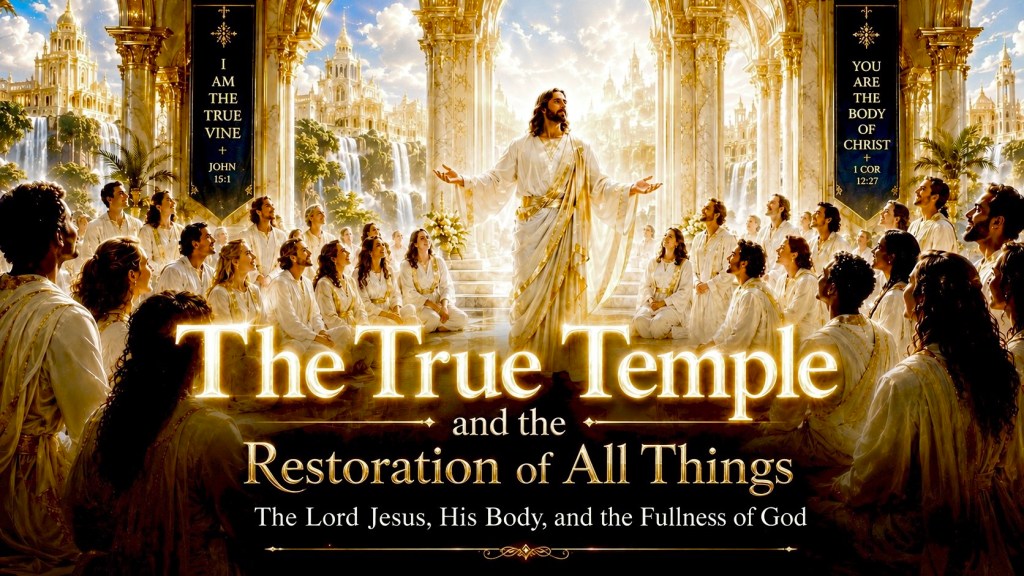
The Lord Jesus, His Body, and the Fullness of God
Introduction: The Temple That Is Not a Building
“For as the body is one and has many members, but all the members of that one body, being many, are one body, so also is Christ” (1 Corinthians 12:12).
This is one of the most remarkable sentences in all of Scripture. Paul does not say, “so also is the Church.” He says, “so also is Christ.” The Head and the Body together constitute a single reality that the Apostle calls “the Christ”—a corporate Person in whom the eternal Son and the faithful who belong to Him are joined as one. The Lord Jesus Himself testified to this union when He confronted Saul on the road to Damascus. Saul was persecuting believers—arresting, imprisoning, and consenting to the death of men and women who followed the Way. Yet the voice from heaven did not say, “Why are you persecuting My people?” It said, “Saul, Saul, why are you persecuting Me?” (Acts 9:4). To touch the Body is to touch the Head. To harm the members is to harm the Lord. The union is not metaphorical. It is the deepest reality in the created order.
This teaching is about that union—and about the Temple it produces. It is about why the Apostles call the faithful the naos of God, the inner sanctuary, and what that Temple has to do with the restoration of all things. If the Body of the Lord Jesus is the True Temple of the living God, and if the fullness of God is destined to fill that Temple, then the formation of the faithful within the Church in this present age is not merely a religious program or a spiritual self-improvement project. It is the cutting and fitting of the living stones who will be manifested as the vessel through which the Father intends to manifest His concealed glory to every realm of creation—celestial and terrestrial—until at last He is “all in all” (1 Corinthians 15:28).
To see this clearly, we must begin where the Apostles begin: with a vocabulary distinction that most readers have never noticed.
The Apostolic Vocabulary: Tabernacle and Temple
The apostolic writings do not use a single word for the heavenly dwelling. They use two—and the distinction is consistent throughout the entire New Testament.
For the heavenly sanctuary structure, the Epistle to the Hebrews uses the Greek noun skēnē (σκηνή), meaning tabernacle. “We have such a High Priest, who is seated at the right hand of the throne of the Majesty in the heavens, a Minister of the sanctuary and of the true tabernacle which the Lord erected, and not man” (Hebrews 8:1–2). “But Christ came as High Priest of the good things to come, with the greater and more perfect tabernacle not made with hands, that is, not of this creation” (Hebrews 9:11). “For Christ has not entered the holy places made with hands, which are copies of the true, but into heaven itself” (Hebrews 9:24). Throughout the Epistle to the Hebrews, the heavenly sanctuary is consistently described as a tabernacle and as holy places—never as a temple.
For the Body of the Lord Jesus, the Apostles use a different word entirely: naos (ναός). The naos is the inner sanctuary of a temple—the holy place and the most holy place, the chambers where the priests served and where the glory of God dwelt. It is distinct from hieron (ἱερόν), which refers to the wider temple precincts and outer courts. The Lord Jesus Himself was the first to apply this word to a living body. When He cleansed the temple in Jerusalem, He declared, “Destroy this temple (naos), and in three days I will raise it up.” The Jews thought He spoke of the physical structure; John tells us plainly, “But He was speaking of the temple (naos) of His body” (John 2:19, 21). The Lord Jesus called His own body the inner sanctuary of God.
Paul takes this same word and transfers it to the Church. “Do you not know that you are the temple (naos) of God and that the Spirit of God dwells in you? If anyone defiles the temple of God, God will destroy him. For the temple of God is holy, which temple you are” (1 Corinthians 3:16–17). He tells the Corinthians again, “Or do you not know that your body is a temple (naos) of the Holy Spirit within you, whom you have from God? You are not your own, for you were bought with a price. So glorify God in your body” (1 Corinthians 6:19–20). To the Ephesians he writes that believers are “fellow citizens with the saints and members of the household of God, having been built on the foundation of the apostles and prophets, Jesus Christ Himself being the chief cornerstone, in whom the whole building, being fitted together, grows into a holy temple (naos) in the Lord, in whom you also are being built together for a dwelling place of God in the Spirit” (Ephesians 2:19–22). And Paul says it with breathtaking directness to the Corinthians: “you are the temple (naos) of the living God” (2 Corinthians 6:16).
Peter confirms the same reality with the language of construction: “Coming to Him as to a living stone, rejected indeed by men, but chosen by God and precious, you also, as living stones, are being built up a spiritual house, a holy priesthood, to offer up spiritual sacrifices acceptable to God through Jesus Christ” (1 Peter 2:4–5). The house of God—the oikos—is consistently the household, the people, the Body: “the house of God, which is the church of the living God” (1 Timothy 3:15); “judgment to begin at the house of God” (1 Peter 4:17).
The pattern, once seen, is unmistakable. Tabernacle = the heavenly sanctuary structure in the Third Heaven where the Lord Jesus ministers as High Priest, located in the Heavenly Jerusalem. Temple / House = the Lord Jesus and His Body, the corporate vessel through which the fullness of God is manifested. Hebrews never collapses these two realities. Paul never collapses them. Peter never collapses them. The Lord Jesus Himself never collapses them. The heavenly sanctuary and the True Temple are distinct but coordinated: the High Priest serves in the tabernacle on behalf of the house. The house is the Body; the tabernacle is the heavenly sanctuary in which the Head ministers for the Body.
Even a passage that might initially appear to blur the distinction actually confirms it. “Therefore, brethren, having boldness to enter the Holiest by the blood of Jesus, by a new and living way which He consecrated for us, through the veil, that is, His flesh, and having a High Priest over the house of God, let us draw near with a true heart in full assurance of faith” (Hebrews 10:19–22). Two distinct realities are present in this text. The Holiest—ta hagia, the holy places—is what the faithful enter through the blood, and this is consistent with the tabernacle vocabulary that Hebrews uses throughout for the heavenly sanctuary. The house of God is what the High Priest is over, and this is consistent with the apostolic vocabulary in the rest of the New Testament, where the house of God is the household, the people, the Body. The High Priest is over the house—the company of priests He has consecrated—and ministers on their behalf within the heavenly tabernacle. The two terms are not synonyms; they are coordinated. The Body and the heavenly sanctuary remain distinct. The Lord ministers in one on behalf of the other.
The Father’s House: What John 14:2 Actually Means
With this vocabulary in place, we are now prepared to hear one of the most familiar passages in the New Testament with fresh ears. On the eve of His suffering, the Lord Jesus told His disciples, “In My Father’s house are many mansions; if it were not so, I would have told you. I go to prepare a place for you. And if I go and prepare a place for you, I will come again and receive you to Myself; that where I am, there you may be also” (John 14:2–3).
For most readers, this passage conjures images of a celestial mansion—a heavenly structure with individual rooms prepared for each believer, waiting to be occupied upon death or at the end of the age. But John’s Gospel has already told the reader how to understand “the Father’s house,” and the answer is not a building.
In John chapter 2, the Lord Jesus entered the Jerusalem temple and drove out the merchants, declaring, “Do not make My Father’s house a house of merchandise!” (John 2:16). In that scene, “the Father’s house” is the temple. Then, within the same paragraph, He speaks the decisive word: “Destroy this temple, and in three days I will raise it up” (John 2:19). The Jews assumed He meant the physical structure. John tells us, “But He was speaking of the temple of His body” (John 2:21). In a single passage, the Father’s house is identified as the temple, and the temple is identified as the body of the Lord Jesus.
This identification is not incidental. John’s Gospel uses it to transform how the reader hears the phrase “Father’s house.” By the time the reader reaches chapter 14, the Gospel has already taught that the Father’s house is the temple and the temple is His body. When the Lord says, “In My Father’s house are many mansions,” the reader who has followed John’s argument knows that the Father’s house is not a celestial building but the Body—the corporate Temple that the Lord Jesus is building through His cross, resurrection, ascension, and the sending of the Spirit.
The word translated “mansions” in John 14:2 is monē (μονή), which means a dwelling place, an abiding place, a place of remaining. It appears only twice in the entire New Testament—both times in the same discourse, in the same chapter of John’s Gospel. The first occurrence is John 14:2: “In My Father’s house are many monai.” The second is John 14:23, twenty-one verses later: “If anyone loves Me, he will keep My word; and My Father will love him, and We will come to him and make Our home (monē) with him.” The same word, in the same conversation, spoken by the same Lord.
The connection is decisive. The dwelling places in the Father’s house are not rooms in a celestial structure. They are the dwellings created by the indwelling of the Father and the Son in the faithful. The Father’s house is the Body. The monai are the abiding places within it—each believer a dwelling place of the living God. “Whoever denies the Son does not have the Father either; he who acknowledges the Son has the Father also.” (1 John 2:23). The Father dwells in the Son, and the Son dwells in those who love Him and keep His word. This is not a future relocation to a distant place; it is incorporation into the Body that is one with the Head, indwelt by the Spirit who is the bond of that union.
The Lord’s climactic phrase confirms this: “that where I am, there you may be also” (John 14:3). Where is the Lord Jesus? His “where I am” is fundamentally relational before it is geographical: “I am in the Father, and the Father in Me” (John 14:11). To be where He is, is to be in Him, in the Father—to be placed within the Body that is united to the Head. Six verses later He says it plainly: “At that day you will know that I am in My Father, and you in Me, and I in you” (John 14:20). The entire upper-room discourse is unfolding the mystery of mutual indwelling, not announcing a future change of address.
Paul’s language of the corporate Christ illuminates this further. He writes to the Galatians, “I have been crucified with Christ; it is no longer I who live, but Christ lives in me” (Galatians 2:20). He labors, he says, “until Christ is formed in you” (Galatians 4:19). And the mystery hidden from ages past, now at last revealed, is this: “Christ in you, the hope of glory” (Colossians 1:27). The indwelling of the Lord Jesus in the believer is the present seed of the coming glory. It is the down payment of what will be fully manifest when the Body is glorified, gathered, and ascended—when the Temple that has been formed in the quarry of this present age takes its place in the Heavenly Jerusalem, where the High Priest already ministers.
What, then, did the Lord Jesus go to prepare?
The Heavenly Jerusalem did not need preparation. The Father who declared His finished creation “very good” (Genesis 1:31) does not build incomplete works that await future renovation. He who knew the end from the beginning, who predestined the faithful before the foundation of the world (Ephesians 1:4–5), would have established the Heavenly Jerusalem from the start with its full purpose in view—a city complete in His foreknowledge, designed from its foundation to be the eternal home of the faithful and the seat of the Royal Priesthood. What needed preparation was the way for sinful, mortal men and women to be incorporated into the divine Son as members of His Body. That preparation was His work—His descent into human flesh, His perfect obedience, His cross, His resurrection, His ascension, and the sending of the Spirit at Pentecost. “Unless a grain of wheat falls into the ground and dies, it remains alone; but if it dies, it produces much grain” (John 12:24). Before the cross, the Lord Jesus stood alone in that mode of sonship. After the cross, He becomes the source of much grain—the many sons brought to share His life. Hebrews says it was fitting for God, “in bringing many sons to glory, to make the captain of their salvation perfect through sufferings” (Hebrews 2:10). The cross is therefore not only the sacrifice that removes sin; it is the womb of the new creation, the place where the solitary grain becomes the seed of a harvest.
By that finished work He prepared the naos of His Body and the way for living stones to be built into it. The faithful, joined to Him by the Spirit, are placed into the Body now. They are members of the household of God now. They are the temple of the living God now (Ephesians 2:19–22; 1 Peter 2:4–10; 1 Corinthians 3:16; 2 Corinthians 6:16). The monai of the Father’s house are dwellings in Him. And when He appears, the Body that has been formed in the quarry of this present age will be glorified, gathered, and ascended—taking its place in the Heavenly Jerusalem, where the High Priest already ministers. The faithful will enter the city as the Body that has been brought to maturity.
The Heavenly Jerusalem is the location in which the True Temple finally stands in glory; but the place the Lord Jesus went to prepare is the place within the Body itself. The heavenly tabernacle is the sanctuary in which the Lord Jesus ministers as High Priest; the Heavenly Jerusalem is the celestial city in which that sanctuary stands; and the True Temple is the Lord Jesus and His Body, the living naos manifested in glory within that realm. But the Lord’s promise—“I go to prepare a place for you”—is about the Temple, not the city.
The True Temple and the Fullness of God
If the faithful are being built into an inner-sanctuary Temple, a question of the deepest significance arises: why does the God who fills all things require a Temple at all? He is infinite. He is omnipresent. He declares, “Do I not fill heaven and earth?” (Jeremiah 23:24). Why, then, does He need a vessel?
The answer lies in the relationship between God’s transcendence over all created realms and His chosen means of manifesting His fullness within them.
Scripture is clear that all heavens are created, including the highest heaven. Nehemiah declares, “You alone are the LORD; You have made heaven, the heaven of heavens, with all their host, the earth and everything on it, the seas and all that is in them, and You preserve them all. The host of heaven worships You” (Nehemiah 9:6). The heaven of heavens—the Third Heaven, the realm of the angelic host and the location of the Heavenly Tabernacle “not of this creation” (Hebrews 9:11)—is nonetheless a created realm. It is “not of this creation” in that it does not belong to the order subject to corruption and dissolution, but it is still a work of God’s hands and therefore finite, bounded, and incapable of containing Him. Solomon understood this when he prayed at the dedication of the Temple: “But will God indeed dwell on the earth? Behold, heaven and the heaven of heavens cannot contain You. How much less this temple which I have built!” (1 Kings 8:27). Even the highest created heaven cannot hold the living God.
The Lord Jesus, having humbled Himself and taken flesh, “descended” and then “ascended far above all the heavens, that He might fill all things” (Ephesians 4:10). As the eternal Son He transcends every created realm, celestial and terrestrial alike. The Third Heaven is where He now manifests His throne-presence, where the angelic host worships, where the Heavenly Jerusalem stands—but He Himself is not contained by it, just as He is not contained by the earth. He is present everywhere but contained nowhere.
Yet Paul gives a purpose for this ascension above all heavens: “that He might fill all things.” And the means through which He fills all things is not the heavens themselves but His Body, the Church. Paul calls the Church “His body, the fullness of Him who fills all in all” (Ephesians 1:23). He prays that the faithful would “be filled with all the fullness of God” (Ephesians 3:19). He describes the goal of the Church’s maturity as “the measure of the stature of the fullness of Christ” (Ephesians 4:13). In the same passage where he speaks of the Lord Jesus ascending far above all the heavens, Paul immediately turns to the gifts given to the Church—apostles, prophets, evangelists, pastors, and teachers—through whom the Body grows toward that fullness (Ephesians 4:11–13). The filling of all things happens through the Body. The Head ascended far above all heavens; the Body, grown to full maturity, becomes the vessel through which that headship is manifested to every created realm.
This is the deepest reason why the quarry of this present age exists and why the faithful are being formed as a naos, an inner-sanctuary Temple. The Father and the Son, who transcend all created heavens, have chosen to manifest Their presence, Their glory, and Their governance through a people united to the Lord Jesus as His Body. Together, Head and Body constitute the vessel through which the uncreated God, who is above the heaven of heavens, makes Himself known in both the celestial and terrestrial realms. The shaping of these living stones—the discipline, the trials, and the long patience by which the Father forms each one for its place in the Temple—is set forth in the companion teaching “The Quarry of Living Stones: Formation in This Present Age.”
This brings us to the meaning of that word fullness—plērōma (πλήρωμα)—which Paul uses with such weight and frequency. The fullness of God is not something God lacks and must acquire. He is already infinitely full. The fullness is what He has concealed within Himself and intends to reveal through the proper vessel at the proper time. “It is the glory of God to conceal a matter, but the glory of kings is to search out a matter” (Proverbs 25:2). God conceals, and He conceals for a purpose: the concealment awaits the vessel capacious enough to bear the revelation.
Throughout the ages, God’s character has been known in part. His power was displayed in creation. His holiness was revealed at Sinai. His justice was manifested in judgment. His faithfulness was proven in covenant. His mercy was foreshadowed in sacrifice. Yet no single vessel—not the angels, not Israel, not the nations, not even the created heavens themselves—has ever contained and displayed the totality of who He is. The angels see His throne but have not experienced His redemption. Israel knew His Law but not the fullness of His grace. The nations witnessed His power but not His covenant heart. Each knew a facet; none bore the whole.
Paul reveals that this is now changing—and through an astonishing means. He writes that “the manifold wisdom of God” is being “made known through the Church to the principalities and powers in the heavenly places” (Ephesians 3:10). The angels—celestial beings who have worshipped before the throne since their creation—are learning something new about God through the Church. Dimensions of His wisdom, His character, and His purpose that they had never seen before are now being revealed through a people being formed in the quarry of this present age. If even the angelic host, with all their proximity to the throne, did not know the fullness of God, then what is being formed in the Church is a vessel of revelation unlike anything the created order has yet seen.
Paul speaks of “the mystery which has been hidden from ages and from generations, but now has been revealed to His saints. To them God willed to make known what are the riches of the glory of this mystery among the Gentiles: which is Christ in you, the hope of glory” (Colossians 1:26–27). The mystery was hidden in God throughout the ages and is now being revealed, but even now only in seed form. “Christ in you” is the hope of glory, not yet the glory itself. The full manifestation is still future, still awaiting the assembly of the Temple and the unveiling of the completed Body.
The fullness, then, is the totality of God’s nature—His holiness and His mercy, His severity and His kindness, His wrath and His patience, the justice that judges and the love that restores, the wisdom that brings sons and daughters to glory through suffering—manifested together, in one vessel, for all creation to behold. The faithful who are being formed in the quarry have experienced what no other beings in the created order have experienced: the Fall and redemption, sin and forgiveness, corruption and renewal, the cross and the resurrection, law and grace, judgment and mercy, suffering and glory. Every dimension of God’s dealings has left its mark upon them. When the Temple is assembled and the fullness of God fills it, what will be unveiled is not something God adds to Himself but something He has concealed within Himself from before the foundation of the world—revealed at last through sons and daughters called out in this present age and uniquely formed by the complete journey from dust to glory, from Adam to Christ, from the quarry to the inner sanctuary.
This reveals why Paul prays with such urgency that believers would understand “what are the riches of the glory of His inheritance in the saints” (Ephesians 1:18). The language is deliberately striking: the Father has an inheritance in the saints. The faithful are not only those who receive an inheritance from God; they are the Father’s inheritance—His own portion, His own treasure. This is the ultimate fulfillment of the covenant promise given at Sinai: “you shall be a special treasure to Me above all people” (Exodus 19:5). The Hebrew word behind “special treasure” is segullāh (סְגֻלָּה), a treasured possession set apart from all others as uniquely belonging to the king. Peter declares this fulfilled in the faithful: “But you are a chosen generation, a royal priesthood, a holy nation, His own special people, that you may proclaim the praises of Him who called you out of darkness into His marvelous light” (1 Peter 2:9).
The Torah already established this pattern in the tribe of Levi. The Lord told Aaron, “You shall have no inheritance in their land, nor shall you have any portion among them; I am your portion and your inheritance among the children of Israel” (Numbers 18:20). The Levites were the Lord’s own portion among the tribes, set apart for priestly service, belonging to Him in a way the other tribes did not. And He was their inheritance; they possessed not land but God Himself. The relationship was mutual: God was their treasure and they were His. The faithful in the ages to come fulfill this Levitical type in its fullness. They are the Father’s own possession, His inheritance, the vessel through which He manifests Himself, and He is their all-sufficient portion—the One who fills them without limit.
John writes of the Son: “For He whom God has sent speaks the words of God, for God does not give the Spirit by measure” (John 3:34). The Son received the fullness of the Spirit without measure, “for in Him dwells all the fullness of the Godhead bodily” (Colossians 2:9). And John declares of the faithful: “we know that when He is revealed, we shall be like Him, for we shall see Him as He is” (1 John 3:2). If the faithful are conformed to His image, receive celestial bodies of the same order as His glorified body, and enter the heavenly realm as His brothers and sisters, then they too will receive the Spirit in overflowing fullness, according to their glorified capacity as sons. In this way the fullness of God is manifested through them as the True Temple, just as it dwells without measure in the Son during His earthly ministry and now in His celestial glory. They do not become a second incarnation, but they do share the divine nature through transformation by the divine seed and the Spirit, and they become the corporate vessel through which the life of the Son is expressed without external limit across the created realms.
The True Temple and the Restoration of All Things
If the True Temple is the vessel through which the fullness of God is manifested, then the Temple is also the instrument by which all things are restored. This is where the apostolic teaching reaches its climax and where the full scope of the Father’s purpose comes into view.
Peter declares that the heavens must receive the Lord Jesus “until the times of restoration of all things, which God has spoken by the mouth of all His holy prophets since the world began” (Acts 3:21). The restoration of all things is not a peripheral hope; it is what all the holy prophets have spoken. It is the destination toward which the entire canonical story moves.
Paul proclaims that through the blood of the cross God will reconcile “all things” to Himself, “whether things on earth or things in heaven, having made peace through the blood of His cross” (Colossians 1:19–20). The scope of reconciliation is cosmic. He writes further that the Father has purposed “in the dispensation of the fullness of the times, to gather together in one all things in Christ, both which are in heaven and which are on earth—in Him” (Ephesians 1:10). The Greek verb translated “gather together in one” is anakephalaiōsasthai (ἀνακεφαλαιώσασθαι), meaning to sum up, to bring under a single head. All things—celestial and terrestrial—are to be summed up under the headship of the Lord Jesus. This is not a vague spiritual sentiment; it is a theological declaration of universal scope.
And Paul provides the sequence. In 1 Corinthians 15, he sets forth the detailed order of the end: “For as in Adam all die, even so in Christ all shall be made alive. But each one in his own order: Christ the firstfruits, afterward those who are Christ’s at His coming. Then comes the end, when He delivers the kingdom to God the Father, when He puts an end to all rule and all authority and power. For He must reign till He has put all enemies under His feet. The last enemy that will be destroyed is death… Now when all things are made subject to Him, then the Son Himself will also be subject to Him who put all things under Him, that God may be all in all” (1 Corinthians 15:22–28).
The phrase “all in all”—panta en pasin (πάντα ἐν πᾶσιν)—is absolute. It admits no exception, no excluded realm, no permanently unredeemed sector of creation. If the last enemy to be destroyed is death, then the condition that makes judgment possible—mortal corruption of the flesh, with its wages of sin—is itself brought to an end. And if God is to be “all in all,” then there is no corner of creation where His presence is replaced by unmitigated suffering.
But how does this restoration happen? It is here that the True Temple reveals its purpose.
The faithful who are raised in the resurrection of life at the appearing of the Lord Jesus receive celestial bodies and are gathered into the Heavenly Jerusalem as the Royal Priesthood. They are the completed naos, the inner-sanctuary Temple, the vessel through which the Father and the Son manifest Their presence to every created realm. During the Seventh Day—the Age to Come, the Day of the Lord—the Royal Priesthood reigns above in the Heavenly Jerusalem while the earth below undergoes judgment and purification. The earth in that age functions as Gehenna, the realm of corrective judgment, where the unfaithful and the ungodly are purified by fire. The Lord Jesus described this in the starkest terms: “The Son of Man will send out His angels, and they will gather out of His kingdom all things that offend, and those who practice lawlessness, and will cast them into the furnace of fire” (Matthew 13:41–42). “Then the righteous will shine forth as the sun in the kingdom of their Father” (Matthew 13:43). The faithful shine above; the purifying fires do their work below.
Yet this judgment is not the end. It is the means by which the end is reached. At the close of the Seventh Day comes the resurrection “of the end”—the final order of 1 Corinthians 15:24, in which all who have passed through the fires of judgment are raised in terrestrial immortal bodies and brought into the renewed creation of the Eighth Day. Death itself, the last enemy, is abolished. The purified unfaithful and the healed nations—all who have been brought through the fires of the Seventh Day—are genuinely restored, genuinely indwelt, genuinely blessed in the Lord Jesus (Ephesians 1:10).
And God becomes “all in all.”
Yet even in this restoration of all things, the ordered structure remains. The faithful receive the fullness of God in overflowing measure as the True Temple—the Body through which the Father and the Son, who transcend all heavens, manifest Their presence in both the celestial and terrestrial realms. The terrestrial orders of the Eighth Day receive God’s dwelling presence in genuine but differentiated measure—indwelt because God is “all in all,” yet receiving the knowledge and blessing of God through the Royal Priesthood of the celestial sons and daughters. The whole creation is filled because God is present in every restored person, in every corner of the renewed heaven and earth, while manifesting His concealed glory, His plērōma, through the vessel He formed during this present age for that unique, set-apart purpose: the faithful, the Royal Priesthood, His own special treasure, His inheritance in the saints.
Paul writes that “in the ages to come He might show the exceeding riches of His grace in His kindness toward us in Christ Jesus” (Ephesians 2:7). The ages to come are the theater in which God shows what has been hidden. The faithful are the vessel through which He shows it. The nations behold in the celestial sons and daughters not merely glorified humans but the living Temple of the living God—the Body through which the Father and the Son, who transcend all heavens, manifest Their concealed fullness to every creature in heaven and on earth. And the creation that groaned under bondage finally sees what it was waiting for: “the earnest expectation of the creation eagerly waits for the manifestation of the sons of God… because the creation itself also will be delivered from the bondage of corruption into the glorious liberty of the children of God” (Romans 8:19, 21). The manifestation of the sons of God is, in truth, the manifestation of the Father Himself through His sons and daughters.
This is why the True Temple is not an afterthought in the biblical story. It is the mechanism of the restoration. The faithful are not simply rewarded for their obedience; they are formed as the priestly vessel through which God’s life, light, and truth flow outward to the renewed creation. The plērōma of God, manifested in the completed Temple, is what heals the nations, fills the earth with the knowledge of the Lord as the waters cover the sea (Isaiah 11:9), and brings every restored person into the genuine experience of God’s presence. The river of life that flows from the sanctuary—foreshadowed in Eden (Genesis 2:10), traced through the Prophets (Ezekiel 47:1–12; Zechariah 14:8), and promised by the Lord Jesus Himself: “out of his heart will flow rivers of living water” (John 7:38)—is the Spirit of God flowing from the glorified Lord Jesus through the Royal Priesthood to every corner of the renewed earth.
Conclusion: The Quarry and the Coming Glory
This is why the quarry cannot be shortened or bypassed. The fullness of God can only be manifested through a vessel that has been formed by every dimension of His character. A people who had not passed through the discipline of the Father, the renewal of the Spirit, and the cross of the Lord Jesus could not bear the weight of that revelation.
The Lord Jesus told His disciples, “In the world you will have tribulation; but be of good cheer, I have overcome the world” (John 16:33). Tribulation is not an accident or a failure of divine care; it is the promised condition of the sons and daughters of God in this present age. And Paul teaches that “tribulation produces perseverance; and perseverance, character; and character, hope” (Romans 5:3–4). Every trial, every testing, every blow of the chisel is forming a Temple capacious enough to contain and display what God has kept hidden in Himself from before the ages. Every cut of the pruning knife—“Every branch in Me that does not bear fruit He takes away; and every branch that bears fruit He prunes, that it may bear more fruit” (John 15:2)—is enlarging the vessel, deepening its capacity, shaping it to hold more of Him. Peter speaks of the same reality with the image of metallurgy: “that the genuineness of your faith, being much more precious than gold that perishes, though it is tested by fire, may be found to praise, honor, and glory at the revelation of Jesus Christ” (1 Peter 1:6–7).
The suffering, the testing, the chiseling, the long patience of the quarry—all of it serves this end. When the Temple is complete and the fullness fills it, creation will understand why the quarry took so long and cost so much, and will worship the wisdom of the God who concealed His glory in order to reveal it through sons and daughters formed in His own image, bearing His fullness, and manifesting His presence in every realm He has made.
If you are in the quarry today—if the chisel is upon you, if the fires are hot, if the pruning knife is close—take heart. You are not enduring random suffering. If you are yielding to the Father’s discipline, abiding in the Lord Jesus, and walking by the Spirit through the trials of this present age, then you are being formed as a living stone in the True Temple of the living God. The Father is shaping you for something no angel has ever been, for a destiny no created being has ever occupied: to be part of the vessel through which the uncreated God, who transcends all heavens, manifests the fullness He has concealed from before the ages. The Lord Jesus has prepared a place for you—not a room in a distant mansion, but a dwelling in His own Body, in the Father’s house, where He and the Father come and make Their home in you (John 14:23). And when that Body is complete, glorified, and filled with all the fullness of God, the restoration of all things will follow—not as a distant theological abstraction, but as the living fruit of the Temple formed in the quarry of this present age.
“For as the body is one and has many members, but all the members of that one body, being many, are one body, so also is Christ” (1 Corinthians 12:12).

