
Updated 5/23/2026
Introduction: The Root From Which the Whole Tree Grows
No phrase appears more frequently in the Apostolic writings than “in Christ.” Paul uses it, or its equivalents “in Him” and “in the Lord,” scores of times across his letters. It is not decorative language. It is the single most important statement that can be made about a believer: that he or she is no longer in Adam but in Christ—no longer under the old headship of sin and death, but under the new headship of the crucified, risen, and exalted Son of God.
Everything in the Christian life flows from this union. Justification flows from it: the believer is counted righteous because he is united to the Righteous One. The salvation of the soul flows from it: Christ’s own life displaces the Adamic corruption within the believer day by day. The firstborn inheritance flows from it: those who are in Christ share His destiny as joint heirs. The future resurrection flows from it: “As in Adam all die, even so in Christ all shall be made alive” (1 Corinthians 15:22). Remove union with Christ, and nothing in the Christian life has a root. Every doctrine becomes an abstraction, every exhortation becomes mere moralism, and every promise floats untethered from the Person in whom it is fulfilled.
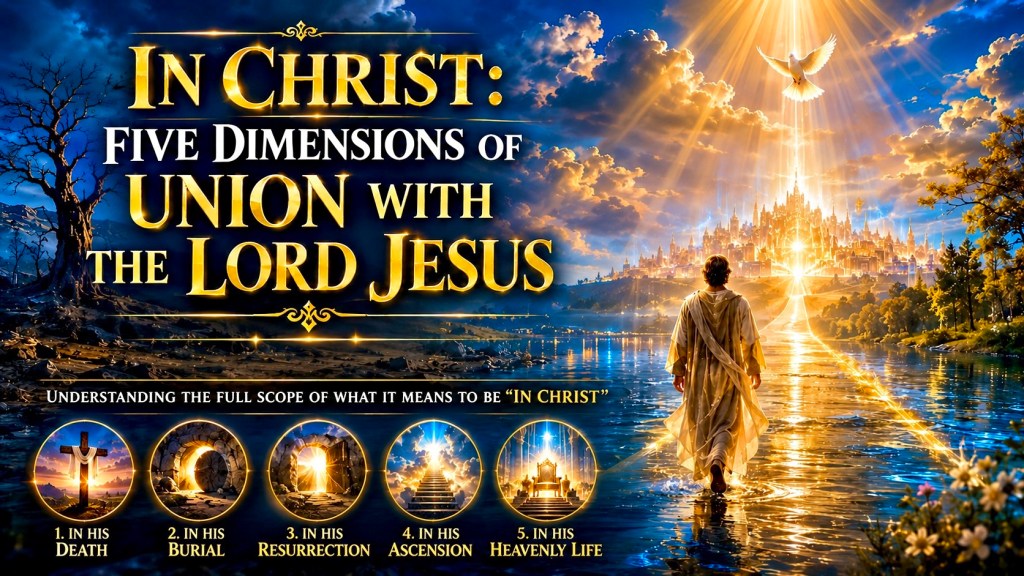
Yet most teaching on this subject treats union with Christ as though it were limited to a single dimension—usually the believer’s identification with His death and resurrection. That is real and essential, but it is not the whole. Scripture reveals that the believer’s union with the Lord Jesus has at least five distinct dimensions, each building upon the last: union with Him in His death, in His burial, in His resurrection, in His ascension, and in His present heavenly life. Together these five dimensions trace the full scope of what it means to be “in Christ”—from the judicial sentence on the old Adamic man all the way to the believer’s participation in the present priestly and kingly ministry of the enthroned Son.
The Mystery Hidden for Ages
Before unfolding the five dimensions, we must see that union with Christ belongs to what Paul calls “the mystery of Christ, which in other ages was not made known to the sons of men” (Ephesians 3:4–5). In the Torah and the Prophets, God made His purposes known in shadows, patterns, and promises. Adam as the head of the human race, Israel as God’s covenant son, the tabernacle and temple as dwelling places of His presence, and the promise of a new heart and Spirit given to His people (Ezekiel 36:26–27)—all of these pointed toward something that remained veiled until the appearing, death, and resurrection of the Lord Jesus.
What was hidden is now revealed: “that the Gentiles should be fellow heirs, of the same body, and partakers of His promise in Christ through the gospel” (Ephesians 3:6). The mystery is not merely that Gentiles are included alongside Jewish believers. The mystery is that Jew and Gentile alike are gathered into one new Man in union with the Lord Jesus as their Head. The Lord Jesus Himself is the mystery in whom “are hidden all the treasures of wisdom and knowledge” (Colossians 2:3). And the Apostolic proclamation is breathtaking in its simplicity: “Christ in you, the hope of glory” (Colossians 1:27).
This mystery has both an individual and a corporate dimension. Individually, it means that the believer’s hope of glory is not rooted in any inherent strength of the soul but in the indwelling Christ, who will one day bring many sons to glory and conform them to His image as the Firstborn among many brethren (Hebrews 2:10; Romans 8:29). Corporately, it means that God is forming in Christ one new Man—a corporate Christ, Head and Body together—composed of those who are united to Him in this age as the church of the firstborn (Ephesians 2:15–16; Hebrews 12:23). Paul can even speak of the whole Body under the single name “Christ,” so intimate is the union between Head and members: “For as the body is one and has many members, but all the members of that one body, being many, are one body, so also is Christ” (1 Corinthians 12:12).
From Adam to Christ: The Great Transfer
All humanity is born in Adam, sharing the corruption, mortality, and spiritual ruin introduced through his transgression. “By one man sin entered the world, and death through sin, and thus death spread to all men, because all sinned” (Romans 5:12). Adam stands in the Torah not merely as the first individual but as the covenant head and root of the human race. In him the race turns from God. In him the race receives the sentence of death. In him the powers of sin and corruption begin their reign. “In Adam all die” (1 Corinthians 15:22).
To be “in Adam” is therefore to be under the old headship: to belong to the old creation order, to carry within the soul the corruption that springs from Adam’s fall, and to be subject to the threefold death that rests upon that corruption—spiritual estrangement from God, the decay and disorder of the soul under sin’s dominion, and the eventual destruction of body and soul in judgment unless grace intervenes.
The Lord Jesus is presented as “the last Adam” and “the second Man” (1 Corinthians 15:45, 47). Paul writes that “the last Adam became a life-giving Spirit”—and that “became” points to His resurrection and exaltation, the moment when, having borne the full weight of Adamic condemnation in His death, He rose as the Head of a new creation and the source of life for all who would be united to Him. In His death He bears the sentence that rests upon the Adamic order. In His resurrection He becomes the Last Adam—the covenant Head of the new creation Man. In His ascension He takes His place as Lord over all things. The transfer from Adam to Christ occurs when the Spirit of grace unites the believer to the Son: “But of Him you are in Christ Jesus” (1 Corinthians 1:30). The believer does not climb out of Adam by moral effort. God Himself places the believer into Christ. Paul gives thanks to the Father, “who has qualified us to be partakers of the inheritance of the saints in the light. He has delivered us from the power of darkness and conveyed us into the kingdom of the Son of His love, in whom we have redemption through His blood, the forgiveness of sins” (Colossians 1:12–14).
In that moment a real transfer of headship takes place: no longer under Adam, but under Christ; no longer in the flesh, but in the Spirit; no longer under condemnation, but under the regime of grace and life. “If anyone is in Christ, he is a new creation; old things have passed away; behold, all things have become new” (2 Corinthians 5:17). The believer belongs to the coming age even while he walks in this one. Everything that follows—the five dimensions of union—unfolds from this great transfer.
The First Dimension: United With Christ in His Death
Union with Christ begins with union in His death. “Our old man was crucified with Him, that the body of sin might be done away with, that we should no longer be slaves of sin” (Romans 6:6). The “old man”—the Greek palaios anthrōpos (παλαιὸς ἄνθρωπος)—is the whole Adamic person governed by the flesh—the self-governing disposition established at the fall, corrupting the soul’s expression, and manifesting through the body in disordered desire and independence from God. When Paul says that this old man “was crucified with” Christ, the compounded verb denotes a real inclusion in Christ’s crucifixion. God has taken the whole Adamic order and brought it under the sentence of the cross through the death of the Lord Jesus.
This is first a judicial reality. The cross is God’s verdict on Adamic humanity. In the death of His Son, God passes sentence on the entire Adamic order. The Lord Jesus, though personally sinless, goes to the cross as the Lamb of God, bearing the guilt and consequences of Adam’s race. He takes upon Himself the full weight of Adamic condemnation and dies under it. But it is through His resurrection and exaltation that He “became a life-giving Spirit” (1 Corinthians 15:45)—the Last Adam, the Head of a new creation, the source of life for all who are united to Him. At the cross He bears the sentence. In the resurrection He becomes the Head of the new humanity. The believer, united to the risen and exalted Christ by the Spirit of grace, is included in both realities—in His death as the end of the old, and in His resurrection as the beginning of the new. God does not merely forgive the believer’s sins. He pronounces the entire Adamic man to be condemned and crucified in Christ, and He raises the believer into a new order of life under the Headship of the Last Adam. “I have been crucified with Christ; it is no longer I who live, but Christ lives in me” (Galatians 2:20).
Here a careful distinction must be drawn between three related but different realities that Scripture names. The “old man” (palaios anthrōpos) refers to the Adamic person as a whole under the rule of sin. The “flesh” (sarx, σάρξ) describes the ongoing inclination of the fallen human nature—the tendency toward self-gratification and independence from God that remains even in the believer after conversion. The “body of sin” (sōma tēs hamartias, σῶμα τῆς ἁμαρτίας) is the whole embodied life as it has been organized under sin’s dominion—the instruments of the body yielded to unrighteousness. In Christ’s death, the old man is crucified once for all. That is a finished work. But in the believer’s daily experience, the flesh must be resisted and the members of the body must be presented to God as instruments of righteousness (Romans 6:13; 8:13). This distinction matters because it prevents two opposite errors: the error of thinking the old man must be crucified again and again (he has already been crucified—the work is done), and the error of thinking the flesh has been eradicated (it has not—it must be put to death daily by the Spirit).
The call to the believer is therefore to reckon what God has already done. “Likewise you also, reckon yourselves to be dead indeed to sin, but alive to God in Christ Jesus our Lord” (Romans 6:11). Reckoning is not pretending. It is faith’s agreement with God’s verdict. When the believer, by the Spirit of grace, counts himself dead to sin and alive to God, he steps into the freedom that Christ has already won.
The Second Dimension: United With Christ in His Burial
Union with Christ includes not only death but burial. “We were buried with Him through baptism into death” (Romans 6:4). Burial signifies removal, closure, and separation. When the Lord Jesus was laid in the tomb, His body was placed out of sight. His death was sealed and attested. In the same way, to be buried with Christ is to be removed from the realm and order of the old creation. The believer is not merely a forgiven Adamic person. He is a person who has, in Christ, passed out of Adamic existence and into a new creation sphere.
Baptism portrays this burial vividly. The believer is taken down into the water, as into a grave, and then lifted up. “Buried with Him in baptism, in which you also were raised with Him through faith in the working of God, who raised Him from the dead” (Colossians 2:12). The burial aspect emphasizes that what belonged to the old life is to be left behind. The dominion of sin has been broken. The entire structure of life in Adam has been closed off as a ruling reality.
Burial also introduces a theme that will become crucial in the later dimensions of union: hiddenness. Having been buried with Christ, the believer’s life is now concealed. “For you died, and your life is hidden with Christ in God” (Colossians 3:3). The world sees only a weak, mortal, often afflicted person. The reality of the believer’s new life is veiled. But this hiddenness is temporary. “When Christ who is our life appears, then you also will appear with Him in glory” (Colossians 3:4). What is now buried and hidden will then be manifested and clothed with an immortal, heavenly body (1 Corinthians 15:40-49; Philippians 3:21).
The Third Dimension: United With Christ in His Resurrection
Union with Christ includes participation in His resurrection. Paul links burial and resurrection in a single movement: “Just as Christ was raised from the dead by the glory of the Father, even so we also should walk in newness of life” (Romans 6:4). The resurrection of the Lord Jesus is not only a past event enacted in His own body. It is a source of new life that flows into all who are united to Him. The risen Christ is “the firstfruits of those who have fallen asleep” (1 Corinthians 15:20). His resurrection life is the prototype and fountain of every future resurrection and of the present spiritual renewal of His people.
The phrase “newness of life” uses the Greek kainotēs (καινότης), indicating not merely an improved version of the old but a life that belongs to a different order—the life of the age to come, the life of the new creation, already present in the divine seed within the believer and through the indwelling Holy Spirit. This resurrection life is communicated by the Spirit of grace: “If the Spirit of Him who raised Jesus from the dead dwells in you, He who raised Christ from the dead will also give life to your mortal bodies through His Spirit who dwells in you” (Romans 8:11). The same Spirit who raised the Lord Jesus now empowers the believer’s inner life, enabling him to walk in a new way.
This is the dimension of union that bears the most visible fruit in the present age. As the believer yields to the Spirit, the life of the risen Christ appears in character, conduct, and affection: love, joy, peace, longsuffering, kindness, goodness, faithfulness, gentleness, self-control (Galatians 5:22–23). These are not natural virtues that the believer cultivates by effort. They are the outworking of the life of Christ in the soul. And there is a deep continuity between the resurrection life present in the believer now and the celestial glory that awaits at the appearing. “As we have borne the image of the man of dust, we shall also bear the image of the heavenly Man” (1 Corinthians 15:49). The more the spirit is transformed by the divine seed and the soul purified through the crucifixion of the flesh, the more the whole inner person reflects Christ’s image in this age—and the more fitting it becomes for the celestial body that will be given at the resurrection of life.
The Lord Jesus Himself spoke of this fuller dimension when He told Nicodemus, “That which is born of the Spirit is spirit” (John 3:6). In this age the Spirit begets the believer from above—the seed of divine life is implanted, the spirit is made alive, and the child of God exists in present reality. But the full birth awaits the resurrection of life, when the entire person is brought into the mode of the Spirit and clothed with a celestial, spiritual body (1 Corinthians 15:44; Philippians 3:21). Resurrection union, therefore, is both a present reality and a future hope. The believer walks in newness of life now. He will be clothed in resurrection glory then. And the walk determines the clothing.
The Fourth Dimension: United With Christ in His Ascension
It is here that most teaching on union with Christ stops—at death, burial, and resurrection. But Scripture does not stop there. The believer is not only united with Christ in what happened at Calvary and at the empty tomb. He is united with Christ in what happened forty days later, when the Lord Jesus ascended to the right hand of the Father.
After His resurrection, the Lord Jesus was exalted to the highest place, fulfilling the words of the Psalmist: “The LORD said to my Lord, ‘Sit at My right hand, till I make Your enemies Your footstool’” (Psalm 110:1). Daniel saw in vision “One like the Son of Man, coming with the clouds of heaven,” who came to the Ancient of Days and was given “dominion and glory and a kingdom, that all peoples, nations, and languages should serve Him” (Daniel 7:13–14). The Apostolic witness declares that this enthronement has taken place. And in a real though presently hidden way, believers share in it.
Paul states it with astonishing directness: God “raised us up together, and made us sit together in the heavenly places in Christ Jesus” (Ephesians 2:6). The language is positional, but it describes a genuine spiritual reality. The believer’s true life is no longer rooted in the earth but in the heavens. To be seated with Christ is to share in His favor with the Father, to have access to the Heavenly Sanctuary, and to participate, in measure, in His kingly authority. The writer of Hebrews confirms this access: “Having boldness to enter the Holiest by the blood of Jesus,” believers may now draw near “with a true heart in full assurance of faith” (Hebrews 10:19, 22). What the High Priest under the Old Covenant could do only once a year, and only with the blood of an animal, the believer can now do continually—because he is seated with the true High Priest in the heavenly places.
Ascension union reorients the believer’s entire life. “If then you were raised with Christ, seek those things which are above, where Christ is, sitting at the right hand of God. Set your mind on things above, not on things on the earth” (Colossians 3:1–2). This does not mean neglecting earthly responsibilities. It means viewing them from a heavenly standpoint. The believer learns to see history under the Lordship of Christ, suffering under the sovereignty of Christ, and service as participation in the ministry of Christ. Earthly life becomes the arena in which heavenly realities are lived out under the eye of the enthroned Lord.
This is the dimension of union that the Lord Jesus described to His disciples as “abiding.” On the night before His crucifixion, He spoke of Himself as the true Vine and His disciples as the branches: “Abide in Me, and I in you. As the branch cannot bear fruit of itself, unless it abides in the vine, neither can you, unless you abide in Me” (John 15:4). The stress falls on the ongoing, organic, life-sharing character of this union. Just as the branch draws life from the vine and bears fruit only as it remains in that vital connection, so the believer lives and bears fruit only as he abides in Christ through faith, obedience, and dependence. The vine is not on earth. The vine has ascended. And the branches draw their life from a heavenly source.
Ascension union also foreshadows the believer’s future participation in the heavenly court and the Heavenly Jerusalem. At the appearing of the Lord Jesus, the faithful will be caught up to meet Him and will enter openly into the heavenly realm that they have already shared in by faith. There the heavenly court will sit, and the faithful will enter His rest as celestial sons and daughters, sharing in the heavenly oversight of the age to come and awaiting their open priestly ministry in the Eighth Day. The ascension life they have known inwardly will become their manifest environment.
The Fifth Dimension: United With Christ in His Heavenly Life
The Lord Jesus does not sit in heaven in passive repose. He lives and ministers as the Great High Priest and King in the presence of the Father. He “always lives to make intercession” for those who come to God through Him (Hebrews 7:25). He rules in the midst of His enemies, extending the scepter of His strength from Zion (Psalm 110:2). He is actively sustaining, governing, interceding, and preparing the inheritance for those who are His. Through union with Him, believers share in this heavenly life even now.
Paul’s testimony, “Christ lives in me” (Galatians 2:20), points to this reality. The risen and ascended Christ dwells in His people by the Spirit. This indwelling life forms His character in them, conforming them to His image (Romans 8:29). As believers yield to this life, they learn to think with the mind of Christ, to love with His love, to endure suffering with His patience, and to serve with His meek authority. The Spirit of grace takes the things that are Christ’s and makes them known in the believer’s inner experience, exactly as the Lord Jesus promised: “He will glorify Me, for He will take of what is Mine and declare it to you” (John 16:14).
Sharing Christ’s heavenly life also means sharing His path of suffering and endurance in this present age. The Lord Jesus “learned obedience through the things He suffered” (Hebrews 5:8). His faithful now learn obedience in the same school. They carry about in the body “the dying of the Lord Jesus, that the life of Jesus also may be manifested” in them (2 Corinthians 4:10). Fellowship with His life is inseparable from fellowship with His sufferings. Yet these sufferings are not signs of abandonment. They are the appointed means by which the soul is weaned from earthly attachments and anchored in the unseen heavenly reality where Christ dwells.
Peter captures the ultimate reach of this union when he speaks of believers becoming “partakers of the divine nature, having escaped the corruption that is in the world through lust” (2 Peter 1:4). This does not mean that believers become what God is in His eternal essence. It means that through union with the Lord Jesus, the incarnate Son, they are truly made like Him as sons and daughters—sharing in His moral likeness, His holiness, His love, and His capacity to dwell in the Father’s presence. The divine nature is communicated not by absorption but by participation: the believer remains a creature, yet a creature so profoundly united to the Creator’s Son that the life flowing through him is the life of God Himself. This is what the salvation of the soul is producing—a human being fitted to share in the divine life and fitted for the celestial body that will manifest it openly.
This present fellowship with Christ’s heavenly life is training for future priestly and kingly service. In the Seventh Day, the faithful will serve as celestial sons in the Heavenly Jerusalem, entering God’s rest and sharing in the heavenly oversight of the age to come. In the Eighth Day, when the nations are fully restored and the creation is renewed, they will openly exercise their Royal Priesthood as the corporate Christ, ministering light, order, and blessing to the immortal nations. The life they live now, in union with Christ amid weakness and conflict, is the same life that will be revealed in glory. There will be no break in continuity—only an intensification and enlargement. What is now hidden within will then be manifest without.
The Fruits of Union: What This Produces in the Believer
Union with Christ is not merely a theological concept to be admired. It bears genuine fruits in the believer’s standing, transformation, relationships, and destiny.
Union with Christ is the ground of justification. God justifies sinners not in isolation from Christ but in Him. “But of Him you are in Christ Jesus, who became for us wisdom from God—and righteousness and sanctification and redemption” (1 Corinthians 1:30). The believer is counted righteous because he is united to the Righteous One. On the cross, Christ was “made sin for us, that we might become the righteousness of God in Him” (2 Corinthians 5:21). Justification is a declaration rooted in covenant union: God declares the believer righteous because he shares the standing of the Son in whom He is well pleased.
Union with Christ is the source of the salvation of the soul. The spirit is saved and joined to Christ at conversion—that is the gift. The soul is saved progressively as Christ’s life displaces Adamic corruption within the believer. “Receiving the end of your faith—the salvation of your souls” (1 Peter 1:9). Through union with Christ, the believer puts off the old man and his deeds, is renewed in the spirit of his mind, and puts on the new man “which was created according to God, in true righteousness and holiness” (Ephesians 4:24). The word of God, the discipline of the Father, the fellowship of the saints, and the trials of life all become instruments in the hand of the Spirit of grace to conform the soul to Christ. This is the bridge between the gift and the prize—the salvation of the soul in this present age, producing the maturity and Christlikeness that qualifies the faithful for the firstborn inheritance.
Union with Christ creates and sustains the corporate Body. Individually, believers are joined to Christ. Corporately, they are joined to one another as members of one Body. “We, being many, are one body in Christ, and individually members of one another” (Romans 12:5). Spiritual gifts, ministries, and offices are all expressions of the one life of the Head distributed through the members according to the will of the Spirit. As this life grows and matures the Body in love, it prepares the church for her vocation in the ages to come: as the assembly of firstborn sons in the Heavenly Jerusalem and as the Royal Priesthood serving God among the restored nations.
And union with Christ determines the believer’s future glory. Those who are faithful to their union in this age, walking by the Spirit and allowing the cross to crucify the flesh, will be counted worthy of the resurrection of life. They will receive celestial bodies, bear the image of the heavenly Man, and be manifested as the sons and daughters of God in the Heavenly Jerusalem. Their union with Christ will be displayed in open likeness to Him and in shared participation in His priestly and kingly ministry. The prize is not something separate from union—it is union brought to its full manifestation.
Conclusion: The Heart of Everything
Union with Christ is the heart of the Restoration of All Things. In His death, the Lord Jesus brings the Adamic man under judicial sentence and opens the way for the destruction of Adamic corruption. In His burial, He removes His people from the realm of the old creation and hides their life with Himself in God. In His resurrection, He imparts the life of the new creation, enabling His people to walk in newness of life and preparing them for celestial glory. In His ascension, He seats them with Himself in the heavenly places, granting access to the Heavenly Sanctuary and calling them to live from their true citizenship. In His heavenly life, He dwells in them by the Spirit of grace, forming His character within them and training them for their future service as royal-priestly sons.
This union is both a gift and a calling. It is a gift because God grants it freely by grace, uniting sinners to His Son apart from their works. It is a calling because those who are united to Christ are summoned to live in a manner worthy of that union—to reckon themselves dead to sin and alive to God, to set their minds on things above, to abide in Christ and bear much fruit, to walk in the Spirit and not fulfill the lusts of the flesh. The grace of God that brings salvation teaches us to deny ungodliness and worldly lusts, and to live soberly, righteously, and godly in this present age, “looking for the blessed hope and glorious appearing of our great God and Savior Jesus Christ” (Titus 2:12–13).
Every dimension of the Christian life flows from being “in Christ.” The question this teaching presses is not whether you believe these truths about union—but whether you are living from them. Are you reckoning the old man dead? Are you walking in the resurrection life the Spirit provides? Are you setting your mind on things above, where Christ is seated? Are you abiding in the Vine, drawing life from the heavenly source? For the faithful who live from their union with Christ in this present age, the appearing of the Lord Jesus will not be a disruption but a consummation—the moment when everything that has been hidden is revealed, everything that has been forming within is clothed with glory, and the life that has been shared with Christ in secret is manifested before the watching creation.

