
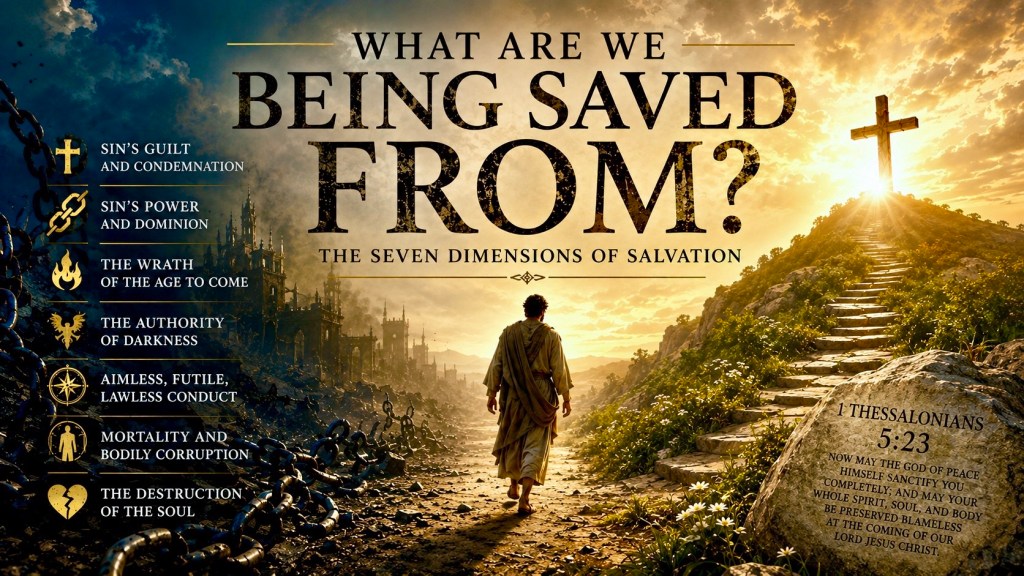
Introduction: The Question Most Christians Never Ask
The words “saved” and “salvation” appear throughout the New Testament with a frequency that should make every serious reader pause and ask the most basic question: saved from what? Most Christians, if pressed, would give a one-word answer—hell. Some might say sin. Others might say God’s wrath. And each of these answers contains a fragment of truth. But the New Testament itself gives a far richer, more layered, and more astonishing answer than any single word can carry.
The Apostles never treat salvation as a single, undifferentiated event. They speak of salvation in three tenses—past, present, and future. They describe it as something that has already happened, something that is happening now, and something that has not yet been fully realized. Paul can say in one breath that believers “have been saved” (Ephesians 2:5, 8), and in the next that “now our salvation is nearer than when we first believed” (Romans 13:11). How can salvation be both complete and still approaching? The answer is that salvation addresses different dimensions of the human condition at different stages, and the failure to see this has produced an impoverished gospel that leaves believers confused about warning passages, uncertain about the role of obedience, and unable to explain why the Apostles speak with such urgency to people who are already “saved.”
What follows is an examination of every major New Testament passage that uses the language of saved, salvation, redeemed, and redemption, analyzed in its own context, and organized according to what each passage tells us we are being saved from. Seven distinct dimensions emerge—and together they reveal a salvation as comprehensive as the death that made it necessary.
I. Saved from Sin’s Guilt and Condemnation
The first and most foundational dimension of salvation is deliverance from the legal guilt that stands against every person because of sin. This is what the Apostles call justification—the declaration that the sinner is righteous before God, not on the basis of his own works but on the basis of the Lord Jesus’ finished work. But this declaration, though rooted in a finished provision, must be received and appropriated through repentance and faith. The Levitical sin offering illustrates this with perfect clarity: the sacrifice could be spotless, the altar prepared, the priest standing ready—but if the offerer refused to lay his hands on the head of the offering and confess his sin, the atonement was not applied. The offense remained. The provision was complete; the appropriation was required. The same is true under the New Covenant. The Lord Jesus has offered Himself once for all as the sin offering for the world, but that offering must be received through repentance toward God and faith in the Lord Jesus, sealed in baptism—the New Covenant act of identification with His death (Romans 6:3). Without this personal appropriation, the gift remains unapplied, and the person remains answerable for his deeds before the righteous Judge.
Paul writes, “Being justified freely by His grace through the redemption that is in Christ Jesus” (Romans 3:24). The entire argument of Romans 1–3 has established that “all have sinned and fall short of the glory of God” (Romans 3:23). Every person—Jew and Gentile alike—stands guilty before the righteous Creator. The redemption that is “in Christ Jesus” is the means by which that guilt is removed. The price is His blood: “In Him we have redemption through His blood, the forgiveness of sins, according to the riches of His grace” (Ephesians 1:7). The result is forgiveness—the guilt of past transgressions removed, the conscience cleansed, the legal record settled. Paul confirms this scope in Romans 3:25, where God set forth the Lord Jesus “as a propitiation by His blood, through faith, to demonstrate His righteousness, because in His forbearance God had passed over the sins that were previously committed.” Previously committed—past sins. The gift of justification covers what lies behind the believer at the moment of faith. Ongoing sins require ongoing confession and repentance: “If we confess our sins, He is faithful and just to forgive us our sins and to cleanse us from all unrighteousness” (1 John 1:9). The blood is sufficient for every sin, but it must be applied—initially through faith at conversion and if needed afterwards continually through confession throughout the believer’s walk.
Paul makes the scope of the provision unmistakable in his argument from lesser to greater in Romans 5: “Therefore, as through one man’s offense judgment came to all men, resulting in condemnation, even so through one Man’s righteous act the free gift came to all men, resulting in justification of life” (Romans 5:18). The condemnation that came through Adam reached every person. The free gift that came through the Lord Jesus reaches no fewer in its provision. If the condemnation was universal, the provision of justification is universal. But provision and application are not the same thing. The gift has come to all; the gift must be received by each. And Paul’s next verse reveals the timing: “For as by one man’s disobedience many were made sinners, so also by one Man’s obedience many will be made righteous” (Romans 5:19). The verb “will be made” is katastathēsontai (κατασταθήσονται)—future passive indicative. Paul did not write “have been made righteous” or “are made righteous.” He wrote will be made. The provision is accomplished—the Lord Jesus’ obedience is finished, complete, once for all. But the actual constituting of the many as righteous is something that unfolds across the ages. Some are constituted righteous now, in this present age, through repentance and faith. Others will be constituted righteous through the corrective fires and the restoration that lies ahead. The future tense holds open the full scope of what the Lord Jesus’ obedience accomplished without collapsing it into a single past event that eliminates the need for personal response. The question the rest of the New Testament answers is not whether the gift reaches all, but in what order and through what process each person receives it—”each one in his own order” (1 Corinthians 15:23).
The past tense of this salvation is captured with precision in passages like Ephesians 2:5 and 8: “By grace you have been saved.” The Greek verb is sesōsmenoi (σεσωσμένοι)—a perfect passive participle, indicating a completed action with ongoing results. Something was done, once, by God, and its effects remain. Titus 3:5 confirms the same: “Not by works of righteousness which we have done, but according to His mercy He saved us, through the washing of regeneration and renewing of the Holy Spirit.” The saving is God’s act. The means is mercy, not merit. The instrument is the washing of regeneration—the cleansing and preparation of the spirit to receive what God intends to plant within it. The old spirit, contaminated through the flesh’s governance—what Paul calls “the filthiness of the flesh and spirit” (2 Corinthians 7:1)—is washed, sanctified, and justified at conversion: “But you were washed, but you were sanctified, but you were justified in the name of the Lord Jesus and by the Spirit of our God” (1 Corinthians 6:11). The blood of the Lord Jesus cleanses the conscience from dead works (Hebrews 9:14). The spirit is set apart, made holy ground. And into that prepared soil the incorruptible seed is planted—the divine begetting by which the old spirit receives the heavenly seed and begins to be transformed from glory to glory. The “renewing of the Holy Spirit” is the indwelling presence who sustains the seed’s growth and governs what the flesh once governed. The gift is the Holy Spirit Himself—freely given, irrevocable, never removed. The transformation of the spirit by the divine seed is the fruit of the gift, not the gift itself. And fruit can wither if the flesh chokes it. But the gift—the Holy Spirit as Person—cannot be undone, and the gifts and the calling of God are irrevocable (Romans 11:29).
The one who has received this gift stands in a new legal reality: “There is therefore now no condemnation to those who are in Christ Jesus” (Romans 8:1). The word “now” marks the present standing. And Paul immediately reveals the purpose of this freedom: “that the righteous requirement of the law might be fulfilled in us who do not walk according to the flesh but according to the Spirit” (Romans 8:4). The absence of condemnation is not a bare legal abstraction detached from the believer’s life. It is a standing whose purpose is fulfilled in those who walk in the Spirit’s provision, not in those who claim the position while living under the flesh’s governance.
II. Saved from Sin’s Power and Dominion
If the first dimension of salvation addresses the guilt of sin, the second addresses its power. The justified believer is not merely forgiven; he is delivered from the dominion of sin over his daily life. This is the ongoing, present-tense dimension of salvation—the progressive deliverance from the tyranny of the flesh—the self-governing orientation established at the fall, through which the soul is corrupted and the spirit’s communion with God is veiled.
Paul makes this explicit in Romans 6:14: “For sin shall not have dominion over you, for you are not under law but under grace.” The old man has been crucified positionally with Christ (Romans 6:6); the believer is now called to reckon himself dead to sin and alive to God (Romans 6:11) and to present his members as instruments of righteousness rather than instruments of unrighteousness (Romans 6:13). The ongoing deliverance from sin’s power is not automatic—it requires the believer’s active cooperation with the Spirit.
This is why Paul writes to believers—to people who are already justified—and tells them, “For if you live according to the flesh you will die; but if by the Spirit you put to death the deeds of the body, you will live” (Romans 8:13). The “if” is real. The choice is real. The consequences are real. The death in view is eschatological loss—the ruin that comes upon the soul-life that remains under the flesh’s governance. The life in view is the life of the Age to Come—entrance into the resurrection of life. And the means of deliverance is the Spirit’s power applied through the believer’s active participation: “if by the Spirit you put to death the deeds of the body.”
The same present-tense salvation appears in Philippians 2:12: “Work out your own salvation with fear and trembling.” Paul addresses believers and tells them to bring to completion what God has already begun. The verb katergazomai (κατεργάζομαι) means to work out fully, to carry through to completion. This is not initial conversion—that is settled. This is the ongoing work by which the flesh is crucified, the soul is purified, and the spirit is transformed by the divine seed from glory to glory. And the ground of that work is immediately supplied: “For it is God who works in you both to will and to do for His good pleasure” (Philippians 2:13). The believer works because God is working within. Grace empowers the very obedience it commands.
This dimension of salvation is what the Apostles call “the salvation of the soul”—and it is addressed with striking directness in three passages that every believer should know. James tells believers to “receive with meekness the implanted word, which is able to save your souls” (James 1:21). Peter speaks of “receiving the end of your faith—the salvation of your souls” (1 Peter 1:9). And the writer of Hebrews sets two paths before the reader: “We are not of those who draw back to perdition, but of those who believe to the saving of the soul” (Hebrews 10:39). In each case, the salvation of the soul is not identical with the initial gift of spiritual regeneration. It is the entire process by which the flesh is crucified—the self-governing orientation put to death by the Spirit through the word—the soul is purified as the flesh’s governance is removed, and the spirit is transformed by the incorruptible seed into Christ’s heavenly nature. Because the soul reflects the condition of the spirit, as the spirit is transformed and the flesh is removed, the soul’s expression changes—increasingly reflecting the image of Christ being formed within.
The Lord Jesus Himself made the salvation of the soul the hinge of discipleship: “For whoever desires to save his life will lose it, but whoever loses his life for My sake will find it. For what profit is it to a man if he gains the whole world, and loses his own soul?” (Matthew 16:25–26). The word translated “life” and “soul” in these verses is the same Greek word—psuchē (ψυχή). To cling to the self-governed soul-life—to refuse the crucifixion of the flesh, to insist on autonomous self-rule—is to lose the soul in the Age to Come. To surrender it for Christ’s sake is to find it—the same soul, purified. The Greek is emphatic: autēn (αὐτήν)—the very soul that was surrendered is the soul that is recovered, not destroyed and replaced but purified and glorified. The soul is the contested territory of the believer’s present life, and its salvation is the central work for which this age exists.
III. Saved from the Wrath of the Age to Come
The third dimension of salvation is future—deliverance from the coming eschatological judgment that the Apostles call “the wrath to come.” This is not identical with the past-tense justification that removed the guilt of sin. It is a future deliverance that the believer awaits and presses toward.
Paul draws the distinction sharply in Romans 5:9: “Much more then, having now been justified by His blood, we shall be saved from wrath through Him.” Justification is past—”having now been justified.” Salvation from wrath is future—”we shall be saved.” The two are related but not identical. Justification settles the legal standing before God; salvation from wrath is the full deliverance that will be realized at the Lord’s appearing.
The Thessalonian correspondence makes this even more explicit. Paul describes the believers as those who “wait for His Son from heaven, whom He raised from the dead—Jesus who delivers us from the wrath to come” (1 Thessalonians 1:10). The present participle “delivers” (rhuomenon, ῥυόμενον) indicates an ongoing deliverance: the Lord Jesus is the One who is delivering and will deliver His faithful from the wrath of the Age to Come. But this deliverance is not merely a future rescue at the last moment. The present participle reveals that the Lord Jesus is presently delivering His people from the wrath to come—by sanctifying, cleansing, and transforming them now, so that when the Day arrives, the wrath has nothing left to address.
The Apostolic witness confirms this from every angle. Paul tells husbands to love their wives “just as Christ also loved the church and gave Himself for her, that He might sanctify and cleanse her with the washing of water by the word, that He might present her to Himself a glorious church, not having spot or wrinkle or any such thing, but that she should be holy and without blemish” (Ephesians 5:25–27). The Lord Jesus’ self-giving was not only for past-tense atonement. It extends into the present: He is sanctifying, He is cleansing, He is washing by the word—right now—so that at His appearing the church is presentable, without spot or wrinkle. That present-tense work of sanctification is the delivering from the wrath to come. He is preparing a people who will not face condemnation because they have already been purified.
Paul writes to Titus with the same logic: “For the grace of God that brings salvation has appeared to all men, teaching us that, denying ungodliness and worldly lusts, we should live soberly, righteously, and godly in the present age, looking for the blessed hope and glorious appearing of our great God and Savior Jesus Christ, who gave Himself for us, that He might redeem us from every lawless deed and purify for Himself His own special people, zealous for good works” (Titus 2:11–14). Grace is not passive. It is actively teaching, instructing, and training the believer in the present age to deny ungodliness—and the goal of this training is readiness for “the blessed hope and glorious appearing.” The redemption from lawlessness and the purification of a special people are present-tense works aimed at the Day of His return. He is delivering us from the wrath by redeeming us from the very lawlessness that would bring the wrath upon us.
John confirms the ongoing nature of this cleansing: “If we walk in the light as He is in the light, we have fellowship with one another, and the blood of Jesus Christ His Son cleanses us from all sin” (1 John 1:7). The verb “cleanses” is katharizei (καθαρίζει)—present tense, continuous action. The blood keeps on cleansing as the believer keeps walking in the light. That ongoing cleansing is the present deliverance from wrath, because the sin that would bring condemnation is being dealt with now, through confession and the blood, rather than being stored up for the Day of judgment.
Paul tells the Thessalonians themselves that their present sufferings serve this very purpose. He boasts of their “patience and faith in all your persecutions and tribulations that you endure, which is manifest evidence of the righteous judgment of God, that you may be counted worthy of the kingdom of God, for which you also suffer” (2 Thessalonians 1:4–5). Their trials, endured in patience and faith, are manifest evidence—endeigna (ἔνδειγμα), visible proof—of God’s righteous judgment. The present-tense suffering, faithfully endured, is the very means by which God is forming in them the character that passes the test of the Judgment Seat and counts them worthy of the kingdom.
This is why Paul writes, “If we would judge ourselves, we would not be judged. But when we are judged, we are chastened by the Lord, that we may not be condemned with the world” (1 Corinthians 11:31–32). The self-judgment that the Spirit empowers in this age is the deliverance from judgment in the Age to Come. And Peter confirms that this refining work begins now, within the household of God: “For the time has come for judgment to begin at the house of God; and if it begins with us first, what will be the end of those who do not obey the gospel of God?” (1 Peter 4:17). Judgment begins at the house of God—not at the world. The Lord Jesus is refining His own people first, in this present age, through the sanctifying work of His Spirit, the cleansing power of His blood, the washing of His word, and the trials that test and strengthen faith. This present refining is the deliverance. Those who submit to it now will not face the wrath then.
And in 1 Thessalonians 5:9 Paul adds, “For God did not appoint us to wrath, but to obtain salvation through our Lord Jesus Christ.” The context is entirely eschatological—the Day of the Lord (v. 2), the sons of light versus the sons of darkness (v. 5). The salvation in view is not initial conversion but the full deliverance at the Lord’s return—the resurrection of life, celestial glory, entrance into the joy of the Lord. But the “us” who are not appointed to wrath are those who have been walking as sons of light and sons of the day (v. 5), who have been sober and watchful (v. 6), who have put on “the breastplate of faith and love, and as a helmet the hope of salvation” (v. 8). The deliverance from wrath belongs to those in whom the Lord Jesus’ present sanctifying work has been received and cooperated with—those who have been delivered from the inside out, so that when the Day breaks, they are found ready.
Romans 13:11 captures the forward-looking character of this salvation with remarkable economy: “And do this, knowing the time, that now it is high time to awake out of sleep; for now our salvation is nearer than when we first believed.” Salvation is approaching. It draws closer with every passing day. It is not behind the believer, settled at the altar call. It is ahead, at the appearing of the Lord Jesus, when everything that has been purchased will be fully delivered.
Hebrews 9:28 confirms this final dimension: “To those who eagerly wait for Him He will appear a second time, apart from sin, for salvation.” The first appearing dealt with sin. The second appearing brings salvation in its completed form. The two appearings bookend the three tenses of salvation: what was accomplished at the cross (past—the gift), what the risen Lord Jesus is accomplishing through His Spirit in His people in this present age (present—the salvation of the soul), and what will be consummated at His return (future—the resurrection of life and the redemption of the body).
IV. Saved from the Authority of Darkness and the Fallen Powers
The fourth dimension of salvation extends beyond the personal and legal into the cosmic. The New Testament teaches that humanity is not merely guilty sinners but captives—held under the authority of spiritual powers that rule this present evil age. Salvation, therefore, includes deliverance from the dominion of these powers.
Paul describes this with breathtaking language in Colossians 1:13–14: “He has delivered us from the power of darkness and conveyed us into the kingdom of the Son of His love, in whom we have redemption through His blood, the forgiveness of sins.” The word translated “power” is exousia (ἐξουσία)—authority, dominion, the right to rule. The believer has been extracted from one kingdom and placed into another. This is not merely forgiveness; it is a transfer of sovereignty. The powers of darkness no longer have authority over the one who is in Christ.
Galatians 1:4 broadens the scope even further. The Lord Jesus “gave Himself for our sins, that He might deliver us from this present evil age, according to the will of our God and Father.” The deliverance is not merely from individual sins but from the entire system of this present evil age dominated by sin, death, and the rebellious powers. The Greek phrase tou aiōnos tou enestōtos ponērou (τοῦ αἰῶνος τοῦ ἐνεστῶτος πονηροῦ)—”this present evil age”—describes the whole era in which the fallen powers exercise their delegated authority over the nations. Salvation includes rescue from that system.
The writer of Hebrews adds the personal dimension of this cosmic deliverance. The Lord Jesus entered into death “that through death He might destroy him who had the power of death, that is, the devil, and release those who through fear of death were all their lifetime subject to bondage” (Hebrews 2:14–15). The fear of death is not merely a psychological condition. It is the chain by which the adversary holds humanity in lifelong slavery. Every compromise with sin, every capitulation to the flesh, every refusal to obey God is ultimately rooted in the fear that obedience will cost more than disobedience—that faithfulness leads to loss and self-preservation leads to safety. The Lord Jesus broke that chain by entering death itself and emerging victorious. Those who are united with Him in His death are released from the fear that kept them enslaved.
V. Saved from Aimless, Futile, Lawless Conduct
The fifth dimension of salvation is deeply practical. The New Testament teaches that humanity is not merely guilty and enslaved but lost—wandering in inherited patterns of futile living, doing what their fathers did, repeating the same empty cycles of self-seeking and purposelessness.
Peter describes this with striking language: “Knowing that you were not redeemed with corruptible things, like silver or gold, from your aimless conduct received by tradition from your fathers, but with the precious blood of Christ, as of a lamb without blemish and without spot” (1 Peter 1:18–19). The word “aimless” is mataios (μάταιος)—empty, futile, going nowhere. The “conduct received by tradition from your fathers” is the inherited pattern of the Adamic life, passed down through the generations, absorbed without examination, perpetuated without purpose. Redemption is rescue from a life that is going nowhere—from the vanity that characterizes the entire fallen order.
Titus 2:14 adds the purpose clause that redemption demands: the Lord Jesus “gave Himself for us, that He might redeem us from every lawless deed and purify for Himself His own special people, zealous for good works.” Redemption is not only from lawlessness but for purification, for the formation of a people who belong to Him, for zeal in the good works that God prepared beforehand (Ephesians 2:10). Every act of redemption has a destination, not merely a departure. God does not save people from futility and leave them standing in a vacuum. He saves them from aimlessness into purpose—the purpose of a priestly people being formed for the ages to come.
The Lord Jesus Himself described this dimension of salvation with the simplest and most poignant language: “For the Son of Man has come to seek and to save that which was lost” (Luke 19:10). The word “lost” (apolōlos, ἀπολωλός) describes a present state of ruin—not annihilation but purposelessness, separation from the shepherd, wandering without direction. The Son of Man came to find what was ruined and restore it to its intended purpose. He came to seek the sheep that had no shepherd, the coin that had rolled into the darkness, the son who had squandered his inheritance in a far country. Salvation is the finding of the lost.
VI. Saved from Mortality and Bodily Corruption
The sixth dimension of salvation addresses what most Christians think of last but the Apostles speak of with intense longing: the redemption of the body. The believer’s spirit has received the divine seed and begun to be transformed.The believer’s soul is being purified as the flesh is crucified. But the body remains mortal, subject to decay, disease, suffering, and death. The salvation of the body is the final act in the drama of redemption, and it awaits the resurrection at the Lord’s appearing.
Paul gives voice to this longing in Romans 8:23 (literal): “Not only that, but we also who have the firstfruits of the Spirit, even we ourselves groan within ourselves, eagerly waiting for the placement of sons, the redemption of our body.” The “firstfruits of the Spirit” is the down payment—the pledge that more is coming. The body’s redemption is the “more.” The groaning is not despair but anticipation—the tension of possessing the firstfruits while waiting for the full harvest.
The most sustained treatment of this dimension appears in 1 Corinthians 15, where Paul traces the full arc from death to resurrection. “For as in Adam all die, even so in Christ all shall be made alive. But each one in his own order” (1 Corinthians 15:22–23). Death came through Adam; resurrection comes through the Lord Jesus. And the climax of the chapter is the transformation itself: “Behold, I tell you a mystery: We shall not all sleep, but we shall all be changed—in a moment, in the twinkling of an eye, at the last trumpet. For the trumpet will sound, and the dead will be raised incorruptible, and we shall be changed” (1 Corinthians 15:51–52). The mortal puts on immortality. Death is swallowed up in victory. The sting of death—sin—and the strength of sin—the law—are both overcome in the Lord Jesus’ resurrection.
Philippians 3:20–21 adds the glorious detail: “For our citizenship is in heaven, from which we also eagerly wait for the Savior, the Lord Jesus Christ, who will transform our lowly body that it may be conformed to His glorious body, according to the working by which He is able even to subdue all things to Himself.” The word “transform” is metaschēmatisei (μετασχηματίσει)—a complete refashioning of the outward form. The “lowly body”—the mortal, humiliated, suffering body of this present age—is conformed to the Lord Jesus’ own glorious body. This is salvation applied to the body, and it is the completion of everything the cross and resurrection set in motion.
VII. Saved from the Destruction of the Soul
The seventh and most searching dimension of salvation is the one the Lord Jesus Himself commanded His disciples to fear above all else: the destruction of the soul in Gehenna.
In Matthew 10:28, the Lord draws the sharpest possible distinction between two kinds of death: “And do not fear those who kill the body but cannot kill the soul. But rather fear Him who is able to destroy both soul and body in Gehenna.” The death of the body is not the ultimate threat. Men can kill the body—and the Lord Jesus calls physical death “sleep” (John 11:11; Matthew 9:24), indicating its temporary and reversible character. But the destruction of the soul in Gehenna is the death to be feared, because it is the undoing of the entire self-identity that the flesh constructed—every layer of autonomous selfhood, every self-image built on self-will and self-preservation, stripped away by the consuming holiness of God until the person is laid bare before their Creator with nothing left of what the flesh built.
The weight of this warning can only be grasped when the reader understands what kind of fire is in view. The fire of Gehenna is not an arbitrary punishment imposed from outside. It is the fire of God’s own holiness—the uncreated glory of the living God encountering everything in the human person that is incompatible with His nature. And the canonical witness reveals, from beginning to end, what happens when sinful humanity meets that holiness.
Isaiah saw the Lord high and lifted up, the train of His robe filling the temple, the seraphim crying “Holy, holy, holy is the LORD of hosts; the whole earth is full of His glory” (Isaiah 6:1–3). And Isaiah’s response was not worship but terror: “Woe is me, for I am undone! Because I am a man of unclean lips, and I dwell in the midst of a people of unclean lips; for my eyes have seen the King, the LORD of hosts” (Isaiah 6:5). The Hebrew nidmêtî (נִדְמֵיתִי) means “I am ruined, cut off, destroyed”—the same word-field as the Greek apollymi that the Lord Jesus uses in Matthew 10:28. In the presence of uncreated holiness, the corruption of the flesh was exposed with absolute clarity. Isaiah saw what he was. But then the seraph took a live coal from the altar—the heavenly altar, burning with the fire of God’s own holiness—and touched his lips: “Behold, this has touched your lips; your iniquity is taken away, and your sin purged” (Isaiah 6:7). The fire that exposed the corruption was the same fire that purified it. The coal did not annihilate Isaiah. It burned away the sin and left the man cleansed. The earthly altar of burnt offering, where the sacrifice was consumed by fire, was the shadow of this heavenly reality—but what Isaiah encountered was the source itself: the uncreated fire of God’s holiness that purges sin from whatever it touches. This is the pattern in miniature of what the fire of God’s holiness accomplishes wherever it meets sinful humanity: it undoes the corruption and preserves the person.
At Sinai, the mountain burned with fire, thick darkness covered it, the trumpet grew louder, and the people trembled at the base (Exodus 19:16–19). God warned that anyone who touched the mountain would die (Exodus 19:12–13). Even Moses—the friend of God, the one who spoke to God face to face—confessed, “I am exceedingly afraid and trembling” (Hebrews 12:21). And the writer of Hebrews draws the line directly from Sinai to the present: “For our God is a consuming fire” (Hebrews 12:29). The same God. The same holiness. The same fire. What met Israel at Sinai is what will meet every person at the judgment—and what cannot survive His presence will be consumed.
Malachi saw the Day of the Lord and asked the question no one wants to answer: “But who can endure the day of His coming? And who can stand when He appears? For He is like a refiner’s fire and like launderers’ soap. He will sit as a refiner and a purifier of silver” (Malachi 3:2–3). The refiner’s fire does not annihilate the silver. It sits patiently over the crucible, sustaining the heat, until every particle of dross rises to the surface and is removed. What remains is pure metal—the same silver, purified. Malachi names what the fire does: it refines. It purifies. It removes what is incompatible with God’s holiness and preserves what is of God.
Daniel encountered the heavenly glory and collapsed entirely: “No strength remained in me; for my vigor was turned to frailty in me, and I retained no strength… I was in a deep sleep on my face, with my face to the ground” (Daniel 10:8–9). The proximity of heavenly glory undid the natural man. Job, after the Lord spoke from the whirlwind, gave the same testimony: “I have heard of You by the hearing of the ear, but now my eye sees You. Therefore I abhor myself, and repent in dust and ashes” (Job 42:5–6). The encounter with God’s holiness produced not defiance but self-abhorrence—the flesh’s pretensions exposed, the self-governance broken, the man falling before the One whose holiness cannot coexist with corruption.
And the Lord Jesus Himself ties the fire to preservation: “Everyone will be seasoned with fire” (Mark 9:49). The verb halizō (ἁλίζω) means to salt—and salt in the ancient world was primarily a preservative. Placed immediately after His warnings about Gehenna, the image appears to combine judgment and preservation—fire that does not merely destroy but seasons what it touches, removing the corruption while preserving the essential substance. The fire of God’s holiness has always had this dual character: it undoes everything that is incompatible with His nature, and it preserves everything that is of God. The flesh—the self-governing orientation that corrupted the soul since the fall—cannot survive the encounter. The soul under the flesh’s governance is brought to ruin as the fire crucifies the flesh involuntarily and purifies the soul through judgment. But the spirit—the deepest enduring ground of the person, which came from God and remains God’s handiwork—endures, freed from the corruption it carried, and returns to God who gave it (Ecclesiastes 12:7).
The same divine holiness that sanctifies voluntarily now will consume involuntarily later whatever remains incompatible with God. That is the governing principle of these encounters—and it is what makes the salvation of the soul so urgent.
This is what Matthew 10:28 warns of. Not an arbitrary punishment. Not annihilation. Not endless torment. It is the uncreated holiness of the living God meeting the corruption of the flesh—and the corruption cannot stand. What Isaiah experienced in a moment of grace, the unfaithful and ungodly will experience through the sustained fire of God’s holiness in the Age to Come. The coal that touched Isaiah’s lips and purged his sin in an instant is the same fire that will burn across the Seventh Day until every particle of the flesh’s corruption has been consumed. The severity is real. The duration is age-long. And the outcome—at the consummation, when mercy triumphs over judgment—is restoration.
And this is the death that the soul experiences under the fire of God’s holiness. It is not annihilation—it is the total stripping away of every identity the flesh constructed. Since the fall, the flesh’s entire project has been to build a covering for the nakedness that Adam and Eve discovered the moment they sinned: “They knew that they were naked; and they sewed fig leaves together and made themselves coverings” (Genesis 3:7). Every act of self-governance since that moment has been another fig leaf—another layer of self-constructed identity designed to cover the nakedness before God. When the fire burns away the flesh, it burns away every fig leaf. Every pretension. Every autonomous claim. Every identity built on self-will, self-image, and self-preservation. What is left is the person laid bare before the One whose holiness exposed them—naked, with nothing to offer, nothing to hide behind, and nothing between them and their Creator.
The writer of Hebrews describes this exposure: “For the word of God is living and powerful, and sharper than any two-edged sword, piercing even to the division of soul and spirit, and of joints and marrow, and is a discerner of the thoughts and intents of the heart. And there is no creature hidden from His sight, but all things are naked and open to the eyes of Him to whom we must give account” (Hebrews 4:12–13). The word “open” is tetrachēlismena (τετραχηλισμένα)—literally “with the neck laid bare,” the posture of a creature fully exposed, unable to turn away. What the word of God does gently in this present age through the Spirit’s cooperative work, the fire does intensely in Gehenna through judgment. But the result is the same: the person fully exposed, every thought and intent discerned, the soul and spirit divided, the flesh’s coverings stripped away. Paul gives us the picture of the person who survives this fire: “If anyone’s work is burned, he will suffer loss; but he himself will be saved, yet so as through fire” (1 Corinthians 3:15). The person himself—preserved. But everything the flesh built—consumed. The word “suffer loss” is zēmioō (ζημιόω)—the same word the Lord Jesus uses in Matthew 16:26: “What profit is it to a man if he gains the whole world, and loses (zēmioō) his own soul?” The loss is real. The stripping is severe. But the person endures—because what bears God’s image is not annihilated by God’s holiness but refined by it, and what the fire strips away is only what the flesh constructed.
This is why the Apostles speak of “the salvation of the soul” with such urgency. The soul is the arena where the decisive battle of this age is fought—because what the Spirit does gently in this age through the believer’s willing cooperation with the word, the fire will do intensely in the Age to Come through judgment. The flesh must be crucified now. The soul must be purified now. The spirit must be transformed by the incorruptible seed now. The word of God plants the seed and nourishes its growth—”as newborn babes, desire the pure milk of the word, that you may grow thereby” (1 Peter 2:2). The Holy Spirit is the living agent who applies the work, putting to death the deeds of the body (Romans 8:13) and purifying the soul through obedience to the truth (1 Peter 1:22). And if the flesh is not crucified—if the self-governing soul-life remains enthroned, if the flesh dominates, if dead works are produced instead of the fruit of the Spirit—then the soul faces the corrective fires of the Age to Come, where what voluntary obedience would have dealt with in this age is dealt with by divine discipline in the next. The fire does what the Spirit was refused permission to do: it crucifies the flesh, purifies the soul, and frees the spirit.
The Lord Jesus made this the central issue of discipleship: “For whoever desires to save his life will lose it, but whoever loses his life for My sake will find it” (Matthew 16:25). To cling to the self-governed soul-life—to refuse the crucifixion of the flesh, to insist on autonomous self-rule—is to lose the soul in the Age to Come. To surrender it for Christ’s sake—to let the flesh be crucified, to let the Spirit’s governance replace the flesh’s governance—is to find it. The Greek is emphatic: autēn (αὐτήν)—the very soul that was surrendered is the soul that is recovered, not destroyed and replaced but purified and glorified in the resurrection.
The writer of Hebrews frames the choice with devastating clarity: “We are not of those who draw back to perdition, but of those who believe to the saving of the soul” (Hebrews 10:39). The word “perdition” is apōleia (ἀπώλεια)—ruin, destruction, the loss of everything the soul was meant to become. It is the opposite of the soul’s salvation. And both options—drawing back to ruin or believing to the saving of the soul—are set before believers, not before the world at large. The warning is addressed to those inside the household.
This seventh dimension of salvation is the one that holds all the others together. The guilt of sin is forgiven so that the flesh can be crucified and the soul purified. The power of sin is broken so that the soul is no longer enslaved to the flesh’s governance. The wrath of the Age to Come is the consequence that falls on the soul in which the flesh was never crucified. The authority of darkness is the system that keeps the soul captive under the flesh’s dominion. The futility of aimless conduct is the soul governed by the flesh, wandering without its Shepherd. The redemption of the body is the final completion of what began with the soul’s salvation. Everything converges on the soul—because the soul is the expressive dimension of the heart, the outward-facing aspect of the inner life—and it is the condition of the soul and the spirit that determines whether the believer enters the resurrection of life or the resurrection of judgment.
The Threefold Pattern: Spirit, Soul, and Body
When these seven dimensions are laid side by side, they resolve into a pattern so clear that it is remarkable how rarely it is seen. The New Testament reveals salvation as a threefold work corresponding to the three dimensions of the human person: spirit, soul, and body.
The gift is the Holy Spirit—past tense—freely given at regeneration, irrevocable, never removed even from the unfaithful. The Holy Spirit, indwelling the believer, plants the incorruptible seed in the prepared spirit—and the spirit’s transformation by that seed is the fruit of the gift, not the gift itself. This is what Paul describes in Ephesians 2:5, 8, in Titus 3:5, and in 2 Timothy 1:9. It is God’s sovereign act of planting the incorruptible seed in the spirit through the washing of regeneration and the renewing of the Holy Spirit. It cannot be earned, and it cannot be undone. It is the gift, and the gifts of God are irrevocable. But the spirit is also being transformed—present tense—by the divine seed from glory to glory. The seed that was planted at conversion is progressively changing the old spirit from its earthly nature into the heavenly nature of the second Man. Paul describes this transformation in 2 Corinthians 3:18: “We all, with unveiled face, beholding as in a mirror the glory of the Lord, are being transformed into the same image from glory to glory, just as by the Spirit of the Lord.” The spirit’s transformation is the growth of the new man—the heavenly seed bringing forth the image of the Firstborn in the deepest ground of the believer’s person.
The soul is being purified—present tense—through the crucifixion of the flesh and the ongoing work of the word and the Spirit. The flesh—the self-governing orientation established at the fall—is being put to death by the Spirit through the word: “If by the Spirit you put to death the deeds of the body, you will live” (Romans 8:13). As the flesh is crucified, the soul is freed from its governance. The corrupted distortions are removed: “Since you have purified your souls in obeying the truth through the Spirit” (1 Peter 1:22). And because the soul reflects the condition of the spirit, as the spirit is transformed by the divine seed and the flesh’s veil is removed, the soul reflects the spirit’s growing light with increasing clarity. This is what James describes in 1:21, what Peter describes in 1:9, what the Lord Jesus describes in Matthew 16:25–26, and what Paul describes in Philippians 2:12 and Romans 8:13. It is the daily work of crucifying the flesh by the Spirit, of receiving the implanted word with meekness, of surrendering the self-governed soul-life for Christ’s sake so that the purified soul can be found. It is conditional, progressive, and urgent. It is the central work for which this present age exists.
The body will be saved—future tense—through resurrection, the redemption of the purchased possession, the transformation of the mortal into the immortal. This is what Paul describes in Romans 8:23, Philippians 3:20–21, and 1 Corinthians 15:51–54. It is the final act of salvation, the moment when everything that has been purchased is fully and finally delivered. At the resurrection, the fully transformed celestial spirit meets the celestial body, and the purified soul—reflecting the fullness of the celestial spirit’s reality—expresses that glory through the celestial body. The whole person is full of celestial light: spirit transformed, soul purified and glorified, body celestial. The mortal puts on immortality. The corruptible puts on incorruption. Death itself—the last enemy—is swallowed up in victory.
Paul captures the full scope of this threefold salvation in a single verse that serves as both summary and prayer: “Now may the God of peace Himself sanctify you completely; and may your whole spirit, soul, and body be preserved blameless at the coming of our Lord Jesus Christ” (1 Thessalonians 5:23). Spirit, soul, and body. Gift, transformation, and resurrection. The salvation that God provides in the Lord Jesus addresses every dimension of the human condition, leaves nothing untouched, and will not rest until the One who began the work has brought it to completion—in His own order, in His own time, and by His own inexhaustible grace.
Conclusion: Why This Matters Now
If salvation is only about the past—only about the moment of conversion, only about the forgiveness of sins, only about the assurance that “I’m going to heaven when I die”—then the warning passages of the New Testament become incomprehensible. Why would Paul tell justified believers to work out their salvation with fear and trembling? Why would Peter speak of “the salvation of your souls” as the goal of faith rather than its starting point? Why would James tell believers to receive the word that is able to save their souls? Why would the Lord Jesus warn that whoever desires to save his soul-life will lose it?
The answer is that salvation is not one event but three—past, present, and future—and the present dimension is the one that determines the believer’s portion in the Age to Come. The Holy Spirit is given by grace through faith—that is the gift, and it is irrevocable. The Holy Spirit plants the incorruptible seed in the spirit, and that seed begins to transform the spirit from glory to glory—but this transformation is the fruit of the gift, not the gift itself. Fruit must be cultivated. Fruit can wither. The gift remains; the fruit depends on whether the flesh is crucified and the Spirit’s work is received. The body will be saved at the resurrection; that is certain. But the flesh must be crucified, the soul must be purified, and the spirit must be brought to maturity by the divine seed—and this threefold work is the present-tense salvation that determines the believer’s portion at the Lord’s appearing. The gift makes the work possible. Grace empowers the obedience. The Spirit provides the power. But the believer must cooperate—must walk in the Spirit, must put to death the deeds of the body, must receive with meekness the implanted word, must surrender the self-governed soul-life for Christ’s sake.
Those who do will hear the Lord’s “well done” and enter the fullness of what salvation was always meant to produce—resurrection life, celestial glory, and participation in the purposes of God in the ages to come. Those who do not will not lose the gift—the Holy Spirit is irrevocable, never removed even from the unfaithful (Romans 11:29). And the person himself endures, because the spirit is the deepest enduring ground of the person—even through the fires of Gehenna, where body and soul are destroyed, the spirit returns to God who gave it (Ecclesiastes 12:7; Hebrews 12:23). But they will lose what the gift was given to produce, and the cost of that loss will be measured in the consuming fire of God’s holiness—the total stripping of every identity the flesh constructed, the undoing of the false self that voluntary faithfulness would have surrendered in this age.
The gospel is not smaller than we thought. It is immeasurably larger. It addresses not one dimension of our ruin but all seven. It plants the incorruptible seed in the spirit, crucifies the flesh, purifies the soul, transforms the spirit from glory to glory, and redeems the body. It breaks the power of sin, delivers from the authority of darkness, rescues from futile living, and preserves from the wrath to come. And at the center of it all stands the Lord Jesus—the One who gave Himself as the sin offering, who bore the guilt in His body on the tree, who rose as the life-giving Spirit, and who will appear a second time, apart from sin, for the salvation of those who eagerly wait for Him.
The question is not whether He is able to save. The question is whether we will let His salvation do its full work—not merely in our standing before God, but in the deepest places where the flesh still governs, where the self still whispers, and where the Spirit of grace is patiently, persistently, mercifully at work, crucifying the flesh, purifying the soul, transforming the spirit, forming Christ within us, from glory to glory, until the Day.
=”Now may the God of peace Himself sanctify you completely; and may your whole spirit, soul, and body be preserved blameless at the coming of our Lord Jesus Christ.”—1 Thessalonians 5:23
 Restoration Theology Press