
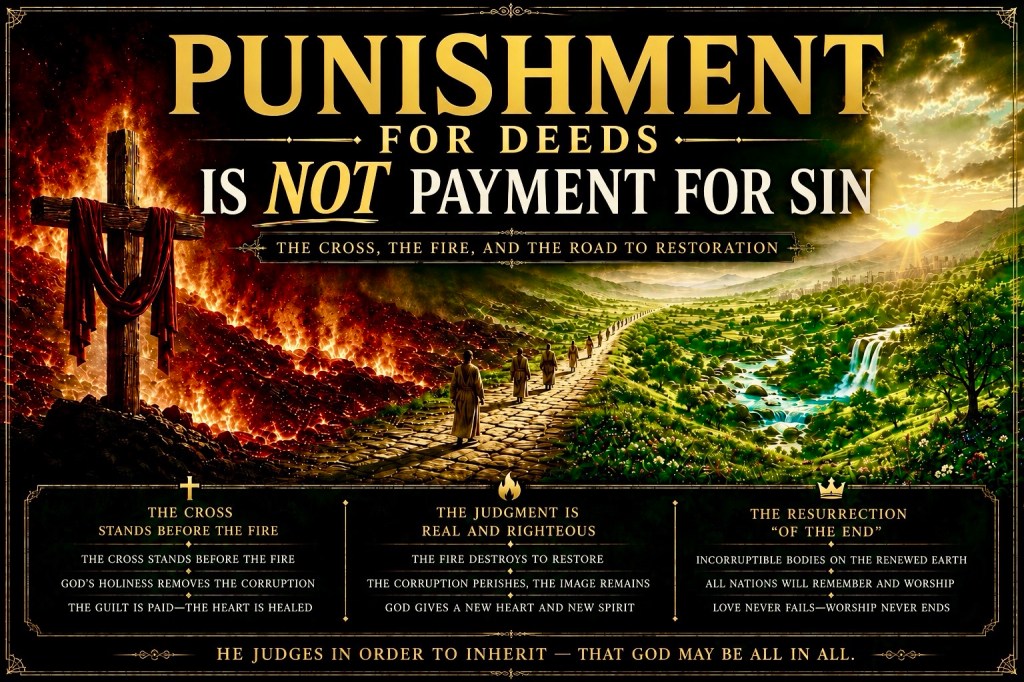
The Cross, the Fire, and the Road to Restoration
Introduction: A Confusion That Must Be Cleared
One of the most persistent objections to the Restoration of All Things is the assumption that it requires the wicked to “pay for their own sins” through suffering in Gehenna and then enter the new creation on the basis of their own endurance. If this were what the Scriptures taught, the objection would be devastating. A restoration grounded in human suffering rather than divine atonement would be no gospel at all. It would make the cross unnecessary and the blood of the Lord Jesus insufficient. It would turn Gehenna into a second altar and the sinner’s pain into a second sacrifice.
But this is not what the Scriptures teach. And the confusion arises from a failure to distinguish between two realities that the biblical witness keeps carefully separate: payment for sin and punishment for deeds. These are not the same thing. They operate on different grounds, serve different purposes, and produce different outcomes. Payment for sin is the atoning work that removes guilt and reconciles the person to God—and that work belongs to the Lord Jesus alone, accomplished once for all on the cross. Punishment for deeds is the proportional accountability that falls on every person according to the light received and the choices made. The cross is the place of the first. Gehenna is the place of the second. And the Restoration of All Things is grounded entirely in the first, not the second.
Until this distinction is grasped, the restoration will always be misunderstood—either softened into a sentimental universalism that dismisses judgment, or rejected as an affront to the cross that replaces grace with suffering. Both errors spring from the same root: the conflation of punishment with payment.
Only the Blood Pays for Sin
The Torah establishes the principle with unmistakable clarity. When a person sinned and became aware of his guilt, he was required to bring a sin offering—the chaṭṭāʾth (חַטָּאת)—to the entrance of the tabernacle. There, in the presence of the priest, he laid his hands on the head of the offering, transferring his sin to the animal through a deliberate act of identification. The animal was slaughtered, its blood was brought before the Lord, and the offering was consumed on the altar. Through this consumption, the sin that had been transferred was dealt with—not ignored, not overlooked, but borne by the substitute and destroyed in the fire (Leviticus 4:1–35).
What makes the chaṭṭāʾth unique among the Levitical offerings is the extraordinary fact embedded in its name. The Hebrew word chaṭṭāʾth means both “sin” and “sin offering.” The same word covers the offense and the sacrifice that bears it. The offering was so thoroughly identified with the sin it bore that it became the sin in the eyes of the law. The identification was total.
This is precisely what Paul describes in 2 Corinthians 5:21: “For He made Him who knew no sin to be sin for us, that we might become the righteousness of God in Him.” The word Paul uses is hamartia (ἁμαρτία)—the Septuagint’s standard translation of chaṭṭāʾth. God made the Lord Jesus to be the sin offering for us. The spotless Lamb was so thoroughly identified with the sin of the world that He bore its name. He was made chaṭṭāʾth—and His death on the altar of the cross dealt with sin once for all.
The provision is universal. Paul declares: “Therefore, as through one man’s offense judgment came to all men, resulting in condemnation, even so through one Man’s righteous act the free gift came to all men, resulting in justification of life” (Romans 5:18). The condemnation that came through Adam reached every person. The free gift that came through the Lord Jesus reaches no fewer in its provision. John confirms: “And He Himself is the propitiation for our sins, and not for ours only but also for the whole world” (1 John 2:2). The Lamb of God takes away the sin of the world (John 1:29)—not the sin of the elect, not the sin of those who respond in this age, but the sin of the world. The chaṭṭāʾth has been slain. The blood has been shed. The altar of the cross has received the Lamb.
This is the ground of all reconciliation—past, present, and future: “For it pleased the Father that in Him all the fullness should dwell, and by Him to reconcile all things to Himself, by Him, whether things on earth or things in heaven, having made peace through the blood of His cross” (Colossians 1:19–20). All things reconciled. Through the blood. Not through suffering. Not through endurance. Not through post-mortem merit. Through the blood. This is non-negotiable. Any framework that grounds restoration in something other than the cross has departed from the apostolic gospel. The Restoration of All Things does not depart from the cross. It is built upon it.
When the blood is applied through repentance and faith, the sins that lie behind the believer are forgiven completely and permanently. God “set forth Christ Jesus as a propitiation by His blood, through faith, to demonstrate His righteousness, because in His forbearance God had passed over the sins that were previously committed” (Romans 3:25). Previously committed—past sins. These are washed away, never to be raised again: “Their sins and their lawless deeds I will remember no more” (Hebrews 10:17). The depths of the sea have received them (Micah 7:19). They are gone.
But the blood that covers the past also inaugurates a new walk in the Spirit in the present. Paul asks the question that every believer must face: “What shall we say then? Shall we continue in sin that grace may abound? Certainly not! How shall we who died to sin live any longer in it?” (Romans 6:1–2). The believer who has been identified with the sin offering’s death through baptism has been raised to walk in newness of life—”that just as Christ was raised from the dead by the glory of the Father, even so we also should walk in newness of life” (Romans 6:4). The old man has been crucified with Him “that we should no longer be slaves of sin” (Romans 6:6). The blood freed the believer from the guilt of the past. The Spirit of grace now empowers the believer to walk as the Lord Jesus walked: “He who says he abides in Him ought himself also to walk just as He walked” (1 John 2:6).
This is the ground on which judgment according to deeds rests. The past is covered—permanently, irrevocably, by the blood. What is judged is not the forgiven past but the present walk—what the believer did with the Spirit of grace he received, whether he crucified the flesh or indulged it, whether he walked as Christ walked or returned to the bondage from which the blood had freed him.
The Torah’s Pattern: Judgment Within Covenant
The Torah does not merely establish the sin offering. It also establishes the relationship between judgment and restoration—and it does so with a consistency that governs everything that follows in the Prophets, the Lord Jesus, and the Apostles.
The covenant curses of Leviticus 26 are among the most severe passages in all of Scripture. Persistent disobedience brings famine, sword, pestilence, confusion, fear, exile, and desolation. The land is laid waste and enjoys its sabbaths while the people are scattered. Yet after listing these curses in devastating detail, the Torah turns a corner: “If they confess their iniquity and the iniquity of their fathers… then I will remember My covenant with Jacob, and My covenant with Isaac, and My covenant with Abraham I will remember; I will remember the land.” And then—most remarkably—the Lord declares: “Yet for all that, when they are in the land of their enemies, I will not cast them away, nor shall I abhor them, to utterly destroy them and break My covenant with them; for I am the LORD their God” (Leviticus 26:40, 42, 44). Here the Torah explicitly forbids the idea that God’s judgment aims at the utter destruction of the people He has judged. The curses are real and terrible, but they operate within a covenant that survives the punishment and reaches toward restoration.
Deuteronomy 30 completes this arc. After describing the curses that will scatter Israel to the ends of the earth, Moses prophesies their return: “The LORD your God will bring you back from captivity, and have compassion on you, and gather you again from all the nations where the LORD your God has scattered you” (Deuteronomy 30:3). The verb translated “have compassion” is from the same root as raḥûm—the womb-love of God that moves Him to gather what He has scattered. The scattering is judgment. The gathering is restoration. And the same God performs both.
Moses declares with breathtaking simplicity: “See now that I, even I, am He, and there is no God besides Me; I kill and I make alive; I wound and I heal; nor is there any who can deliver from My hand” (Deuteronomy 32:39). Killing and making alive, wounding and healing—these are not two separate programs. They are two movements of the same hand, serving the same purpose. God does not wound to destroy. He wounds to heal. He does not kill to annihilate. He kills to make alive.
And the Song of Moses itself, after its ferocious description of divine fire burning to the lowest Sheol, ends not with destruction but with atonement and rejoicing: “Rejoice, O Gentiles, with His people; for He will avenge the blood of His servants, and render vengeance to His adversaries; He will provide atonement for His land and His people” (Deuteronomy 32:43). The very song that speaks of fire consuming the earth concludes with atonement—not only for Israel but for the Gentiles alongside her. The Torah’s final word on judgment is not destruction. It is atonement.
The Prophets Confirm: Tearing and Healing as One Purpose
The Prophets receive the Torah’s pattern and develop it into a sustained prophetic vision in which judgment and restoration are inseparable—two movements within a single redemptive purpose.
Hosea provides one of the most compressed prophetic statements of this principle: “Come, and let us return to the LORD; for He has torn, but He will heal us; He has stricken, but He will bind us up. After two days He will revive us; on the third day He will raise us up, that we may live in His sight” (Hosea 6:1–2). The tearing and healing, striking and binding, death and raising up are not two different divine programs but two movements within a single redemptive purpose. The One who tears is the One who heals. The One who strikes is the One who binds. Within the pattern of the ages, this prophetic principle governs the entire journey from this present evil age through to the new creation. In this present age, God tears and strikes through the Father’s discipline of His sons—’for whom the LORD loves He chastens, and scourges every son whom He receives’ (Hebrews 12:6). The fiery trials and the testing of faith are the present-age form of the tearing: ‘that the genuineness of your faith, being much more precious than gold that perishes, though it is tested by fire, may be found to praise, honor, and glory at the revelation of Jesus Christ’ (1 Peter 1:6–7). For the faithful who submit to this tearing—who crucify the flesh with its passions and desires (Galatians 5:24) and by the Spirit put to death the deeds of the body (Romans 8:13)—the healing comes early. They are raised at the Lord’s appearing in the resurrection of life (John 5:29), having attained the out-resurrection—the exanastasis (ἐξανάστασις) that Paul presses toward as the prize of the upward call of God in Christ Jesus (Philippians 3:11–14). They do not wait for the third day. They completed the work in the first. But for the unfaithful and the ungodly, the tearing extends across two days—the discipline refused in this present age and the fires of Gehenna in the Seventh Day—and the raising up comes on the third day: the resurrection ‘of the end’ (1 Corinthians 15:24), at the dawn of the Eighth Day, when God heals and binds what His judgment tore and struck.
Jeremiah is told that the Lord has set him over nations and kingdoms “to root out and to pull down, to destroy and to throw down, to build and to plant” (Jeremiah 1:10). The rooting out and the pulling down are not the final verbs. They serve the building and the planting that follow. God tears down in order that He may truly build. This order—destruction followed by construction, judgment followed by restoration—is the heartbeat of every prophetic oracle.
Most remarkably, Jeremiah extends this pattern beyond Israel to the pagan nations. Of Moab: “Yet I will bring back the captives of Moab in the latter days” (Jeremiah 48:47). Of Ammon: “But afterward I will bring back the captives of the people of Ammon” (Jeremiah 49:6). Of Elam: “But it shall come to pass in the latter days: I will bring back the captives of Elam” (Jeremiah 49:39). In every case, the judgment is severe, yet in every case it is bounded—and followed by restoration.
Isaiah promises to “thoroughly purge away your dross, and take away all your alloy,” so that Zion may again be called “the city of righteousness, the faithful city” (Isaiah 1:25–26). The dross is purged. The alloy is removed. But the silver survives—because the silver is the soul and spirit made in God’s image, and what bears His image is refined by His holiness, not annihilated.
Malachi compares the Lord to “a refiner’s fire and like launderers’ soap,” who sits to refine and purify the sons of Levi “and purge them as gold and silver, that they may offer to the LORD an offering in righteousness” (Malachi 3:2–3). The same fire that devours the stubble also burns away alloy and dross. The same furnace that brings judgment also purifies. The product of the refining is not ash but a purified vessel.
The canonical witness from Torah through the Prophets is unanimous: judgment is real, severe, and proportional—but it is never the final word. The final word is always restoration. Always healing. Always atonement.
Judgment According to Deeds: What the Scriptures Actually Say
If the blood of the cross is the sole ground of reconciliation, what then is the purpose of judgment? The Scriptures answer this question with remarkable consistency: judgment holds every person accountable for what they did with the light they received. It is proportional, measured, and calibrated to deeds—not a flat, undifferentiated sentence but a searching evaluation of each life according to its own circumstances.
The Lord Jesus teaches this with unmistakable clarity, and His teaching distinguishes between two categories of those who face judgment. The unfaithful—those who knew the master’s will and refused—receive proportional discipline measured to the light they had: “That servant who knew his master’s will, and did not prepare himself or do according to his will, shall be beaten with many stripes. But he who did not know, yet committed things deserving of stripes, shall be beaten with few. For everyone to whom much is given, from him much will be required” (Luke 12:47–48). Many stripes and few stripes. Greater light, greater accountability. The punishment is measured according to knowledge and responsibility—and a measured punishment is by definition a bounded one.
Paul then describes the judgment of the ungodly—those who lived entirely outside the covenant, who hardened themselves in rebellion. God “will render to each one according to his deeds”: life of the age to those who by patient continuance in doing good seek for glory, honor, and immortality; but to those who are self-seeking and do not obey the truth, but obey unrighteousness—”indignation and wrath, tribulation and anguish, on every soul of man who does evil, of the Jew first and also of the Greek” (Romans 2:6–9 literal). The language here is not fatherly discipline. It is the full weight of divine wrath—indignation, wrath, tribulation, anguish—four words that describe the severity of Gehenna for those who lived in open rebellion against the light of creation and conscience.
Three outcomes emerge from these texts. The faithful receive the life of the age—the resurrection of life, the firstborn inheritance, the prize. The unfaithful receive many stripes or few stripes—corrective discipline proportioned to the light they received and refused, the chastening of sons who knew the master’s will and would not obey. The ungodly receive indignation, wrath, tribulation, and anguish—the full severity of Gehenna for those who stood farthest from the light yet bore the image of the God they refused. In every case, the judgment is proportional to the light. In no case does a single word demand its endlessness.
The Lord Jesus applies the same principle to entire cities. “Assuredly, I say to you, it will be more tolerable for the land of Sodom and Gomorrah in the day of judgment than for that city!” (Matthew 10:15). If there is a “more tolerable” and a “less tolerable,” then the judgment itself is weighed. A graduated judgment is a purposive judgment, not an indiscriminate consignment to identical suffering for all.
He also uses the word “until” in ways that imply an end. The unmerciful servant is delivered to the tormentors “until he should pay all that was due to him” (Matthew 18:34). The debtor is imprisoned “till you have paid the last penny” (Matthew 5:26). Real suffering, real confinement—but with a terminus, not an endless sentence.
The Lord Jesus declares: “For the Son of Man will come in the glory of His Father with His angels, and then He will reward each according to his works” (Matthew 16:27). Each. According to his works. Not a single standard applied to all, but a proportional rendering that weighs every life on its own terms.
Paul echoes this before the Roman church: “So then each of us shall give account of himself to God” (Romans 14:12). And again: “For we must all appear before the judgment seat of Christ, that each one may receive the things done in the body, according to what he has done, whether good or bad” (2 Corinthians 5:10).
The Greek word the Lord Jesus uses for “punishment” in Matthew 25:46 is kolasis (κόλασις), a word that originally meant corrective pruning. And the adjective aiōnios (αἰώνιος) means “of the age,” not “eternal” in the abstract philosophical sense. Kolasis aiōnios is punishment belonging to the coming age—age-lasting, not timeless.
The Scriptures are unified on this point. Every person is held accountable. Every deed is weighed. Every life is measured against the light it received. The judgment is real, it is searching, and it is proportioned to knowledge and responsibility.
The Difference: Accountability Is Not Atonement
Here is where the distinction must be drawn with precision.
Judgment according to deeds tells each person: you will answer for what you did with what you were given. You will bear the consequences of refusing the light. You will endure proportional correction—many stripes or few stripes, more tolerable or less tolerable, according to the measure of your knowledge and the hardness of your rebellion. This is accountability. It is righteous. It is necessary. And the Scriptures never soften it.
But accountability is not atonement. Suffering for your deeds does not pay for your sin. The stripes received in judgment do not accomplish what the blood of the Lord Jesus accomplished on the cross. No amount of endurance in Gehenna removes guilt, satisfies divine justice, or reconciles a person to God. Only the blood does that. Only the chaṭṭāʾth does that. Only the Lamb of God who takes away the sin of the world does that.
The confusion between punishment and payment produces two errors, each a mirror of the other.
The first error says: “If the wicked are restored after judgment, they must have paid for their sins through suffering—and that makes the cross unnecessary.” But this assumes that the fire of Gehenna is a substitute atonement—a second altar on which the sinner’s suffering replaces the Lamb’s sacrifice. The Scriptures never describe Gehenna this way. Gehenna is the place of accountability and the place where the flesh is crucified if not dealt with by the word and the Spirit in this age. The cross is the place where sin is paid for. They are not the same place, and they do not accomplish the same thing.
The second error says: “If the cross paid for all sin, then judgment is unnecessary—everyone should be restored immediately without any reckoning.” But this ignores the moral seriousness of God’s character. The Father is not indifferent to how His creatures respond to the light He gives them. The servant who knew his master’s will and refused bears a different accountability than the servant who did not know. The city that witnessed the Lord Jesus’ miracles and hardened itself faces a stricter judgment than the city that never saw such light. Accountability is real precisely because God takes every person seriously—seriously enough to reckon with them according to the truth of their lives.
The cross pays for sin. Judgment holds each person accountable for deeds and for the light they received and refused—including the provision of reconciliation itself. These two truths stand together without contradiction. The blood is sufficient for all. The judgment is proportioned to each—to what they did, to what they knew, and to what they rejected. And the restoration that follows is grounded in the blood, not in the suffering.
The Wilderness Generation: The Pattern in Israel’s Own History
Paul provides the clearest biblical illustration of this distinction in his warning to the Corinthian church. “Moreover, brethren, I do not want you to be unaware that all our fathers were under the cloud, all passed through the sea, all were baptized into Moses in the cloud and in the sea, all ate the same spiritual food, and all drank the same spiritual drink. For they drank of that spiritual Rock that followed them, and that Rock was Christ. But with most of them God was not well pleased, for their bodies were scattered in the wilderness” (1 Corinthians 10:1–5).
Notice the repetition: all were under the cloud, all passed through the sea, all were baptized, all ate the same spiritual food, all drank from the same spiritual Rock—and Paul identifies that Rock as Christ. The provision was universal within the covenant community. Every Israelite who left Egypt had the blood of the Passover lamb on their doorposts. Every one of them was delivered from Pharaoh’s hand. Every one of them received the same spiritual sustenance from the same Christ. The blood covered them all.
But with most of them God was not well pleased. Their bodies were scattered in the wilderness. They lusted after evil things. They committed idolatry—”The people sat down to eat and drink, and rose up to play” (1 Corinthians 10:7). They committed sexual immorality. They tempted Christ. They complained. And they bore the consequences: twenty-three thousand fell in one day; some were destroyed by serpents; some were destroyed by the destroyer (1 Corinthians 10:8–10).
Here is the critical distinction. The judgments that fell on Israel in the wilderness were not payment for sin. The Passover lamb had already dealt with sin on the night they left Egypt. The blood was on the doorposts. The firstborn were spared. The provision was complete. What the wilderness judgments accomplished was accountability—proportional punishment for what they did with the provision they had received. They had the blood, but they walked in rebellion. They had the deliverance, but they lusted after Egypt. They had the Rock, but they complained against the God who gave it. The punishment was real and severe—but it was never a substitute for the blood. The blood had already paid. The wilderness held them accountable for what they did after the blood was applied.
What they lost was the inheritance—it was the promised land. The prize. The calling. Israel was summoned at Sinai to be “a kingdom of priests and a holy nation” (Exodus 19:6)—the priestly calling that would bless the nations. Most of that generation forfeited the calling and died in the wilderness. They lost the inheritance. They lost the prize, not the gift.
Paul then says explicitly: “Now all these things happened to them as examples, and they were written for our admonition, upon whom the ends of the ages have come. Therefore let him who thinks he stands take heed lest he fall” (1 Corinthians 10:11–12). This is the pattern. The provision is universal—the blood of the Lamb covers all. The inheritance is conditional—it belongs to the faithful who persevere. The punishment is proportional—measured to the light received and the obedience refused. And losing the inheritance is not the same as losing the blood. The Passover lamb still paid for past sins. The wilderness generation still bore the consequences of their rebellion. Both truths stood together in Israel’s history, and both truths stand together in the age to come.
Judgment Begins at the House of God
The Scriptures do not present judgment as something that belongs only to the future or only to the ungodly. Peter declares: “For the time has come for judgment to begin at the house of God; and if it begins with us first, what will be the end of those who do not obey the gospel of God? Now ‘if the righteous one is scarcely saved, where will the ungodly and the sinner appear?’” (1 Peter 4:17–18).
Judgment begins with the faithful—now, in this present age. The Father disciplines those He has received as sons. “For whom the LORD loves He chastens, and scourges every son whom He receives” (Hebrews 12:6). The fiery trials, the testing of faith, the crucifixion of the flesh through the believer’s willing cooperation with the Spirit—this is judgment in its gracious form, administered by the Father’s hand in this age so that the believer might be “a partaker of His holiness” (Hebrews 12:10). The faithful crucify the flesh voluntarily. They purify their souls through obedience to the truth through the Spirit: “Since you have purified your souls in obeying the truth through the Spirit in sincere love of the brethren, love one another fervently with a pure heart” (1 Peter 1:22). They take up their cross and follow the Lord Jesus, denying themselves—not their personhood, but the flesh and their autonomous self-rule—and pressing toward the out-resurrection as a prize to be attained (Philippians 3:11–14).
This is why the faithful are not appointed to wrath. “For God did not appoint us to wrath, but to obtain salvation through our Lord Jesus Christ” (1 Thessalonians 5:9). Their judgment has already taken place—through the Father’s discipline, the fiery testing of faith, and the voluntary crucifixion of the flesh in this present age. At the Lord’s appearing, they receive the firstborn inheritance: celestial bodies, the Heavenly Jerusalem, the crown of righteousness, the joy of the Lord.
But the writer of Hebrews warns of the severest possible consequence for those within the covenant who refuse to cooperate with this work: “For if we sin willfully after we have received the knowledge of the truth, there no longer remains a sacrifice for sins, but a certain fearful expectation of judgment, and fiery indignation which will devour the adversaries. Anyone who has rejected Moses’ law dies without mercy on the testimony of two or three witnesses. Of how much worse punishment, do you suppose, will he be thought worthy who has trampled the Son of God underfoot, counted the blood of the covenant by which he was sanctified a common thing, and insulted the Spirit of grace? For we know Him who said, ‘VENGEANCE IS MINE, I WILL REPAY,’ says the Lord. And again, ‘THE LORD WILL JUDGE HIS PEOPLE.’ It is a fearful thing to fall into the hands of the living God” (Hebrews 10:26–31).
Notice what this passage says—and what it does not say. It says “there no longer remains a sacrifice for sins.” There is only one sacrifice—the chaṭṭāʾth, offered once for all. If it is trampled underfoot, no second altar exists, no second offering can be brought. What remains is not an alternative atonement but “a certain fearful expectation of judgment, and fiery indignation.” This is precisely the teaching’s central point: when the one sacrifice is refused, what follows is judgment—accountability for despising the provision—not a second payment for sin. There is no second payment. There is only the one Lamb, the one blood, the one cross.
Notice also the words “by which he was sanctified.” The person described is not an unbeliever who never knew the truth. He is someone who received the knowledge of the truth, was sanctified by the blood of the covenant, and then counted that blood a common thing and insulted the Spirit of grace. He had the blood. He had the Spirit. He trampled what he received. This is the wilderness generation in its New Covenant form—those who had the Passover lamb and despised it, who drank from the Rock and complained against the God who gave it.
And the lesser-to-greater argument confirms proportional judgment according to light. If rejecting Moses’ law brought death without mercy, how much worse for trampling the Son of God? Greater covenant, greater accountability. Greater light, greater reckoning. This is the same principle the Lord Jesus teaches with many stripes and few stripes, more tolerable and less tolerable—judgment proportioned to the revelation received and refused.
The writer of Hebrews then quotes two lines from the Song of Moses: “Vengeance is Mine, I will repay” (Deuteronomy 32:35) and “The LORD will judge His people” (Deuteronomy 32:36). These words come from the same song that declares, “I kill and I make alive; I wound and I heal” (Deuteronomy 32:39) and that ends with atonement for His land and His people, with the Gentiles rejoicing alongside them (Deuteronomy 32:43). The Song of Moses moves from vengeance to judgment of His people to killing and making alive to atonement and rejoicing. The writer of Hebrews quotes the vengeance and judgment. The Torah reveals the healing and atonement that follow. Both belong to the same song, the same God, and the same redemptive purpose.
But Peter’s question presses the point: “if the righteous one is scarcely saved, where will the ungodly and the sinner appear?” If the faithful—who had the word, the Spirit, and the Father’s discipline in this age—are saved with difficulty, what of those who never had the word’s work begun? What of those who refused the gospel entirely? The answer is not that they escape judgment. The answer is that their judgment is far more severe—because what the faithful accomplished voluntarily through cooperation with the Spirit in this age, the unfaithful and the ungodly must have accomplished involuntarily through the fire of Gehenna in the age to come.
Three categories emerge from the Scriptures with unmistakable clarity. The faithful—those who walked according to the Spirit, crucified the flesh, and persevered—receive the resurrection of life. The unfaithful—genuine believers who received the Spirit but refused to crucify the flesh, who clung to the self-governing soul-life—face the chastening of sons in the age to come: corrective discipline proportioned to the light they resisted, measured in many stripes or few stripes according to the knowledge they possessed and the grace they refused (Luke 12:47–48). And the ungodly—those who never received the gospel, who hardened themselves in rebellion, who lived entirely within the Adamic order—face wrath in the full scriptural sense: “indignation and wrath, tribulation and anguish, on every soul of man who does evil” (Romans 2:8–9). Even among the ungodly, however, light shapes the measure of wrath. The one who sinned against the bare witness of creation and conscience does not stand in the same place as the one who knowingly persecuted the people of God. Both endure wrath, but the degree of that wrath accords with the degree of their knowledge and the hardness of their rebellion.
In every case, the judgment is proportional, purposive, and bounded by the age to come. In no case does it constitute payment for sin.
The Historical Pattern: Judgment for Rejecting the Visitation
The Lord Jesus Himself provides the clearest illustration of this principle in His lament over Jerusalem. As He approached the city for the last time, He wept over it and said: “If you had known, even you, especially in this your day, the things that make for your peace! But now they are hidden from your eyes. For days will come upon you when your enemies will build an embankment around you, surround you and close you in on every side, and level you, and your children within you, to the ground; and they will not leave in you one stone upon another, because you did not know the time of your visitation” (Luke 19:42–44).
The judgment that fell on Jerusalem in AD 70 was real, devastating, and terrible. The city was besieged, starved, breached, and burned. The Temple was destroyed. The nation was scattered. The suffering was immense.
But that judgment did not pay for Jerusalem’s sins. The cross had already paid for those sins—the Lord Jesus Himself bore them on the altar of Calvary. What the judgment of AD 70 accomplished was accountability—the consequence of rejecting the visitation. Jerusalem had received the greatest light any city had ever received. The Son of God walked her streets, taught in her Temple, healed her sick, and proclaimed the kingdom in her hearing. And she rejected Him. The judgment that followed was proportioned to the magnitude of what she refused.
This is the pattern that governs all eschatological judgment. The cross pays for sin—universally, sufficiently, once for all. Judgment holds each person and each generation accountable for what they did with the light they received. The two are not in competition. They are two dimensions of the same righteous God—the God who atones through the blood of His Son and who renders to each according to his deeds.
The same principle appears in the Lord Jesus’ warning about the cities of Galilee: “It will be more tolerable for Tyre and Sidon in the day of judgment than for you… it shall be more tolerable for the land of Sodom in the day of judgment than for you” (Matthew 11:22, 24). Sodom was destroyed by fire in Genesis 19. But the Lord Jesus says Sodom will face further judgment in “the day of judgment”—future tense. This means Sodom’s inhabitants are raised in the resurrection of judgment (John 5:29). And the Lord Jesus presupposes that their judgment will be more tolerable than the judgment faced by Chorazin, Bethsaida, and Capernaum—because those cities received greater light and refused it. The judgment is proportional to the visitation. The accountability is measured by the light.
And God has already declared what happens to Sodom after judgment. Through Ezekiel, the Lord says: “When I bring back their captives, the captives of Sodom and her daughters, and the captives of Samaria and her daughters, then I will also bring back the captives of your captivity among them… When your sisters, Sodom and her daughters, return to their former state, and Samaria and her daughters return to their former state, then you and your daughters will return to your former state” (Ezekiel 16:53, 55). Sodom is raised. Sodom is judged proportionally. Sodom is restored. The full sequence—resurrection, proportional accountability, restoration—is visible across the Scriptures when the distinction between punishment and payment is maintained.
What Gehenna Actually Accomplishes
If Gehenna is not a substitute atonement—if the sinner’s suffering does not pay for sin—then what does the fire of Gehenna actually accomplish? The Lord Jesus gives the answer in His most concentrated statement about eschatological judgment: “And do not fear those who kill the body but cannot kill the soul. But rather fear Him who is able to destroy both soul and body in Gehenna” (Matthew 10:28).
Notice carefully: the Lord Jesus says God destroys soul and body. He does not say God destroys the spirit. The body—the mortal Adamic body—returns to dust under the fire of divine judgment. The flesh—the self-governing orientation that corrupted the soul since the fall—is consumed by the fire of God’s holiness, and the soul, bearing God’s image, is purified through the fire’s stripping work as every identity the flesh constructed is burned away. The destruction is real because the flesh, the self-governed soul-life, truly perishes under the fire of holiness, even though the deepest God-given ground of personhood endures.
The Greek word the Lord Jesus uses is apollymi (ἀπόλλυμι), which carries the full weight of ruin and destruction. But apollymi cannot mean annihilation—because the Lord Jesus uses the very same word in Matthew 16:25: “For whoever desires to save his life will lose (apollymi) it, but whoever loses (apollymi) his life for My sake will find it.” You cannot find something that has been annihilated. The losing is the destruction of the corrupted condition—the flesh, self-governed soul-life. The finding is the recovery of the purified soul.
And what of the spirit? Solomon declares: “Then the dust will return to the earth as it was, and the spirit will return to God who gave it” (Ecclesiastes 12:7). After the flesh is consumed and the soul purified, it is the heart—the unified inner man, soul and spirit as one entity—that returns to God who gave it. Scripture names it “spirit” in that context because the spirit-dimension is in view when the person stands before God, not because the soul ceases to exist. The heart-unit continues—purified, freed from the corruption it carried—and awaits the resurrection “of the end” (1 Corinthians 15:24), when it is clothed with a new, incorruptible terrestrial body and enters the renewed earth of the Eighth Day. The writer to the Hebrews confirms this pattern: when he describes the faithful dead dwelling in the Heavenly Jerusalem, he does not call them “souls.” He calls them “the spirits of just men made perfect” (Hebrews 12:23)—named by the spirit-dimension because that dimension is now dominant in the heavenly realm.
The fire crucifies the flesh, purifies the soul, and frees the spirit. What the word does gently in this age through the believer’s willing cooperation with the Spirit, the fire does intensely in Gehenna through involuntary judgment. The cross and the fire target the same thing—the fallen Adamic nature. The difference is when and how.
But the fire produces no new life. It only removes what is contrary to God’s holiness. Transformation—the planting of the divine seed, the renewal of the spirit from glory to glory—is the work of the word and the Spirit alone, and it belongs to this present age. This is why the unfaithful and the ungodly receive terrestrial bodies at the resurrection “of the end,” not celestial bodies. The fire purified what the word would have purified. But the fire could not do what only the divine seed could do—and that seed was either never planted or never brought to maturity. The difference in glory between the faithful and those restored through judgment is the permanent consequence of refusing the word in this age.
Paul confirms this pattern directly: “knowing this, that our old man was crucified with Him, that the body of sin might be done away with, that we should no longer be slaves of sin” (Romans 6:6). The phrase “done away with” is katargeō (καταργέω)—to render inoperative, to abolish, to bring to nothing. For the faithful, the old man is crucified with the Lord Jesus through faith and baptism—identification with the sin offering’s death. For the unfaithful and the ungodly, the same old man is crucified involuntarily in the fires of Gehenna. The same corruption. The same crucifixion. The same katargeō. But one is accomplished voluntarily through the cross in this age; the other is accomplished involuntarily through fire in the age to come.
Paul further confirms this in 1 Corinthians 5:5, where he instructs the church to deliver a sinning believer “to Satan for the destruction of the flesh, that his spirit may be saved in the day of the Lord Jesus.” The word for “destruction” is olethros (ὄλεθρος)—and the pattern is the same: the flesh is destroyed; the spirit is preserved. The purpose of the destruction is not annihilation but salvation—the spirit saved through the destruction of the flesh.
Gehenna does not pay for sin. The cross paid for sin. Gehenna removes the Adamic corruption—the flesh, the self-governing orientation, the old man—that refused the cross in this age. The fire is the means by which the obstacle is removed so that the atonement already accomplished can reach the person in God’s appointed time.
The Ground of All Restoration Is the Cross
No one is restored apart from the blood of the Lord Jesus. No one is reconciled to God through their own suffering. No one enters the new creation on the basis of having endured Gehenna. The ground of all reconciliation—for the faithful who receive the prize in this age, for the unfaithful who are chastened as sons, and for the ungodly who endure wrath—is the blood of the cross and the blood of the cross alone.
Paul states this without qualification: “For it pleased the Father that in Him all the fullness should dwell, and by Him to reconcile all things to Himself, by Him, whether things on earth or things in heaven, having made peace through the blood of His cross” (Colossians 1:19–20). All things reconciled. Through the blood. Not through suffering. Not through endurance. Not through post-mortem merit. Through the blood.
The Lord Jesus gave Himself “a ransom for all, to be testified in due time” (1 Timothy 2:6). The ransom has been paid—for all. The testimony of that ransom unfolds in its own appointed seasons, through the ordered sequence of the ages. The faithful receive the testimony now, through faith and baptism. The rest receive it in its appointed time—after judgment has removed what refused the cross, and the atonement that was always sufficient reaches them at last.
This is not a second plan of salvation operating alongside the first. It is the same plan—the same blood, the same cross, the same chaṭṭāʾth—reaching every person in its own appointed order. “For as in Adam all die, even so in Christ all shall be made alive. But each one in his own order” (1 Corinthians 15:22–23). The scope is universal. The timing is ordered. And the ground is always the cross.
The Resurrection “of the End”: Divine Initiative, Not Human Merit
At the resurrection “of the end”—the final tagma of 1 Corinthians 15:24—the hearts preserved by God after the fires of Gehenna are clothed with new, incorruptible terrestrial bodies and enter the renewed earth of the Eighth Day. This restoration is not earned. It is not the reward for having survived the fire. It is the sovereign act of the God who declared through Ezekiel: “I will give you a new heart and put a new spirit within you; I will take the heart of stone out of your flesh and give you a heart of flesh. I will put My Spirit within you and cause you to walk in My statutes, and you will keep My judgments and do them” (Ezekiel 36:26–27).
Count the times God says “I will.” He gives the heart. He puts the spirit within. He removes the stone. He causes the obedience. This is not human faith producing restoration. This is God acting sovereignly to restore what judgment has prepared. The fire removed the obstacle—the Adamic corruption, the self-governing flesh, the old man that would not yield. And the God who reconciles all things through the blood of the cross now raises the freed heart into a new body, a new creation, a new life—not because the person earned it through suffering, but because the blood that was always sufficient has finally reached them.
The mechanism of restoration for the unfaithful and the ungodly who passed through Gehenna is not post-mortem faith in the sense of a conscious decision made after death. It is divine initiative—the same divine initiative that Ezekiel describes, the same sovereign act that gives hearts of flesh to replace hearts of stone, the same Spirit who causes obedience rather than waiting for it. What the faithful received through grace and faith in this age—the crucifixion of the flesh, the purification of the soul, the transformation of the spirit—the unfaithful and the ungodly receive through judgment and then grace at the resurrection “of the end.” The fire accomplished what willing cooperation with the Spirit would have accomplished. And the grace of the cross covers what the fire could never cover—the guilt, the sin, the offense that only blood can address.
And here the question that so many raise—”is faith necessary after judgment?”—reveals itself as wrongly framed. Paul himself tells us that faith belongs to this age, not the age that follows all things being made new. “Love never fails. But whether there are prophecies, they will fail; whether there are tongues, they will cease; whether there is knowledge, it will vanish away… For now we see in a mirror, dimly, but then face to face. Now I know in part, but then I shall know just as I also am known. And now abide faith, hope, love, these three; but the greatest of these is love” (1 Corinthians 13:8, 12–13). Faith is for this age—the age where we see dimly, where we know in part, where we believe in what we cannot yet see. Hope is for this age—the age where the promise is not yet fulfilled. When the Eighth Day dawns and the restored nations stand on the renewed earth in incorruptible bodies with purified hearts, they are not seeing dimly. They are seeing face to face. They are not believing in what they cannot see. They are standing in the presence of the God who restored them. Faith gives way to sight. Hope gives way to fulfillment. What remains is love—and love never fails.
The Psalms describe exactly this—not faith decisions but willing worship from restored hearts. “All the ends of the world shall remember and turn to the LORD, and all the families of the nations shall worship before You” (Psalm 22:27). They remember—the heart that was clouded by the flesh now recalls the God it was made for. They turn—not coerced, not forced, but willingly. They worship—the natural response of a purified heart in the presence of its Creator. “All nations whom You have made shall come and worship before You, O Lord, and shall glorify Your name” (Psalm 86:9). They come. They worship. They glorify. This is not post-mortem faith. This is restored humanity doing what humanity was created to do.
And the nations are Christ’s inheritance—”Arise, O God, judge the earth; for You shall inherit all nations” (Psalm 82:8). He judges in order to inherit. The judgment serves the inheritance. And the inheritance is willing worshippers, not reluctant captives.
Faith is necessary now—in this present evil age, where it determines your order in the resurrection, whether you receive the prize or face the fire, whether you enter the Heavenly Jerusalem or Gehenna. But after judgment has done its work and God has acted sovereignly to restore—new heart, new spirit, new body, everything contrary to God removed—there is nothing left to “believe in” that cannot be seen. What remains is love, worship, and willing obedience. The heart bows because it has been made new, and a new heart in the presence of God does the only thing a new heart can do.
Conclusion: Two Realities, One Righteous God
The Scriptures present two realities that must never be confused and must never be separated.
The first reality is that only the blood of the Lord Jesus pays for sin. No amount of suffering atones. No measure of endurance reconciles. The fire, however severe, can never accomplish what the cross accomplished. The chaṭṭāʾth has been slain. The Lamb of God has taken away the sin of the world. The blood has made peace. And that peace—accomplished once for all on the cross—is the sole ground on which anything in heaven or on earth is reconciled to God.
The second reality is that every person will be held accountable for what they did with the light they received. The servant who knew and refused receives many stripes. The servant who did not know receives few. The city that witnessed the visitation and rejected it faces a stricter judgment than the city that never saw such light. Judgment begins at the house of God in this present age through the Father’s discipline of His sons, and it extends to the unfaithful and the ungodly in the age to come through the fires of Gehenna. Accountability is real, it is proportional, and it is inescapable. No one passes through the age to come without answering for the truth of their own life.
The cross is the place of the first reality—the atoning sacrifice that pays for sin and reconciles all things through the blood. Gehenna is the place of the second reality—proportional, purposive accountability that removes the Adamic corruption and frees the heart for restoration. The fire serves the cross. It does not replace it. It removes what refused the cross so that the cross can reach the person. And when the fire has completed its work and the last enemy has been destroyed, God will be all in all (1 Corinthians 15:28)—not because the unfaithful and the ungodly earned their way back through suffering, but because the blood of the Lamb was always sufficient for every sin of every person in every age, and in the fullness of time, that sufficiency reached every last one of them.
“For this is good and acceptable in the sight of God our Savior, who desires all men to be saved and to come to the knowledge of the truth. For there is one God and one Mediator between God and men, the Man Christ Jesus, who gave Himself a ransom for all, to be testified in due time” (1 Timothy 2:3–6).
 Restoration Theology Press