
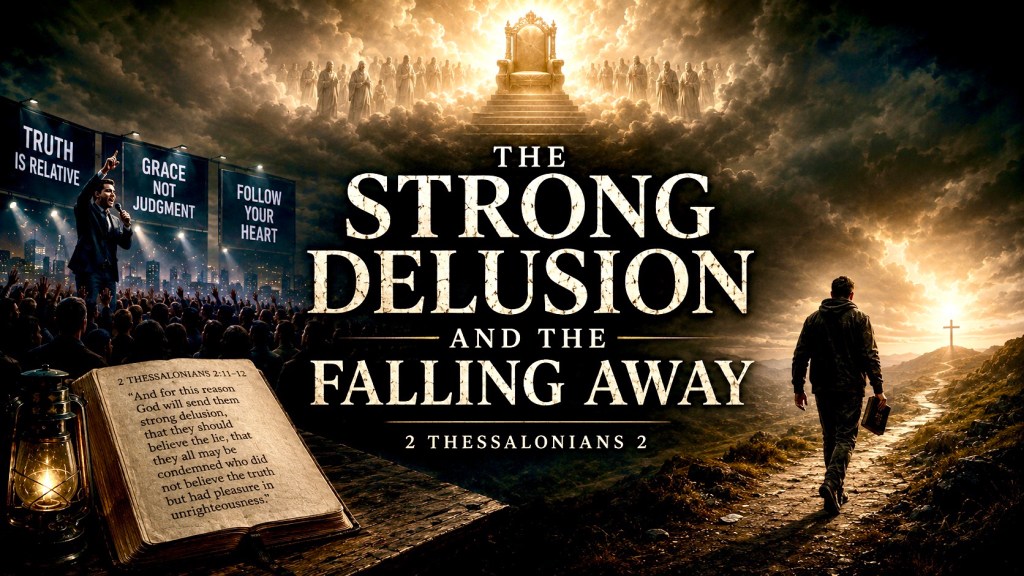
Introduction: A Delusion Sent by God
One of the most sobering statements in all of Scripture is found not in a passage about God’s wrath against the ungodly, but in a letter written to believers about what will happen before the Lord Jesus returns. Paul writes to the Thessalonians: “And for this reason God will send them strong delusion, that they should believe the lie, that they all may be condemned who did not believe the truth but had pleasure in unrighteousness” (2 Thessalonians 2:11–12).
The statement is startling because of its subject. It is not Satan who sends the strong delusion. It is God. The God of truth, the God who cannot lie, the God who desires all men to come to the knowledge of the truth—this God sends a delusion so powerful that those who receive it believe the lie and are judged for it. The natural question that arises is: how can this be? In what way does the God of truth send a delusion? On what grounds does He do so? And what might this delusion look like when it comes?
These are not speculative questions for a distant future. Paul told the Thessalonians that “the mystery of lawlessness is already at work” (2 Thessalonians 2:7). The roots of the delusion were already growing in the apostolic age. What Paul describes is not an isolated event that strikes a healthy church without warning but the culmination of a long, hidden process—a process that reaches maturity in a generation that has refused to love the truth. The purpose of this teaching is to trace that process through Scripture, to uncover the mechanism by which God sends the delusion, and to ask honestly whether the signs of its approach are visible in our own generation.
The Falling Away: Deliberate Departure, Not Gradual Drift
Paul begins his warning by establishing two events that must precede the Day of the Lord: “Let no one deceive you by any means; for that Day will not come unless the falling away comes first, and the man of sin is revealed, the son of perdition” (2 Thessalonians 2:3). The Thessalonians had been shaken by a report—whether through a prophetic utterance, a spoken word, or a forged letter—suggesting that the Day of the Lord had already arrived. Paul corrects this by giving them a sequence: two things must happen first.
The word translated “falling away” is the Greek apostasia (ἀποστασία), and it does not describe a gentle cooling of religious interest. It denotes a deliberate standing away from—a conscious departure from what was once professed and held. It carries the weight of rebellion, not mere negligence. Paul is not describing a generation that slowly loses interest in church attendance. He is describing a generation that turns against the truth it once claimed to believe.
The grammar of the verse is precise. The adverb prōton (“first”) modifies the coming of the apostasy specifically: the falling away comes first. The conjunction kai (“and”) then introduces the revealing of the man of sin as a second, consequent event. The apostasy is not merely listed alongside the man of sin as though they were two unrelated prerequisites. The apostasy comes first and creates the environment out of which the man of sin emerges. The falling away ripens the soil; the lawless one is the fruit that grows from it.
Paul develops this picture elsewhere with increasing urgency. He warns Timothy that “in latter times some will depart from the faith, giving heed to deceiving spirits and doctrines of demons” (1 Timothy 4:1). He describes a time when “they will not endure sound doctrine, but according to their own desires, because they have itching ears, they will heap up for themselves teachers; and they will turn their ears away from the truth, and be turned aside to fables” (2 Timothy 4:3–4). He portrays an atmosphere in which people maintain “a form of godliness” while “denying its power” (2 Timothy 3:5)—outward structures intact, meetings held, songs sung, ministries operational, but the fear of God gone, the obedience of faith abandoned, and the love of the truth replaced by a love of comfort.
This is the portrait of the falling away: not a dramatic overnight collapse, but a slow and deliberate turning. Truth is available. It is preached, printed, and accessible. But it is not loved. It is filtered, softened, and reshaped until it no longer confronts the desires of the heart. And when a generation has been formed in this way—shaped by decades of leavened teaching, trained to prefer affirmation over correction—the ground is ready for what comes next.
The Mystery of Lawlessness: The Hidden Engine
Paul reveals that the final surge of deception at the end of the age is not a sudden eruption but the mature fruit of something that has been working throughout the entire period of the church. He calls it “the mystery of lawlessness” and says it “is already at work” (2 Thessalonians 2:7). The word “mystery” indicates that this lawlessness does not always appear in open revolt. It works in hiddenness. It often clothes itself in religious language, institutional respectability, and outward forms of godliness.
Lawlessness in the Greek is anomia (ἀνομία), and it is not mere disorder or social breakdown. It is the refusal of God’s law—His right to define good and evil, to command obedience, and to judge sin. Anomia is not the absence of all rules; it is the replacement of God’s rules with man’s. It is the spirit that says, “We will decide what is right. We will determine what grace permits. We will define the boundaries of love and sin on our own terms.”
This mystery has been operating quietly across the centuries in three arenas. In doctrine, it works by diluting or twisting the apostolic gospel, marginalizing the fear of God, denying or minimizing future judgment, and recasting the work of the Lord Jesus as mainly therapeutic rather than redemptive and purifying. In worship, it preserves religious forms while the heart drifts from obedience, replacing adoration with self-expression and centering human experience rather than the glory of God. In daily living, it redefines sin, excuses disobedience, normalizes what Scripture calls uncleanness, and treats the commands of the Lord Jesus as optional for those who consider themselves “under grace.”
Over time this hidden rebellion accumulates. Small compromises become settled habits. Minor distortions become new orthodoxies. The spirit of this age persuades the visible church that autonomy is maturity, that restraint is oppression, that holiness is extremism. John names this same force under another title when he speaks of “the spirit of the Antichrist, which you have heard was coming, and is now already in the world” (1 John 4:3).
The mystery of lawlessness does not force the falling away. It cultivates the conditions in which the falling away becomes inevitable for those who will not resist it. It is the Satanic sowing that produces the human harvest. The man of sin does not appear in a vacuum. He embodies and concentrates a lawlessness that has been fermenting for generations. By the time he is revealed, he does not introduce a new rebellion. He simply personifies the rebellion that the falling away has already embraced.
“Because They Did Not Receive the Love of the Truth”
At the center of Paul’s warning stands a phrase that governs everything that follows: “because they did not receive the love of the truth, that they might be saved” (2 Thessalonians 2:10). This is the hinge on which the entire passage turns. The strong delusion does not fall upon the world at random. It does not strike innocent people without cause. It comes upon those who had every opportunity to love the truth and chose instead to take pleasure in unrighteousness.
Paul’s phrase is carefully constructed. He does not say they did not receive the truth—as though they had never heard it. He says they did not receive the love of the truth. The truth came to them. It was preached to them, available to them, perhaps even formally professed by them. But they did not love it. They did not delight in what God had said when it cut across their preferences. They did not submit when truth and desire collided. They did not persevere in holding to Scripture when culture, church trends, and personal cost pressed them to compromise. They did not treat truth as a command shaping daily choices but as information to be accepted or set aside according to convenience.
By contrast, they “had pleasure in unrighteousness.” The Greek word for “pleasure” is eudokēsantes (εὐδοκήσαντες), denoting not a reluctant lapse but a settled approval—a willful finding of satisfaction in what God condemns. They were not merely weak; they were willing. They chose the comfort of unrighteousness over the cost of truth. They preferred a version of the gospel that left their idols undisturbed. They used Scripture selectively—to support existing desires rather than to crucify them. They treated the difficult words of the Lord Jesus—His warnings of judgment, His demands of holiness, His insistence on the narrow way—as embarrassing remnants of a harsher period rather than as the living words of the Son of God.
This is not a portrait of the openly godless. It is a portrait of the religiously comfortable—those who sit in the assembly, sing the songs, affirm the creeds, and yet have never allowed the truth to reach the place where it would cost them something. And it is precisely this posture that makes them vulnerable to what God is about to send. The strong delusion is not an attack on truth-lovers who are caught off guard. It is a judicial response to a generation that had truth within reach and would not love it.
How God Sends the Delusion: The Lying Spirit and the Throne
The question of mechanism—how God sends a delusion without Himself becoming a liar—is answered by one of the most remarkable scenes in the Old Testament.
In 1 Kings 22, the prophet Micaiah is brought before Ahab, king of Israel, and Jehoshaphat, king of Judah. Ahab wants to go to war against Ramoth Gilead. He has already consulted four hundred prophets, and all of them have told him what he wants to hear: “Go up, for the Lord will deliver it into the hand of the king” (1 Kings 22:6). But Jehoshaphat is uneasy and asks whether there is another prophet who might be consulted. Ahab admits there is one—Micaiah—but adds, “I hate him, because he does not prophesy good concerning me, but evil” (1 Kings 22:8).
When Micaiah is brought forward, he delivers one of the most extraordinary revelations in all of Scripture: “I saw the LORD sitting on His throne, and all the host of heaven standing by, on His right hand and on His left. And the LORD said, ‘Who will persuade Ahab to go up, that he may fall at Ramoth Gilead?’ So one spoke in this manner, and another spoke in that manner. Then a spirit came forward and stood before the LORD, and said, ‘I will persuade him.’ The LORD said to him, ‘In what way?’ So he said, ‘I will go out and be a lying spirit in the mouth of all his prophets.’ And the LORD said, ‘You shall persuade him, and also prevail. Go out and do so’” (1 Kings 22:19–22).
The scene is staggering in its implications. God sits on His throne in complete sovereign authority. The host of heaven—including spiritual beings both faithful and otherwise—stands before Him. A spirit volunteers to go out as a lying spirit in the mouth of Ahab’s prophets. And God authorizes it: “Go out and do so.” The deception is real. The lying spirit is real. The false prophets through whom it operates are real. But the entire operation unfolds under divine sovereignty, not outside it. God does not Himself lie. He authorizes a lying spirit to operate among a man who has already rejected truth and demonstrated that he will not receive it.
The critical detail is that Ahab had already chosen. Micaiah was available. Truth was standing right in front of him. One prophet spoke the word of the Lord while four hundred spoke what the king wanted to hear. Ahab knew which one was telling the truth—he admitted it openly before the inquiry even began. The issue was never the availability of truth. The issue was the love of it. Ahab hated the truth because the truth did not flatter him. And when a man hates the truth because it does not tell him what he wants to hear, God has every right to hand him over to the lie he prefers.
This is the mechanism of 2 Thessalonians 2:11. The “working of Satan” in verse 9 and the “strong delusion” God sends in verse 11 are not two separate operations running side by side. They are the same operation viewed from two vantage points. From below—from the human perspective—it appears as Satanic deception: fallen powers manifesting with signs and wonders, a lawless figure rising to prominence, a lie so compelling it sweeps away multitudes. From above—from the throne room—it is God’s judicial act: the sovereign release of lying spirits among those who would not love the truth. Satan is the instrument. God is the One who removes the restraint and authorizes the instrument to operate at full power.
This is confirmed by the role of the restrainer in verse 7. Paul writes that the mystery of lawlessness is already at work, “only He who now restrains will do so until He is taken out of the way. And then the lawless one will be revealed.” Something has been holding back the full manifestation of the lie throughout this entire age. The leavening has advanced, but there has been a boundary on how far and how fast it could operate. When God removes that restraint, the removal itself is the sending of the strong delusion. God does not create a new deception from nothing. He releases the flood that has been pressing against the dam all along. The lying spirits that have been working in limited, hidden ways throughout the church in this age are given full, unrestrained access to a generation that has refused the truth.
The same judicial pattern appears throughout Scripture. Pharaoh hardened his own heart before God hardened it further. The self-chosen hardening preceded the judicial hardening. The human refusal came first; the divine confirmation followed. And once God hardened what Pharaoh had already chosen, the course was set and there was no turning back (Exodus 7–14). Paul traces the identical pattern in Romans 1, where three times he writes that “God gave them over”—gave them over to uncleanness, to vile passions, to a debased mind—because they “exchanged the truth of God for the lie” and “did not like to retain God in their knowledge” (Romans 1:24, 26, 28). The giving over is not arbitrary cruelty. It is judicial consequence. God hands people over to the full weight of what they have chosen.
The strong delusion of 2 Thessalonians 2 is this same pattern brought to its ultimate, end-of-the-age expression. A generation that will not love the truth is given over to the lie—and the lie arrives not through crude atheism but through signs, wonders, and spiritual phenomena so powerful that only those who have cultivated a genuine love of the truth can see through them.
“The Lie”: The Definite Article and the Serpent’s Promise
Paul does not say that those under the strong delusion will believe “a lie”—as though any random falsehood would suffice. He says they will believe “the lie”—τῷ ψεύδει (tō pseudei), with the definite article. This is not a generic deception. It is a specific, singular, concentrated falsehood—one that Scripture has been tracking from the very beginning.
The canonical referent is Genesis 3:4–5. The serpent’s lie to the woman was twofold: “You will not surely die”—the denial of divine judgment—and “You will be like God, knowing good and evil”—the offer of human autonomy in place of divine authority. These two threads run together through the entire biblical story. Every subsequent rebellion is a variation on this original theme. Babel is the serpent’s lie in corporate form: humanity gathering to make a name for itself, to build its own way into the heavens, to declare independence from the God who scattered the nations. The golden calf is the serpent’s lie in worship: Israel fashioning a god in its own image rather than submitting to the God who revealed Himself at Sinai. The kings of Israel who “did evil in the sight of the Lord” are the serpent’s lie enthroned in governance: rulers who decided for themselves what was right, exchanging the commands of the living God for the practices of the nations.
If the strong delusion is the final expression of “the lie,” then it is Genesis 3 brought to full civilizational harvest—the serpent’s original promise believed at a scale and with an intensity never before seen in human history. It is the moment when humanity, in its most sophisticated and technologically advanced form, finally embraces what the serpent offered in the garden: “You will be like God.” Not in crude rebellion—not with pitchforks and blasphemous banners—but in the calm, confident, culturally celebrated conviction that man has outgrown his need for God and is ready to define reality, morality, and destiny on his own terms.
The Love of the Truth as the Only Safeguard
If the strong delusion is judicial—if it falls upon those who refused to love the truth—then the only safeguard is to become the kind of person upon whom it cannot land. And Paul has already named what that looks like: receiving the love of the truth.
This is more than intellectual accuracy. A person may hold correct doctrinal positions and still lack the love of the truth. Correct doctrine becomes an idol when it is held for the sake of being right rather than for the sake of knowing and obeying God. The love of the truth is a posture of the heart, not merely a position of the mind. It means the heart delights in what God has said, even when what He has said is inconvenient. It means that when truth and desire collide, truth wins—not easily, not without struggle, but finally and decisively. It means persevering in what Scripture teaches even when the surrounding culture, the visible church, and one’s own emotions press for compromise. It means treating the Word of God not as a resource to be consulted when useful but as the voice of the living God to be obeyed in all things.
Those who cultivate this posture are not immune to temptation, and they are not guaranteed an easy path. But they are the ones the Lord Jesus describes as “the elect” whom even the most powerful deception cannot finally mislead (Matthew 24:24). They are kept not by their own strength but by the truth they have loved and the God who honors those who honor His Word.
The warning for the church in this generation is direct and urgent. The truth is still available. The Scriptures are still open. The apostolic gospel has not been withdrawn. But the question that will determine whether a believer stands or falls when the strong delusion arrives is not whether the truth is available. It is whether the truth is loved. If a generation of professing believers prefers a Christ who affirms but never confronts, a grace that covers but never crucifies, a future that comforts but never judges—then the 1 Kings 22 mechanism is already in motion. The lying spirits are already volunteering. And the day may come, as it came for Ahab, when God says from His throne: “Go out and do so.”
Where the Delusion Leads: The Judgment of the Seventh Day
In the framework of the ages that Scripture reveals, the strong delusion does not have the final word—but neither is it without consequence. Those who refuse the love of the truth in this present evil age and are swept into the lie will face the corrective judgment of Gehenna in the Seventh Day—the Age to Come. The leaven they embraced will be burned away. The truth they rejected will be vindicated in fire. The lie they believed will be exposed as the worm-eaten fruit of the serpent’s ancient promise.
This judgment is real and severe. The Lord Jesus warned repeatedly that those who hear His words and do not obey them are building on sand, and that the collapse of that house will be great (Matthew 7:26–27). Paul writes that the one who builds on the foundation with wood, hay, and straw will “suffer loss” though “he himself will be saved, yet so as through fire” (1 Corinthians 3:15). The fire of Gehenna in the Seventh Day is the burning away of everything that was built on the lie—every false comfort, every self-serving theology, every idol that was cherished in place of the truth.
But the fire is not eternal torment, and it is not annihilation. It is the corrective discipline of a God whose purpose has always been restoration. The prophet Isaiah spoke of a time when the Lord would wash away the filth and purge the blood of Jerusalem “by the spirit of judgment and by the spirit of burning” (Isaiah 4:4). Malachi spoke of the Lord who “is like a refiner’s fire and like launderers’ soap” and who “will sit as a refiner and a purifier of silver” (Malachi 3:2–3). The God who sends the strong delusion is the same God who will bring every deceived soul through the fires of correction and into the knowledge of the truth they once refused. The path through Gehenna for those who rejected truth in this age is real, proportionate to the light that was rejected, and age-lasting in its duration—but it serves the purpose of a Father who will not rest until all things are restored and God is all in all (1 Corinthians 15:28).
This does not soften the warning. It sharpens it. To know that God’s purpose is restoration and yet to refuse His truth in this age is to choose the longest and most difficult road to the destination that could have been reached by a far shorter path. Those who love the truth now and walk in it faithfully will receive the inheritance of the Firstborn at the appearing of the Lord Jesus—the prize, the crown, the celestial glory prepared for those who endured. Those who refuse the truth will still, at the end of all things, come to know the God they rejected—but they will come through fire, through the consuming of the body, the involuntary crucifixion of the flesh, and the purification of the soul, through the burning away of every lie they embraced, and they will arrive at truth stripped of everything they clung to in place of it.
The love of the truth is not merely a safeguard against deception. It is the narrow way that leads to life—to the fullness of the inheritance, to the resurrection of life, to the glory of sons and daughters of God conformed to the image of the firstborn Son.
Conclusion: Micaiah or the Four Hundred?
In the end, the picture Paul draws in 2 Thessalonians 2 is the same picture Micaiah drew in the court of Ahab. God sits on His throne. The host of heaven stands before Him. A lying spirit volunteers to go out and deceive those who will not love the truth. And God, whose ways are just and whose judgments are righteous, authorizes it: “Go out and do so.”
Ahab had a choice. One prophet told the truth. Four hundred told him what he wanted to hear. He chose the four hundred. He went to Ramoth Gilead. He disguised himself, thinking he could outwit the word of the Lord. And a certain man drew a bow “at random”—the Hebrew says “in his simplicity”—and the arrow found the joint in the king’s armor, and Ahab died in his chariot as the sun went down (1 Kings 22:34–35). The lying spirit prevailed, exactly as God had said it would. The truth Ahab rejected became the judgment he could not escape.
The church in every generation faces the same choice. The voices of accommodation are many. The voices that speak what the culture, the academy, and the institutions want to hear grow louder with every passing year. The voice that speaks the unadorned truth of Scripture—the truth about sin and holiness, about judgment and mercy, about the narrow way and the cost of discipleship—may be solitary. It may be hated. It may be dismissed as extreme, outdated, or unloving. But it is the voice of the Lord.
The question that will determine whether a believer stands or falls when the strong delusion comes is not “how many voices agree?” It is not “what does the culture approve?” It is not “what makes me feel comforted and affirmed?” The question is simply this: do I love the truth—the whole truth, the hard truth, the truth that crucifies my flesh and exposes my idols—enough to stand with the one who speaks it, even when the four hundred say otherwise?
The falling away is coming. In many ways it is already here. The mystery of lawlessness has been at work for a long time. The lying spirits are patient, and they are persuasive, and they come with signs and wonders. But the throne of God is still occupied. The Word of God is still open. And the love of the truth is still the only ground on which a man or woman can stand and not be swept away.
“Therefore, brethren, stand fast and hold the traditions which you were taught, whether by word or our epistle” (2 Thessalonians 2:15).

