
Updated 7/19/2026
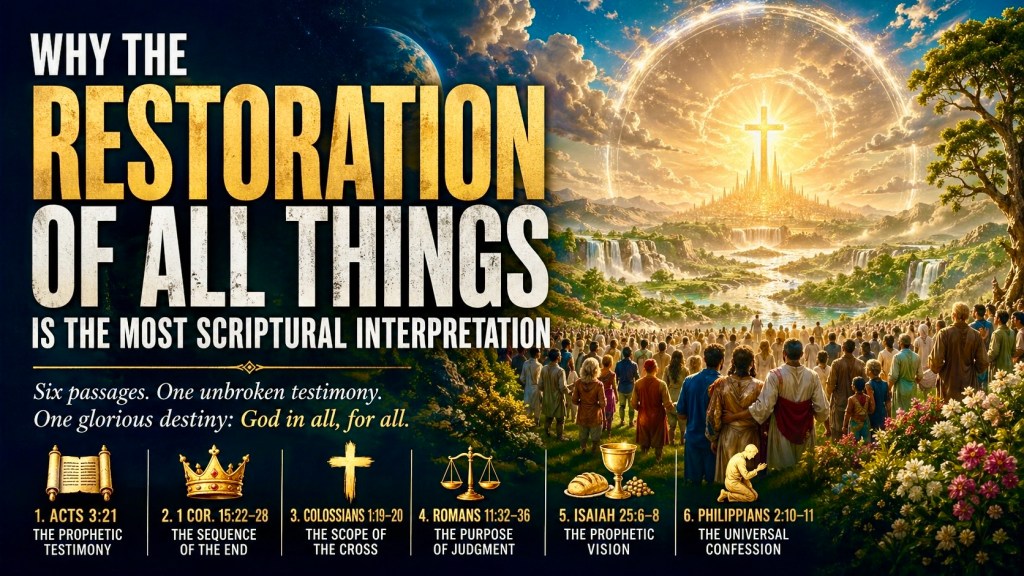
Every major position on the destiny of the lost—eternal torment, annihilationism, and the Restoration of All Things—claims to rest on Scripture. But only one of them can account for everything the Bible actually says without quietly reducing the meaning of a single passage. That position is the Restoration of All Things.
Restoration Theology reads Scripture in its canonical order—Torah, Prophets, the Lord Jesus, and the Apostolic Epistles. What follows traces that canonical progression, beginning with the foundation God laid in the Torah and confirmed through the Lord Jesus, and then drawing from the Prophets and the Apostles who expounded what was already established.
The foundation was laid in the Torah, when God promised Abraham, “In you all the families of the earth shall be blessed” (Genesis 12:3). Paul identifies this promise as the gospel preached beforehand (Galatians 3:8). When the good news has run its full course, the result is the blessing of all families—not their permanent ruin. The Lord Jesus confirmed the universal scope of what is coming when He declared that all who are in the graves will hear His voice and come forth—“those who have done good, to the resurrection of life, and those who have done evil, to the resurrection of judgment” (John 5:28–29). The resurrection is universal; the outcomes are two; and the ages that follow unfold from there.
The six passages that follow, drawn from the Prophets and the Apostles, build on this foundation. They are not proof-texts lifted from obscure corners of the canon. They span the full apostolic witness and confirm what the Torah and the Lord Jesus already established.
1. Acts 3:21—The Prophetic Testimony
Peter declares that heaven must receive the Lord Jesus “until the times of restoration of all things, which God has spoken by the mouth of all His holy prophets since the world began” (Acts 3:21).
Notice the scope. Not some things—all things. And not spoken by one obscure prophet, but by all of them, since the world began. This is not a marginal idea tucked into a neglected corner of the apostolic preaching. Peter treats the Restoration of All Things as the very destination of the ages—the thing every prophet pointed toward. The “restoration of all things” is not a peculiarity of one apostle’s private theology; it is the unanimous prophetic testimony, the goal toward which the entire canonical story moves.
A doctrine of eternal torment cannot coexist with a “restoration of all things” spoken by all the prophets. Either the prophets spoke truly and all things are restored, or they exaggerated and some things remain eternally unrestored. The apostolic witness leaves no room for the second option. If the Restoration of All Things is a heresy, then every prophet in ancient Israel was complicit in it—and Peter, filled with the Holy Spirit, endorsed their testimony in the temple courts.
2. 1 Corinthians 15:22–28—The Sequence of the End
Paul lays out the most detailed eschatological sequence in the apostolic writings. Christ the firstfruits. Then those who are His at His coming. Then the end—when every rule, authority, and power has been abolished, when “the last enemy that will be destroyed is death,” and when God becomes “all in all” (1 Corinthians 15:23–28).
The Greek verb Paul uses for “destroyed” is katargeō (καταργέω), which means to render inoperative, to abolish, to bring to nothing. Death is not merely restrained or pushed to the margins of the new creation. It is abolished. It ceases to function. It has no one left to claim and no power left to wield.
Now think carefully about what “all in all” requires. If God is all in all, there is no corner of creation where He is absent. No dungeon of unresolved torment running alongside the new heavens and the new earth. No pocket of unredeemed suffering persisting forever as a monument to defeat. “All in all” is absolute. It admits no exception, no excluded realm, no eternally unreconciled sector of the cosmos. If even one soul remains in endless torment, then God is not all in all—He is all in almost all, and a rival kingdom of death endures forever beside His throne.
Paul allows no such outcome.
3. Colossians 1:19–20—The Scope of the Cross
Paul proclaims that through the blood of the cross, God will reconcile “all things” to Himself—“whether things on earth or things in heaven” (Colossians 1:19–20). The scope of reconciliation is cosmic. If an eternal realm of unreconciled torment persists alongside the new creation, then “all things” have not been reconciled, the blood of the cross has failed to make peace with a portion of creation, and Paul’s declaration is false.
But if Paul speaks truly—and the Spirit who inspired him does not lie—then the reconciliation is complete, and no pocket of unresolved suffering endures beyond the ages appointed for judgment. The cross does not merely save some and abandon the rest; it reaches as far as the ruin reaches, and it makes peace with everything it touches.
Paul echoes this same cosmic scope in Ephesians, where he reveals that God has “made known to us the mystery of His will, according to His good pleasure which He purposed in Himself, that in the dispensation of the fullness of the times He might gather together in one all things in Christ, both which are in heaven and which are on earth—in Him” (Ephesians 1:9–10). This is not a secondary plan devised in response to the fall. It is the mystery of God’s will, purposed in Himself according to His good pleasure before the ages began. And notice the age-language: “in the dispensation of the fullness of the times.” The gathering of all things in Christ is not a timeless abstraction—it unfolds within the ordered sequence of the ages, at the appointed time when every age has run its course and God’s purpose has reached its fullness.
4. Romans 11:32–36—The Purpose of Judgment
“For God has committed them all to disobedience, that He might have mercy on all” (Romans 11:32).
Paul does not say that God allowed some to fall so that He might condemn them forever. He says the universal imprisonment under sin serves the larger purpose of universal mercy. The “all” who are imprisoned are the same “all” on whom mercy falls. Read it again. The logic is inescapable: the scope of judgment is real, and the scope of mercy is equally real.
What follows is not despair but worship. Paul immediately breaks into the doxology: “Oh, the depth of the riches both of the wisdom and knowledge of God! How unsearchable are His judgments and His ways past finding out!… For of Him and through Him and to Him are all things, to whom be glory to the ages” (Romans 11:33, 36, literal). This is not the cry of a man who has just described an eternal standoff between mercy and torment. It is the worship of a man who has glimpsed the full sweep of a plan in which mercy encompasses judgment and God’s purpose reaches every creature. “Of Him and through Him and to Him are all things.” All things return to the One from whom they came.
5. Isaiah 25:6–8—The Prophetic Vision
“And in this mountain the LORD of hosts will make for all peoples a feast of choice pieces, a feast of wines on the lees, of fat things full of marrow, of well-refined wines on the lees. And He will destroy on this mountain the surface of the covering cast over all people, and the veil that is spread over all nations. He will swallow up death forever, and the Lord GOD will wipe away tears from all faces” (Isaiah 25:6–8).
Notice first the audience: “all peoples,” “all nations,” “all faces.” The feast God prepares is not for the elect alone—it is for all peoples. The veil He removes is not draped over Israel only—it covers all nations. The tears He wipes away are not from the faces of believers alone—they are from all faces.
And notice what happens to death: it is not managed, not reduced, not confined to one corner of the cosmos. It is swallowed up. Isaiah’s vision leaves no category of humanity permanently excluded from the mercy of God. No nation left veiled. No face still weeping. No death still operating when the feast has been spread and the covering removed.
6. Philippians 2:9–11—The Universal Confession
Paul declares that because the Lord Jesus humbled Himself to the point of death—even the death of the cross—“God also has highly exalted Him and given Him the name which is above every name, that at the name of Jesus every knee should bow, of those in heaven, and of those on earth, and of those under the earth, and that every tongue should confess that Jesus Christ is Lord, to the glory of God the Father” (Philippians 2:9–11).
This passage demands careful attention. The confession is not extracted under duress from tormented souls in an eternal dungeon. It is rendered “to the glory of God the Father.” A coerced confession from humanity writhing in unending agony does not glorify the Father; it indicts Him. A willing, reconciled acknowledgment of the Lordship of Christ—rendered freely, after judgment has done its necessary work—glorifies the Father, because it reveals that His purpose in Christ has reached every creature in every realm. The day is coming when every being—heavenly, earthly, and under the earth—will freely confess that the Lord Jesus is Lord, and that confession will be an act of worship, not a cry of despair.
The Test Every Position Must Pass
Here is the honest question every believer should ask: Can my eschatology account for all six of these passages without reducing the word “all” in any of them?
Eternal torment cannot. If torment is endless, then death is not destroyed, God is not all in all, all things are not reconciled, mercy does not reach all, tears remain on faces forever, and the universal confession is a forced cry of anguish rather than an act of worship to the glory of the Father.
Annihilationism cannot. If the lost are permanently erased, then all things have not been restored, all faces have not had their tears wiped away, the feast has not been spread for all peoples, and God is all in all only because He has deleted part of His creation. The confession of every tongue never occurs, because the tongues have been annihilated.
The Restoration of All Things is the only interpretation that lets every one of these passages mean exactly what it says. Judgment is real, severe, and age-lasting. But it is not God’s final word. The fire of the coming age removes the flesh that cannot inherit the kingdom; the mortal body it governed dies under that fire. The soul is purified through the removal of the flesh’s governance, and the heart returns to God who gave it. It does not destroy God’s purpose to reconcile all things in Christ. Beyond judgment lies new creation, where death is abolished, every tear is wiped away, every knee has bowed, every tongue has confessed, and the life of God fills all things without remainder.
The Shape of the Restoration
But what does the Restoration of All Things actually look like? If judgment is real but not final, what does it accomplish, and what emerges on the other side?
The Restoration of All Things unfolds within a structure of three ages. This present age is the season of sowing, the quarry in which the Father forms sons and daughters for the age to come. The Seventh Day—the Day of the Lord, the Age to Come—is inaugurated by the appearing of the Lord Jesus, the universal resurrection, and the onset of judgment. The earth itself becomes Gehenna, the realm of divine fire. The Eighth Day is the new creation: death abolished, creation renewed, and God all in all (1 Corinthians 15:28; 2 Peter 3:13). When Scripture speaks of judgment that is aiōnios (αἰώνιος)—a word most translations render as “eternal” or “everlasting”—it does not mean eternal in the philosophical sense. It means belonging to the age, bounded by the age, and serving the purpose for which the age was appointed. The judgments of the Seventh Day are real and searching, but they end when the Seventh Day ends, and the Eighth Day opens onto restoration.
What does the fire of the Seventh Day actually do? It removes the flesh—the self-governing disposition that corrupted and ruled the soul—involuntarily from those who refused to have it put to death by the Spirit in this present age. The soul is purified through the removal of the flesh’s governance, not annihilated (Matthew 10:28, where apollumi (ἀπόλλυμι) means to ruin and bring to loss). The heart, freed from the flesh’s governance, returns to God who gave it (Ecclesiastes 12:7). Scripture distinguishes two tracks within this judgment. For the unfaithful believer, the fire is corrective discipline within the household, many stripes or few (Luke 12:47–48). For the ungodly, it is wrath—real indignation, tribulation, and anguish (Romans 2:8–9). Yet even wrath is bounded: “For I will not contend forever, nor will I always be angry; for the spirit would fail before Me, and the souls which I have made” (Isaiah 57:16). The fire is subtractive: it removes what must be removed and purifies what remains, but it does not transform. Transformation belongs exclusively to the divine seed—the incorruptible seed of God that remains in the one who has been begotten (1 John 3:9; 1 Peter 1:23)—and the Spirit, working from glory to glory in this present age (2 Corinthians 3:18). Where the seed was carelessly ignored through unfaithfulness, the fire cannot bestow what was never cultivated.
The three restored orders emerge across the Seventh and Eighth Days according to the sequence Scripture establishes. At the appearing of the Lord Jesus, the faithful—those who walked by the Spirit and put to death the deeds of the body in this present age—are transformed in a moment, receive celestial bodies, and ascend to the Heavenly Jerusalem as the Royal Priesthood (1 Peter 2:9; Hebrews 12:22–23; 1 Corinthians 15:51–52). They serve the Lord Jesus throughout the Seventh Day while the fires of Gehenna accomplish their purifying work below. The unfaithful believer, purified through that fire but having forfeited the firstborn inheritance, is restored in the Eighth Day as an outer-court terrestrial priest on the renewed earth—the Levitical pattern of the servant who ministers in the house but does not draw near to the altar or enter behind the veil (Numbers 18:1–7; Ezekiel 44:10–14). The ungodly, purified through the full weight of divine wrath, are raised in the resurrection “of the end” as terrestrial immortal nations, walking in the light of the heavenly city and its priestly sons (Isaiah 60:3; 1 Corinthians 15:24). These three orders are not temporary stages. They are the permanent architecture of the new creation. Restoration is universal. The outcome is not uniform. And this is precisely what the six passages above require: a restoration that reaches every creature in every realm, ordered by the wisdom of God, structured by the ages He appointed, and accomplished through the blood of the cross.
This is not wishful thinking. It is not sentimental optimism. It is the testimony of Moses, the Prophets, the Lord Jesus, and the Apostles—read in the order God gave them and within the structure of the ages He Himself established. “Mercy triumphs over judgment” (James 2:13). It always has. It always will.

