
Updated 5/24/2026
Light, Influence, and the Fire of the Age to Come
Introduction: A Sacred and Dangerous Calling
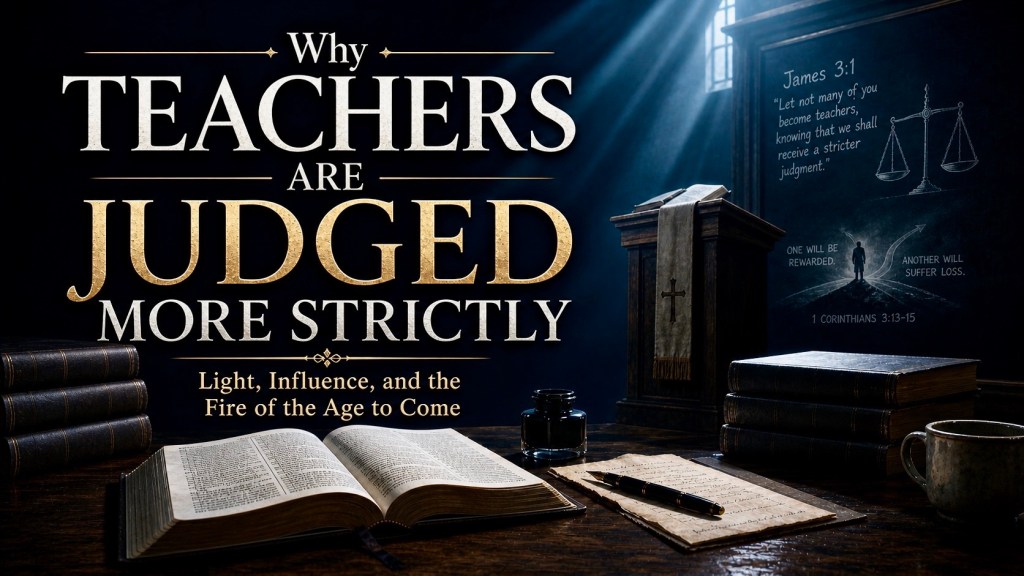
Among all the warnings given to believers in the New Testament, few are as sobering as the warning addressed to teachers: “Let not many of you become teachers, knowing that we shall receive a stricter judgment” (James 3:1). Scripture does not say that teachers might receive greater judgment; it says they will. Teaching is a divine stewardship that carries extraordinary privilege but also extraordinary accountability, for teachers shape the understanding, obedience, and destiny of others. In the Age to Come, their words and influence will be weighed with precision by the Lord Jesus, who Himself taught in the fear of God and spoke only what the Father commanded (John 12:49–50).
This teaching explores why teachers are judged more severely, how this judgment reflects the character of God, and why the fear of the Lord must govern every aspect of teaching. It also shows how this greater judgment fits into the order of the ages—the present evil age in which we now live, the coming age of rest for the faithful and corrective judgment for the unfaithful and ungodly (the Seventh Day), and the new creation in which God will be all in all (the Eighth Day). The purpose is not to discourage those whom God has truly called to teach, but to awaken holy sobriety, deep humility, and trembling dependence upon the Spirit of grace.
The Principle Established in Torah: Those Nearest the Word Bear the Greatest Accountability
The principle that teachers and leaders are held to a higher standard does not begin with James. It begins in the Torah, where God first reveals that those who stand closest to His word and His presence bear the sharpest consequences when they presume upon that nearness.
The most striking case is Nadab and Abihu, the sons of Aaron, who “offered profane fire before the Lord, which He had not commanded them” (Leviticus 10:1). Fire came out from the presence of the Lord and consumed them. They were not outsiders or idolaters. They were priests—men ordained to minister in the holy place, standing nearer to the presence of God than any other Israelites. Their sin was not a moral atrocity in the eyes of men; it was unauthorized worship, an act of presumption in the handling of sacred things. The Lord’s response to Aaron is devastating in its clarity: “By those who come near Me I must be regarded as holy; and before all the people I must be glorified” (Leviticus 10:3). The nearer the access, the stricter the requirement. The higher the stewardship, the more severe the consequence of carelessness.
Moses himself illustrates the same principle. He was the most faithful servant in all God’s house (Numbers 12:7; Hebrews 3:5), the man to whom God spoke face to face. Yet when he struck the rock at Meribah instead of speaking to it as commanded, the Lord said, “Because you did not believe Me, to hallow Me in the eyes of the children of Israel, therefore you shall not bring this assembly into the land which I have given them” (Numbers 20:12). The people he led grumbled constantly and were still permitted to enter the land through their children. Moses, the leader, was denied entry for a single act of misrepresentation before the people. He was not judged as the people were judged. He was judged as the one who stood nearest to the word of God—and the standard was correspondingly higher.
The Torah also establishes the graduated scale of accountability that governs all divine judgment. The sin of ignorance and the sin of the high hand are not treated alike (Numbers 15:27–31). The one who sinned unknowingly brought a sacrifice and was forgiven. The one who sinned presumptuously, with full knowledge, was to be “cut off from among his people.” This distinction—judgment measured by the degree of knowledge and intention—runs through the entire canon and reaches its fullest expression in the words of the Lord Jesus and His apostles.
The Prophets: The Watchman Who Fails to Warn
The Prophets deepen the Torah’s principle and apply it directly to those who speak on God’s behalf. Ezekiel is appointed as a watchman over the house of Israel, and the Lord makes the stakes explicit: “When I say to the wicked, ‘You shall surely die,’ and you give him no warning, nor speak to warn the wicked from his wicked way, to save his life, that same wicked man shall die in his iniquity; but his blood I will require at your hand” (Ezekiel 3:18; cf. 33:6). The watchman who speaks faithfully delivers his own soul. The watchman who remains silent—whether from fear, laziness, or a desire to be liked—shares in the guilt of those he failed to warn.
This is the prophetic precedent for James 3:1. The teacher, like the watchman, stands between God’s word and God’s people. If the teacher speaks faithfully, both are served. If the teacher distorts, softens, omits, or accommodates, the damage is not limited to the teacher alone—it spreads to every soul that trusted his voice. The Prophets make clear that this accountability is not optional. It is woven into the nature of the calling itself.
Malachi intensifies the warning by addressing the priests directly: “The lips of a priest should keep knowledge, and people should seek the law from his mouth; for he is the messenger of the Lord of hosts. But you have departed from the way; you have caused many to stumble at the law” (Malachi 2:7–8). The priest who teaches rightly is a messenger of God. The priest who misleads causes others to stumble—and the judgment he receives is proportionate not merely to his own failure but to the stumbling he caused in others. This is the principle that the Lord Jesus will bring to its sharpest expression.
The Weight of Influence: Why Teachers Are Held to a Higher Standard
Teaching—whether through preaching, writing, counseling, or discipling—is not simply the communication of information. It is the formation of souls. Because of this, teachers enter into a sphere of accountability not shared in the same way by all believers. Their words shape the understanding, affections, and obedience of others. They can strengthen or weaken faith, clarify or distort truth, build up or mislead. The Lord sees this influence not only in the moment but in its generational effects.
This is why the Lord Jesus repeatedly warned the scribes and Pharisees—not primarily because they were the worst sinners morally, but because they were misguiding those who trusted them. He accused them of shutting up the kingdom of heaven against men, of neither entering themselves nor allowing those who were entering to go in (Matthew 23:13). He rebuked them for traveling land and sea to make a single proselyte and then making him twice as much a son of Gehenna as themselves (Matthew 23:15). Their error was not merely personal sin; it was corporate harm flowing from their role as teachers. The stricter judgment arises from this principle: those who influence others shape the destiny of many, and their responsibility is measured accordingly.
In the household of God, teachers stand at a junction where many paths converge. Through their handling of Scripture, they can point believers toward the narrow way that leads to life in the Age to Come, or they can normalize compromise, dull the fear of the Lord, and foster presumption. Because the stakes are so high, the Lord does not treat their words as casual. He weighs them as seeds that either bear fruit to life or contribute to barrenness, corruption, and loss.
Light, Knowledge, and the Severity of Judgment
Teachers are judged more strictly because they possess greater light. The Lord Jesus taught that judgment is always proportionate to the measure of understanding given: “For everyone to whom much is given, from him much will be required” (Luke 12:48). Teachers, by their very calling, engage deeply with Scripture, doctrine, and truth. Their exposure to divine light increases their accountability. The more clearly one knows the will of God, the more serious the consequences of disobedience, negligence, or distortion.
The Lord Jesus applied this principle with devastating specificity to the cities that had witnessed His miracles: “Woe to you, Chorazin! Woe to you, Bethsaida! For if the mighty works which were done in you had been done in Tyre and Sidon, they would have repented long ago in sackcloth and ashes. But I say to you, it will be more tolerable for Tyre and Sidon in the day of judgment than for you” (Matthew 11:21–22). The judgment is not uniform. It is calibrated to the light received. Tyre and Sidon sinned in relative darkness; Chorazin and Bethsaida sinned in the full light of the Son of God’s presence. The same principle governs teachers in the church: they have handled the mysteries of God, they have opened the Scriptures, they have stood in the light—and if they distorted what they saw, the divine fire will be proportionately severe.
Paul demonstrates this principle when he warns the elders in Ephesus that he is “innocent of the blood of all men” because he “did not shun to declare… the whole counsel of God” (Acts 20:26–27). He understood that if he held back truth, diluted it, or substituted human philosophy for the word of God, he would bear responsibility for the damage that followed. Later he charges Timothy to “be diligent” in handling the word of truth, rightly dividing it, and to take heed to himself and to the doctrine, because in doing so he would save both himself and those who heard him (2 Timothy 2:15; 1 Timothy 4:16).
The same principle governs the Day of the Lord and the age of judgment that follows the appearing of the Lord Jesus. Those who have stood closest to the light—Israel with the Torah, covenant cities that saw the Lord’s miracles, and teachers in the church who have handled the mysteries of God—are judged more strictly because they sinned, if they sinned, against a clearer revelation. James’s warning that teachers will receive a stricter judgment is therefore not an isolated statement. It is a particular application of the larger biblical principle that judgment is according to works and according to light. The nearer the light, the greater the responsibility; the greater the responsibility, the heavier the judgment when that light is resisted.
Teachers and the Fire of the Coming Age
Scripture clearly teaches that every believer’s work will be tested by fire in the Age to Come. Paul describes himself as a wise master builder who laid the foundation, which is Jesus Christ, and warns that others must take care how they build on it. On that Day, each one’s work will become manifest, “because it will be revealed by fire; and the fire will test each one’s work, of what sort it is” (1 Corinthians 3:13). For teachers, this fire is especially searching, because their work consists of words, doctrines, and the shaping of human souls.
Paul explains that if anyone builds on the foundation with gold, silver, and precious stones, his work will endure and he will receive a reward. If he builds with wood, hay, and straw, his work will be burned and he will suffer loss, though he himself “will be saved, yet so as through fire” (1 Corinthians 3:12–15). The fire here is not the pagan notion of endless torment, nor is it a metaphor emptied of real consequence. It is the refining, exposing, corrective fires of divine holiness of the coming age—what the Lord Jesus calls Gehenna—that reveal what was truly of Christ and what was of human wisdom, pride, and compromise. In the theology of the ages, Gehenna is not an underground torture chamber but the condition of the earth itself during the Seventh Day, when the Lord Jesus reigns and all that is corrupt, false, and self-willed is burned away. It is finite, purposeful, and aimed at purification—not at endless punishment and not at annihilation.
For teachers, this testing can be particularly intense. A lifetime of ministry may be weighed and found largely composed of wood, hay, and straw—attractive in this age, impressive in the eyes of men, but lacking the substance of obedience and truth. Teachers whose work is rooted in ambition, fear of man, novelty, or accommodation to the spirit of the age will see that work consumed. They may be sons and daughters of God, yet they will be judged as those who stood before others in the name of God. The severity of their discipline corresponds not only to their own actions but to the multiplied effect of those actions in the lives of those they influenced.
The Fear of God in Teaching
The fear of the Lord is the foundation of faithful teaching. Without it, a teacher is vulnerable to pride, presumption, self-promotion, and theological carelessness. Scripture commands believers to serve God “with reverence and godly fear” because He is a consuming fire (Hebrews 12:28–29). Teachers stand nearest to that fire because they stand nearest to the Word. The same word that sanctifies also judges. The Lord Jesus said, “The word that I have spoken will judge him in the last day” (John 12:48). The words of Scripture that teachers expound today will be the standard by which their teaching is weighed in the coming age.
Because of this, teachers must cultivate humility, recognizing that all true understanding comes from the Spirit and that apart from Him they can do nothing. They must walk in sobriety, knowing that every word they speak in the Lord’s name will be evaluated by Christ. They must be faithful, refusing to soften or distort truth in order to gain approval, preserve reputation, or avoid offense. They must maintain purity of motive, teaching not to be seen or admired but to serve the Lord and build up His people. They must guard integrity, ensuring that their life and doctrine are consistent, so that their example does not contradict their message. Above all, they must live in conscious dependence upon the grace of God, who works in His servants both to will and to do for His good pleasure.
Teachers, more than any, must be those who tremble at the word of the Lord (Isaiah 66:2). They are the first hearers of what they proclaim. If the word does not pierce them, it will have little power through them. The fear of God does not paralyze; it purifies. It delivers teachers from the fear of man, from attachment to praise or numbers, and from the subtle idolatry of ministry as a source of identity. It anchors them in the reality that they speak before the One whose eyes are like torches of fire (Daniel 10:6).
The Harm of False Teaching and the Weight of Stumbling Others
The Lord Jesus pronounced some of His most severe warnings on those who cause others to stumble. “Whoever causes one of these little ones who believe in Me to stumble,” He said, “it would be better for him if a millstone were hung around his neck, and he were thrown into the sea” (Mark 9:42; Matthew 18:6). The imagery is violent because the danger is real. To lead astray a simple believer, to encourage sin, or to weaken the fear of God in those who trust us is to incur a judgment more serious than physical death.
False teaching, compromised teaching, and negligent teaching can weaken the fear of God, trivialize holiness, and distort the gospel. They can produce spiritual complacency, misrepresent the character of God, and encourage a false assurance that leaves people unprepared for the judgment of the Age to Come. They can lead believers away from obedience, hinder spiritual growth, and misdirect hope from the resurrection of life and the firstborn inheritance to shallow expectations of earthly blessing or a cheap view of grace.
This danger must be named plainly, because it operates on both sides of the theological spectrum. The teacher who preaches eternal torment without the hope of restoration distorts the character of God and binds consciences with a fear that Scripture does not warrant. But the teacher who preaches the restoration of all things without the sobering reality of age-lasting corrective judgment—as though the outcome of this life does not matter, as though Gehenna is a footnote rather than a furnace—produces a different and equally dangerous distortion. Such teaching breeds the very presumption that James warns against. It whispers to the soul: “All roads lead to the same place eventually, so the urgency of faithfulness is merely rhetorical.” But the Scriptures never speak this way. The Lord Jesus never spoke this way. He warned of outer darkness, of weeping and gnashing of teeth, of the servant beaten with many stripes and the one beaten with few (Luke 12:47–48). He distinguished the faithful servant who is set over all the master’s goods from the wicked servant who is cut in two and appointed his portion with the hypocrites (Matthew 24:45–51). These warnings are not decorative. They describe real, age-lasting consequences that faithful teaching must never soften.
In the Seventh Day, the fire of God will expose every distortion, every misleading word, and every false comfort. Teachers may realize too late that their negligence or compromise produced generations of spiritual harm. The Lord will bring to light not only what they taught explicitly, but the practical direction of life their teaching encouraged. Did it lead people to deny themselves, take up the cross, and follow the Lord Jesus? Did it sharpen the fear of the Lord and the pursuit of holiness? Or did it normalize mixture, excuse worldliness, and cloud the reality of judgment and the prize of the inheritance? The stricter judgment that James speaks of is not arbitrary; it is the righteous response of God to the corporate damage caused by those who mishandled His word.
Teachers in the Age to Come
The severity of the warning to teachers must be held together with the magnitude of the promise. Those who teach faithfully will shine with extraordinary glory in the Age to Come. Daniel was told that “those who are wise shall shine like the brightness of the firmament, and those who turn many to righteousness like the stars to the age and forever” (Daniel 12:3). Faithful teachers who handle the word with reverence, humility, and fear will receive great reward, for they helped shape souls that will glorify God in the coming ages.
In the resurrection of life—the resurrection that the Lord Jesus calls “the resurrection of the just” (Luke 14:14), the resurrection that Paul strains forward to attain (Philippians 3:11)—faithful teachers will be found among those who inherit the kingdom and share in the Royal Priesthood. The Royal Priesthood is the prize of the faithful: those who endured, who loved the truth, who walked in the fear of God, and who are counted worthy to reign with Christ in celestial glory in the Heavenly Jerusalem. It is not the automatic possession of every believer. It is the inheritance awarded to those who were faithful with what they were given—and teachers who turned many to righteousness will find that their labor in the word and doctrine is remembered, and the lives they touched will serve as living testimonies to the grace of God working through them. In the Eighth Day, when all things are made new and the nations walk in the light of Christ, those who turned many to righteousness will share in the work of teaching, governing, and shepherding under the Lord Jesus in ways that surpass anything imagined in this age.
By contrast, those who corrupted the word will suffer proportionately. Their correction in the Seventh Day may be long and severe. A teacher who lived for applause, popularity, or influence may find his entire life’s work consumed in the fire, entering the new creation with nothing but the bare fact of sonship, while a quiet, faithful servant who taught a small flock, or instructed his family and friends with integrity and fear of God, enters the kingdom with honor. The Lord’s scales do not measure by visible size of ministry, but by truth, obedience, and love. The stricter judgment of teachers thus includes both a sharper fire for the unfaithful and a greater reward for the faithful.
Conclusion: Teaching as Sacred Stewardship in the Fear of God
Teaching is a gift, a calling, a ministry, and a stewardship—but above all, it is a test. It tests the heart of the one who teaches and shapes the hearts of those who listen. God entrusts His truth only to those who, in measure, tremble at His word, walk in His light, and love His glory more than their own. Teachers will be judged strictly because they stand closest to the word, carry the greatest influence, and receive the greatest light. Their judgment in the coming age will be searching and exacting. Yet their reward can be unparalleled, for those who lead many to righteousness will share in the glory of the Firstborn and participate in the restoration of the nations.
The warning is therefore not to avoid teaching if God has truly called and equipped you, but to teach with fear, humility, purity, faithfulness, and trembling joy, knowing that every word will one day be weighed by the Lord. Those who stand before others in His name must first bow deeply before Him in secret. Those who open the Scriptures publicly must first allow the Scriptures to open them privately. In this way, the stricter judgment becomes not merely a threat, but a sanctifying hope: that the One who called us to speak in His name will purify our lips, guard our hearts, and make our teaching an instrument of life in the ages to come.
Whether you teach from a pulpit, in a living room, through a pen, or at a kitchen table—whether your audience is thousands or your own children—the principle is the same. The God who appointed Nadab and Abihu to the priesthood and then consumed them for presumption, who denied Moses the promised land for a single misrepresentation, who set watchmen on the walls and required their blood if they failed to warn—this same God has entrusted His word to you. He does not entrust it lightly, and He does not evaluate it casually. But neither does He leave you to carry it alone. The Spirit who reveals the truth also empowers the teacher to speak it faithfully. The grace that illumines also sustains. The Father who holds His servants to the strictest account is the same Father who chastens those He loves, who refines because He intends to glorify, and who will not rest until every distortion is burned away and every faithful word bears its eternal fruit.
Let those who teach do so in the fear of the Lord—not the fear that silences, but the fear that purifies. And let those who sit under teaching test what they hear against the whole counsel of God, knowing that the responsibility for truth does not rest on the teacher alone. In the end, every soul will stand before the Lord Jesus, and the words He has spoken will judge each one. But for teachers, the fire will be nearer, the scrutiny sharper, and the stakes immeasurably higher—because they dared to speak in His name. May the God who calls also keep, and may the word that goes forth from faithful lips return to Him bearing the fruit of righteousness in the age that is to come.

