
Updated 5/23/2026
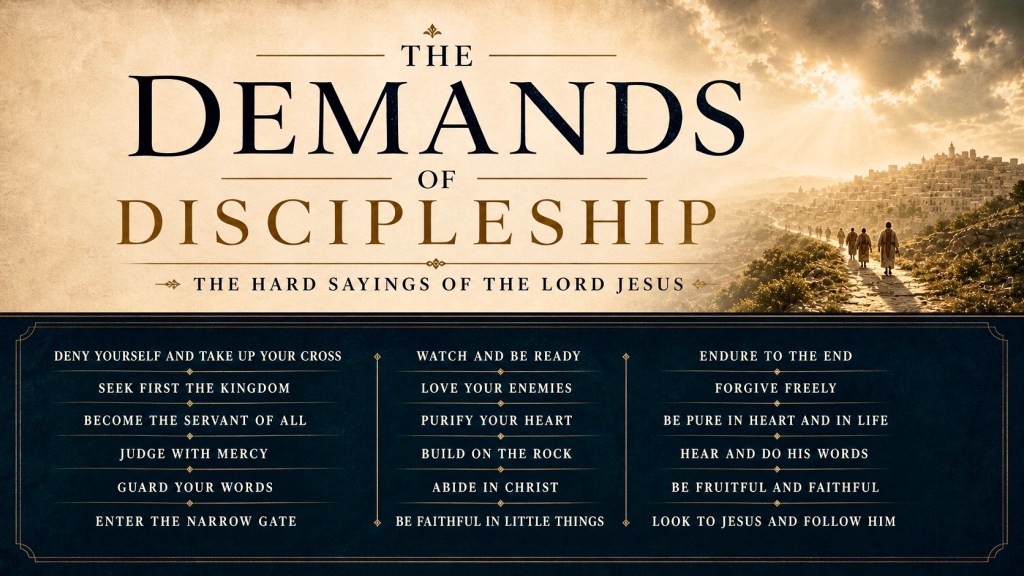
The Hard Sayings of the Lord Jesus
Introduction: The King Who Speaks With Final Authority
The Lord Jesus did not come to offer suggestions. He came proclaiming the Kingdom of God with uncompromising authority and calling everyone who follows Him into a life of obedience, holiness, humility, endurance, and cross-bearing. His words are not theological options. They are binding commands. He declared that the Father “has given Him authority to execute judgment” and that “the word that I have spoken will judge him in the last day” (John 5:27; 12:48). The “last day” is the appearing of the Son of Man on the last day of this present evil age, when the resurrection of life and the resurrection of judgment take place together (John 5:28–29). His teaching is the standard on the Day of Judgment. Not our traditions. Not our theological systems. His words.
Much of modern Christianity has softened these demands beyond recognition, turning discipleship into a formula of belief rather than a life of obedience. Yet the Lord Jesus presented discipleship as the decisive dividing line between life and judgment in the Age to Come. His hard sayings reveal the standard by which every believer will be measured and the foundation upon which inheritance is granted or lost. They expose the illusion that covenant identity alone guarantees glory. Identity as a son or daughter is given purely by grace—Christ’s own life gifted to all who belong to Him. But the Father’s placement of a believer as a firstborn heir is granted only to those who abide in that grace, yield to Christ’s power at work within them, and walk in the path He has marked out. The saving gift is Christ Himself given to all who believe. The prize of the firstborn inheritance is Christ’s likeness formed in those who cooperate with the Spirit of grace in this present age.
And these demands are not novel. They did not appear for the first time on the lips of the Lord Jesus as though He were introducing a previously unknown standard. The Torah demanded total allegiance to the Lord. The Prophets exposed the heart as the true battleground and called for the fruit of justice and mercy rather than empty ritual. The Lord Jesus gathers up these ancient demands, raises them to their intended fullness, and sets them before His disciples as the standard of the Age to Come. His hard sayings are not additions to Scripture; they are the substance toward which the entire witness of Scripture had been pointing.
What follows is a gathering of these demands—the Lord’s own words about what it means to follow Him. They are not comfortable words. But they are the words that will judge every disciple at His appearing, and the words that, if embraced, prepare the heart for the resurrection of life and the joy of the Age to Come.
Deny Yourself, Take Up the Cross, and Follow Me
Discipleship begins with the death of self. “Whoever desires to come after Me, let him deny himself, and take up his cross daily, and follow Me” (Luke 9:23). The Greek verb arneomai (ἀρνέομαι), “deny,” means to renounce, to disown. The disciple must renounce self-will, self-ownership, and self-preservation as the ruling principle of life. And the “cross” is not a symbol of inconvenience. In the first century it was the instrument of execution. To take up the cross daily is to consent to the death of fleshly ambition and worldly attachment so that the life of Christ may govern the inner person.
The Lord insists that this decision requires deliberate calculation. He commands us to “count the cost,” like a builder who estimates before constructing a tower or a king who considers his forces before going to war (Luke 14:28–32). He concludes with words that allow no compromise: “Whoever of you does not forsake all that he has cannot be My disciple” (Luke 14:33). The point is not that every disciple must abandon every possession outwardly, but that everything—time, relationships, resources, plans, even life itself—must be yielded to His Lordship. Nothing is held back. Nothing is exempt.
Then He exposes the paradox at the heart of the ages: “Whoever desires to save his life will lose it, but whoever loses his life for My sake will find it” (Matthew 16:25). The “life” here is psuchē (ψυχή)—the soul governed by the flesh, the self-centered existence that the fall established. Whoever clings to the flesh’s governance now will lose that soul in the judgment of the coming age. Whoever yields the flesh’s rule to the cross now—surrendering autonomous self-governance for Christ’s sake—will find that soul purified, preserved, and glorified in the resurrection of life. Self-denial in this age is the appointed means by which the flesh is crucified, the soul is purified, and the whole person is made ready for life in the Age to Come.
Paul received this demand from the Lord and proclaimed it as the settled pattern: “I have been crucified with Christ; it is no longer I who live, but Christ lives in me” (Galatians 2:20). The daily cross-bearing the Lord demands is not a grim duty imposed from without. It is the believer’s active participation, by the Spirit, in the death that Christ has already accomplished. And the Spirit of grace empowers what the Lord commands, for “it is God who works in you both to will and to do for His good pleasure” (Philippians 2:13). The demand for self-denial is always accompanied by the provision of divine power to carry it out.
Seek First the Kingdom of God
The Lord Jesus does not merely demand the renunciation of self; He commands the enthronement of a new governing reality. “Seek first the kingdom of God and His righteousness, and all these things shall be added to you” (Matthew 6:33). The kingdom is not to be fitted alongside other pursuits. It is to be placed first—above every competing interest—so that all other concerns are ordered beneath it.
This demand stands directly against the anxiety that drives fallen humanity. “Do not worry about your life, what you will eat or what you will drink; nor about your body, what you will put on” (Matthew 6:25). The disciple is called to trust the Father’s provision and to direct all energy toward the kingdom and its righteousness. And the Lord exposes the lethal alternative with devastating simplicity: “You cannot serve God and mammon” (Matthew 6:24). No divided allegiance is possible. “For where your treasure is, there your heart will be also” (Matthew 6:21). The placement of treasure reveals the true orientation of the heart. Those who invest their lives in the kingdom are laying up treasure that will endure into the Age to Come. Those who cling to earthly wealth and security are storing treasure in a realm that will not survive the fires of divine judgment.
The Greatest Must Become the Servant of All
The kingdom reverses the world’s hierarchy entirely. In the world, greatness belongs to those who rule. In the kingdom, greatness belongs to those who serve. The Lord Jesus—King of heaven and earth—declared that “the Son of Man did not come to be served, but to serve, and to give His life a ransom for many” (Mark 10:45).
When His disciples argued about who would be greatest, He set a child in their midst and said, “Whoever humbles himself as this little child is the greatest in the kingdom of heaven” (Matthew 18:4). Humility is the doorway to greatness. Authority in the coming kingdom is granted only to those who learn lowliness in this age. “Whoever desires to become great among you shall be your servant” (Matthew 20:26).
Paul holds up Christ’s self-emptying as the defining standard: He did not grasp at equality with God but “made Himself of no reputation, taking the form of a bondservant” and “humbled Himself and became obedient to the point of death, even the death of the cross” (Philippians 2:7–8). The result of this descent is the supreme exaltation: “Therefore God also has highly exalted Him and given Him the name which is above every name” (Philippians 2:9). Those who willingly go low now will be lifted into honor in the Age to Come. Those who seek exaltation now forfeit it then. Servanthood is not voluntary charity added to an otherwise self-directed life. It is the crucifixion of pride, ambition, and the need to be first. Only the meek and lowly of heart learn the pattern of their Master, who says, “Learn from Me, for I am gentle and lowly in heart” (Matthew 11:29).
The Measure You Use Will Be Measured Back to You
One of the most sobering warnings the Lord Jesus ever spoke is that divine judgment corresponds exactly to the standard we apply to others. “With what judgment you judge, you will be judged; and with the measure you use, it will be measured back to you” (Matthew 7:2). Whatever standard we impose on others is the standard Christ will impose on us at the judgment seat.
The disciple who judges harshly invites harsh judgment upon himself. The merciful receive mercy. “For if you forgive men their trespasses, your heavenly Father will also forgive you. But if you do not forgive men their trespasses, neither will your Father forgive your trespasses” (Matthew 6:14–15). Every word, attitude, and deed with which we have treated others becomes the very measure by which Christ evaluates us in the Day of the Lord.
This means that discipleship requires cultivating mercy, patience, humility, and restraint—precisely because these define the standard by which God will judge us. A harsh, critical spirit sows a harvest of severe discipline in the age of judgment. A merciful, patient spirit sows a harvest of mercy in the resurrection of life. The Spirit of grace, who is Himself the Spirit of mercy and compassion, works to form this merciful disposition in every heart that yields to His governance.
Every Idle Word Will Be Brought Into Judgment
The Lord Jesus declares that words are not trivial: “For every idle word men may speak, they will give account of it in the day of judgment” (Matthew 12:36). The Greek adjective argos (ἀργός) means “useless, lazy, unproductive.” Careless insults, reckless accusations, boastful claims, gossip, manipulation, and deceit—they all fall under this warning. And they emerge from the heart: “For out of the abundance of the heart the mouth speaks” (Matthew 12:34). Words reveal what fills the inner person.
He also raises the standard of truthfulness beyond anything the religious world of His day practiced. He commands, “Let your ‘Yes’ be ‘Yes,’ and your ‘No,’ ‘No.’ For whatever is more than these is from the evil one” (Matthew 5:37). In the kingdom, the disciple’s word should be so reliable that no oath is necessary. Simple, transparent speech—free from manipulation, exaggeration, and deception—is the mark of a heart being conformed to the character of the God who cannot lie.
James applies the Lord’s teaching with startling directness: “The tongue is an unruly evil, full of deadly poison,” and he warns that “with it we bless our God and Father, and with it we curse men, who have been made in the similitude of God. Out of the same mouth proceed blessing and cursing. My brethren, these things ought not to be so” (James 3:8–10). The tongue must be brought under the governance of the Spirit. Careless, deceitful, and destructive speech will be weighed at the judgment seat.
The Narrow Gate and the Difficult Way
“Enter by the narrow gate; for wide is the gate and broad is the way that leads to destruction, and there are many who go in by it. Because narrow is the gate and difficult is the way which leads to life, and there are few who find it” (Matthew 7:13–14).
The way to life in the Age to Come presses and constrains the disciple. It refuses the broad indulgence of the flesh and demands a wholehearted surrender that few are willing to give. The broad path—easy, popular, affirming of fallen desires—”leads to destruction.” Within the pattern of the ages, that destruction is the loss of the soul in the age of judgment: exclusion from the resurrection of life and entrance into the corrective discipline of Gehenna.
Modern Christianity has widened the path with doctrines that dismiss obedience and holiness as unnecessary, but the Lord offers no such version of discipleship. The narrow way is not an optional path for advanced believers. It is the only path to life in the coming age. Yet the narrowness of the way does not mean the disciple walks it alone or in his own strength. The Spirit of grace is the One who empowers the disciple to press through the narrow gate, and the Lord Jesus Himself is the Way (John 14:6). The path is narrow, but the One who leads us on it is mighty, and His grace is sufficient for every step.
Watch and Be Ready
The Lord Jesus placed extraordinary emphasis on watchfulness. “Watch therefore, for you do not know what hour your Lord is coming” (Matthew 24:42). The call is not to anxious speculation about dates but to moral readiness—living as if the Master might appear at any moment.
He warns that the unfaithful servant, who mistreats others and indulges himself because he assumes the Master delays, will be “appointed his portion with the unbelievers” (Luke 12:45–46). This does not mean loss of sonship but loss of firstborn inheritance. The unfaithful servant, though belonging to the household, shares the experience of judgment in the age of corrective discipline, receiving many or few stripes according to his knowledge and disobedience.
Paul carries this demand into the Apostolic teaching: “The day of the Lord so comes as a thief in the night… Therefore let us not sleep, as others do, but let us watch and be sober” (1 Thessalonians 5:2, 6). And the writer to the Hebrews adds a further dimension: “Exhort one another daily, while it is called ‘Today,’ lest any of you be hardened through the deceitfulness of sin” (Hebrews 3:13). Watchfulness is not merely an individual posture; it is a corporate discipline in which believers help one another stay alert as the Day approaches.
Readiness means stewardship, sobriety, holiness, and faithfulness in every sphere of life. Those who lived as if His delay gave them permission for carelessness will find themselves assigned to discipline in the Age to Come. Those who lived as if His nearness demanded obedience will enter the joy of their Lord.
Love Your Enemies and Be Perfect as Your Father Is Perfect
The Lord requires that His disciples practice a mercy that mirrors the Father’s own. “Love your enemies, bless those who curse you, do good to those who hate you… that you may be sons of your Father in heaven” (Matthew 5:44–45). Luke records Him saying that the Father “is kind to the unthankful and evil” and concludes, “Therefore be merciful, just as your Father also is merciful” (Luke 6:35–36).
To love enemies, bless persecutors, and forgive those who sin against us is to participate in the perfection of the Father’s love. The Lord commands, “Therefore you shall be perfect, just as your Father in heaven is perfect” (Matthew 5:48). The Greek adjective teleios (τέλειος) means mature, complete, brought to its intended goal. To be “perfect” in this sense is to allow the Spirit to bring our love into alignment with the Father’s own—a love that pursues, forgives, and restores even those who have wronged Him most deeply.
Failure to forgive exposes the disciple to severe divine discipline. The parable of the unforgiving servant ends with the master delivering him “to the torturers until he should pay all that was due to him,” and the Lord adds, “So My heavenly Father also will do to you if each of you, from his heart, does not forgive his brother” (Matthew 18:34–35). This discipline reaches its highest intensity in the age of judgment for those who refuse mercy in this age. “Judgment is without mercy to the one who has shown no mercy. Mercy triumphs over judgment” (James 2:13).
Purify Your Heart
The Lord teaches that sin begins in the heart long before it is expressed outwardly. “Whoever is angry with his brother without a cause shall be in danger of the judgment” (Matthew 5:22). “Whoever looks at a woman to lust for her has already committed adultery with her in his heart” (Matthew 5:28). The outward act is only the fruit. The root is the desire, the fantasy, the hatred nursed in secret.
Jeremiah diagnosed the problem with devastating clarity: “The heart is deceitful above all things, and desperately wicked; who can know it?” (Jeremiah 17:9). It is this very heart that the Lord Jesus addresses when He traces murder to anger and adultery to lust. He is not adding new commandments; He is revealing what God always demanded but what the unregenerate heart could never deliver. And because sin is rooted in the heart, He requires radical measures to avoid it: “If your right eye causes you to sin, pluck it out… for it is more profitable for you that one of your members perish, than for your whole body to be cast into Gehenna” (Matthew 5:29–30, literal). The imagery does not command literal mutilation. It commands the decisive removal of anything—any habit, any relationship, any indulgence—that draws the heart into sin. These warnings are addressed to disciples, not unbelievers, and they point directly to the danger of Gehenna for the unfaithful.
Those who refuse to deal with lust, anger, and deception now will face the crucifixion of the flesh and the involuntary purification of the soul under the fires of divine holiness in the age of judgment. Those who accept the cross now, allowing the Spirit to purify the heart, will enter the resurrection of life with hearts prepared for the presence of God. “Blessed are the pure in heart, for they shall see God” (Matthew 5:8). The promise is breathtaking: purity of heart is the condition for the beatific vision—for standing in the presence of the God whose holiness no impurity can approach.
Build on the Rock: Hear His Words and Do Them
The Lord concludes His greatest sermon by dividing humanity into two groups: “Whoever hears these sayings of Mine, and does them, I will liken him to a wise man who built his house on the rock,” while “everyone who hears these sayings of Mine, and does not do them, will be like a foolish man who built his house on the sand” (Matthew 7:24–26). Both hear. Only one obeys. Both houses stand for a time. Only one stands in the storm.
The storm is the testing of the Day of the Lord, when the hidden foundation of every life is exposed. Hearing alone—without obedience—is spiritual self-deception. “Be doers of the word, and not hearers only, deceiving yourselves” (James 1:22). And Paul confirms that the fire of that Day tests not merely the existence of a foundation—for all who are in Christ share the same foundation—but the quality of what has been built upon it. “If anyone builds on this foundation with gold, silver, precious stones, wood, hay, straw, each one’s work will become clear; for the Day will declare it, because it will be revealed by fire” (1 Corinthians 3:12–13). The disciple who hears and does the Lord’s words builds with imperishable materials. The one who hears and does not builds with materials that will be burned away, suffering loss even though he himself is saved—yet so as through fire (1 Corinthians 3:15).
Abide in Christ
In John 15 the Lord reveals that discipleship is impossible apart from abiding in Him. “I am the vine, you are the branches. He who abides in Me, and I in him, bears much fruit; for without Me you can do nothing” (John 15:5). Fruitfulness—tangible evidence of real discipleship—comes only through union with Him in obedience, love, and dependence. “Every branch in Me that does not bear fruit He takes away” (John 15:2).
The Lord had already set this before His disciples in the Parable of the Sower: some hear but never truly receive the word; some receive it with joy but fall away under pressure; some go on hearing but allow the cares of this age and the deceitfulness of riches to choke the word so that they become unfruitful. Only the good ground—those who hear, understand, and bear fruit—are counted as true heirs of the kingdom (Matthew 13:18–23). Fruitfulness is not an optional extra for particularly devoted Christians. It is the distinguishing mark between those whose faith proves genuine and those whose profession ends in unfaithfulness.
At the same time, the Lord’s mention of thirty-, sixty-, and hundredfold harvest reminds us that within the company of the faithful there are different measures of fruit and therefore different measures of glory in the Age to Come. A believer called late in life or whose earthly pilgrimage is cut short may not have the outward breadth of fruit that another has, but if he or she walks fully in the light given and abides in the Lord Jesus, that life is good ground in His sight. The Father, who knows our frame and appoints our times, judges fruitfulness in relation to the grace and opportunity He Himself has given.
The Greek verb menō (μένω), “abide,” means to remain, to stay, to dwell. Abiding is the continual cooperation with the Spirit of grace that keeps the disciple in living fellowship with Christ. Without it, the disciple withers and loses everything: “If anyone does not abide in Me, he is cast out as a branch and is withered; and they gather them and throw them into the fire” (John 15:6). Abiding is not a mystical feeling. It is a practical posture—daily trust, obedience, prayer, and submission to the Spirit.
Be Faithful in Little Things
The Lord teaches that faithfulness in “very little” determines authority over “much” in the Age to Come. “He who is faithful in what is least is faithful also in much” (Luke 16:10). In the parable of the minas, the faithful servant who gained ten minas hears, “Well done, good servant; because you were faithful in a very little, have authority over ten cities” (Luke 19:17).
Stewardship of time, possessions, responsibilities, relationships, and gifts becomes the basis on which Christ bestows rulership in the coming kingdom. Paul applies this directly: “Moreover it is required in stewards that one be found faithful” (1 Corinthians 4:2). Every believer has been entrusted with gifts, opportunities, resources, and relationships, and each will give account for what was done with them.
The quiet faithfulness of daily life—hidden obedience, honest work, sacrificial love, integrity in secret—is training for royal and priestly authority. The Father uses small responsibilities to prepare sons and daughters for the weight of the firstborn inheritance. Negligence brings loss and rebuke at His appearing. Faithfulness brings honor, authority, and the words every disciple longs to hear: “Well done.”
Endure to the End
The Lord warned His disciples plainly: “You will be hated by all for My name’s sake. But he who endures to the end will be saved” (Mark 13:13). The Greek verb hypomenō (ὑπομένω) means to remain under, to stand firm under pressure. Endurance is not passive resignation. It is active faithfulness amid difficulty.
The Torah’s account of Israel in the wilderness provides the foundational pattern. When Israel refused to believe God’s word and enter the Promised Land, the entire generation that drew back in unbelief died in the wilderness. Joshua and Caleb, who believed, endured the same heat, the same scarcity, the same forty years of trial—and they alone entered the inheritance. Paul draws the connection explicitly: the Israelites “all passed through the sea, all were baptized into Moses… all ate the same spiritual food, and all drank the same spiritual drink. For they drank of that spiritual Rock that followed them, and that Rock was Christ. But with most of them God was not well pleased; for their bodies were scattered in the wilderness.” He then adds: “Now these things became our examples” (1 Corinthians 10:1–6). The wilderness generation is the portrait of the household of faith in this age—all baptized, all partaking of Christ, all sharing the same spiritual provision, yet only the faithful entering the inheritance.
The writer to the Hebrews makes this connection with sustained urgency: “Today, if you will hear His voice, do not harden your hearts as in the rebellion” (Hebrews 3:15). He warns that the generation that fell “could not enter in because of unbelief” (Hebrews 3:19), and he draws the parallel directly: “Therefore, since a promise remains of entering His rest, let us fear lest any of you seem to have come short of it” (Hebrews 4:1). The rest that Israel failed to enter was not merely the land of Canaan. The faithful patriarchs themselves looked beyond the earthly land to “a heavenly country,” and God “has prepared a city for them” (Hebrews 11:16)—the Heavenly Jerusalem, the inheritance of the firstborn.
The Prophets deepened this understanding of trial as the instrument of divine refinement. Isaiah declared, “Behold, I have refined you, but not as silver; I have tested you in the furnace of affliction” (Isaiah 48:10). Malachi spoke of the Lord coming “like a refiner’s fire” to purify the sons of Levi (Malachi 3:2–3). Trial is not meaningless suffering. It is the refiner’s process by which the priestly character of the sons and daughters of God is formed.
The writer to the Hebrews gathers the full weight of this demand into a single appeal: “Therefore do not cast away your confidence, which has great reward. For you have need of endurance, so that after you have done the will of God, you may receive the promise” (Hebrews 10:35–36). He then points to the great cloud of witnesses and exhorts, “Let us run with endurance the race that is set before us, looking unto Jesus, the author and finisher of our faith, who for the joy that was set before Him endured the cross, despising the shame, and has sat down at the right hand of the throne of God” (Hebrews 12:1–2). The Lord Jesus Himself is the supreme model of endurance. He endured the cross for the joy set before Him, and those who follow Him are called to endure in the same spirit, for the same reason—the joy and glory of the Age to Come.
Conclusion: The Words That Will Judge Every Disciple
The hard sayings of the Lord Jesus define true discipleship. They reveal the path of obedience that leads to life in the Age to Come and the dangers that lead to loss, discipline, and the destruction of the flesh and body and the involuntary purification of the soul in the age of judgment (Matthew 10:28). They show that the saving work of Christ—His death and resurrection that secure the begetting of the spirit and ultimate restoration—is the free gift given to all who belong to Him, while the inheritance—the prize of resurrection life and participation in the Royal Priesthood—is granted as a reward to the faithful. Identity as a son or daughter is given by grace. Placement as a firstborn heir is granted through faithfulness. Resurrection is universal. Resurrection into glory is conditional.
These demands are not arbitrary impositions laid upon helpless people. They are the culmination of the entire witness of Scripture—now spoken by the One who also sends the Spirit of grace to empower every demand He makes. The Spirit who writes the law on the heart (Jeremiah 31:33; Ezekiel 36:26–27) is the same Spirit who enables the believer to deny self, take up the cross, seek first the kingdom, love enemies, forgive freely, and endure to the end. The demands of discipleship and the provision of grace are never separated. They are two sides of the same New Covenant reality.
The Lord Jesus does not demand sinless perfection in this age. But He does demand seriousness, loyalty, purity, mercy, humility, endurance, and submission to His Lordship. His words are the foundation for the priesthood, the pathway to the firstborn inheritance, and the standard by which every disciple will be judged. Those who hear and do His words build upon the Rock and will stand in the storm of divine testing. Those who hear and do not do them will fall into loss, outer darkness, and the purifying discipline of the Age to Come.
Yet the severity of His demands is matched by the greatness of His promise. Those who watch, obey, endure, love, show mercy, forgive, and walk in the Spirit will “shine forth as the sun in the kingdom of their Father” (Matthew 13:43). They will enter the joy of their Lord, share His celestial glory, and serve as Royal Priesthood in the Heavenly Jerusalem and over the renewed earth in the ages to come.

