
Updated 5/23/2026
Introduction: A Hope That Must Not Be Flattened
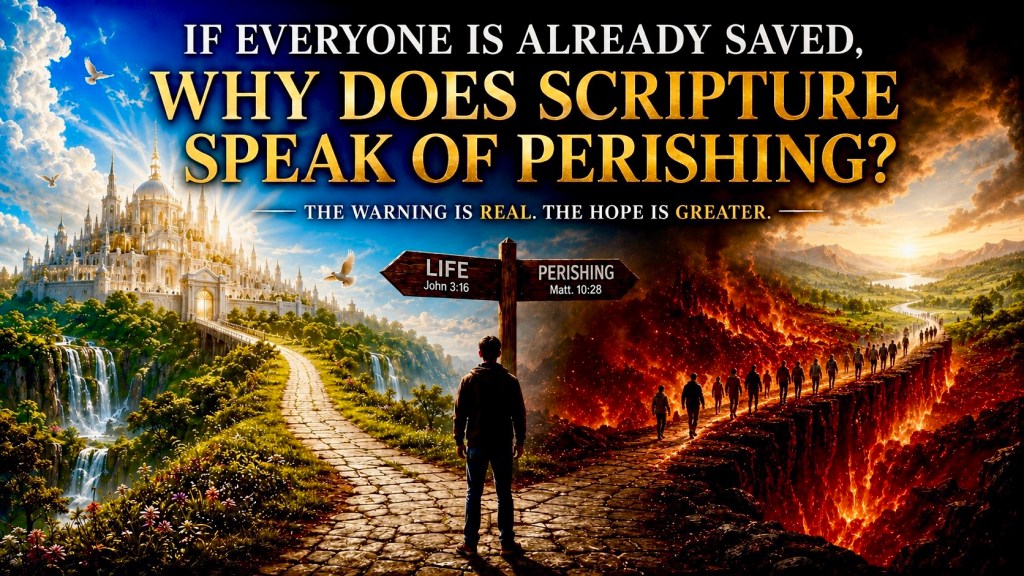
There is a growing conviction among some who hold to universal restoration that everyone is already saved—they simply do not know it yet. In this view, the work of the cross has already accomplished everything. Perishing is an illusion. Destruction is a metaphor. The warnings of the Lord Jesus and the Apostles are, at most, descriptions of a subjective ignorance that will eventually be dispelled when every person finally recognizes what has always been true about them.
This teaching believes the destination is right but the journey has been abolished. And once you abolish the journey, you have not honored Scripture—you have quietly rewritten it.
The Restoration of All Things is a biblical hope. It is spoken by every prophet since the world began (Acts 3:21). It is the destination toward which the purpose of the ages moves, the consummation in which God becomes “all in all” (1 Corinthians 15:28). But the Scriptures that announce this destination also describe, in unflinching terms, the road that leads there—and that road passes through real perishing, real destruction, and real judgment that spans an entire age. The claim that everyone is already saved does not magnify the cross. It empties the warnings of Scripture of their weight, and it renders the age to come unnecessary.
What follows is an examination of the biblical language of perishing and destruction—not to defend eternal torment or annihilation, but to demonstrate that these are realities Scripture takes with full seriousness, and that the Restoration of All Things depends on them rather than bypassing them.
The Full Weight of the Word: What “Perish” Actually Means
Before the perishing language of Scripture can be rightly understood in its eschatological context, its basic meaning must be established. The Greek verb apollymi (ἀπόλλυμι) carries a wide range of meaning. It can mean to destroy, to ruin, to kill, to die—and it can also mean to lose or to be lost. All of these meanings are genuine, and all of them appear in the teaching of the Lord Jesus Himself. The question is not which meaning is correct, as though one sense could be isolated and applied uniformly across every occurrence. The question is whether we will let the context govern the meaning, or whether we will flatten the entire range of the word into whichever sense is most comfortable.
Among some universalists, apollymi has been reduced to a single meaning: lost. The lost sheep, the lost coin, and the lost son of Luke 15 are cited as proof that the word never really means destruction or death—it only means separation, displacement, something temporarily misplaced that will inevitably be found. And it is true that apollymi carries this meaning in those parables. The sheep that was “lost” (apollymi) was not annihilated; it was separated from the flock and in danger, yet still existed and was found (Luke 15:4–6). The coin that was “lost” was not dissolved; it was out of use and out of place, yet the woman searched until she recovered it (Luke 15:8–9). The prodigal son who was “lost” was not obliterated; he was estranged, degraded, and living among swine, yet his father declared, “this my son was dead and is alive again; he was lost and is found” (Luke 15:24). In every case, what was lost was capable of being recovered. This is a real and important dimension of the word.
But to make “lost” the only meaning of apollymi, and to carry that softened sense into every passage where the word appears, is to do something Scripture itself will not support. The same Lord Jesus who spoke of the lost sheep and the lost coin also used apollymi in contexts where the meaning is unmistakably severe—contexts where the word means to kill, to die, and to destroy.
When Luke records the Lord Jesus saying, “from the blood of Abel to the blood of Zechariah who perished between the altar and the temple” (Luke 11:51), no one spiritualizes the word. Zechariah was killed. He died violently in the temple precincts. The word apollymi here means exactly what it appears to mean: he was put to death. He was not “lost” in the sense of being temporarily misplaced. He was dead.
When the Lord Jesus speaks of the Galileans whose blood Pilate mingled with their sacrifices and the eighteen on whom the tower in Siloam fell, He says plainly, “unless you repent you will all likewise perish” (Luke 13:3, 5). The context is unmistakable. These were people who died—suddenly, violently, without warning. The Lord Jesus does not soften their fate into a metaphor. He uses their literal deaths as the basis for His warning: what happened to them bodily is a picture of what awaits those who refuse to repent. “Likewise perish” does not mean “likewise become temporarily displaced.” It means: you will meet a comparable end.
When He says, “it cannot be that a prophet should perish outside of Jerusalem” (Luke 13:33), He means that prophets are killed in Jerusalem. The next sentence confirms it: “O Jerusalem, Jerusalem, the one who kills the prophets and stones those who are sent to her!” (Luke 13:34). Perishing and killing are held together in the same breath.
The word, then, is not a single-note word. It is a word with a genuine range—from the gentle sense of being lost and waiting to be found, to the severe sense of death, killing, and destruction. Both ends of the range are real. Both are used by the Lord Jesus. And the context must be allowed to determine which meaning is in view. To take the softest meaning and impose it on the hardest contexts is not faithful exegesis—it is selective reading driven by a theological conclusion that has been decided in advance. And it is the same mistake, in reverse, that those who teach eternal torment make when they take the hardest meaning and impose it on the parables of the lost sheep, the lost coin, and the lost son.
The faithful reader must hold the full range of the word together—and when the Lord Jesus speaks of what awaits those who do not believe, those who do not repent, and those who face the judgment of God in Gehenna, the context demands the severe end of the range, not the gentle end.
The Lord Jesus Spoke of Perishing as Real and Future
With the full weight of the word established, the Lord Jesus’ eschatological warnings take on their intended gravity.
In the Sermon on the Mount, He warns that if the right eye causes one to sin, it is better to pluck it out and cast it away, “for it is more profitable for you that one of your members perish, than for your whole body to be cast into Gehenna” (Matthew 5:29). He repeats the same warning for the right hand (Matthew 5:30). The logic is stark: there is something worse than the loss of a bodily member, and that something is the casting of the whole body into Gehenna. If everyone is already saved and Gehenna is merely a metaphor for present ignorance, then this warning is theatrical—severe language with no corresponding reality behind it. But the Lord Jesus does not speak theatrically. He is warning His own disciples that Gehenna is a real future destination for those who do not deal radically with sin.
In John’s Gospel, the same word governs the most beloved verse in Scripture: “For God so loved the world that He gave His only begotten Son, that whoever believes in Him should not perish but have everlasting life” (John 3:16). The literal rendering of the final phrase is “life of the age”—life in the age to come, the life of the Seventh Day received at the resurrection of life. The verse sets perishing and life of the age as genuine alternatives. To believe is to receive life in the age to come. To refuse to believe is to perish. If perishing is not a real outcome—if everyone receives life regardless of belief—then the verse has no structure. The contrast dissolves. “Whoever believes” becomes meaningless, because the outcome is the same whether one believes or not.
The Lord Jesus reinforces this in the same discourse: “He who believes in Him is not condemned; but he who does not believe is condemned already, because he has not believed in the name of the only begotten Son of God. And this is the condemnation, that the light has come into the world, and men loved darkness rather than light, because their deeds were evil” (John 3:18–19). The condemnation is present tense—”condemned already.” It is not a future threat that God might impose if He changes His mind. It is the standing condition of those who have refused the light. To say that these people are “already saved but don’t know it” is to contradict the Lord Jesus’ own declaration that they are “condemned already.”
He says again: “And I give them life of the age, and they shall never perish; neither shall anyone snatch them out of My hand” (John 10:28). The promise that the faithful shall never perish only has meaning if perishing is a genuine possibility for others. If no one can perish—if perishing is not a real category—then the assurance offered to the faithful is hollow. It is a promise of protection from something that does not exist.
The Apostles Spoke of Perishing as a Present Reality
The Apostolic witness confirms and extends the Lord Jesus’ teaching. Paul does not treat perishing as a past condition that the cross has already resolved for everyone. He speaks of it as an ongoing, present-tense reality that distinguishes those who are being saved from those who are not.
“For the message of the cross is foolishness to those who are perishing, but to us who are being saved it is the power of God” (1 Corinthians 1:18). Both participles are present tense in the Greek—”those who are perishing” and “those who are being saved” describe two groups of people in their current spiritual condition. Paul does not say “those who were perishing”—as though the cross had already resolved their condition and moved them out of danger. He says “those who are perishing,” present tense, describing their ongoing spiritual state even now, after the cross has been accomplished. The cross made reconciliation possible for all. But those who have not received it remain in the condition Paul describes: perishing. The cross is the power of God to those who receive it. To those who do not, it remains foolishness, and they remain in the condition of perishing.
Paul deepens this in his second letter to the Corinthians: “For we are to God the fragrance of Christ among those who are being saved and among those who are perishing. To the one we are the aroma of death leading to death, and to the other the aroma of life leading to life” (2 Corinthians 2:15–16). The gospel itself has a dual effect. To those who receive it, it leads to life. To those who reject it, it leads to death. If everyone is already saved, then neither trajectory is real—there is no “death leading to death” and no “life leading to life,” because everyone ends up in the same place regardless of their response to the gospel. Paul’s entire framework collapses.
He says it again even more explicitly: “But even if our gospel is veiled, it is veiled to those who are perishing, whose minds the god of this age has blinded, who do not believe, lest the light of the gospel of the glory of Christ, who is the image of God, should shine on them” (2 Corinthians 4:3–4). Those who are perishing have been blinded by the god of this age. The light has not reached them—not because God has withheld it, but because they have been prevented from seeing it by the spiritual powers that govern this present evil age. This is not a description of people who are secretly saved. It is a description of people who are in genuine spiritual peril.
Paul writes to the Thessalonians about the coming of the lawless one, whose deception operates “among those who perish, because they did not receive the love of the truth, that they might be saved” (2 Thessalonians 2:10). The reason they perish is stated plainly: they did not receive the love of the truth. If they had received it, they might have been saved. They did not, and so they perish. The conditional language is unmistakable. Salvation was available. They refused it. Perishing followed.
Peter writes that the Lord is “not willing that any should perish but that all should come to repentance” (2 Peter 3:9). This is one of the most important verses in the entire discussion. God’s will is that none should perish. His desire is universal. But Peter does not say that none will perish—he says that God is not willing that any should perish, and that the means by which perishing is avoided is repentance. If everyone is already saved, then repentance is unnecessary, and Peter’s exhortation is meaningless. But if perishing is real, and if repentance is the divinely appointed means of avoiding it, then the verse affirms both the universal scope of God’s mercy and the genuine reality of what happens to those who do not repent.
Jude warns of those who “have gone in the way of Cain, have run greedily in the error of Balaam for profit, and perished in the rebellion of Korah” (Jude 1:11). The rebellion of Korah ended in the earth opening and swallowing Korah and his company alive (Numbers 16:31–33). The word “perished” here means they died under the direct judgment of God. Jude applies this to false teachers in the present age—people who are walking in the same trajectory and heading toward the same kind of divine confrontation. This is not metaphorical language for people who are secretly safe.
Destruction Is Real—And It Reaches the Soul
The perishing language of the Gospels and Epistles converges on a single, climactic warning from the Lord Jesus Himself: “And do not fear those who kill the body but cannot kill the soul. But rather fear Him who is able to destroy both soul and body in Gehenna” (Matthew 10:28).
This is the deepest statement in Scripture about the nature of eschatological judgment, and it must be handled with precision. The Lord Jesus draws a distinction between what human violence can accomplish and what divine judgment accomplishes. People can kill the body—they can end embodied life. But they cannot touch the soul. Only God can destroy both soul and body in Gehenna. The destruction reaches the whole person as constituted in mortal flesh.
The Greek verb apollymi, which we have already seen carries the full weight of death, killing, and ruin, is the word the Lord Jesus uses here. He is not describing a mild correction or a temporary inconvenience. He is describing the destruction of the entire Adamic constitution—the flesh and its total governance of the soul, the self-life that has corrupted the person’s desires, will, and moral consciousness—under the fire of divine judgment. The body is consumed. The flesh—the complete disposition of the soul exerting its rule of self, established at the fall and energized by the fallen powers—is crucified under the fire of God’s holiness. And through that crucifixion of the flesh, the soul itself is purified, stripped of the corruption that governed it since the fall. The entire Adamic constitution of the person is dismantled in Gehenna.
And yet—and this is where the biblical framework holds together what the “everyone is already saved” position cannot—the Lord Jesus does not say that the spirit is destroyed. He says “soul and body.” The spirit is not the soul. It is the God-breathed core of the person—the neshāmâh (נְשָׁמָה), the deepest personal ground, the person in the essential sense, the spirit that God made and forms within each person (Zechariah 12:1)—and it is not subject to the destruction that falls on the flesh and the mortal body. The spirit is the God-ward dimension of the heart, and when the flesh’s governance has been consumed and the soul has been purified, the spirit is freed and returns to God who gave it (Ecclesiastes 12:7).
Scripture is remarkably consistent in calling living human beings “souls”—nephashōth (נְפָשׁוֹת) in the Hebrew and psychai (ψυχαί) in the Greek. This is because the soul is the expressive dimension of the heart—the outward-facing aspect that connects to the body and the realm the person inhabits. In embodied, terrestrial life, the soul-dimension is dominant, and so living persons are called “souls.” Yet when the writer of Hebrews describes the faithful dead who dwell in the Heavenly Jerusalem, he does not call them souls. He calls them “the spirits of just men made perfect” (Hebrews 12:23). This is not accidental. In the heavenly realm, the spirit-dimension is dominant, and so the faithful dead are called “spirits.” The naming reflects which dimension of the heart is manifest in a given order of existence. The faithful in this age crucified the flesh—the self-governing disposition that corrupted and governed the soul—through willing cooperation with the grace of God. They took up the cross. They surrendered the flesh’s rule of self in order to save the soul, just as the Lord Jesus taught: “For whoever desires to save his life will lose it, but whoever loses his life for My sake will find it” (Matthew 16:25). What the faithful lost was not the soul itself but the flesh’s governance over the soul—the autonomous self-rule that the serpent’s path established (Genesis 3:5) and that Christ’s path crucifies (Luke 22:42). What dwells in the presence of God, conscious, personal, and perfected, is the heart—the unified inner man of soul and spirit. They are still persons. They are still identifiable as ‘just men.’ The flesh has already been put to death, the soul has been purified, and the spirit has been transformed through the sanctifying work of the Spirit in this present age. In the heavenly realm, the spirit-dimension of the heart is dominant—which is why Hebrews calls them ‘spirits’ rather than ‘souls’—but the purified soul remains as part of the same heart, reflecting the spirit’s perfected reality. They await the resurrection of life, when they will be clothed with celestial bodies and the purified heart—spirit transformed, soul glorified—will be expressed through the celestial body as the complete celestial person in the heavenly order.
For the unfaithful and ungodly, the path is different but the destination of the spirit is the same. Solomon declares: “Then the dust will return to the earth as it was, and the spirit will return to God who gave it” (Ecclesiastes 12:7). Solomon uses “spirit” because it is the spirit-dimension that is in view when the person passes from the earthly realm into God’s keeping—the same naming convention that governs Hebrews 12:23. But the soul is not left behind; the heart persists as the unified inner man, and what returns to God is the purified heart with the spirit-dimension dominant. What the faithful experienced by grace in this age—the crucifixion of the flesh and the purification of the soul—the unfaithful and ungodly experience by judgment in Gehenna. The body is consumed under the fire of God’s holiness. The flesh’s corrupting governance, still clinging to the soul-dimension of the heart even after the body is gone, is crucified involuntarily by the divine fire. The soul is purified as the flesh’s governance is consumed. The purified heart returns to God who gave it, preserved through judgment, awaiting the resurrection “of the end” when it will be clothed with a new incorruptible terrestrial body on the renewed earth of the Eighth Day.
This is not annihilation. The person is not erased from existence. But neither is it a fiction. The destruction is real. The flesh genuinely perishes. The Adamic corruption is genuinely consumed. The soul is genuinely purified—not improved, but stripped of everything the flesh made it into. And this is precisely why the Restoration of All Things requires an entire age to accomplish. The fires of Gehenna are not decorative. They are the means by which God removes everything in the person that resists the Lordship of Christ, so that the spirit, freed from the flesh’s corruption, and the soul, purified through the flesh’s crucifixion, may be restored in new creation wholeness at the resurrection “of the end.”
Paul confirms this trajectory when he speaks of those who will be “punished with destruction of the age from the presence of the Lord and from the glory of His power” (2 Thessalonians 1:9). The literal rendering is “destruction of the age to come”—olethros aiōnios (ὄλεθρος αἰώνιος). The destruction is not eternal in the philosophical sense of having no end. It belongs to the age to come. It is the destruction that characterizes the Seventh Day, the age in which the Lord Jesus reigns and all enemies are progressively subjected under His feet. It is age-lasting, measured, proportionate—and it is real. Those who face it are not secretly saved. They are under judgment, and the judgment endures for as long as the age endures.
Peter warns of false teachers who bring on themselves “swift destruction” and whose “destruction does not slumber” (2 Peter 2:1, 3). He places them alongside the angels who sinned, the world of Noah’s day, and the cities of Sodom and Gomorrah—all of which experienced real, devastating divine judgment. The pattern Peter establishes is unmistakable: God judges the ungodly, and He does so with real consequences. The destruction is not metaphorical. It is the same destruction that consumed the old world by water and the cities of the plain by fire.
Yet Peter also provides the key that unlocks the restorative purpose within the destruction. He speaks of the destruction of Sodom and Gomorrah as “making them an example to those who afterward would live ungodly” (2 Peter 2:6). Their destruction was real—but the prophet Ezekiel declares that God will “bring back their captives, the captives of Sodom and her daughters… then you and your daughters shall return to your former state” (Ezekiel 16:53, 55). The destruction removed the corruption. The restoration follows in its appointed time. Both are real. Neither cancels the other.
Why the Ages Are Necessary
If perishing is real, and if the destruction of the flesh, the purification of the soul, and the destruction of the body in Gehenna are real, then the statement that ‘all are saved now’ cannot be a present accomplished fact. Nor will it be accomplished at the appearing of the Lord Jesus. It requires the age to come in God’s purpose.
Paul lays out the sequence plainly: “For as in Adam all die, even so in Christ all shall be made alive. But each one in his own order: Christ the firstfruits, afterward those who are Christ’s at His appearing. Then comes the end, when He delivers the kingdom to God the Father, when He puts an end to all rule and all authority and power. For He must reign till He has put all enemies under His feet. The last enemy that will be destroyed is death” (1 Corinthians 15:22–26).
The Greek word for “order” is tagma (τάγμα), a military term meaning a ranked formation. The resurrection unfolds in ordered ranks—not all at once, not simultaneously, and not as a single undifferentiated event. Christ rises first as the firstfruits. Then, at His appearing, those who are His—the faithful—are raised in celestial bodies and enter the resurrection of life. But “then comes the end”—to telos (τὸ τέλος)—the final consummation, the last ranked formation, the resurrection “of the end.” Between the second rank and the third lies the entire span of the Seventh Day—the age of corrective judgment, the age in which Gehenna accomplishes its work, the age in which death is progressively abolished through the destruction of the flesh, the purification of every soul, and the freeing of every spirit.
This sequence cannot be collapsed. If everyone is already saved, there is no need for the Seventh Day. If there is no Seventh Day, there is no Gehenna. If there is no Gehenna, there is no destruction of the flesh. If there is no destruction, the Adamic corruption is never removed. And if the Adamic corruption is never removed, death can never be abolished—because death entered through sin (Romans 5:12), and as long as sin remains, death remains. The only way for death to be destroyed as the last enemy is for every trace of Adamic corruption to be consumed through the fires of divine judgment across the age to come.
The “everyone is already saved” position does not merely jump to the destination—it eliminates the mechanism by which the destination is reached. It is not a larger hope. It is a smaller one, because it has no room for the ages, no room for the ordered resurrection, and no room for the consuming fire of God that alone can accomplish what the cross has made possible but the ages must work out.
Conclusion: The Hope That Holds Both Truths Together
None of what has been said here diminishes the Restoration of All Things. It establishes it on its proper biblical foundation.
God is “not willing that any should perish but that all should come to repentance” (2 Peter 3:9). His will is universal. His mercy endures through the ages. His purpose, spoken by every holy prophet since the world began, is to restore all things (Acts 3:21). The blood of the cross reconciles “all things to Himself, whether things on earth or things in heaven” (Colossians 1:20). Death, the last enemy, will be destroyed (1 Corinthians 15:26). God will be “all in all” (1 Corinthians 15:28). The destination is certain.
But the journey to that destination is not a legal fiction. It is not an already-accomplished fact waiting to be recognized. It is a real passage through real judgment, real destruction, and real purification that spans the entire age to come. The Lord Jesus warned of it. The Apostles taught it. The Torah and the Prophets established the pattern for it. To collapse it into a present reality is to do violence to the very Scriptures that announce the hope.
The Restoration of All Things is true. But it is not flat, not uniform, and not automatic. It is ordered, sequential, and purchased at the cost of an age of divine fire. Those who repent and believe in this present age receive life of the age to come—the resurrection of life, celestial bodies, entrance into the Heavenly Jerusalem, and the firstborn inheritance at the appearing of the Lord Jesus. Those who do not repent face the reality that Scripture calls perishing—the destruction of the flesh and the involuntary purification of the soul in Gehenna, the consuming of the Adamic corruption under the fire of God’s holiness, and the long, severe, measured judgment of the Seventh Day. Their spirits, freed through judgment, and their purified hearts, return to God who gave them. And at the resurrection “of the end,” when death itself is abolished, they are raised in incorruptible terrestrial bodies on the renewed earth of the Eighth Day.
This is not a smaller hope than the “everyone is already saved” position. It is a larger one—because it takes seriously everything Scripture says about the journey, not only the destination. It honors the warnings of the Lord Jesus as real warnings about real consequences. It honors the Apostolic witness that distinguishes between those who are being saved and those who are perishing. It honors the ordered resurrection of 1 Corinthians 15, which requires the ages to unfold in their divinely appointed sequence. And it honors the character of God, who is both merciful and severe—whose mercy endures for thousands of generations, but who by no means clears the guilty (Exodus 34:6–7).
The Restoration of All Things is not threatened by the reality of perishing. It depends on it. Because only a God who judges with divine fire can restore with real glory. And only a restoration that has passed through the furnace of the Age to Come can stand forever in the light of the Eighth Day, when every creature that draws breath does so under the Lordship of Christ, and God is all in all.

