
Updated: 8/13/26
Introduction: What Has Been Misunderstood
Few words in Scripture have been more misunderstood—or more fought over—than “the few,” “the firstfruits,” and “the elect.” Traditional Christianity has built an entire theology on them: God saves a few, elects a remnant, and consigns the rest to everlasting fire or destruction. The few are the totality of the saved. The elect are chosen for exclusive salvation while billions are passed over. The firstfruits are simply another name for the redeemed, and there is no further harvest.
On the other side, many who hold the hope of universal restoration have quietly set these terms aside. If everyone is saved in the end, then “the few” is an embarrassment, “the elect” is a relic of Calvinism, and “the firstfruits” is a metaphor that need not be pressed. The universal passages are quoted and the exclusive-sounding ones are explained away, softened, or simply ignored.
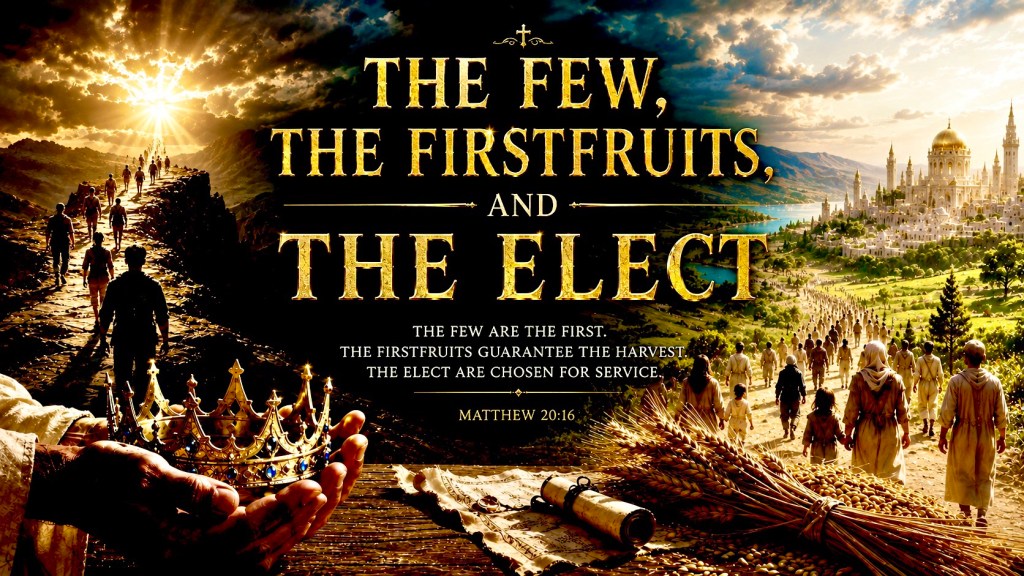
Both readings are wrong—and both are wrong for the same reason. They assume that “the few” describes the total number of the saved. It does not. When these three terms are traced through the canonical progression—Torah, Prophets, the Lord Jesus, and the Apostolic Epistles—a very different picture emerges. The few are the first, not the only. The firstfruits are not the whole harvest but the first portion that consecrates and guarantees the full ingathering. And the elect are not chosen so that others would be excluded but chosen for priestly service—to minister the restoration of God to the rest of creation.
What Scripture reveals is not a God who saves a handful and abandons the rest, nor a God who saves everyone in the same way at the same time, but a God who works in order—first the few, then the many until He is all in all.
The Few—What the Narrow Path Actually Means
The Lord Jesus said, “Enter by the narrow gate; for wide is the gate and broad is the way that leads to destruction, and there are many who go in by it. Because narrow is the gate and difficult is the way which leads to life, and there are few who find it” (Matthew 7:13–14). He also declared, “Many are called, but few are chosen” (Matthew 22:14).
These words have been used for centuries to argue that only a small fraction of humanity will be saved and the rest will be punished or destroyed forever. But this reading forces the Lord Jesus to contradict everything the prophets spoke before Him and everything the Apostles wrote after Him. If “few” means “the total number God will ever save,” then the prophets lied when they said God would restore all things (Acts 3:21), Paul lied when he said God will be all in all (1 Corinthians 15:28), and the promise to Abraham—that in his Seed all the families of the earth would be blessed (Genesis 12:3)—will never be fulfilled. The few cannot be the final count without demolishing the canonical witness.
So what does the Lord Jesus mean? He means exactly what He says—but He is describing who finds the narrow path in this age, not who is ultimately restored across the ages. The Torah had already established this distinction. When God set before Israel the choice between life and death, blessing and cursing (Deuteronomy 30:19), the choice was real and the consequences were severe—but neither the blessing nor the cursing was the end of Israel’s story. The nation that chose death in the wilderness was judged, and the generation that refused to enter the land perished—but God did not abandon His purpose for the nation. He raised up the next generation, led them into the land, and continued His covenant.
The same pattern holds in the teaching of the Lord Jesus. The narrow path leads to the resurrection of life—the entrance into the age to come as part of the Royal Priesthood, the company of faithful sons who will reign with Christ and minister to the nations. The broad path leads to the resurrection of judgment—not annihilation, not eternal torment, but the corrective, purifying fire of the Seventh Day, where the flesh that refused the cross in this age is involuntarily removed by the severity of God in the age to come. Both paths lead somewhere. The few who find the narrow way enter life first. The many who walk the broad way enter judgment—and through judgment, in God’s order and in God’s time, they are brought to restoration in the Eighth Day.
The “few” is therefore not a statement about how many souls God ultimately reclaims. It is a statement about how many walk the narrow path in this present evil age and are counted worthy of the resurrection of life at the appearing of the Lord Jesus. The few are the firstfruits—and firstfruits, by definition, are never the whole harvest.
The Firstfruits—The Torah Pattern That Governs the Whole Harvest
The concept of firstfruits is established in the Torah before it ever appears in the Apostolic Epistles, and the Torah’s meaning governs everything that follows. The LORD commanded Israel, “When you come into the land which I give to you, and reap its harvest, then you shall bring a sheaf of the firstfruits of your harvest to the priest. He shall wave the sheaf before the LORD, to be accepted on your behalf” (Leviticus 23:10–11).
The firstfruits sheaf was the first portion of the harvest—cut before the rest, offered to God before anything else was gathered, and waved before the LORD as a consecration of the whole field. The firstfruits were God’s portion. They belonged to Him. They were set apart for Him before anything else was touched. And in being offered, they consecrated the whole field and guaranteed that the full ingathering would follow. The Scripture mentions two firstfruits: the first sheaf of the barley crop and the two loaves from the wheat crop (Leviticus 23:9-12, 15-17). The barley sheaf symbolizes the Lord Jesus, while the two wheat loaves represent the body of Christ, which has been called out from this present evil age. Both are presented to the Lord and lifted up and waved. Together, they constitute the firstfruits portion that belongs to God. The firstfruits were the promise that the full harvest would follow—and in being offered, they consecrated the whole. As Paul writes, “For if the firstfruit is holy, the lump is also holy; and if the root is holy, so are the branches” (Romans 11:16). The holiness of the first portion sanctified the rest. No Israelite farmer cut the firstfruits and left the remainder to rot in the field. The offering of the first guaranteed the ingathering of the whole.
This is the pattern that governs the relationship between God and His faithful. The firstfruits are God’s inheritance—His own portion drawn from the harvest. And He is theirs. Moses declared, “The LORD’s portion is His people; Jacob is the place of His inheritance” (Deuteronomy 32:9). The Levites, who stood with God at the golden calf and received the priestly calling, were given no land inheritance among the tribes—because God Himself was their inheritance (Deuteronomy 18:2). The pattern is reciprocal: God claims His faithful as His own portion, and His faithful receive Him as their own inheritance. Paul carries this into the New Covenant when he prays that believers would know “the riches of the glory of His inheritance in the saints” (Ephesians 1:18). God’s inheritance is not land or gold—it is His people. The faithful are the firstfruits that belong to God, and God is the inheritance that belongs to them.
This is the pattern Paul uses when he calls the Lord Jesus “the firstfruits of those who have fallen asleep” (1 Corinthians 15:20). The Lord Jesus’ resurrection is not an isolated event—it is the first sheaf of a great resurrection harvest. If there are firstfruits, there must be a later harvest. Paul makes this explicit: “For as in Adam all die, even so in Christ all shall be made alive. But each one in his own order: Christ the firstfruits, afterward those who are Christ’s at His coming. Then comes the end” (1 Corinthians 15:22–24). The word Paul uses for “order” is tagma (τάγμα), a military term meaning rank or company. The resurrection unfolds in ordered companies—first Christ, then those who are His, then the end—and only when the final enemy, death itself, has been abolished does God become “all in all” (1 Corinthians 15:28).
James extends the firstfruits language to believers themselves: “Of His own will He brought us forth by the word of truth, that we might be a kind of firstfruits of His creatures” (James 1:18). The faithful in this age are not the whole harvest. They are “a kind of firstfruits”—the first portion of something far larger. The phrase “of His creatures” points beyond the church to the whole creation. If believers are the firstfruits of God’s creatures, then His creatures extend beyond the firstfruits company, and the full harvest remains to be gathered.
Paul confirms this in Romans 8, where he writes that “we ourselves, who have the firstfruits of the Spirit, groan within ourselves, eagerly waiting for the placement as sons, the redemption of our body” (Romans 8:23 literal). Even the faithful do not yet possess the fullness—they have the firstfruits of the Spirit, the down payment of the inheritance, and they groan for the completion. And the creation itself groans alongside them: “For the earnest expectation of the creation eagerly waits for the revealing of the sons of God” (Romans 8:19). Creation is not waiting for its own destruction. It is waiting for the sons to be revealed—because when the sons are revealed, creation itself “will be delivered from the bondage of corruption into the glorious liberty of the children of God” (Romans 8:21).
The firstfruits pattern, traced from Torah through the Apostolic witness, teaches one unmistakable truth: the few who are gathered first are not the end of the harvest. They are the beginning. They consecrate and guarantee what follows. And what follows is the full ingathering—every creature, every nation, every soul—gathered in God’s order and in God’s time, until He is all in all.
The Elect—Chosen for Service, Not Exclusive Salvation
Perhaps no biblical term has been more distorted than “the elect.” In much of Christian theology, election has been understood as God choosing some individuals for salvation and passing over the rest—selecting a fixed number for heaven and consigning everyone else to eternal ruin. This reading, rooted in certain strands of Augustinian and Reformed theology, has shaped Western Christianity for centuries. But it cannot survive contact with the canonical narrative.
The first election in Scripture is the election of Abraham. God chose one man out of all the nations—but the purpose of that choosing is stated in the same breath: “In you all the families of the earth shall be blessed” (Genesis 12:3). Abraham was not chosen so that the nations would be excluded. He was chosen so that through him and his Seed, the nations would be blessed. The election was for the sake of the non-elect. The chosen one exists to serve the unchosen.
The same pattern governs the election of Israel. At Sinai, God declared to the nation, “You shall be to Me a kingdom of priests and a holy nation” (Exodus 19:6). A priest does not exist for himself. A priest stands between God and the people—mediating, interceding, bearing the presence of God to those who cannot yet approach Him directly. Israel was elected as a priestly nation—chosen not for exclusive privilege but for representative service. Israel’s calling was to preserve God’s revelation, embody His ways, and ultimately bring forth the Seed through whom the nations would be reclaimed. The election was vocational, not exclusionary. Israel existed for the nations, not against them.
When Israel failed in this priestly calling—turning to idolatry, rejecting the prophets, refusing the covenant—God did not abandon His purpose. He raised up from within Israel a faithful Israelite, His own Son, who embodied the nation’s calling, fulfilled the Royal Priesthood, and carried the blessing to Jew and Gentile alike. The Lord Jesus is the true Elect One—the Servant in whom the Father’s soul delights (Isaiah 42:1), the faithful Seed of Abraham through whom all nations are blessed. And those who are joined to Him by the Spirit become participants in His election—not elected for exclusive salvation, but elected for the same priestly vocation Israel was given at Sinai.
Peter makes this unmistakable when he writes to the churches, “You are a chosen generation, a royal priesthood, a holy nation, His own special people, that you may proclaim the praises of Him who called you out of darkness into His marvelous light” (1 Peter 2:9). The language is drawn directly from Exodus 19:6. The elect in the New Covenant are chosen for the same purpose Israel was chosen—to be a kingdom of priests who serve God on behalf of the nations. The election creates a priestly order, not an exclusive club. The chosen exist to mediate the knowledge and blessing of God to those who have not yet received it.
Paul understood this perfectly. In Romans 11, he wrestles with the mystery of Israel’s partial hardening and the inclusion of the Gentiles, and he concludes not with the permanent exclusion of anyone but with the declaration that “God has committed them all to disobedience, that He might have mercy on all” (Romans 11:32). Within that chapter he speaks of a present “remnant according to the election of grace” (Romans 11:5)—a remnant, not the totality. The elect remnant exists as the priestly core through whom God preserves His purpose until the fullness of Israel and the fullness of the nations are gathered in. The remnant is the firstfruits, not the final harvest.
Election, traced from Abraham through Israel through the Lord Jesus to the Apostolic churches, is never about exclusive salvation. It is about vocational calling—being chosen to go first, to bear the priestly burden, to walk the narrow path, and to serve as the instrument through which God’s mercy reaches all. The elect are the few. The few are the firstfruits. And the firstfruits exist for the sake of the harvest.
The Gift and the Prize—Why the Distinction Matters
If the few, the firstfruits, and the elect are not the only ones saved but the first ones saved, then what distinguishes them from the rest? The answer lies in a distinction that runs through the entire Apostolic witness but is rarely taught: the distinction between the gift and the prize.
The gift is the complete, finished work of Christ on the cross, which is brought to us through the Holy Spirit. No one earns the gift; it is received by faith. The Holy Spirit is freely given to all who believe, uniting us to God, regenerating the human spirit, and making the believer a true child of the Father. Every true believer possesses the gift. The divine seed of God is placed in the believer by the Holy Spirit and remains in them (1 John 3:9). They are genuine sons and daughters of God. They belong to the family.
The prize is the firstborn inheritance—the resurrection of life, the celestial body, entrance into the Heavenly Jerusalem, and participation in the Royal Priesthood that will serve with Christ in the ages to come. Paul speaks of prize when he writes, “I press toward the goal for the prize of the upward call of God in Christ Jesus” (Philippians 3:14). He calls it a prize, not a gift, because it is awarded to those who run the race, fight the fight, and finish the course. The gift is the means by which the prize of the inheritance is obtained. The Spirit of grace enables the believer to abide in Christ and walk in His ways. Peter exhorts believers to “be even more diligent to make your call and election sure” (2 Peter 1:10). The writer to the Hebrews warns that believers may “fall short” of entering God’s rest (Hebrews 4:1). Paul himself disciplines his body “lest, when I have preached to others, I myself should become disqualified” (1 Corinthians 9:27). The prize can be forfeited. And the Torah establishes this pattern long before the Apostles articulate it.
Every tribe of Israel shared the same redemption from Egypt—the same Passover lamb, the same passage through the sea, the same manna, the same water from the Rock. The gift was universal. But when Israel worshiped the golden calf and the cost of faithfulness became severe, only the sons of Levi rallied to the Lord’s side (Exodus 32:26). They chose God when the rest chose the flesh. And God gave them Himself as their inheritance—the priestly portion, the right to dwell in His presence and serve before Him. The prize went to those who stood with God at the moment of testing.
The same pattern appears at Kadesh Barnea. All twelve spies saw the land. All twelve received the same promise. But only Joshua and Caleb followed God fully (Numbers 14:24). They alone, of that entire generation, entered the promised land. The rest perished in the wilderness—not because God’s redemption had failed, but because they refused to walk in the faith that the gift of redemption required.
Esau is the Torah’s most devastating example. He was the natural firstborn. The birthright belonged to him by right of birth. Yet he “despised his birthright” for a single meal (Genesis 25:34). The writer to the Hebrews applies this directly to believers in the New Covenant: “Lest there be any profane person like Esau, who for one morsel of food sold his birthright. For you know that afterward, when he wanted to inherit the blessing, he was rejected, for he found no place for repentance, though he sought it diligently with tears” (Hebrews 12:16–17). Esau did not cease to be Isaac’s son. But the firstborn portion, once despised, could not be recovered. His tears were real—but the inheritance had passed to another.
This is the distinction that governs the ages. The gift given through the work of the Lord Jesus and the impartation of the indwelling Spirit is freely given to those who believe. The prize—the firstborn inheritance, the resurrection of life, the Royal Priesthood—is awarded to those who walk faithfully, who yield to the Spirit of grace, and who allow the cross to put to death the flesh in this present age. Those who refuse the cross in this age forfeit the firstborn portion. They will be restored in the Eighth Day—but only after passing through the divine fire of God’s holiness they could have avoided (1 Corinthians 3:11-15).
How Restoration Unfolds
If the few are the firstfruits and not the final harvest, then what happens to the rest? Scripture does not leave us guessing. The restoration unfolds in an ordered sequence, and the order matters as much as the outcome.
Paul lays out the framework in 1 Corinthians 15: “For as in Adam all die, even so in Christ all shall be made alive. But each one in his own order: Christ the firstfruits, afterward those who are Christ’s at His coming. Then comes the end, when He delivers the kingdom to the God and Father, when He puts an end to all rule and all authority and power” (1 Corinthians 15:22–24). The “all” who are made alive are made alive in a structured sequence—not all at once, and not all in the same way.
At the appearing of the Lord Jesus, a universal resurrection takes place. The Lord Jesus Himself declared, “The hour is coming in which all who are in the graves will hear His voice and come forth—those who have done good, to the resurrection of life, and those who have done evil, to the resurrection of judgment” (John 5:28–29). All come forth. But not all come forth to the same end. One resurrection on the last day of this present age, two outcomes, two paths forward into the ages to come.
The resurrection of life belongs to the faithful—the few, the firstfruits, the elect who walked the narrow path in this age. They receive celestial, incorruptible bodies and ascend to the Heavenly Jerusalem to serve as the Royal Priesthood under the headship of the Lord Jesus. These are the “church of the firstborn who are registered in heaven” (Hebrews 12:23). They are the priestly order that the Torah foreshadowed in Aaron and his sons, in the Levites who rallied to God at the golden calf, in Joshua and Caleb who followed fully. Their calling is to minister the knowledge and blessing of God to the creation that lies beyond the inner court.
The resurrection of judgment belongs to the unfaithful and the ungodly. The unfaithful are those who belonged to the Lord but did not persevere—the Esaus who despised the birthright, the servants who buried the talent, the builders whose works were wood, hay, and straw. They are saved, “yet so as through fire” (1 Corinthians 3:15). The ungodly are those who never knew the Lord—or who knew Him and rejected Him entirely. They face the full weight of divine judgment, proportionate to their deeds (Romans 2:8-9). For both, the Seventh Day—the Age to Come—is the age of Gehenna, where the earth itself becomes the realm of corrective judgment. The flesh is involuntarily removed under the fire of God’s holiness, and the soul is purified as the flesh’s governance is consumed. The body dies, and the purified heart returns to God who gave it (Ecclesiastes 12:7). The judgment is real but it is not final, for what is destroyed is the self governance of the flesh, not the person.
Then comes the Eighth Day—the new creation, the age beyond the age to come, when death itself has been abolished as the last enemy and God becomes all in all. In that Day, the full harvest is gathered. All humanity stands together under the headship of Christ, each the fruit of the same mercy, though their callings, glories, and histories differ.
The Royal Priesthood—the faithful who yielded to the Spirit of grace in this present age and were conformed to the image of the Firstborn Son—serve in the Heavenly Jerusalem, the true sanctuary, ministering in God’s immediate presence. They receive celestial, incorruptible bodies and share the glory of the Lord Jesus as the priestly sons of the inner court. These are the firstfruits, the few who walked the narrow path, now placed at the summit of the restored creation.
The outer-court priesthood—the unfaithful believers who were truly in Christ but walked carelessly, resisted sanctification, or despised the Father’s discipline—passed through the fires of the Seventh Day, “saved, yet so as through fire” (1 Corinthians 3:15). The flesh was involuntarily removed in that fire. In the Eighth Day they are raised in terrestrial immortal bodies and serve on the renewed earth, standing between the city above and the nations below. Like the Levites stationed around the tabernacle, they form a living bridge—teaching the ways of God, mediating righteousness, and transmitting the light they receive from the Royal Priesthood to the nations. Like Esau, they forfeited the firstborn portion, but they did not cease to be sons, and in mercy they were given a place of honored service on the renewed earth.
The restored nations—those who lived outside the covenant, who hardened themselves in unbelief, and who endured the divine wrath in the Seventh Day—are raised in the final resurrection into terrestrial immortal bodies on a renewed earth. They are the nations whom the priests serve—the peoples who flow to the mountain of the Lord, saying, “He will teach us His ways, and we shall walk in His paths” (Isaiah 2:3). Yet they are beloved, restored, and immortal, living testimonies to the truth that no person lies beyond the reach of the mercy that conceived the ages. Isaiah saw this: “He will swallow up death forever, and the Lord GOD will wipe away tears from all faces” (Isaiah 25:8). All faces.
Together these three orders display the full spectrum of divine mercy: mercy that formed the faithful through prior discipline in this age, mercy that corrected the unfaithful through severe chastening in the age to come, and mercy that reclaimed the ungodly through wrath unto restoration.
This is the order Paul describes. This is the harvest the firstfruits guarantee. The few go first—not because they are the only ones God loves, but because they are the priestly company through whom God’s love reaches the rest.
Conclusion: The Few Exist for the Many
The traditional reading says: the few are saved, the many are damned, and the story ends there. The common universalist reading says: everyone is saved in the same way, the distinction doesn’t matter, and the few is an irrelevant detail. Scripture says neither.
The few are the firstfruits of a harvest that includes every soul ever created. They are the elect—chosen not for exclusive privilege but for priestly service. They are the narrow-path walkers, the cross-bearers, the ones in whom the Spirit of grace has done His transforming work in this present age. They are the Royal Priesthood being formed in the quarry of this life, chiseled and shaped by discipline, suffering, and obedience, so that they might be assembled as the living Temple in the Age to Come.
Their election is not a wall. It is a door—the door through which the mercy of God flows outward to the nations. Abraham was chosen so that all families would be blessed. Israel was chosen as a kingdom of priests to serve the nations. The Lord Jesus, the true Elect One, came not to be served but to serve and to give His life as a ransom for many (Matthew 20:28). And the faithful who share His election share His vocation: they are being prepared to serve, to minister, to reign—not for their own glory, but for the restoration of all things.
The few matter—not because they are the end of the story, but because they are the beginning. The firstfruits matter—not because they are the whole harvest, but because they consecrate and guarantee the full ingathering. The elect matter—not because God has abandoned the non-elect, but because the elect are the priestly instrument through whom the non-elect will be reached, judged, purified, and restored.
God will be all in all (1 Corinthians 15:28). Every knee will bow. Every tongue will confess. Every enemy will be subdued. Death itself will be abolished. The creation that groans now will be delivered into the glorious liberty of the children of God (Romans 8:21). But the road from here to there runs through the ordered sequence Scripture establishes: first the few, then the many. Each one in his own order. Each one in his own time. And at the end, when every age has run its course and every purpose has been fulfilled, the firstfruits and the full harvest will stand together before the Father—and God will be all in all.
The few are not a monument to exclusion. They are the first sheaf of a harvest that will fill the earth.

