
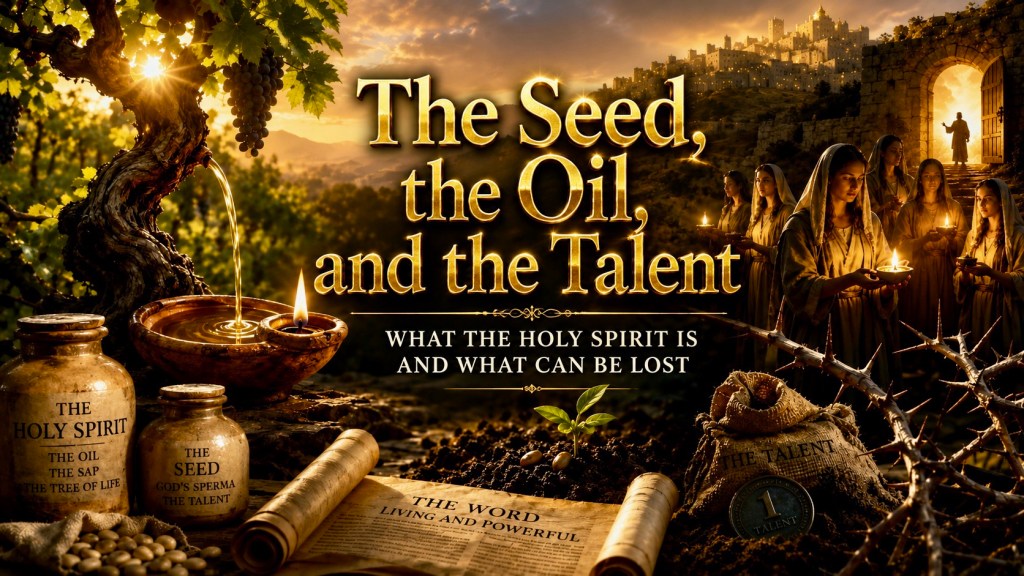
What the Holy Spirit Is and What Can Be Lost
Introduction: The Tree of Life and the Question It Raises
In the garden, God placed two trees at the center: the tree of life and the tree of the knowledge of good and evil (Genesis 2:9). The tree of the knowledge of good and evil receives most of the attention, because Adam’s disobedience in eating from it brought the fall. But the tree of life reveals something equally crucial about human existence before the fall: Adam needed ongoing, external sustenance to maintain his communion with God.
The tree of life was not a one-time meal. It was a continuous provision—a source to which Adam could return day after day for the sustaining life his mortal frame required. When Adam fell, God did not destroy the tree of life. He barred access to it: “He placed cherubim at the east of the garden of Eden, and a flaming sword which turned every way, to guard the way to the tree of life” (Genesis 3:24). The tree still stood. The life was still available. But access was cut off—and without that sustaining source, the dying that God warned of in Genesis 2:17 began its relentless work.
This raises the question that governs this entire teaching: if Adam’s created spirit needed an ongoing, external source of sustaining life, does the believer’s spirit need the same? And if so, what is that source—what does it plant, what does it grow, and what happens when a believer refuses to cooperate with its work?
The Vine and the Oil: The Holy Spirit as the Sustaining Presence
The Lord Jesus answers the first question directly in John 15. “I am the true vine, and My Father is the vinedresser… Abide in Me, and I in you. As the branch cannot bear fruit of itself, unless it abides in the vine, neither can you, unless you abide in Me. I am the vine, you are the branches. He who abides in Me, and I in him, bears much fruit; for without Me you can do nothing” (John 15:1, 4–5).
A branch is genuinely distinct from the vine—it has its own form, its own leaves, its own individual expression. But it has no independent life source. It does not generate its own sap. The life that flows through the branch is the life of the vine, communicated through the organic connection between them. Cut the branch from the vine and it withers—not because it loses some external support, but because the life it was living was never its own in the first place.
The Holy Spirit is the sap of the vine—the sustaining life that flows from the Lord Jesus into the believer’s spirit, keeping the transformation alive, nourishing the growth of the divine seed, producing fruit of Christ’s life in the believer. He is the tree of life restored. What Adam lost access to in the garden, the believer receives through the indwelling of the Holy Spirit. The tree of life was external to Adam; the Holy Spirit is internal to the believer. But the function is the same: continuous sustenance without which the spiritual life cannot be maintained.
Paul describes the resulting union: “He who is joined to the Lord is one spirit with Him” (1 Corinthians 6:17). The believer’s spirit and the Holy Spirit are distinguishable—the branch is not the vine trunk—but they are functionally one, because the life that sustains and transforms the spirit is the Lord’s own life communicated by His Spirit. They are “one spirit” the way the branch and the vine are one organism—genuinely distinct in identity, genuinely one in life.
The Holy Spirit, then, is the gift—the sustaining Presence, the oil in the lamp, the sap of the vine, the tree of life restored. He is given at conversion, and He remains. But the Holy Spirit does more than sustain. He plants something. And what He plants is the subject of the next section—because understanding the distinction between what He is and what He plants changes everything about how we read the Lord’s warnings.
The Seed Planted in the Spirit: What the Holy Spirit Plants and What Grows
The foundational prophecy for understanding the Holy Spirit’s relationship to the believer’s spirit is Ezekiel 36:26–27. God promises: “I will give you a new heart and put a new spirit within you; I will take the heart of stone out of your flesh and give you a heart of flesh. I will put My Spirit within you and cause you to walk in My statutes.”
Ezekiel names two distinguishable realities. “My Spirit within you” and “a new spirit within you” are not two names for the same thing, nor are they unrelated to each other. The first is the gift—the Holy Spirit, the irrevocable sustaining Presence of God. The second is the fruit—the new creation that grows from the divine seed the Holy Spirit plants in the old spirit, the heavenly-order reality that emerges when the seed bears fruit in prepared ground. The gift is irrevocable; the fruit is not. It depends on the soil, the clearing of the thorns, and the faithful cooperation of the believer with the Spirit’s sustaining work.
“My Spirit within you” is the Holy Spirit as the sustaining Presence—the oil, the sap, the tree of life restored. “A new spirit within you” is the new creation that the Holy Spirit produces—the heavenly-order spirit that grows from the divine seed planted in the prepared ground of the old spirit.
Peter identifies the seed: “Having been begotten again, not of corruptible seed but incorruptible, through the word of God which lives and abides to the age” (1 Peter 1:23 literal). John makes the identification explicit: “Whoever has been begotten of God does not sin, for His seed remains in him; and he cannot sin, because he has been begotten of God” (1 John 3:9 literal). The word “seed” is sperma (σπέρμα)—and the possessive is decisive: His seed. God’s own seed. This is God’s own life-principle deposited within the believer’s spirit at the divine begetting.
The divine begetting follows the pattern established by the incarnation. “The Holy Spirit will come upon you, and the power of the Highest will overshadow you; therefore, also, that Holy One who is to be born will be called the Son of God” (Luke 1:35). In the incarnation, the Holy Spirit overshadowed Mary—the divine seed met the existing element—and a new creation was conceived. In the divine begetting, the Holy Spirit plants the divine seed in the old spirit—the existing element, the soil prepared by washing, sanctifying, and justifying (1 Corinthians 6:11)—and the transformation begins. The Lord Jesus is the unique and supreme prototype—the eternal Son who transcends all created orders (Ephesians 4:10). The believers’ begetting is derivative, not identical—but it follows the same pattern: the same Spirit, the same seed, the same overshadowing. “For whom He foreknew, He also predestined to be conformed to the image of His Son, that He might be the firstborn among many brethren” (Romans 8:29).
Three realities must therefore be distinguished. The Holy Spirit is the Sower and the Sustainer—the gift, the oil, the sap. The divine seed is what the Holy Spirit plants in the old spirit at the begetting—it carries the divine nature and has the inherent capacity to produce increase. And the new spirit is what grows from the union of the seed and the prepared soil of the old spirit—the heavenly-order new creation that emerges progressively, from glory to glory (2 Corinthians 3:18), as Christ is formed within (Galatians 4:19).
The seed is nourished by the living word: “As newborn babes, desire the pure milk of the word, that you may grow thereby” (1 Peter 2:2). The word plants the seed and the word feeds the growth. The believer who pursues the word feeds the transformation. The believer who neglects it starves it.
Peter’s analogy communicates the urgency of the believer’s need for the word—the recently begotten must crave the nourishment that feeds the seed’s growth as instinctively as an infant craves milk. But the fuller canonical picture places the birth itself not at conversion but at the resurrection. The distinction is embedded in the original languages. The Greek verb gennaō (γεννάω) covers the entire generative sequence—from conception to delivery—and only the context determines which end is in view. When gennaō is used for the initial divine work at conversion (John 3:3; 1 Peter 1:23; 1 John 3:9), the begetting—the conception—is in view: the divine seed is planted in the old spirit and the new creation begins to develop. But when Paul applies Psalm 2:7 to the resurrection of the Lord Jesus, the other end of the sequence comes into focus: “God has fulfilled this for us their children, in that He has raised up Jesus. As it is also written in the second Psalm: ‘You are My Son, today I have begotten You’” (Acts 13:32–33). The Hebrew word underneath the Greek in Psalm 2:7 is yalad (יָלַד)—not the father’s word for conceiving but the word for bringing forth, delivering, giving birth. It is the word used in Genesis 3:16 (“in pain you shall bring forth children”) and throughout Scripture when a mother delivers a child. The Father’s declaration over the risen Son is therefore not “today I have conceived You” but “today I have brought You forth”—today is the day of birth, the full emergence of the Son in His glorified resurrection body. The resurrection is the birth. And the Lord Jesus is called “the firstborn from the dead” (Colossians 1:18)—His resurrection was His birth into the new creation order, and the believers follow the same pattern as the Firstborn (Romans 8:29). This is where the Lord Jesus’ own words in John 3:6 reach their full realization: “That which is born of the Spirit is spirit.” At conversion, the believer is begotten of the Spirit—the divine seed is planted in the old spirit, and the new heavenly spirit begins to develop from glory to glory. At the resurrection of life, the believer is born of the Spirit—brought forth into the heavenly order in a celestial body, fully spirit in mode and nature, the completed new creation finally manifest. The begetting happened in this age; the birth happens at His appearing. In this present age, the believer has been conceived but not yet born. Christ is being formed within (Galatians 4:19). The new spirit is developing. The whole creation groans with labor pains, and believers groan inwardly, “eagerly waiting for the placement as sons, the redemption of our body” (Romans 8:22–23). The Lord Jesus Himself used this imagery: “A woman, when she is in labor, has sorrow because her hour has come; but as soon as she has given birth to the child, she no longer remembers the anguish, for joy that a human being has been born into the world” (John 16:21). The sorrow is now; the birth is at His appearing. Peter’s Greek word for “babes”—brephē (βρέφη)—can itself mean an unborn child or embryo (Luke 1:41, 44), not only a newborn infant. The recently begotten believer is therefore more precisely a developing life receiving nourishment through the direct organic connection of the Holy Spirit—the sap of the vine sustaining the seed’s growth—than a newborn infant drinking milk. Peter’s point about craving the word remains fully valid; the fuller canonical framework simply locates the birth where the Apostles consistently place it: at the resurrection of life, when the many sons and daughters are brought forth into glory (Hebrews 2:10) and “that which is born of the Spirit is spirit” reaches its full and final realization.
This is why everything that follows carries such weight. The believer in this present age is not yet born—the new spirit is still developing, Christ is still being formed within, the birth is still ahead. And this raises the question that governs everything that follows: what happens when the seed is planted but never bears fruit? What happens when the soil receives the seed but the thorns are not cleared and choke it?
The Sower and the Soils: The Lord’s Own Teaching on the Seed’s Four Fates
The Lord Jesus answered this question Himself, and He answered it first—before the parables of the virgins and the talents, before Paul’s warnings about grieving and quenching the Spirit, before the writer of Hebrews warned of falling away. He told the parable of the sower.
“Behold, a sower went out to sow. And as he sowed, some seed fell by the wayside; and the birds came and devoured them. Some fell on stony places, where they did not have much earth; and they immediately sprang up because they had no depth of earth. But when the sun was up they were scorched, and because they had no root they withered away. And some fell among thorns, and the thorns sprang up and choked them. But others fell on good ground and yielded a crop: some a hundredfold, some sixty, some thirty” (Matthew 13:3–8).
The Lord Jesus interpreted this parable Himself. The seed is the word of the kingdom. The soils are the hearts that receive it. The wayside hearer never receives the seed at all—the wicked one snatches it away before it takes root. The rocky-ground hearer receives it with joy but has no depth; when tribulation or persecution comes, he immediately stumbles. Neither of these is the subject of this teaching, because neither was genuinely begotten from above.
But the thorny-ground hearer is the one who must be reckoned with. The Lord says: “Now he who received seed among the thorns is he who hears the word, and the cares of this world and the deceitfulness of riches choke the word, and he becomes unfruitful” (Matthew 13:22). Mark adds: “the desires for other things entering in choke the word, and it becomes unfruitful” (Mark 4:19). This hearer received the seed. The word was planted. The divine begetting took place. But the thorns—the cares of this world, the deceitfulness of riches, the desires for other things—were not cleared. The flesh was not crucified. And the thorns choked the seed so that it produced no harvest.
The thorny-ground hearer is the foolish virgin. The thorny-ground hearer is the one-talent servant. The thorny-ground hearer is the unfaithful believer who received the divine seed and the Holy Spirit’s sustaining oil, yet grieved the Spirit through walking after the flesh until the oil waned and the seed produced no fruit because the thorns were never cleared.
The good-ground hearer is the one “who hears the word and understands it, who indeed bears fruit and produces: some a hundredfold, some sixty, some thirty” (Matthew 13:23). The good ground is the old spirit prepared by grace, where the flesh is being crucified, the thorns are being cleared, and the seed has room to grow. The fruit is the new spirit—the heavenly-order creation growing from glory to glory. The varying measures—a hundredfold, sixty, thirty—correspond to the varying degrees of faithfulness and the varying measures of glory that Paul describes: “star differs from star in glory” (1 Corinthians 15:41).
The writer of Hebrews confirms this same pattern with unmistakable precision. He describes genuine believers—those who “were once enlightened, and have tasted the heavenly gift, and have become partakers of the Holy Spirit, and have tasted the good word of God and the powers of the age to come” (Hebrews 6:4–5). These are not nominal Christians. They tasted the heavenly gift. They partook of the Holy Spirit. They tasted the powers of the Age to Come. And yet the writer warns that they can “fall away” to such a degree that renewal to repentance becomes impossible in this age (Hebrews 6:6). Then he turns to the same agricultural imagery: “For the earth which drinks in the rain that often comes upon it, and bears herbs useful for those by whom it is cultivated, receives blessing from God; but if it bears thorns and briers, it is rejected and near to being cursed, whose end is to be burned” (Hebrews 6:7–8).
The rain is the Holy Spirit—the sustaining Presence, the oil, the sap. The earth is the old spirit—the ground that receives the seed. The useful herbs are the fruit of the divine seed—the new spirit growing to maturity. The thorns and briers are the flesh—the self-governing disposition that was never crucified. And the burning is Gehenna—where the thorns are crucified involuntarily by the fire of God’s holiness in the Age to Come. The ground itself is not annihilated. The rain fell on it. The seed was planted in it. But the thorns choked the fruit, and the burning is the severe remedy for what willing obedience would have prevented.
The Oil Running Out and the Talent Buried: Two Parables, One Warning
In Matthew 25, the Lord Jesus tells two parables back-to-back that answer the same question from two angles. The parable of the virgins shows the process of loss during this age. The parable of the talents shows the verdict at the judgment seat.
All ten virgins went out to meet the bridegroom. All ten had lamps. All ten were part of the bridal party. This is not a parable about the saved and the lost. It is a parable about the faithful and the unfaithful within the household of God. The distinction between the wise and the foolish is not the possession of a lamp but the possession of oil.
The most overlooked detail is the tense of the foolish virgins’ confession: “Our lamps are going out”—sbennyntai (σβέννυνται)—present tense, in process. They had been burning. The foolish virgins had oil. Their lamps were lit when they first went out. But over the long delay, the oil was consumed and not replenished. By the time the midnight cry came, the lamps were sputtering and dying.
Paul’s warnings describe the process by which this happens. “Do not quench the Spirit” (1 Thessalonians 5:19)—the word “quench” is sbennymi (σβέννυμι), the very same root as the virgins’ lamps “going out.” Paul uses the word the Lord Jesus chose for the foolish virgins’ condition and turns it into a command: do not do this. “And do not grieve the Holy Spirit of God, by whom you were sealed for the day of redemption” (Ephesians 4:30). The Holy Spirit is not an impersonal force. He can be grieved. He can be wounded by the believer’s sin and refusal to cooperate. And as He is grieved and quenched, His effective sustaining work diminishes—the oil runs lower, the flame grows dimmer, and the divine seed that should be growing from glory to glory is instead being choked by the thorns of the flesh.
Immediately after the virgins, the Lord tells the parable of the talents. A master entrusts his goods to three servants—five talents to one, two to another, one to a third—”to each according to his own ability” (Matthew 25:15). The faithful servants traded with what was given and doubled the master’s investment. The one-talent servant buried his in the ground and produced nothing.
If the oil represents the Holy Spirit’s sustaining presence—the gift, the sap, the tree of life—then the talent represents the divine seed given at the begetting. The seed is what the Holy Spirit plants in the old spirit, and it has the inherent capacity to produce increase—Christ formed within, the new spirit growing toward heavenly-order maturity, the firstborn inheritance secured at His appearing (1 John 3:2; Philippians 3:21). The faithful servants traded with their talents and produced fruit: the seed bore its harvest. The one-talent servant buried the seed, refused to cooperate, and produced nothing.
At the master’s return, the faithful hear: “Well done, good and faithful servant; enter into the joy of your lord” (Matthew 25:21). The unfaithful hear: “You wicked and lazy servant… Take the talent from him, and give it to him who has ten talents… And cast the unprofitable servant into the outer darkness” (Matthew 25:26, 28, 30).
This is the judgment seat of Christ. The oil had already been quenched through neglect. The seed had already been choked by the thorns of the flesh. The judgment seat does not create the loss—it reveals and confirms it. The divine seed is formally forfeited and given to the faithful. And the firstborn inheritance—having Christ formed within, being made like the Lord Jesus, receiving a celestial body at His appearing—is lost.
Paul writes that “the gifts and the calling of God are irrevocable” (Romans 11:29). The gift—the Holy Spirit Himself—is not revoked. He remains present even in Gehenna as the administering agent of the Father’s corrective fire. But the divine seed—the talent entrusted for a purpose—is forfeited when it produces no fruit. The gift remains. The seed is lost. The firstborn inheritance is forfeited.
Fire Purifies but Only the Seed Transforms
This is where the teaching reaches its most consequential point. It is the answer to the question: why do the unfaithful receive terrestrial bodies in the Eighth Day rather than celestial bodies at the Lord’s appearing?
In Gehenna, the flesh is crucified involuntarily by the fire of God’s holiness, and both soul and body are destroyed (Matthew 10:28). The thorns that were not willingly cleared—the cares of the world, the deceitfulness of riches, the desires for other things—are burned away involuntarily. The flesh is consumed. The body returns to dust. The soul is purified through the removal of the flesh’s governance. After the flesh is consumed and the soul purified, the heart—the unified inner man, now freed from the flesh’s governance—returns to God who gave it (Ecclesiastes 12:7), named by its God-ward dimension as “spirit” because it is the spirit-dimension that is in view when the person stands before God.
But the spirit-dimension of the heart is still earthly in nature—purified by fire, cleansed from the flesh’s corruption, yet never transformed by the divine seed into the heavenly nature. The seed was forfeited before the fire began. The fire purified but did not transform. Only the divine seed transforms. The fire can crucify the flesh and purify the soul; it doesn’t change the spirit from the earthly nature to the heavenly nature. That required the seed, and the seed was forfeited.
The faithful, in whom the seed bore fruit and the new spirit grew from glory to glory, receive celestial bodies at the Lord’s appearing—bodies that match their transformed, heavenly-order spirits. The unfaithful, from whom the seed was forfeited at the judgment seat, are purified in Gehenna but never transformed. Their spirits are clean but still of earthly nature. And a earthly spirit receives a terrestrial body, just as a transformed heavenly spirit receives a celestial body. The body matches the spirit’s nature at the resurrection.
The ungodly—those who were never begotten from above—follow a parallel but more severe path. They never received the divine seed. Their spirits remained in the earthly condition, cut off from the life of God. In Gehenna, the full weight of divine justice falls on the flesh—”indignation and wrath, tribulation and anguish, on every soul of man who does evil” (Romans 2:8–9). The flesh is crucified involuntarily, the body consumed, the soul purified through the removal of every trace of the flesh’s governance. The heart returns to God. In the Eighth Day, the purified heart receives a terrestrial immortal body—alive, immortal, reconciled through the blood of the Lord Jesus (Colossians 1:20)—but at the lower earthly order, having never been begotten from above.
The person is not annihilated. The heart—the unified inner man, soul and spirit as one entity with two dimensions—survives through death, through Gehenna, and into God’s keeping. The God who formed every spirit from the neshāmâh (Zechariah 12:1; Isaiah 42:5) does not abandon what He made. The blood that was shed on the cross reconciles all things—”whether things on earth or things in heaven” (Colossians 1:20). But the cost of the delay is real. The unfaithful lost the firstborn inheritance—the celestial glory, the Heavenly Jerusalem, the Royal Priesthood. The ungodly never had the opportunity for it in this age. Both are restored in the Eighth Day, but at a lower order than the faithful who cooperated with the Spirit’s transforming work in this present age.
Conclusion: The Provision Is Complete
The Holy Spirit is the gift—the sustaining Presence, the oil in the lamp, the sap of the vine, the tree of life restored. He is given at conversion, and He remains. The divine seed is the talent—the sperma of God planted in the old spirit at the begetting, carrying the divine nature, entrusted for a purpose: that Christ might be formed within, that the believer might be conformed to the image of the Son, that the firstborn inheritance might be secured at His appearing. The new spirit is the harvest—the heavenly-order creation that grows from the seed in the prepared soil of the old spirit, from glory to glory, until the believer is ready for the celestial body at the resurrection of life.
What can be forfeited is the divine seed—and with it the firstborn inheritance: having Christ formed within, being made like the Lord Jesus, receiving a celestial body, entering the Heavenly Jerusalem as a member of the Royal Priesthood. Not because God revokes His gift—the Holy Spirit remains—but because the believer buries the seed through neglect, grieves the Spirit through sin, quenches His sustaining work through resistance, and allows the flesh to choke the growth that would have produced the harvest.
The vine’s sap is still flowing. The oil is still available. The seed is still being planted through the living word. The Spirit is still sustaining, still nourishing, still bearing witness with every willing spirit that the Father’s purpose is to bring many sons and daughters to glory.
The question is the same one it has always been: will the soil receive the seed, clear the thorns, and bear the fruit? Or will the thorns choke the word, the oil run out, and the talent be buried in the ground?
The provision is complete. The Spirit is given. The seed is planted. The word is living and powerful. Everything needed for the transformation of the spirit—from the earthly nature to the heavenly nature, from the image of Adam to the image of the Last Adam, the heavenly Man—has been freely provided.
“Watch therefore, for you know neither the day nor the hour in which the Son of Man is coming” (Matthew 25:13).
 Restoration Theology Press